

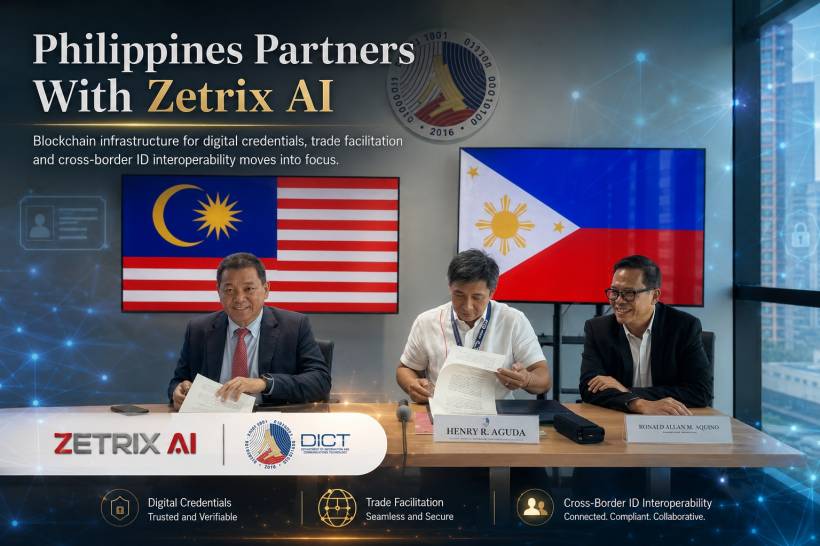
The Philippines is preparing to use public blockchain technology to strengthen how government-issued credentials are created, verified and recognised across different systems. The initiative brings together the Philippines' Department of Information and Communications Technology, Zetrix Philippines and My Blockchain Infrastructure, a joint venture involving Malaysia's Zetrix AI and national research and development agency MIMOS.
Rather than treating blockchain as a standalone experiment, the project is intended to support practical public-sector services. Its early priorities include digital credentials, trade facilitation and closer interoperability between Malaysian and Philippine digital identity systems.
Building a National Public Blockchain Platform
Under the agreement, the participating organisations will use the Zetrix protocol to develop and operate public blockchain infrastructure for the Philippines.
The platform is expected to support government applications that require trusted records, secure verification and reliable information exchange between agencies.
For public-sector use, blockchain can provide a shared record that is difficult to alter without detection. This may be valuable when agencies need to confirm whether a credential is genuine, determine who issued it and verify that the information has not been changed after issuance.
However, the real benefit will depend less on the technology itself and more on how well it is integrated with existing government systems, identity platforms and administrative processes.
Government Credentials Will Be the First Priority
The initial phase will concentrate on the issuance, verification and authentication of government-issued credentials.
These could potentially include licences, certificates, permits, registrations or other official documents that citizens and businesses regularly need to present.
Today, credential verification often requires manual checks, separate agency databases or direct confirmation from the issuing organisation. These processes can be slow, inconsistent and difficult to complete across different departments.
A blockchain-supported system could allow authorised parties to confirm a credential more quickly while reducing dependence on paper documents or isolated databases.
The objective is not simply to place documents on a blockchain. A properly designed system would store verifiable references or proofs that allow an organisation to confirm authenticity without unnecessarily exposing personal information.
Faster Access to Government Services
Henry R. Aguda, Secretary of the Philippines' Department of Information and Communications Technology, said the collaboration could make government credential verification more secure and efficient across different systems.
From a citizen's perspective, the most important outcome would be reduced friction.
People often need to submit the same documents repeatedly when dealing with different agencies. They may also face delays while records are manually checked or transferred between departments.
A trusted digital credential framework could make it easier for citizens to prove eligibility, identity or professional status when applying for services.
This could shorten processing times and reduce uncertainty, particularly when citizens need to use government services outside the agency that originally issued the credential.
Connecting Malaysian and Philippine Digital Identities
Another major part of the project involves interoperability between Malaysian and Philippine digital identity systems.
Cross-border digital identity is more complex than simply allowing one system to read another country's records. Each country has its own laws, privacy requirements, identity standards and security controls.
For interoperability to work, both sides must agree on how credentials are issued, which authorities are trusted and how users give permission for their information to be verified.
If implemented carefully, the system could make certain cross-border activities more efficient. Businesses, travellers, workers and government agencies may be able to verify selected credentials without relying entirely on physical documents or lengthy manual checks.
The project may therefore become an early test of whether regional digital identity systems can work together while preserving national control over sensitive data.
Trade Facilitation Is Also Part of the Plan
The collaboration will also explore blockchain applications for trade facilitation.
International trade involves a large number of documents, including certificates of origin, customs declarations, inspection records, invoices and shipping documents.
When these records are stored in separate systems, businesses and authorities may struggle to confirm whether the information is complete, authentic and current.
A shared blockchain-based infrastructure could make certain trade documents easier to verify across borders. It may also reduce duplication, improve traceability and support faster customs or regulatory processing.
The potential is especially relevant for trade between Southeast Asian countries, where improving digital document recognition could reduce administrative delays and strengthen regional commerce.
Zetrix Builds on Malaysia's Blockchain Infrastructure
Zetrix already serves as the underlying blockchain for the Malaysia Blockchain Infrastructure, which was launched in April 2025.
That experience gives the company a working national-level reference as it expands into the Philippines.
The Malaysian platform is intended to support trusted digital applications across government and industry. By using a related protocol in the Philippines, both countries may find it easier to create interoperable services in the future.
Zetrix AI Group Managing Director TS Wong described the agreement as part of a broader effort to bring countries in the region into a more connected digital ecosystem.
The long-term vision appears to extend beyond individual applications. Zetrix is positioning itself as infrastructure for regional identity, trade and digital government services.
A Wider History of Government Technology Work
Zetrix has been used in several areas since its launch in April 2022, including digital identity verification, customs processing, voting-related applications and stablecoin projects.
Its presence in the Philippines also predates the latest agreement.
The company and its wider ecosystem have reportedly been involved in Philippine digital government services for close to a decade.
Its existing local relationships include organisations such as the Bureau of Internal Revenue, National Bureau of Investigation, Securities and Exchange Commission, Philippine Ports Authority and Bureau of Fisheries and Aquatic Resources.
These connections may help the new blockchain initiative move beyond a limited pilot, particularly if government agencies can build on existing technical and institutional relationships.
Blockchain Alone Will Not Solve Administrative Problems
Although blockchain can improve trust and verification, it is not a complete solution by itself.
Government agencies will still need clear data standards, privacy safeguards, cybersecurity controls and governance arrangements.
They must also decide who is authorised to issue credentials, who can verify them and what happens when a record must be corrected, revoked or replaced.
User experience will be equally important. Citizens should not need to understand blockchain concepts to use the service.
The system must be simple, accessible and compatible with existing digital government channels. If it adds more steps or requires users to manage complicated technical tools, adoption may remain limited.
Privacy and Security Will Be Critical
Digital identity projects involve sensitive personal information, making privacy protection one of the most important design requirements.
A public blockchain does not necessarily mean that personal data should be openly visible.
Well-designed credential systems can store cryptographic proofs while keeping the underlying personal information protected elsewhere. Verification can then confirm that a credential is valid without revealing more data than necessary.
The participating organisations will need to ensure that the system complies with Philippine privacy laws and follows strict controls around access, consent and data retention.
Security will also need to extend beyond the blockchain layer. User accounts, mobile devices, government portals and administrative systems can still become targets even when the underlying ledger is secure.
Regional Cooperation Could Be the Larger Opportunity
The collaboration reflects a wider shift toward regional digital infrastructure in Southeast Asia.
Countries are increasingly exploring ways to recognise digital identities, trade records and official credentials across borders.
A common technical foundation could support faster services and stronger economic links, but it will require cooperation at both the policy and technology levels.
Malaysia and the Philippines may use this project to demonstrate how national systems can remain independently governed while still exchanging trusted information.
If successful, similar models could eventually be considered for education credentials, professional licences, customs documentation or other cross-border services.
Final Thoughts
The partnership between the Philippines and Zetrix AI represents a practical attempt to move blockchain beyond speculation and into public-sector infrastructure.
Its first priorities—government credentials, trade facilitation and digital identity interoperability—address real administrative problems where secure verification and trusted data exchange are valuable.
The technology could help reduce document fraud, speed up public services and make certain cross-border processes more efficient.
Its success, however, will depend on governance, privacy, integration and usability rather than blockchain alone.
If the Philippines can combine strong technical foundations with clear policy controls and a simple citizen experience, the project could become an important step toward more connected digital government services across Southeast Asia.











Comments 0