

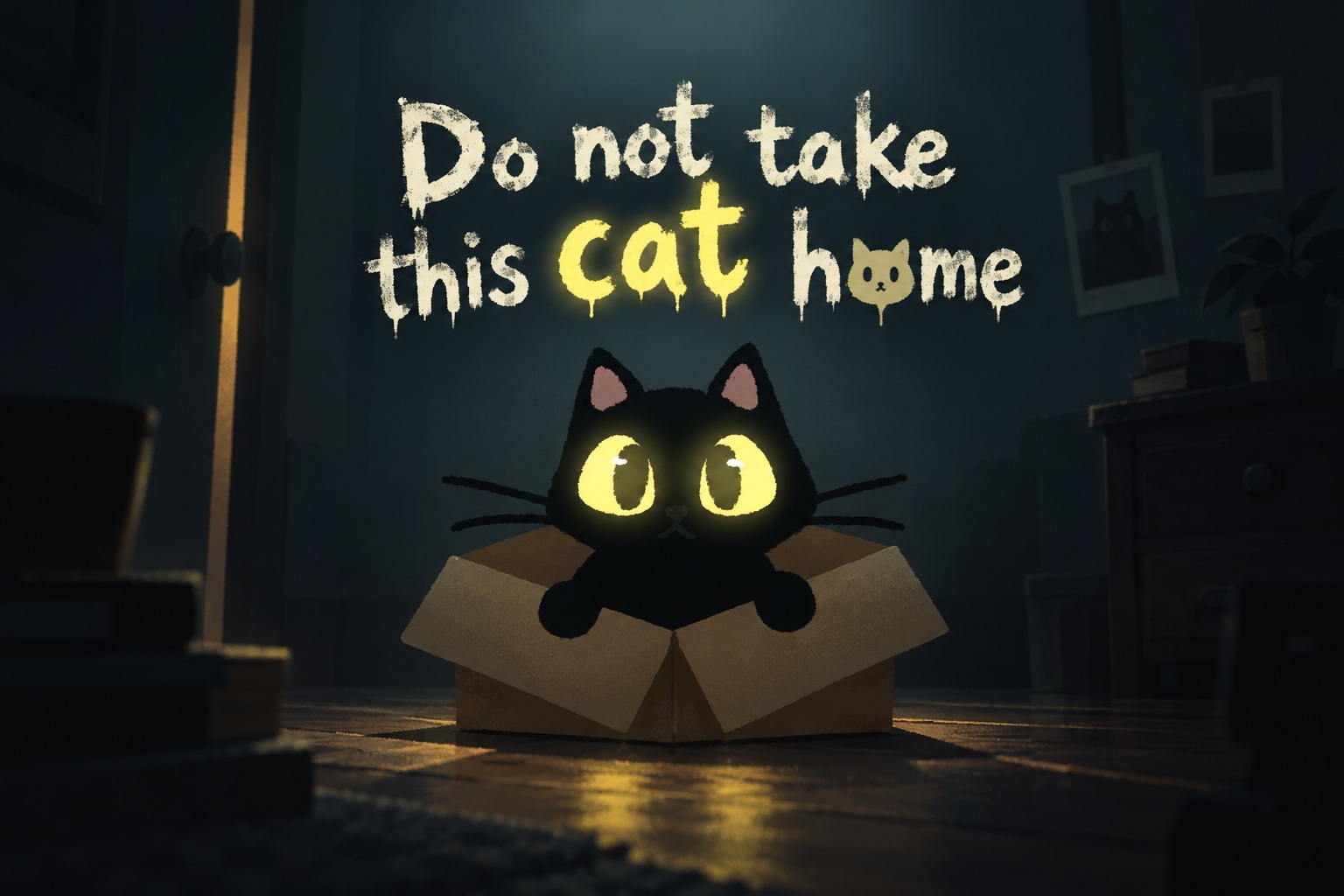
Do NOT Take This Cat Home begins with one of the easiest emotional decisions imaginable. You are having a miserable day, hear a faint meow coming from a dark alley, and discover an adorable black cat sitting alone inside a cardboard box. The title has already given you very clear instructions, but leaving such a helpless-looking animal behind feels unnecessarily cruel. Taking the cat home seems like the obvious compassionate choice, and that single act becomes the beginning of an increasingly surreal psychological horror story.
Do NOT Take This Cat Home – A Cute Black Cat, 39 Endings and a Psychological Horror Nightmare
Do NOT Take This Cat Home begins with one of the easiest emotional decisions imaginable. You are having a miserable day, hear a faint meow coming from a dark alley, and discover an adorable black cat sitting alone inside a cardboard box. The title has already given you very clear instructions, but leaving such a helpless-looking animal behind feels unnecessarily cruel. Taking the cat home seems like the obvious compassionate choice, and that single act becomes the beginning of an increasingly surreal psychological horror story.
Developed by Pixeliminal, Do NOT Take This Cat Home is a choice-driven visual novel built around repeatedly questioning whether the cute creature in front of you is really what it appears to be. The story contains more than 32,000 words, numerous branching decisions, animated sequences, mini-games, disturbing transformations, and 39 unique endings alongside a true ending. Some routes remain humorous or strangely wholesome for a while, while others descend quickly into manipulation, violence, obsession, isolation, body horror, and reality-bending events that make the original alley encounter feel increasingly suspicious.
Now playable online through Lemon Web Games, Do NOT Take This Cat Home brings its enormous branching story, unsettling black cat, dozens of endings, strange mini-games, and psychological horror directly into the web browser. Players can repeatedly revisit familiar choices, deliberately make terrible decisions, investigate alternative routes, and gradually uncover what the cat actually represents. Because so much of the experience depends on experimentation, one playthrough reveals only a small part of what the game contains. The real story emerges through repetition.
It Starts With a Cat in a Cardboard Box
The opening is deliberately ordinary. The protagonist is already unhappy before anything supernatural happens, making the discovery of the cat feel like a small opportunity for comfort. The animal looks cute, helpless, and completely incapable of representing any serious danger. Everything about the scene encourages the player to ignore the warning in the title.
That contradiction is immediately effective. The player already knows something must be wrong because the game explicitly says not to take the cat home. Yet visual presentation and emotional instinct encourage the opposite decision. Curiosity becomes just as powerful as sympathy.
The game understands that most players will want to discover what happens if they deliberately make the obvious mistake. Instead of preventing that curiosity, it builds the entire experience around it. The title becomes less of an instruction and more of a challenge.
Taking the Cat Home Is Only the Beginning
Bringing the cat home does not immediately trigger a conventional horror sequence. The game often allows the situation to remain strange, funny, or deceptively comfortable before introducing something more disturbing. This gradual escalation gives players enough time to become attached to the creature.
The cat reacts to choices in ways that can seem affectionate, needy, playful, or increasingly manipulative. Ordinary interactions begin developing uncomfortable implications. The protagonist may believe they are caring for an animal, while the player gradually suspects that the relationship is becoming something else entirely.
The best horror comes from not knowing exactly when the situation crossed the line. One choice may seem harmless in isolation, but several choices together can place the protagonist inside a route that becomes increasingly difficult to escape. The game constantly asks whether kindness is still kindness when something begins demanding complete control.
The Cat Is Designed to Be Difficult to Resist
The black cat's appearance is central to the game's effectiveness. It is deliberately cute, expressive, and emotionally appealing. Players are supposed to want to trust it. If the creature looked obviously demonic from the opening scene, the central dilemma would disappear.
Instead, the horror grows from the contrast between appearance and behavior. The cat can remain visually adorable while the surrounding situation becomes increasingly alarming. That mismatch creates discomfort without requiring constant graphic imagery.
Even after seeing several disturbing endings, returning to the opening can still create the same temptation. The player knows what the creature may be capable of, yet the design remains inviting. Do NOT Take This Cat Home weaponizes cuteness extremely effectively.
Choices Create Completely Different Routes
The game is structured around branching decisions rather than one fixed narrative path. A seemingly small choice can move the story toward an entirely different scenario, and later decisions can split those routes again. This makes experimentation essential.
Some options involve how the protagonist treats the cat, whether they trust it, how much affection they show, whether they resist certain behavior, or whether they investigate suspicious events. Other choices become much stranger once reality begins breaking down. The game rarely allows the player to assume that one kind decision will automatically lead to a good outcome.
Because of this structure, failure is not really failure in the traditional sense. Reaching a disturbing ending reveals information that may help interpret another route later. Every conclusion becomes another piece of the larger mystery.
Thirty-Nine Endings Encourage Constant Experimentation
Do NOT Take This Cat Home contains 39 unique endings before accounting for its true conclusion. That enormous number immediately changes how the game should be approached. Reaching one ending is not finishing the story so much as completing one experiment.
Some endings can happen relatively quickly, while others require deeper progression through specific decision chains. Players gradually begin remembering which choices produced particular outcomes and deliberately testing combinations they previously avoided. The game becomes a map of consequences.
The large ending count also prevents the horror from becoming predictable. Even after several playthroughs, a familiar scene may contain another choice leading somewhere completely unexpected. The player is continually encouraged to ask what happens if they do the opposite next time.
The True Ending Requires Understanding More Than One Route
The true ending is not simply another option presented immediately after the first playthrough. The broader structure encourages players to experience numerous conclusions and gather enough context to understand what is really happening. Progress comes through knowledge.
This transforms repetition into investigation. Dialogue that seemed meaningless during an early run may become important after another ending reveals new information. A strange object, visual detail, or behavioral pattern can suddenly make sense several routes later.
The player therefore becomes less like someone passively reading a horror story and more like someone examining a puzzle. The truth exists behind multiple contradictory experiences, and understanding it requires looking beyond any one version of events.
Cute Comedy and Horror Constantly Collide
One of the game's strongest qualities is its willingness to be funny. The cat can behave absurdly, the protagonist can find themselves in ridiculous situations, and some choices deliberately play with visual novel expectations. This humor creates breathing room.
It also makes the horror more effective. A game that remains relentlessly disturbing eventually becomes predictable, but Do NOT Take This Cat Home regularly shifts tone. A funny interaction can become uncomfortable within moments, while a frightening sequence may suddenly introduce something bizarre.
The player never knows whether the next decision will produce a joke, a romantic-looking scene, a nightmare, or something almost impossible to categorize. Tonal unpredictability becomes part of the suspense.
Psychological Manipulation Is More Important Than Traditional Monsters
Although the game contains disturbing imagery, its strongest horror often comes from emotional manipulation. The cat's behavior can resemble affection while gradually creating dependency, guilt, possessiveness, or isolation. The protagonist may begin accepting increasingly unhealthy situations because the relationship has been normalized slowly.
This makes the horror feel more personal than a simple creature attack. The player is not merely trying to avoid something dangerous. They are trying to understand when attention becomes control and when companionship becomes possession.
Different routes explore these ideas from different angles. Some become openly hostile, while others remain disturbingly affectionate. The most uncomfortable moments are often the ones where the situation looks superficially caring.
Isolation Becomes a Recurring Theme
Several routes explore the idea of the protagonist becoming increasingly separated from everything except the cat. What initially looks like companionship can begin replacing normal relationships, routines, or personal independence. The outside world becomes less important.
This reinforces the cat's role as more than a supernatural threat. It can function as an emotional trap. The protagonist may be offered affection, protection, comfort, or belonging, but those benefits can come with increasingly severe conditions.
The game repeatedly asks whether being loved is still meaningful when the relationship removes your ability to choose anything else. That question gives many endings a disturbing emotional weight even without relying on graphic horror.
The Protagonist Is Already Vulnerable Before the Cat Arrives
The opening makes clear that the protagonist is not having a particularly happy or fulfilling life. That matters because the cat does not enter a completely stable situation. It appears when comfort and connection may already be desperately wanted.
This makes the protagonist easier to manipulate. Someone who feels isolated or miserable may tolerate behavior they would otherwise reject if the alternative is returning to loneliness. The supernatural premise exaggerates this dynamic but does not invent it from nothing.
The cat therefore becomes frightening partly because it seems capable of understanding exactly what the protagonist needs. It offers something emotionally valuable before revealing the possible cost. Horror grows from vulnerability rather than simple stupidity.
The Game Frequently Breaks Expectations
Do NOT Take This Cat Home is comfortable becoming strange. Routes can move beyond ordinary visual novel dialogue into surreal sequences, unexpected interface changes, unusual animations, mini-games, and moments that challenge the player's understanding of what is actually happening.
These shifts help prevent the experience from feeling like a static sequence of text boxes. The game uses presentation itself as part of the storytelling. When reality becomes unstable, the interface can begin feeling unstable as well.
This unpredictability also supports the broader mystery. Players cannot always assume that what they are seeing should be interpreted literally. Some routes feel symbolic, while others reveal information that seems more concrete. Determining how everything connects becomes part of the challenge.
Mini-Games Break Up the Visual Novel Structure
Although the game is primarily narrative-driven, mini-games occasionally interrupt conventional reading and choice selection. These sections provide mechanical variety and can make already strange situations feel even less predictable.
Because the player is suddenly required to interact differently, the shift can create additional tension. Reading dialogue is passive compared with having to perform an unexpected task under pressure. The game uses this change deliberately.
Mini-games also help individual routes feel distinct. An ending is not always reached through the same pattern of selecting dialogue options. The game continues experimenting with how players interact with its world.
Disturbing Imagery Escalates Gradually
The visual horror becomes more extreme depending on the route. Early scenes may show only subtle abnormalities, while deeper endings introduce much more explicit transformations and disturbing imagery. The escalation mirrors the player's growing knowledge.
This pacing prevents the game from wasting its most shocking ideas immediately. Players first become familiar with the cute cat, ordinary room, and protagonist's routine. Later distortions are more effective because they corrupt something already recognizable.
The artwork plays an important role in this transformation. Characters and environments can move from charming to deeply unsettling without abandoning the visual identity established at the beginning. Familiarity becomes part of the horror.
The Same Scene Can Feel Completely Different Later
Repeated playthroughs change how earlier moments are interpreted. A line of dialogue that seemed cute before one ending may sound threatening after the player learns more. A harmless expression can become suspicious once another route reveals what the cat may actually be thinking.
This creates one of the game's best forms of replay value. The content does not need to change for the player's reaction to change. Knowledge becomes another lens through which familiar scenes are viewed.
Eventually, the opening alley encounter itself can feel different. What once looked like a rescue now resembles the beginning of something deliberately engineered. The player starts questioning whether meeting the cat was ever accidental.
The Title Becomes More Meaningful With Every Ending
At first, Do NOT Take This Cat Home seems like a deliberately obvious joke. The game tells you exactly what not to do, while knowing perfectly well that curiosity will make most players do it anyway. After several endings, however, the title begins feeling increasingly serious.
The warning may refer to more than physical danger. Taking the cat home can expose the protagonist to manipulation, dependence, psychological collapse, supernatural events, or outcomes far worse than ordinary death. The consequences vary dramatically.
Eventually the title becomes almost tragic. The player knows that avoiding the cat might have prevented everything, yet doing so would also prevent discovering the truth. Curiosity is necessary for understanding and dangerous for exactly the same reason.
Trying to Abandon the Cat Does Not Always Solve the Problem
Players naturally experiment with rejecting the creature after discovering how dangerous it can become. Unfortunately, once the relationship has begun, simply changing your mind may not be enough. Some routes explore what happens when the protagonist tries to create distance.
This reinforces the idea that the cat is not an ordinary pet. It may react to rejection in ways that reveal how little control the protagonist actually has. The relationship can become frightening precisely when the player attempts to leave it.
The game therefore avoids providing one obvious safety button. The correct decision may have been much earlier than the player realized. By the time something looks dangerous, the situation may already be deeply established.
Not Every Bad Ending Feels the Same
With 39 endings, the game avoids simply repeating variations of the protagonist dying. Some conclusions are horrifying, others tragic, surreal, darkly funny, emotionally uncomfortable, or deliberately confusing. The variety makes collecting endings genuinely interesting.
Certain conclusions expose the cat's more violent nature, while others focus on psychological control. Some reveal more about the protagonist, and others seem designed primarily to destabilize the player's understanding of reality. Each contributes something slightly different.
This means players are rarely completing routes simply to increase an ending counter. Many conclusions contain information, imagery, or thematic ideas that make them memorable independently. Discovering another ending feels like opening another part of the game's personality.
The Cat Can Represent More Than One Kind of Fear
The creature can be interpreted through several psychological ideas depending on the route. It can resemble unhealthy attachment, emotional dependency, fear of abandonment, obsessive affection, isolation, or the danger of accepting comfort without questioning its conditions.
The game does not reduce everything to one simple metaphor. Different endings emphasize different aspects, allowing the cat to remain mysterious. Its literal supernatural nature and symbolic significance can coexist.
This ambiguity contributes heavily to discussion around the game. Players can understand the same scene differently without either interpretation necessarily being completely wrong. Psychological horror works best when explanation does not eliminate every mystery.
Dark Humor Prevents the Story From Becoming Predictable
Some choices are deliberately ridiculous, and the game occasionally rewards experimentation with outcomes that seem almost designed to surprise the player through absurdity. These moments make the branching structure more enjoyable.
Humor also encourages players to take risks. An option that looks obviously foolish may lead to something funny—or something horrific. There is rarely a reliable way to predict which.
That uncertainty keeps decision-making interesting even after several runs. Players stop selecting only what seems safest and begin choosing whatever sounds most unusual. Curiosity becomes the real progression mechanic.
The Visual Novel Format Fits the Story Perfectly
A choice-based visual novel is particularly effective for this premise because the central horror revolves around decisions and relationships rather than mechanical combat. The player spends significant time watching the cat, interpreting dialogue, and deciding how the protagonist should respond.
This creates intimacy. The creature occupies the screen repeatedly and becomes familiar enough that tiny changes in expression can feel meaningful. A conventional action game might struggle to develop the same relationship.
The format also makes branching natural. Every decision can lead toward another version of the relationship without requiring elaborate changes to a large physical game world. The story can become extraordinarily diverse while remaining focused on a relatively small cast.
There Is No Traditional Combat System to Hide Behind
When the situation becomes frightening, the player cannot simply equip a weapon and defeat the problem. Do NOT Take This Cat Home is primarily about decision-making rather than physical power. That makes the protagonist feel much more vulnerable.
The player may recognize that something is dangerous without having any obvious method of confronting it. Their main tools are choices, resistance, curiosity, and whatever understanding has been gained through previous endings.
This keeps attention on the psychological conflict. If the cat could simply be defeated through conventional combat, the relationship would become much less interesting. Horror remains personal.
Replayability Is Built Directly Into the Narrative
Many story games provide a few alternate endings, but Do NOT Take This Cat Home treats repetition as an essential part of understanding the experience. Thirty-nine endings ensure that there is always another branch to investigate.
Players naturally begin creating their own objectives. Perhaps the next run will involve agreeing with everything the cat wants, resisting at every opportunity, deliberately making absurd choices, or revisiting a route where one alternative decision remained unexplored.
The game rarely makes these repetitions feel identical because branching can happen quickly. Familiar sections become short pathways toward completely different scenarios. Progress is measured through understanding rather than statistics.
The True Ending Gives the Other Routes Context
After seeing enough of the game's possibilities, the true ending can provide a broader framework for interpreting what has happened. Rather than making every strange event completely literal, the larger picture can reveal connections between the protagonist's emotional state, the cat, and the repeating scenarios.
The journey toward that understanding is what gives the ending weight. Someone reaching it after only reading a summary would not experience the same accumulation of confusion, attachment, frustration, and discovery.
This is why the enormous branching structure matters. The true conclusion is not simply the longest route. It is the point where many separate pieces begin fitting together.
Pixeliminal Uses Horror to Explore Relationships
The game is frightening, but its most interesting questions are often about connection. Why would someone remain attached to something clearly harmful? How easily can affection become obligation? How much control might someone surrender simply to avoid being alone?
These questions make the game more memorable than a story about an evil cat alone. The supernatural creature exaggerates relationship dynamics until they become impossible to ignore. Horror makes emotional boundaries visible.
Different endings answer these questions differently. Some punish complete submission, while others reveal the consequences of rejection or obsession. No single route represents the entire argument.
The Artwork Gives the Cat Enormous Personality
The game's expressive character artwork is essential because so much of the story depends on the player reading the cat's behavior. Cute poses, exaggerated reactions, subtle expression changes, and increasingly disturbing transformations help communicate what words alone could not.
The visual contrast becomes especially strong during horror sequences. Something designed to be adorable can suddenly appear deeply wrong while remaining recognizably the same creature. The familiarity makes transformations more effective.
The protagonist's environment also contributes to the atmosphere. Ordinary domestic spaces gradually become associated with increasingly surreal experiences. Home stops feeling safe.
Sound and Silence Strengthen the Unease
Audio plays an important role even though the game is primarily text-driven. Music can make seemingly harmless moments feel slightly wrong, while quieter scenes encourage players to focus more closely on what is happening.
Changes in sound can signal that the tone is shifting before the visuals become obviously disturbing. This creates anticipation. Players begin expecting something whenever familiar audio suddenly changes.
Silence can be especially effective during uncomfortable interactions. Without music providing emotional guidance, the player is left alone with the cat and whatever choice is approaching. The game knows when restraint creates stronger tension.
The Game Rewards Curiosity Even While Punishing It
Almost every reason to continue playing comes from curiosity. Players want to know what another choice does, what the cat really is, how a particular ending works, and whether the warning in the title can ever truly be obeyed.
Ironically, curiosity is also what causes most of the protagonist's problems. The cat was discovered because they investigated the alley, taken home because they ignored the warning, and repeatedly interacted with because the player wanted to see what happened.
This creates a clever relationship between player and protagonist. Both keep moving deeper for essentially the same reason. They know something is wrong and want answers anyway.
Playing Do NOT Take This Cat Home Online Today
Through Lemon Web Games, Do NOT Take This Cat Home can now be played directly in your web browser with no downloads or setup required. Features of the web-based version include:
New players should avoid worrying about finding the perfect route immediately. The game is designed around making decisions, seeing what happens, and carrying that information into another playthrough. A disturbing ending is not wasted progress because it may reveal something important about another branch. Let curiosity guide the first few runs.
Once several endings have been discovered, players can become much more deliberate. Revisit earlier decisions, choose alternatives that previously looked unreasonable, and pay attention to repeated dialogue or visual details that may have gained new meaning. The deeper mystery becomes clearer only after several apparently contradictory experiences have been compared.
Who Should Play Do NOT Take This Cat Home
Do NOT Take This Cat Home is particularly suitable for players who enjoy discovering stories rather than simply being told them. No single route explains everything, and understanding the larger narrative requires experimentation. Players who enjoy comparing endings and reconsidering earlier scenes will get much more from the experience than someone interested only in reaching one conclusion.
It is also a strong choice for horror fans who prefer psychological discomfort over conventional combat or constant jump scares. The game can certainly become disturbing, but its strongest moments often come from recognizing how a seemingly affectionate relationship has changed. Emotional unease becomes more important than physical danger.
Play Do NOT Take This Cat Home Online Now
Do NOT Take This Cat Home begins with a lonely black cat inside a cardboard box and expands into a branching psychological horror story containing dozens of possible outcomes. Players can show affection, reject the creature, investigate its behavior, make deliberately terrible choices, or attempt to understand the strange relationship developing between the cat and protagonist. Every route exposes another possibility, and even endings that appear completely disconnected can contribute toward understanding the larger mystery.
Through Lemon Web Games, players can experience Do NOT Take This Cat Home directly in a modern browser and explore its 39 endings, true ending, mini-games, surreal sequences, and increasingly disturbing variations on one seemingly harmless act of kindness. The game rewards experimentation rather than perfect decision-making, making curiosity the most important tool available. The warning is clearly written in the title, but discovering exactly why that warning exists is almost impossible to resist.
Final Thoughts
Do NOT Take This Cat Home works because it understands how powerful contradiction can be in horror. The cat is adorable but frightening, affectionate but manipulative, comforting but isolating, and familiar while remaining fundamentally unknowable. Every positive quality can gradually acquire a darker interpretation depending on which route the player follows. The creature becomes disturbing precisely because trusting it feels so natural.
Its enormous branching structure gives those ideas room to develop from several directions. Thirty-nine endings allow the game to explore humor, obsession, dependency, fear, rejection, violence, surrealism, and emotional vulnerability without forcing everything into one linear explanation. Repetition does not simply reveal more content; it changes how familiar content is understood.
Through Lemon Web Games, Do NOT Take This Cat Home can be played directly in the browser as a strange, funny, uncomfortable, and highly replayable psychological horror experience. The mechanics are straightforward, yet the decisions can lead somewhere completely unexpected, and the true nature of the cat becomes increasingly difficult to separate from the protagonist's own emotional struggles. The title gives players the safest possible advice from the very beginning—but ignoring that advice is exactly what makes the game so fascinating.











Comments 0