

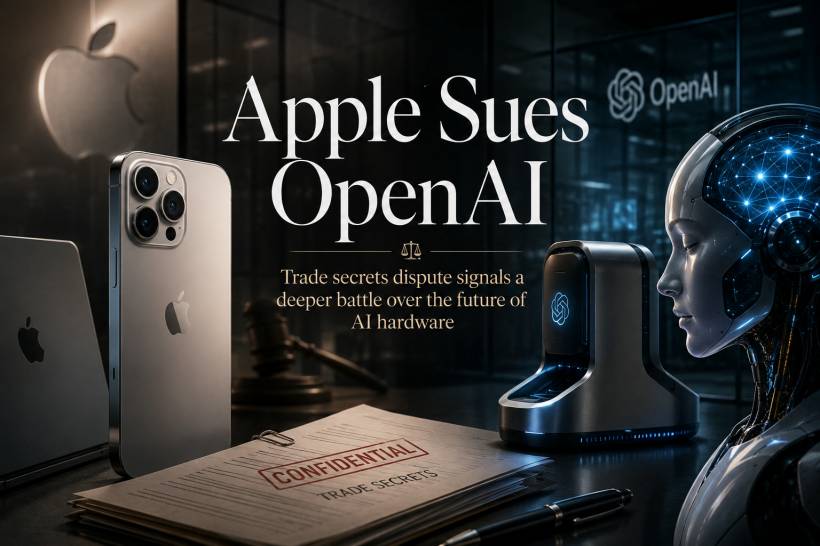
The relationship between Apple and OpenAI appears to be shifting from strategic cooperation to direct competition. Apple has filed a federal lawsuit against OpenAI, its hardware subsidiary io Products and two former Apple employees, accusing them of misappropriating confidential information to support OpenAI's expansion into consumer hardware. The case was filed in the US District Court for the Northern District of California.
The allegations arrive as technology companies compete not only over artificial intelligence models, but also over the devices through which people may eventually use those systems. Apple remains one of the world's most influential hardware makers, while OpenAI is attempting to move beyond ChatGPT and establish a more direct presence in consumer technology.
However, it is important to remember that Apple's claims are currently allegations presented in a lawsuit. They have not yet been proven in court, and OpenAI has denied that it is interested in obtaining or exploiting another company's trade secrets.
Apple Alleges a Coordinated Effort to Obtain Confidential Information
Apple's complaint goes beyond accusing two former employees of taking files when they left the company.
The iPhone maker alleges that OpenAI pursued a wider strategy to acquire Apple's proprietary information through employee recruitment, former staff members and relationships with suppliers. According to the lawsuit, this information could help OpenAI accelerate the development of its planned consumer hardware products.
Apple reportedly believes OpenAI did not simply benefit from the general knowledge and experience of people who had previously worked on Apple products. Instead, the company claims that specific confidential documents, supplier information and unreleased hardware details were improperly accessed or transferred.
That distinction will likely become central to the case.
Employees are generally allowed to take their professional skills, experience and knowledge with them when changing jobs. What they cannot take are protected trade secrets, internal documents, confidential designs or information belonging to their previous employer.
Apple will therefore need to demonstrate that the material involved was genuinely confidential, that reasonable measures were used to protect it and that the defendants improperly obtained or used it.
Two Former Apple Employees Are Named in the Case
The lawsuit identifies Chang Liu and Tang Yew Tan, both of whom previously held significant roles at Apple before joining OpenAI's hardware efforts.
Liu previously worked as a senior systems electrical engineer. Apple alleges that he failed to return a company-issued computer and continued accessing Apple's internal systems after leaving the company.
According to the complaint, Liu allegedly discovered that he could still authenticate into Apple's network and then downloaded confidential hardware-related files. Apple also claims that he discussed methods of avoiding detection while accessing company information.
These are serious allegations because they involve more than an employee recalling information from previous projects. Apple is claiming that company systems and documents were accessed after Liu's employment had ended.
Liu has not been found liable, and the court will need to examine the evidence, access records and circumstances surrounding the alleged downloads.
Tang Tan's Long Apple Career Adds Another Dimension
Tang Tan spent approximately 24 years at Apple and eventually became vice president of product design for major products including the iPhone and Apple Watch. He later helped establish io, the hardware company connected to former Apple design chief Jony Ive. OpenAI acquired io in 2025, and Tan became OpenAI's chief hardware officer.
His extensive experience would naturally be valuable to any company attempting to build a new category of consumer device. Apple, however, alleges that Tan took more than his general expertise when he departed.
The company claims he forwarded information involving Apple's suppliers and internal industry research to himself before leaving. It further alleges that confidential knowledge was later used to benefit OpenAI's hardware programme.
Apple has also accused Tan of encouraging Apple employees pursuing positions at OpenAI to bring internal information or hardware materials into recruitment discussions. OpenAI disputes the broader claim that it organised a systematic effort to obtain Apple's secrets.
Because Tan held a senior position and worked across multiple generations of Apple products, the case could involve sensitive information covering suppliers, manufacturing techniques, component selection and product-development processes.
OpenAI Rejects Apple's Accusations
OpenAI has denied wrongdoing and says it is focused on developing original technology rather than taking confidential information from competitors.
The company's position is that it has no interest in other businesses' trade secrets. Its response directly challenges Apple's description of the alleged conduct as a coordinated corporate strategy.
This creates two very different narratives.
Apple portrays itself as protecting years of engineering investment from a rival that allegedly used former employees and supplier relationships to shorten its development process.
OpenAI, meanwhile, maintains that it is independently building new products and has no reason to rely on stolen Apple information.
The legal process may eventually reveal whether the alleged actions were isolated decisions involving individual employees or part of a wider pattern connected to OpenAI's recruitment and hardware development.
Why OpenAI Is Moving into Hardware
OpenAI is widely known for ChatGPT and its artificial intelligence models, but software alone does not give the company complete control over how consumers experience its technology.
Most people currently interact with OpenAI's services through smartphones, computers and operating systems built by other companies. That means OpenAI remains dependent on platforms controlled by businesses such as Apple, Google and Microsoft.
Developing its own consumer device could provide OpenAI with a direct connection to users. It could also allow the company to design hardware specifically around voice interaction, cameras, contextual AI and more natural ways of communicating with digital assistants.
OpenAI's partnership with Jony Ive and its acquisition of io made those hardware ambitions much more visible. OpenAI previously described io as a company created by Ive alongside Tang Tan, Scott Cannon and Evans Hankey to develop a new generation of technology products.
For Apple, this is not merely another AI company experimenting with gadgets. OpenAI has recruited experienced hardware specialists, including people who helped create some of Apple's most important products.
From Partners to Potential Competitors
The lawsuit is especially notable because Apple and OpenAI have also been partners.
Apple introduced ChatGPT integration across parts of its software ecosystem in 2024, allowing users to access OpenAI's technology through supported Apple Intelligence features. That arrangement made OpenAI an important contributor to Apple's broader AI offering.
However, cooperation in one area does not prevent competition in another.
Apple may rely on external AI models for certain capabilities, while OpenAI still relies heavily on smartphones and computers made by established hardware companies. At the same time, both companies are working toward greater independence.
Apple wants tighter control over the intelligence built into its devices. OpenAI wants more control over how its AI reaches consumers.
That overlap could eventually place them in direct competition, particularly if OpenAI develops a product intended to reduce people's dependence on conventional smartphones.
The Broader Battle for AI Talent
The case also highlights how aggressively technology companies are competing for experienced engineers and designers.
Building advanced AI products requires more than developing powerful models. Companies also need specialists in chips, electrical systems, industrial design, manufacturing, cameras, audio, batteries and supply-chain management.
Hiring experienced people from competitors is a normal part of the technology industry. The difficulty begins when a new employee arrives with documents, prototypes or information that legally belongs to a former employer.
Apple claims more than 400 former Apple workers have joined OpenAI, although the company acknowledges that employees are generally free to move between businesses. Its lawsuit focuses on the claim that certain individuals carried confidential information with them or were encouraged to obtain it.
The outcome may influence how technology companies conduct recruitment, interview senior candidates and manage access for employees preparing to leave.
What Apple May Be Trying to Protect
Apple's advantage does not come only from the appearance of its products.
Its hardware business depends on an enormous network of component suppliers, manufacturing partners, testing procedures, engineering systems and production techniques developed over many years.
Information about how Apple selects suppliers, evaluates components or prepares a product for mass production could be extremely valuable to a company with limited experience manufacturing consumer hardware at scale.
A successful device requires more than an attractive concept. It must be reliable, manufacturable, repairable, secure and capable of being produced in large quantities.
Apple's concern appears to be that OpenAI could use confidential knowledge from former employees to avoid mistakes, accelerate development and reproduce processes that took Apple years to refine. This is Apple's legal theory, not an established finding.
A Lawsuit With Strategic Consequences
Even before a final court ruling, the case could affect OpenAI's hardware plans.
Legal discovery may require the defendants to disclose internal communications, recruitment records, downloaded files and interactions with Apple suppliers. Apple may also seek restrictions preventing particular information from being used while the case continues.
For OpenAI, delays could be costly if the company is preparing to introduce its first major consumer device. For Apple, the lawsuit may help protect confidential processes while sending a warning to employees, suppliers and competitors.
At the same time, Apple will need to be precise. A company cannot classify every piece of employee knowledge as a trade secret simply because it would be useful to a competitor.
The court will need to separate legitimate professional experience from confidential information that may have been improperly taken.
Final Thoughts
Apple's lawsuit against OpenAI reveals how quickly the artificial intelligence race is expanding beyond software.
The next major battle may not be about which company has the smartest chatbot. It may be about who controls the device, interface and physical experience through which people interact with AI every day.
Apple dominates consumer hardware but continues to face pressure to strengthen its position in generative AI. OpenAI has become a major force in AI software but lacks Apple's decades of experience designing and manufacturing devices for millions of customers.
That makes each company strong in the area where the other is still trying to grow.
Whether Apple can prove that OpenAI benefited from stolen trade secrets remains for the court to decide. What is already clear is that the partnership between the two companies has become far more complicated.
They may continue working together where their technologies complement each other, but OpenAI's hardware ambitions are transforming that relationship. What began as cooperation between an AI developer and a device maker is increasingly looking like a contest over who will shape the next generation of personal technology.











Comments 0