

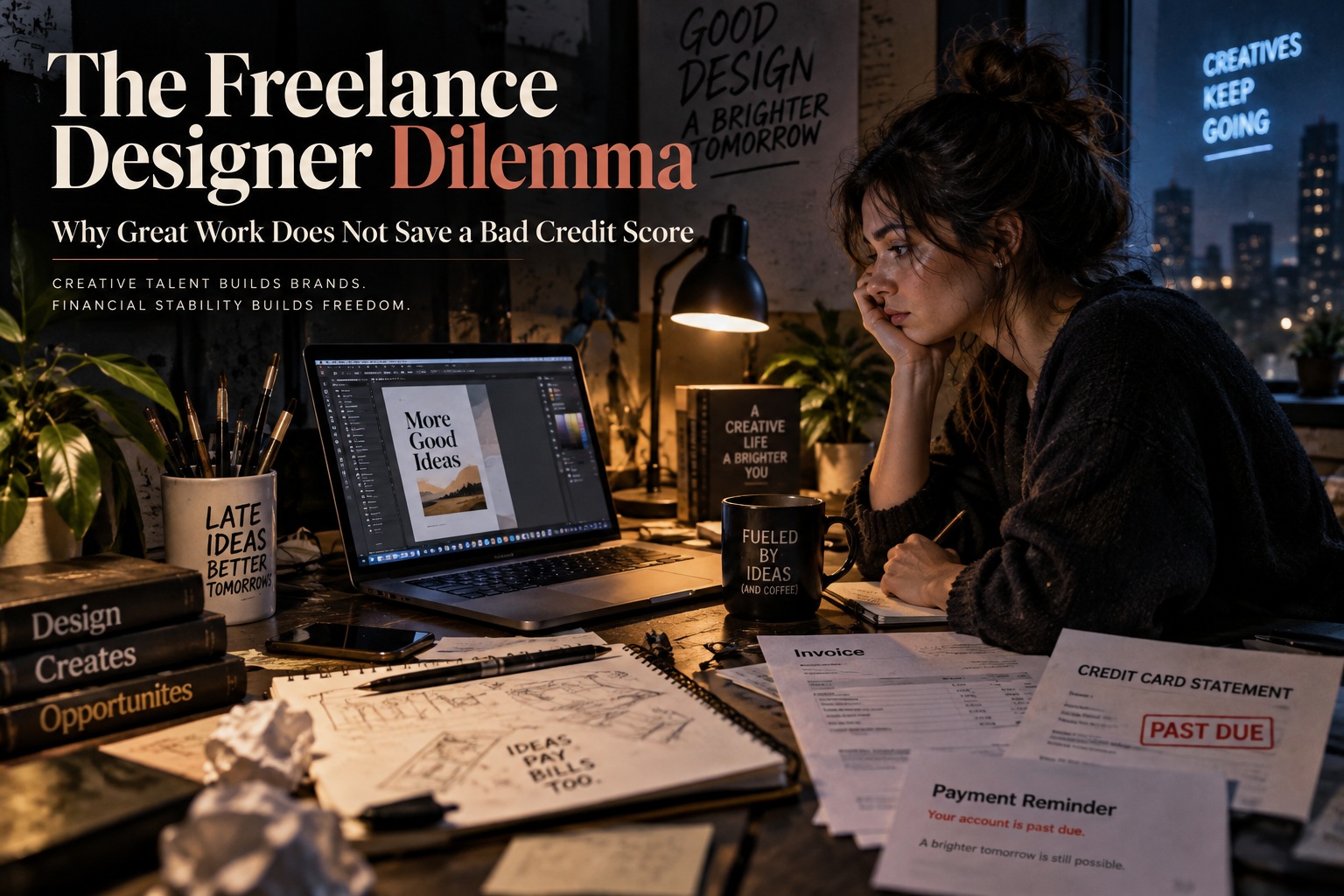
Freelancing gives designers a kind of freedom that traditional employment rarely offers. You can choose your clients, shape your own schedule, work from almost anywhere and build a career around the kind of creative work you actually enjoy. But that freedom also comes with financial volatility, and one of the areas freelancers often overlook is how irregular income can quietly affect their credit profile.
A strong portfolio may help you win work, but it carries very little weight when you apply for financing, rent a new apartment or try to lease a car. Banks, landlords and lenders are usually more interested in your repayment history, debt levels and credit score than the quality of your branding projects or the number of followers you have on Behance. That disconnect can be frustrating, especially for freelancers whose income is healthy overall but arrives unpredictably.
The Real Problem Is Not Low Income — It Is Uneven Cash Flow
Many freelance designers do not necessarily earn less than salaried workers. The issue is that the money often arrives in bursts. One month might bring two large retainers and a new project deposit, while the next is spent chasing overdue invoices and waiting for an accounts department to release payment.
Meanwhile, the expenses never become irregular just because the income does. Rent, utilities, software subscriptions, insurance, cloud storage, font services and equipment instalments continue to arrive on schedule. When that timing mismatch forces you to lean more heavily on credit cards, your credit profile can begin to deteriorate even when the underlying business is profitable.
This is why freelancers need to think about credit management differently from employees with predictable monthly salaries. A strong year financially can still contain several uncomfortable weeks where available cash becomes tight.
Credit Utilisation Can Hurt You Before You Have Actually Done Anything Wrong
One of the most common traps is credit utilisation, which measures how much of your available revolving credit you are using. A freelancer might spend several thousand dollars on a new workstation, monitor, tablet or camera equipment and plan to pay the balance off as soon as a client invoice clears.
From your perspective, the purchase is manageable. You know the money is coming in, and you may even have a signed contract or approved invoice sitting in your inbox. Credit scoring systems do not see that future payment, though. They only see that a large percentage of your credit limit is currently in use.
If a card with a US$5,000 limit suddenly carries a US$4,000 balance when the issuer reports it, your utilisation may appear extremely high. Even if you pay the balance in full a few weeks later, your score can temporarily move in the wrong direction simply because of when the balance was reported.
Your Credit Report Does Not Understand Your Invoice Pipeline
This is one of the biggest differences between business reality and credit scoring. Freelancers tend to think in terms of receivables, upcoming work and signed client commitments, while credit bureaus largely work with what has already been reported.
A designer might know that US$10,000 in invoices is due within the next month, but those invoices do not appear as an asset in a personal credit score. The card balance does. That can create a distorted picture where someone with strong future cash flow temporarily looks overextended.
The practical lesson is that timing matters. If you are planning a major loan or rental application, it can help to reduce large card balances before the statement closes rather than waiting until the final payment due date.
Creative Tunnel Vision Can Turn Small Bills Into Big Credit Problems
Freelancers also have another risk that has less to do with income and more to do with attention. When you are deep into a demanding client project, it is surprisingly easy to forget a minor payment. A small utility bill, store card or old subscription account can disappear from your mental radar while you are dealing with revisions, deadlines and late-night design sessions.
The problem is that credit systems do not care whether the missed payment was accidental or only involved a small amount. Once an account becomes seriously overdue, the damage can remain visible for years. A forgotten US$20 or US$30 balance can therefore become far more expensive than the original amount.
That is why payment automation is especially useful for freelancers. Setting at least the minimum payment to autopay gives you a safety net during the weeks when client work consumes most of your attention.
A Good Credit Score Gives Freelancers More Room to Move
Credit is not only about borrowing money. It influences many practical decisions that can shape a freelance career. A stronger credit profile can make it easier to rent a studio, finance a car, buy equipment, obtain a business credit line or move into a new apartment without needing additional guarantees.
A poor score creates the opposite effect. You may still be approved, but at a higher interest rate, with a larger deposit or under less favourable terms. Over time, those extra costs can quietly reduce the financial flexibility that makes freelancing attractive in the first place.
For an independent creative professional, credit therefore functions partly as financial leverage. The healthier it is, the more options you have when an opportunity appears.
Credit Monitoring Should Be Routine, Not Something You Do Before a Loan Application
Many freelancers only think about their credit score when they are about to apply for something important. By then, any problems may take weeks or months to correct.
A better approach is to monitor your credit profile regularly using a reliable free service. This gives you visibility into score movements, outstanding balances, new inquiries and other changes without adding another recurring expense to your already long list of subscriptions.
The real value is not the number itself but the early warning. If one card balance is affecting your utilisation, you can deal with it. If an account suddenly appears that you do not recognise, you can investigate immediately rather than discovering the problem during a mortgage or car-loan application.
Checking Early Makes Big Financial Decisions Less Stressful
Suppose you know you want to lease a new studio next spring. Waiting until the application month to look at your credit means you are giving yourself almost no time to fix anything.
Checking several months earlier gives you options. You may decide to pay down one high-balance card, avoid opening new accounts or correct an inaccurate entry before a landlord or lender sees it. The same applies if you are planning to finance a high-end workstation or apply for a larger credit facility.
A little preparation can make the difference between walking into an application confidently and discovering an unpleasant surprise after the paperwork has already been submitted.
Freelancers Also Have a Larger Identity-Theft Surface
There is another reason independent creatives should pay close attention to their credit activity: freelancers often share personal and financial information across many different platforms.
Over the course of a year, you may send tax forms to clients, upload identification to payment processors, connect bank accounts to invoicing services and create merchant profiles on multiple marketplaces. You might also work with overseas clients, contractors and platforms that all have different levels of security maturity.
That creates a much wider digital footprint than many people realise. Every additional service that holds your personal information becomes another potential place where that information could be exposed.
Identity Theft Can Damage Credit Before You Even Know It Happened
If someone obtains enough personal information to open a fraudulent credit account in your name, the damage may develop quietly. You might not notice until a new account appears on your report, your score changes unexpectedly or a debt collector contacts you about something you never opened.
Regular credit monitoring makes these events easier to catch quickly. An alert about an unfamiliar inquiry or newly opened account can give you time to contact the lender, dispute the activity and freeze your credit before the fraud spreads further.
For freelancers who rely on their personal credit for equipment, vehicles or business-related financing, that early detection is particularly important. Identity theft can affect both personal life and the ability to continue operating the business smoothly.
Your Business and Personal Finances Should Not Be Completely Blurred
Another common freelance habit is running every expense through the same personal credit card. It is convenient at first, but it can make utilisation harder to control and complicate budgeting.
As the business grows, separating personal and business expenses becomes increasingly valuable. Even if you remain a sole proprietor, using a dedicated business account or card for software, advertising, equipment and other work-related costs can make cash flow easier to understand.
It also helps you see whether the business is genuinely supporting itself or whether personal credit is regularly being used to plug short-term gaps. That distinction becomes important when deciding whether your pricing, payment terms or client mix needs to change.
Late-Paying Clients Are a Credit Risk Even When They Owe You Money
Freelancers often think of slow-paying clients as an annoyance, but they can indirectly become a personal financial risk. When invoices are delayed, you may end up using more credit to cover expenses that should have been paid from operating cash.
This is why invoice management is not just administrative work. It is part of personal financial protection. Clear payment terms, deposits, milestone billing and consistent follow-up can all reduce the amount of time you are effectively financing a client's project out of your own pocket.
A client that repeatedly pays late may still be profitable on paper but expensive in practice if their behaviour forces you to carry larger credit balances.
Build a Buffer So Credit Does Not Become Your Emergency Fund
One of the strongest protections against freelance income volatility is a cash reserve. The goal is not to eliminate the use of credit altogether but to avoid depending on it every time a client pays late.
A few months of essential expenses can create meaningful breathing room. Instead of immediately putting rent or software subscriptions onto a card while waiting for an invoice, you can draw from the reserve and replenish it when the payment arrives.
This can reduce utilisation spikes and make your credit profile more stable across slower months. It also lowers the psychological pressure to accept bad client work simply because cash is temporarily tight.
Equipment Purchases Need More Planning Than Freelancers Sometimes Admit
Creative professionals regularly need expensive hardware. A new MacBook Pro, colour-accurate monitor, camera, drawing tablet or storage system can easily cost thousands.
It is tempting to treat these purchases as unavoidable business expenses and worry about the financing later. A better approach is to think about how the purchase will appear on your credit profile before making it, particularly if you have another major financial application coming soon.
If you have enough cash, paying part of the purchase upfront may keep utilisation lower. If you use a card for rewards or buyer protection, paying down the balance before the statement date can sometimes help prevent the full amount from being reported.
A Strong Portfolio and a Strong Credit Profile Solve Different Problems
Designers understandably focus heavily on professional reputation. Your portfolio proves you can do the work, testimonials prove you can deliver and your client list demonstrates credibility.
But financial institutions are evaluating something completely different. They are trying to estimate how reliably you will repay money. Your ability to design a brilliant brand identity does not answer that question for them.
Freelancers therefore need to manage two reputations at the same time: creative reputation and financial reputation. One attracts clients. The other affects your access to housing, financing and larger financial opportunities.
Simple Habits Can Protect Your Credit Without Becoming Another Full-Time Job
Credit management does not need to become a complicated financial project. A few repeatable habits can eliminate many of the common problems freelancers face:
None of these habits is particularly exciting, but that is exactly why they work. They remove financial problems from the parts of your life that depend on memory and attention.
Financial Stability Gives You More Creative Freedom
The most important reason to care about credit is not the score itself. It is the freedom that comes from having more financial options.
A freelancer with stable finances can walk away from a bad client, invest in better equipment, take time to develop a personal project or survive a slower month without panicking. Someone carrying expensive debt and a damaged credit history has far less room to make those choices.
That means financial discipline is not separate from creative independence. In many ways, it supports it.
Final Thoughts
Freelance design careers are inherently unpredictable. Clients pay late, workloads fluctuate and large expenses occasionally arrive at exactly the wrong time. Those realities do not automatically lead to poor credit, but they do make freelancers more vulnerable to the behaviours that damage it.
The solution is not to obsess over a three-digit number every day. It is to build simple systems that keep your financial reputation protected while you focus on your work. Automate minimum payments, monitor your reports, keep utilisation under control where possible and build enough cash reserve to avoid treating credit cards as the first response to every slow month.
Your portfolio may determine whether someone hires you, but your financial profile influences many of the opportunities that happen outside the studio. Real freelance freedom comes from having both: work you are proud of and finances strong enough to give you room to choose what comes next.











Comments 0