

Malaysia's banking sector found itself in the spotlight recently after online claims suggested that customer data linked to OCBC Malaysia and UOB Malaysia had allegedly appeared on a cybercrime forum. The claims quickly gained attention because anything involving bank data, customer identity details and possible dark web exposure naturally raises concern among the public.
However, both banks have since denied the allegations. OCBC Malaysia stated that its internal investigation found the data in question to be fabricated and not linked to its customers. UOB Malaysia also responded clearly, saying that there had been no breach of its customer database and that its systems remain secure.
While that should provide some reassurance, the incident is still a useful reminder that customers should remain alert. Even when a breach claim turns out to be false, cybercriminals often use moments like this to create fear, spread misinformation, or launch phishing attempts pretending to be official bank warnings.
How The Allegation Started
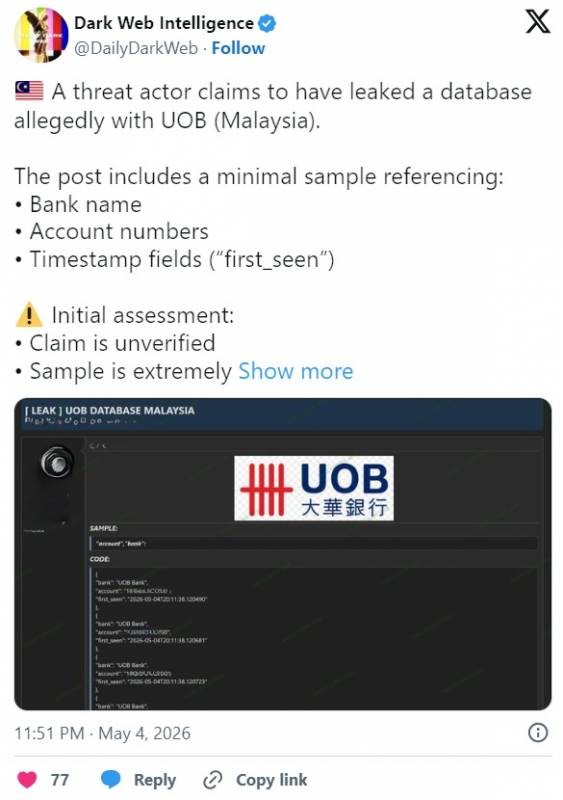
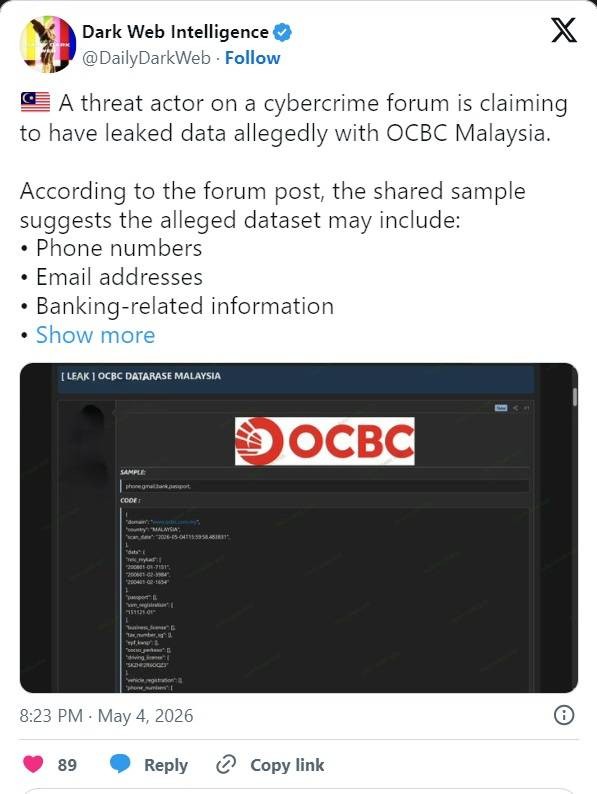
The issue began when posts shared by the Dark Web Intelligence account on X highlighted claims from a cybercrime forum. According to the original reports, separate posts allegedly connected OCBC Malaysia and UOB Malaysia to possible data exposure.
At the time, the claims had not been independently verified. This is an important point because cybercrime forums are full of exaggerated, recycled, fabricated or misleading breach claims. Some threat actors post fake samples to gain attention, build reputation, or scam buyers into paying for useless data.
That does not mean all such claims should be ignored. Banks, companies and cybersecurity teams still need to investigate them properly. But it does mean the public should be careful before assuming that every dark web claim is automatically true.
OCBC Says The Data Was Fabricated
OCBC Malaysia has since issued a response denying that its customer data was exposed. According to the bank, its Technology Information Security Office completed an investigation and verified that the data being circulated was fabricated and not customer data.
The bank also reassured customers that their information remains secure, adding that it maintains strict security controls and continuous monitoring to protect customer data.
This response is important because the alleged OCBC-related sample appeared to involve more serious categories of information. Based on the original claim, the supposed dataset was said to contain items such as phone numbers, email addresses, banking-related details, passport information, national ID numbers, business registration records and driving licence data.
If such information had been genuine, the risk would have been significant. Data containing identity and financial-related details can be abused for phishing, social engineering, account takeover attempts, identity fraud and other targeted scams. However, OCBC's investigation has concluded that the circulated data is not its customer data.
UOB Malaysia Also Denies Any Breach
UOB Malaysia has also responded to the online speculation and stated that the claims are false. The bank said there has been no breach of customer data and that its systems remain safe.
Compared with the OCBC-related claim, the alleged UOB dataset appeared to be less detailed from the beginning. The sample reportedly only contained basic fields such as the bank's name, account numbers and timestamp entries marked as "first_seen". There was no clear indication of full customer identity data, transaction history or a complete structured customer database.
Because of that limited information, the UOB-related claim was already difficult to assess. It could have involved fabricated data, previously exposed unrelated information, synthetic records, or a dataset being misrepresented as something more serious than it really was.
With UOB's official denial, both banks have now rejected the claims and stated that their customer systems and data remain secure.
Why False Breach Claims Still Matter
Even when a breach claim is denied and found to be false, it should not be dismissed as harmless. Data breach rumours can create confusion among customers, especially when they involve banks. Many people may panic, click suspicious links, call fake support numbers, or respond to messages pretending to offer "account protection".
This is exactly the kind of situation scammers like to exploit. After news of an alleged breach spreads, customers may receive fake SMS messages, WhatsApp alerts, emails or phone calls claiming that their bank account needs urgent verification. The scammer may then ask for login details, card information, TAC numbers, one-time passwords or approval through a banking app.
That is why customers should treat the banks' official channels as the only reliable source of updates. Social media posts, screenshots and forwarded messages can be useful as early warnings, but they should not replace direct confirmation from the bank.
The Bigger Cybersecurity Lesson For Customers
Whether a breach claim is real or false, the same basic safety habits still apply. Customers should monitor their bank accounts regularly and look out for unfamiliar transactions, sudden login alerts or unusual account activity.
It is also wise to make sure banking app notifications are enabled. These alerts can help users detect suspicious activity quickly. Where available, multi-factor authentication and secure device binding should also be used.
Most importantly, customers should never share sensitive banking information with anyone. Banks will not ask customers to reveal passwords, PIN numbers, TAC codes, one-time passwords or secure verification approvals through phone calls, SMS, WhatsApp or email.
If someone contacts you claiming to be from the bank and says your account is at risk, do not panic. End the conversation and contact the bank directly using the official number listed on the bank's website or banking app.
What Banks Need To Continue Doing
For banks, these incidents show why fast and clear communication matters. When allegations appear online, customers want certainty. Silence can sometimes create more anxiety, especially when screenshots of supposed leaked data are already being shared.
OCBC and UOB's denials help close the information gap, but banks still need to continue monitoring for impersonation scams that may follow after such reports. Cybersecurity is not only about protecting internal systems. It is also about protecting customers from confusion, manipulation and social engineering.
Public trust in banking depends heavily on transparency, speed of response and visible security practices. Even when a claim is false, a strong response reassures customers that the matter has been investigated and not simply ignored.
Final Thoughts
The alleged data breach claims involving OCBC Malaysia and UOB Malaysia have now been denied by both banks. OCBC says the data in question was fabricated and not linked to its customers, while UOB Malaysia says there has been no breach of customer data and that its systems remain secure.
That is reassuring, but customers should still remain cautious. Breach rumours often create opportunities for scammers, especially when the topic involves banks and personal information. The safest approach is to monitor accounts, avoid clicking suspicious links, and never share banking credentials or one-time passwords with anyone.
In this case, the claims appear to have been refuted by both institutions. But the reminder remains the same: in today's digital banking environment, staying alert is just as important as trusting the systems that protect us.











Comments 0