

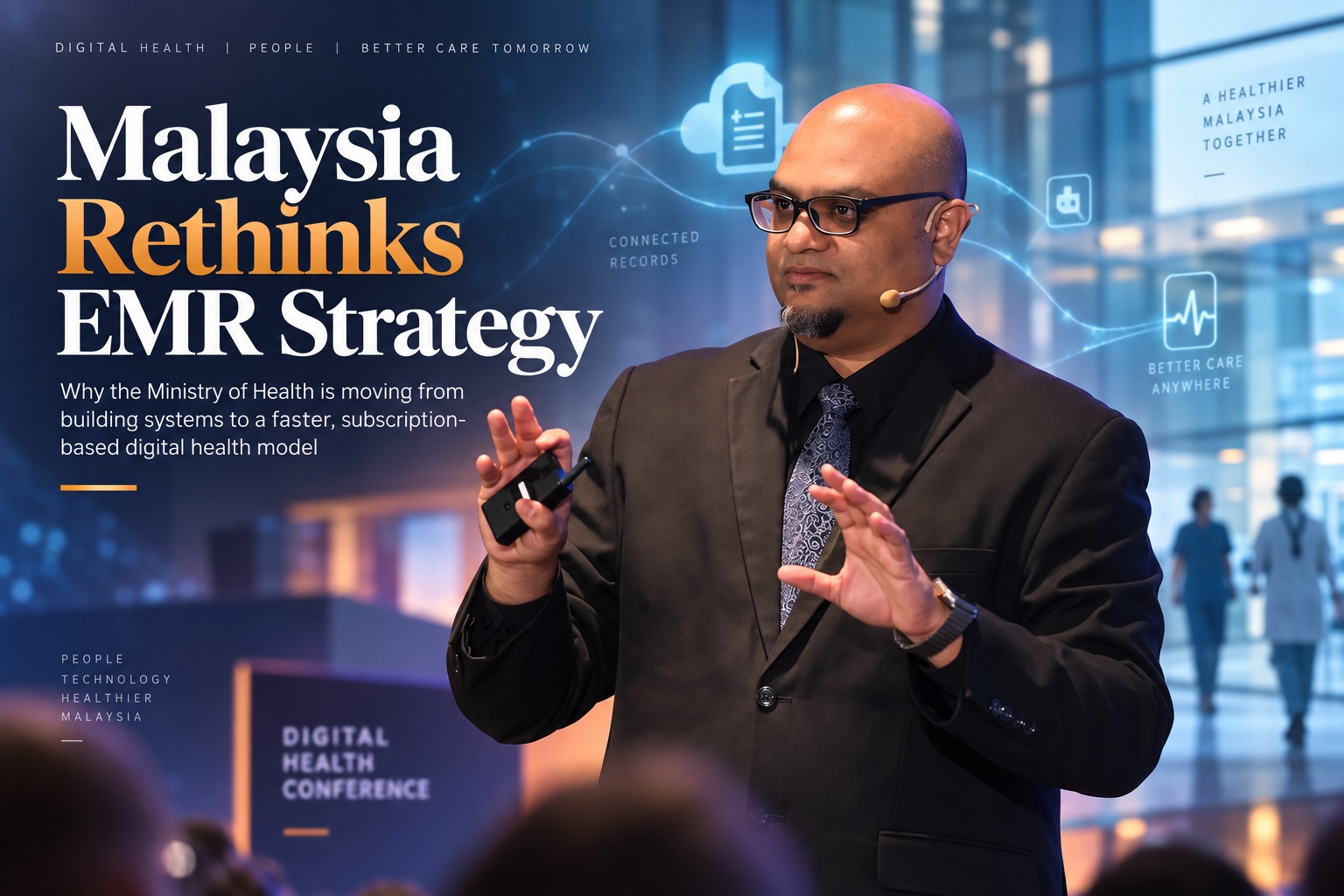
Malaysia's Ministry of Health is changing the way it approaches digital healthcare. Rather than continuing the traditional model of commissioning and building new electronic medical record systems from the ground up, the ministry is moving toward a more flexible subscription-based approach that can adapt more quickly as technology changes.
The shift was outlined at HIMSS25 APAC by Dr Mahesh Appannan, head of the Ministry of Health's Digital Health Division, who described a broader effort to modernise Malaysia's public healthcare system over the coming years. The objective is not simply to install more software. The ministry wants to create what it describes as a person-centric and sustainable digital health ecosystem, with connected patient information, stronger interoperability and better use of health data at the centre of the strategy.
Why Malaysia No Longer Wants to Keep Building Everything From Scratch
For decades, government technology projects have often followed a familiar pattern: define requirements, secure development funding, build a system, deploy it and maintain it for many years. That approach can work for relatively stable systems, but healthcare technology is changing far more quickly than traditional procurement cycles were designed to accommodate.
Dr Appannan explained that when the Digital Health Division was established in March of the previous year, one of its first strategic changes was moving away from a predominantly build-oriented model. The ministry had spent roughly two decades developing systems internally or commissioning purpose-built platforms, but maintaining that approach was becoming increasingly difficult as new technologies, standards and capabilities emerged much faster.
The ministry also faced a practical administrative problem. Upgrading an existing government-developed system could require a completely new development budget application, making relatively routine enhancements slower and more cumbersome than they needed to be. Subscription-based systems potentially allow the ministry to adopt technology that can be updated continuously rather than waiting for another major development cycle.
Agility Has Become More Important Than Owning Every System
The reasoning behind the change is straightforward: healthcare technology is moving too quickly for systems to remain static for ten or fifteen years. Cloud services, artificial intelligence, interoperability standards and cybersecurity requirements can change significantly within only a few years, meaning healthcare organisations need platforms that can evolve alongside them.
A subscription model potentially shifts some of that burden to technology providers. Instead of the government owning a large custom-built application and being responsible for every future enhancement, it can subscribe to services that are continuously maintained and updated. That does not remove the need for governance or technical oversight, but it changes the relationship between the ministry and its technology suppliers.
The ministry's data assets also become increasingly important under this model. The long-term value is not necessarily the ownership of a particular software platform but the ability to securely manage, exchange and use healthcare information across different systems.
Technology Vendors Will Need to Prove Their Value
The change also affects how technology companies should approach the Ministry of Health. Dr Appannan made it clear that vendors should not arrive with a catalogue containing dozens of products and expect the ministry to decide which one might be useful. Instead, technology providers are expected to understand the ministry's problems and propose solutions that address clearly identified gaps.
This is an important change in procurement philosophy. A proof of concept should demonstrate something genuinely useful rather than reproduce functionality that already exists elsewhere in the health system. Vendors that simply present another version of an existing solution may find it much harder to gain support.
The ministry is effectively asking technology companies to begin with the healthcare problem rather than the product. That means understanding clinical workflows, operational limitations, existing infrastructure and the needs of both healthcare workers and patients before proposing the technology.
Malaysia Wants a Person-Centric Digital Health Ecosystem
The broader goal goes beyond replacing individual hospital systems. The Ministry of Health wants to create a person-centric digital health ecosystem, where healthcare information can move more effectively with the patient rather than remaining isolated inside individual facilities.
This is closely connected to the concept of precision public health. If healthcare data can be collected consistently and used responsibly across the system, public-health authorities can potentially understand disease patterns, identify population-level risks and allocate resources more effectively.
From the patient's perspective, the vision is simpler: medical information should not disappear whenever they move from one clinic or hospital to another. A connected system could allow clinicians to understand previous diagnoses, medications, laboratory results and treatment histories without forcing patients to repeat the same information at every facility.
The Current Level of Digitalisation Shows How Much Work Remains
The scale of the challenge is considerable. According to figures presented by the ministry, only around 14% of Malaysian hospitals have been digitalised, and even those facilities are not yet fully connected with one another.
Primary healthcare shows an even larger gap. Only about 6.8% of primary healthcare clinics were described as connected and digital, while the figure falls to approximately 0.7% when rural and community clinics are included. Dental clinics fare slightly better, with around 11.3% digitalisation.
These figures demonstrate why Malaysia's digital health transformation cannot be treated simply as an EMR replacement project. The country needs connectivity, infrastructure, interoperability, workforce readiness and consistent governance alongside the clinical systems themselves.
All Government Hospitals Are Targeted for Digitalisation by 2028
Despite the low starting point, the Ministry of Health has set an ambitious deadline. The current target is to digitalise all government hospitals by the end of 2028, giving the ministry a relatively short window to expand digital infrastructure across the country.
That timeline means implementation needs to happen at a much faster pace than previous healthcare IT programmes. A traditional model in which every facility independently commissions, builds and customises its own system would make nationwide expansion extremely difficult.
A subscription-oriented approach may help by allowing the government to deploy proven platforms more rapidly while standardising core requirements. However, speed alone will not guarantee success. Systems still need to work reliably in clinical environments and fit the actual workflows of doctors, nurses, pharmacists and other healthcare professionals.
One Record, One Citizen Remains the Central National EMR Vision
Malaysia's wider digital health programme centres around the One Record, One Citizen national electronic medical record initiative. The objective is to ensure that every citizen can eventually have a healthcare record that can be used across the public health system rather than being fragmented between individual institutions.
As part of the strategy, the Ministry of Health intends to divide the country into four zones, with four EMR platforms supporting the respective regions. Rather than attempting to force every facility onto one enormous national application, this approach allows multiple systems to operate while still working toward common interoperability and governance requirements.
The first request for proposal is expected to cover 16 hospitals across three regions. The tender process will include simulation testing and user evaluation, indicating that usability and real-world clinical performance will play a role in deciding which systems are selected.
Simulation Testing Could Be More Important Than Vendor Presentations
Healthcare technology can look impressive during a sales demonstration and still perform poorly once clinicians begin using it. Requiring simulation tests allows users to interact with systems under scenarios that resemble actual healthcare workflows rather than evaluating them primarily through presentations and specification documents.
User evaluation is equally important because clinicians experience the consequences of poor system design every day. An application may satisfy every technical requirement while still forcing nurses to perform unnecessary steps or making doctors search through several screens to find basic information.
Building user testing into the procurement process creates an opportunity to identify those weaknesses before widespread deployment. It also sends a message to vendors that technology will be judged by how well it works in clinical practice, not simply by the length of its feature list.
Global Standards Will Form the Foundation of the Architecture
Although Malaysia is changing its procurement model, it does not mean abandoning technical standards. The Ministry of Health plans to adopt internationally recognised frameworks and interoperability standards, including FHIR, as part of its redesigned digital architecture.
FHIR, or Fast Healthcare Interoperability Resources, provides a standardised way for healthcare systems to exchange clinical information. Its importance becomes much greater in an environment where several different EMR platforms may be operating across different parts of the country.
If every vendor stores and exchanges information in completely proprietary ways, One Record, One Citizen would become extremely difficult to achieve. Common standards make it possible for different systems to exchange information without requiring every hospital to run identical software.
HIMSS Maturity Models Will Be Used as a Guide Rather Than Another IT System
Malaysia also plans to use HIMSS digital maturity frameworks, particularly the Electronic Medical Record Adoption Model, or EMRAM, as part of its transformation strategy. The purpose is to provide hospitals with a recognised framework for assessing whether technology is being used safely and effectively.
This is an important distinction because EMRAM is sometimes misunderstood as another system that hospitals must purchase or deploy. Simon Lim, HIMSS APAC executive vice president and managing director, explained that the framework is not intended to introduce another technical layer. Its purpose is to help hospitals optimise the technology they already use and measure whether it is actually improving outcomes.
Dr Jason Tee of HIMSS reinforced the same idea, noting that standards should not become exercises in ticking boxes. A digital maturity framework should help demonstrate that a system is safe, functional and capable of delivering measurable value to a healthcare organisation.
Institut Jantung Negara Shows What Digital Maturity Can Look Like
Malaysia already has a local example of how the HIMSS framework can be applied. Institut Jantung Negara, or IJN, became the first hospital in the country to achieve Stage 6 validation under HIMSS EMRAM.
Dr Alwi Mohamed Yunus, who led the EMRAM programme at IJN, described some of the misconceptions encountered during the process. Some people initially assumed that EMRAM was a software product the hospital had purchased, while others believed that an organisation should only approach HIMSS after reaching an advanced stage of digital maturity.
In reality, IJN began its journey while it was still heavily paper-based. The framework was used as a roadmap for digital transformation rather than as a certification process that could only begin after the hospital had already become highly digital.
Digital Maturity Frameworks Can Help Hospitals Decide What They Actually Need
The IJN experience also highlights a potentially important financial benefit. Rather than asking a vendor to determine everything the hospital required, the maturity framework helped identify gaps in a structured way.
Dr Alwi said this approach allowed the organisation to address far more requirements than it might otherwise have identified through a conventional vendor engagement. More importantly, the cost of adopting the framework was relatively small compared with purchasing an entirely new system simply because a supplier recommended it.
This illustrates why digital maturity assessments can be valuable before major technology investments. Hospitals can first understand where their weaknesses are and then buy technology specifically to address those weaknesses rather than starting with a product and looking for a reason to deploy it.
Healthcare Tourism Also Helped Push Digital Maturity Forward
IJN's engagement with EMRAM was initially linked to its role in Malaysia's healthcare tourism industry. In 2023, the Malaysia Healthcare Travel Council partnered with HIMSS to support digital transformation among hospitals serving international healthcare travellers.
Digital maturity can be particularly important in healthcare tourism because international patients often expect high levels of coordination, accessibility and information management. Hospitals competing globally need to demonstrate not only strong clinical capabilities but also modern operational and digital infrastructure.
The partnership therefore gave Malaysian healthcare organisations another reason to benchmark themselves against international standards rather than evaluating digital progress entirely through domestic criteria.
Vendors Need to Understand the Framework Before Selling Into Healthcare
HIMSS representatives also urged technology providers to understand digital maturity models before approaching hospitals with solutions. Dalvin Loh, HIMSS APAC vice president, emphasised that vendors should align their proposals with what healthcare organisations are actually trying to achieve.
This means a vendor should be able to explain which digital maturity gap its technology addresses, what measurable improvement should result and how that improvement can be evaluated. Simply providing a list of capabilities does not demonstrate value.
For the Ministry of Health, this could help prevent duplicated investments and disconnected pilot projects. When every solution is linked to a broader architecture and maturity roadmap, individual technology purchases become part of a larger transformation rather than standalone experiments.
Moving to Subscription Does Not Mean Giving Up Control
The phrase "Malaysia is not building new EMR systems" can sound as though the government is outsourcing its entire digital health strategy, but that would be an oversimplification. The ministry is changing how technology is acquired, not abandoning responsibility for the architecture, standards or healthcare data.
In fact, moving toward subscription-based platforms may make governance more important. The government still needs clear rules covering data ownership, interoperability, cybersecurity, service availability, vendor portability and what happens if a supplier relationship ends.
The goal should therefore be to avoid becoming dependent on any single vendor. A subscription model works best when healthcare data remains portable and systems follow common standards, allowing the ministry to change platforms when necessary without losing control over information.
Data May Become More Valuable Than the Applications Themselves
One of the most interesting ideas behind the ministry's strategy is the emphasis on data assets as leverage. Software platforms will inevitably change. The EMR selected today may be replaced or significantly redesigned a decade from now, while the clinical information accumulated across the healthcare system needs to remain useful for generations.
That means the long-term strategic asset is not necessarily the software itself. It is the healthcare data, the standards used to describe it and the ability to exchange it securely.
If Malaysia builds a strong national data architecture, individual systems can evolve without forcing the entire healthcare ecosystem to start again each time technology changes. This may prove particularly important as artificial intelligence and advanced analytics become more deeply integrated into healthcare.
A Strong Digital Foundation Will Also Determine Malaysia's AI Readiness
The strategy has important implications for healthcare AI. Hospitals cannot make effective use of advanced AI if patient information remains scattered across paper records and disconnected databases.
AI applications for clinical documentation, decision support, population health, operational forecasting and research depend heavily on accessible, structured and trustworthy data. Digitalising hospitals and implementing interoperability standards therefore creates the foundation on which future AI capabilities can be built.
This is another reason the shift away from repeatedly constructing isolated systems matters. If every hospital develops technology independently, national-scale AI and analytics become much harder because the underlying data is inconsistent.
The Hardest Part May Still Be Connecting Everything
Digitalising individual hospitals is only one part of the challenge. Connecting those facilities into a functioning national ecosystem may prove even more difficult.
Malaysia's existing environment contains hospitals and clinics with different levels of maturity, different systems and different infrastructure. Rural facilities may face connectivity constraints that large urban hospitals do not experience, while older applications may have limited interoperability capabilities.
The four-zone approach means interoperability cannot be optional. The success of One Record, One Citizen depends on different EMRs exchanging information accurately and consistently, regardless of which vendor operates each region.
People Will Ultimately Determine Whether the Strategy Works
Technology strategy can provide the architecture, but clinicians and healthcare workers will determine whether the transformation succeeds in practice. Doctors, nurses, pharmacists and allied health professionals need systems that reduce administrative burden rather than create more of it.
This is why user evaluation in the tender process is so important. Clinical workflows are complex, and seemingly small interface problems can become significant when repeated hundreds of times during a working day.
Training and change management will therefore need to accompany the technical rollout. Digitalisation should not simply replicate old paper processes on a screen; it should be used as an opportunity to redesign inefficient workflows where appropriate.
The 2028 Target Will Require a Different Pace of Implementation
Moving from the current level of hospital digitalisation to nationwide coverage by the end of 2028 represents a significant operational challenge. Procurement, infrastructure upgrades, integration, testing, training and deployment will all need to happen in parallel across multiple facilities.
The move toward subscriptions and reusable standards appears partly designed to support that speed. Building a custom system for every requirement would make the timeline extremely difficult to achieve.
At the same time, rapid implementation creates risks. The ministry will need to ensure that pressure to meet the deadline does not result in systems being deployed before hospitals are ready to use them safely and effectively.
Final Thoughts
Malaysia's decision to move away from continuously building new EMR platforms represents a significant change in its digital health strategy. Instead of treating every requirement as another software-development project, the Ministry of Health wants a more agile environment built around subscription services, interoperable data and internationally recognised standards.
The approach also changes expectations for technology vendors. The ministry is looking for solutions that address real gaps, demonstrate measurable value and fit within a larger national architecture rather than another collection of disconnected products.
With One Record, One Citizen, four regional EMR environments, FHIR interoperability and HIMSS maturity frameworks forming part of the roadmap, Malaysia is attempting to build something broader than a nationwide collection of hospital information systems. The ambition is a connected ecosystem where clinical information can move with the patient and technology can change without forcing the country to continually rebuild its digital foundation.
Whether the strategy succeeds will depend on execution over the next few years. But the change in philosophy is significant: Malaysia is increasingly treating healthcare data, interoperability and outcomes as the long-term assets, while the software itself becomes something that can evolve as technology changes.











Comments 0