

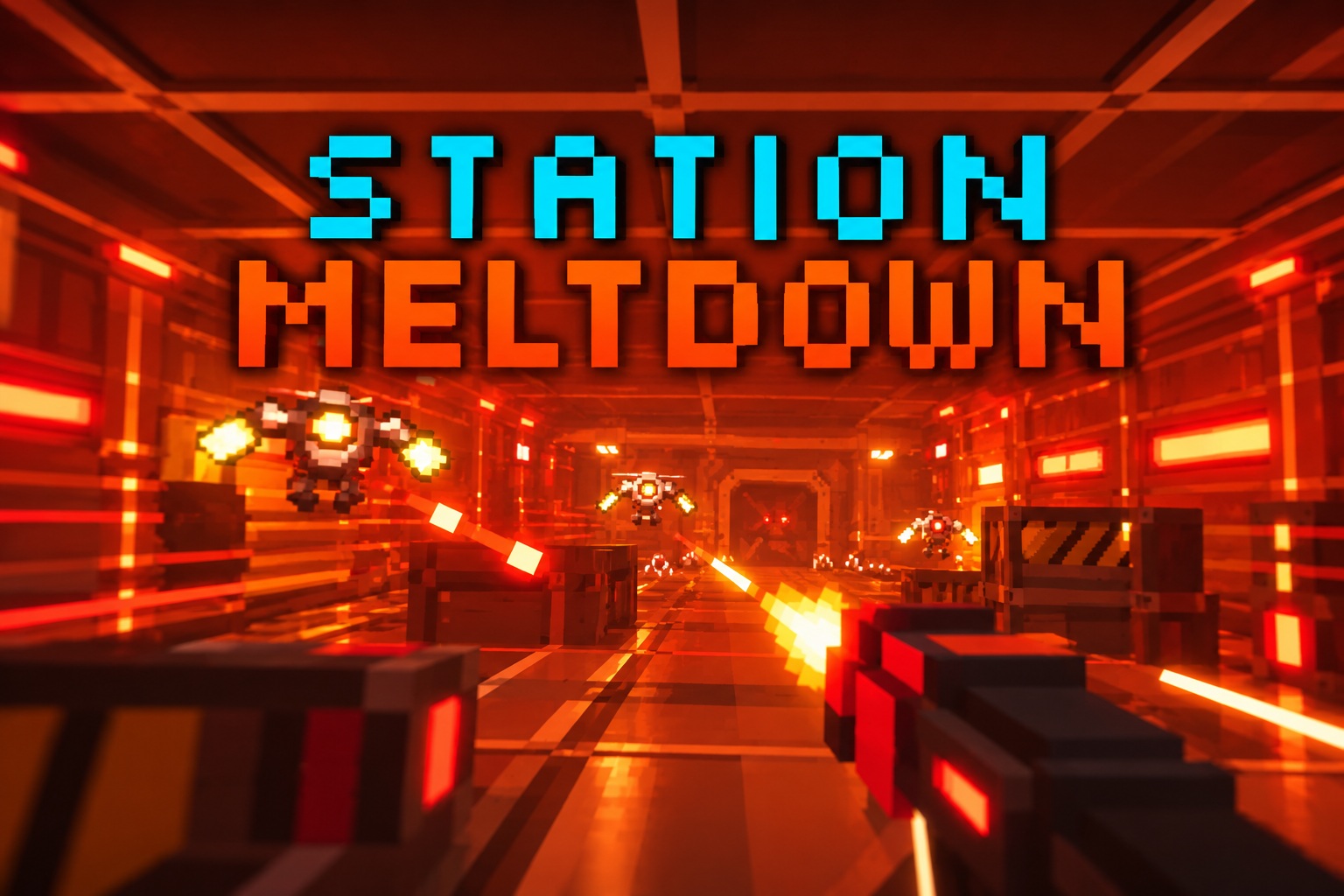
Station Meltdown is a compact but energetic first-person shooter built around one straightforward objective: survive as long as possible while an abandoned space station fills with increasingly dangerous waves of hostile robots. Created by Maksim Chmutov, the game focuses almost entirely on movement, shooting, weapon management, and quick decision-making rather than lengthy story sequences or complicated progression systems. Players move from one combat area to another, clearing robotic enemies while collecting weapons and ammunition that provide additional options for the next encounter. The longer the run continues, the more demanding the station becomes.
What makes Station Meltdown especially enjoyable is how quickly it places the player into meaningful combat. Enemies fire visible projectiles that can often be avoided through careful strafing and the powerful dash ability, turning firefights into a mixture of aiming and high-speed movement. New weapons gradually change how players approach different situations, while melee attacks offer another option when enemies get too close. The endless structure ensures that every successful room simply leads toward another opportunity to test accuracy, mobility, and survival skills.
Now playable online through Lemon Web Games, Station Meltdown brings its endless robot battles, fast first-person movement, dash mechanics, multiple firearms, ammunition management, melee combat, and colourful voxel-inspired environments directly into the web browser. Players can enter the station, clear successive combat rooms, discover additional weapons, and continue pushing forward until the increasingly aggressive robotic forces finally overwhelm them. There is no complicated preparation before the action begins, making the game ideal for both short sessions and longer score-chasing attempts. Each run becomes another opportunity to move faster, aim more accurately, and survive slightly longer than before.
An Abandoned Station Filled With Hostile Machines
Station Meltdown takes place aboard a deserted space station that has become occupied by aggressive robots. Instead of exploring a peaceful science-fiction facility, players immediately discover that nearly every combat area is another potential ambush.
The setting gives the game a clear visual identity without requiring extensive exposition. Metallic corridors, enclosed arenas, futuristic structures, and mechanical enemies establish the science-fiction atmosphere within seconds.
The abandoned environment also creates an effective contrast between quiet moments and combat. A room may initially seem empty, only for the next robot wave to transform it into another frantic firefight.
The Game Gets to the Action Immediately
There is very little downtime between beginning a run and facing enemies. Station Meltdown avoids lengthy tutorials and narrative introductions, allowing players to learn primarily through movement and combat.
The controls are familiar to anyone who has played a modern first-person shooter. Move through the environment, aim toward enemies, fire available weapons, reload when necessary, and use mobility to stay alive.
This accessibility is one of the game's greatest strengths. The mechanics are easy to understand quickly, while actually surviving later waves requires considerably more practice.
Movement Is Just as Important as Accuracy
Station Meltdown is not a shooter where standing still and exchanging fire is a reliable strategy. Enemy projectiles create moving danger zones that constantly force players to reposition.
Strafing around attacks is useful, but the player also needs to consider walls, corners, and other enemies occupying the same space. Dodging one projectile can easily place the player directly in front of another.
Good movement therefore involves reading the entire room rather than reacting only to the nearest enemy. Experienced players gradually develop routes that provide enough space to attack while remaining difficult to hit.
The Dash Ability Changes Everything
The dash is one of Station Meltdown's most important mechanics because it allows the player to reposition much faster than ordinary movement. A well-timed dash can escape an incoming projectile, cross an exposed section of the arena, or create distance from a group of robots.
Using it effectively requires judgement. Dashing unnecessarily may leave the player without the same mobility when a more dangerous attack arrives seconds later.
The strongest players use the dash as part of normal movement rather than treating it only as a panic button. Combining strafing, jumping, and sudden bursts of speed makes the player considerably harder to hit.
Robot Projectiles Encourage Active Dodging
Many enemies attack with projectiles that travel visibly through the environment rather than instantly hitting the player. This gives players opportunities to react.
The challenge increases once several robots begin firing simultaneously. Individual projectiles may be easy to avoid, but overlapping attacks can gradually eliminate safe spaces.
This creates an almost arcade-like rhythm inside the FPS format. Players are simultaneously aiming at targets and navigating through patterns of incoming fire.
Different Weapons Change the Rhythm of Combat
Station Meltdown provides several firearms rather than forcing players to rely on one weapon throughout the entire run. New combat rooms can introduce additional equipment and ammunition.
Different guns naturally encourage different approaches. A weapon suited to rapid close-range fire may feel completely different from one designed around more deliberate shots.
Finding a new firearm can therefore change the character of the next several encounters. Players begin learning which weapons feel most effective against particular enemy situations.
Ammunition Prevents Careless Shooting
Powerful weapons are only useful while ammunition remains available. Players need to keep track of how much they are using instead of firing endlessly without consideration.
Missing repeatedly can create serious problems later, particularly if the strongest weapon runs empty just as another difficult wave begins. Accuracy therefore contributes directly to long-term survival.
Ammunition pickups provide temporary relief, but they should not encourage wastefulness. Efficient shooting gives players more options when the station becomes increasingly dangerous.
Reloading Creates Vulnerable Moments
Reloading may only take a short time, but that delay can become dangerous when several robots are already attacking. Players need to think about when it is safe to refresh the weapon.
Waiting until the magazine is completely empty during a crowded firefight can leave the player temporarily unable to respond. Reloading between enemy bursts is often much safer.
This gives ordinary weapon handling tactical importance. Successful runs depend not only on aim but also on maintaining readiness.
The Weapon Wheel Keeps the Arsenal Accessible
Players can switch between available firearms through a weapon wheel, allowing them to respond quickly when the current gun no longer suits the situation.
This is particularly valuable when ammunition runs low. Instead of stopping the action, the player can immediately move to another weapon and continue fighting.
Weapon switching also supports experimentation. Players can compare different firearms during the same run and gradually develop preferences for particular combat situations.
Melee Attacks Provide a Last-Resort Option
When enemies get too close, players can use a melee attack instead of relying entirely on firearms. The ability is especially useful when ammunition is limited or there is no time to reload.
Closing the distance deliberately can be risky, however, because nearby enemies leave less room to dodge incoming attacks. Melee works best when used with confidence rather than desperation.
The mechanic gives players another tool without complicating the controls. Station Meltdown remains focused on fast reactions and straightforward combat.
Weapon Inspection Adds a Small Touch of Personality
Players can inspect the current firearm, giving them a closer look at the weapon model between battles. It is not essential to survival, but it adds personality to the arsenal.
Small features like this help make the weapons feel like individual objects rather than interchangeable damage numbers. Players naturally begin recognising favourite guns by appearance as well as performance.
Inspection also provides a brief moment of calm during quieter parts of a run. The station rarely stays peaceful for very long.
Each Room Becomes Another Survival Test
Progression is structured around moving through successive combat spaces. Clearing one area allows the player to continue deeper into the station, where another enemy group awaits.
This creates a clear rhythm of battle, recovery, preparation, and another battle. Players receive just enough time between encounters to collect supplies and prepare mentally for what comes next.
The simple structure works well because the game does not need elaborate objectives. Surviving one more room is already enough motivation.
Enemy Waves Gradually Increase the Pressure
Early battles allow players to become comfortable with movement and shooting, but the difficulty grows as the run continues. More threats demand increasingly efficient reactions.
The game rarely needs to introduce completely new mechanics to become harder. Adding more enemies and overlapping projectiles naturally increases the pressure.
This creates a satisfying difficulty curve because players are asked to become better at skills they already understand. Survival becomes a genuine measure of improvement.
Positioning Can Prevent the Player From Becoming Surrounded
One of the easiest ways to lose control of a room is allowing robots to occupy several angles around the player. Once enemies attack from every direction, finding safe movement becomes much harder.
Staying near open routes allows the player to reposition if the current area becomes dangerous. Moving toward the middle of a crowded enemy group is usually far riskier.
Good positioning also makes aiming easier. Keeping several enemies within the same general direction allows the player to attack without constantly turning across the entire room.
Corners Can Help and Hurt
Environmental cover can temporarily block enemy attacks, making corners useful for controlling exposure. However, relying too heavily on enclosed positions can become dangerous if enemies move close.
A player trapped against a wall has fewer directions available for dodging. What initially felt like protection can quickly become a dead end.
The best approach is often to use environmental geometry temporarily rather than treating one position as permanent cover. Station Meltdown rewards mobility.
The Voxel-Inspired Visual Style Keeps Combat Readable
Station Meltdown uses colourful, blocky 3D visuals that give the game a distinctive indie personality. Robots, weapons, projectiles, and environmental structures remain easy to identify during fast movement.
This readability becomes increasingly important once several enemies are active simultaneously. Players need to understand where threats are without stopping to study the scene.
The simplified visual style also keeps attention firmly on gameplay. Movement and combat remain the main spectacle.
The Science-Fiction Setting Fits the Arcade Design
An abandoned station full of hostile machines provides the perfect excuse for endless combat rooms. Robots can appear in large numbers without requiring complicated narrative explanations.
The mechanical enemies also fit naturally with the bright projectiles and futuristic weapons. Everything feels consistent with the game's fast arcade-inspired approach.
Station Meltdown is therefore able to establish its world efficiently. The setting provides enough context while leaving most of the player's attention available for combat.
There Is No Need for a Complicated Story
Some shooters rely heavily on cinematic sequences and extensive dialogue. Station Meltdown takes the opposite approach.
The mystery of the abandoned station provides atmosphere, but the main attraction is surviving its robotic inhabitants. Players create their own small stories through near misses, successful dashes, ammunition shortages, and desperate final battles.
This minimalist approach suits the endless structure. The game is designed to be replayed rather than completed once for a fixed narrative ending.
Endless Structure Encourages Personal Goals
Station Meltdown does not need a traditional final level to provide motivation. Each run becomes a challenge to survive longer than the previous one.
Players may focus on reaching more rooms, improving their score, becoming more accurate, or mastering a favourite weapon. These personal objectives naturally appear after only a few attempts.
The endless format also makes restarting easy. Failure immediately suggests another run rather than feeling like the conclusion of a long campaign.
Short Runs Can Still Feel Complete
One of the advantages of the endless structure is that Station Meltdown works well even when there is little time available. A run can provide several intense battles without requiring a long commitment.
Longer sessions remain appealing because improvement becomes visible across repeated attempts. The player gradually understands enemy behaviour and learns better movement habits.
This flexibility makes the game particularly suitable for browser play. Starting another attempt takes very little effort.
Fast Restarts Keep Frustration Low
When a run ends, the natural response is often to immediately try again. There is no lengthy setup preventing another attempt.
This is important because failure is central to endless survival games. Players are expected to lose eventually.
A quick return to the action keeps the focus on improvement rather than punishment. The next run becomes an opportunity to correct whatever went wrong.
Score Chasing Adds Another Reason to Improve
Survival itself provides a clear objective, but score-focused players can treat every enemy as another opportunity to improve their performance.
Better movement and accuracy naturally lead toward stronger runs. Players who eliminate enemies quickly spend less time exposed to incoming fire.
The score therefore reflects many of the same skills required for survival. Improvement in one area usually benefits the other.
Repeated Runs Build Mechanical Confidence
At first, players may need to consciously think about dashing, weapon switching, reloading, and dodging. After enough practice, these actions become more automatic.
That frees attention for higher-level decisions such as enemy priority and positioning. The game gradually feels faster because the player is processing more information without hesitation.
This progression happens almost entirely through personal skill rather than permanent character statistics. The player becomes stronger because they understand the game better.
Target Priority Becomes Increasingly Important
When several robots are present, attacking the closest one is not always the best choice. Some enemies may occupy more dangerous positions or create projectile patterns that limit movement.
Removing those threats first can dramatically simplify the rest of the room. The battlefield becomes easier once the most disruptive enemy disappears.
Players naturally begin making these decisions faster with experience. What initially feels like chaotic shooting gradually becomes controlled threat management.
Station Meltdown Rewards Aggressive Confidence
Playing too cautiously can allow enemy numbers and projectiles to build up. Eliminating threats quickly often creates more breathing room than constantly retreating.
Aggressive play does not mean standing still and trading damage. The most effective style combines rapid movement with decisive shooting.
Once players become comfortable with the dash and weapon handling, the game starts feeling almost rhythmic. Movement and attacks flow together instead of happening as separate actions.
Playing Station Meltdown Online Today
Through Lemon Web Games, Station Meltdown can now be played directly in your web browser with no downloads or setup required. Features of the web-based version include:
New players should concentrate on movement before worrying about clearing rooms as quickly as possible. Learn how far the dash travels, keep open space available for escape, and avoid standing still while several robots remain active. Once movement becomes comfortable, shooting accuracy will naturally improve because the player spends less time reacting in panic.
It is also worth becoming familiar with every available weapon. A gun that initially feels weaker may prove extremely useful in certain situations, especially when ammunition for another weapon is running low. Switching confidently between weapons makes longer runs far more manageable.
Who Should Play Station Meltdown
Station Meltdown is particularly suitable for players who enjoy shooters where movement is as important as raw accuracy. The dash, visible enemy projectiles, and increasingly crowded rooms reward players who remain mobile and constantly reposition themselves.
It should also appeal to anyone looking for immediate action without a large learning barrier. The controls are straightforward, the objective is obvious, and the difficulty grows naturally through increasingly demanding combat.
Play Station Meltdown Online Now
Station Meltdown turns an abandoned space station into an endless robotic shooting gallery where every new room provides another chance to improve. Dash through incoming fire, switch between firearms, manage ammunition, use melee attacks when enemies get too close, and keep advancing for as long as your reflexes can handle the increasing pressure.
Through Lemon Web Games, players can experience Station Meltdown directly in a modern browser and jump into its fast arcade-inspired FPS action almost immediately. There is no complicated campaign to learn and no lengthy preparation between attempts. Enter the station, keep moving, keep shooting, and see how far the next run can go.
Final Thoughts
Station Meltdown succeeds by concentrating almost entirely on the fundamentals of a fast shooter. Movement needs to feel responsive, weapons need to be satisfying, enemies need to create readable threats, and every new room needs to push the player slightly harder than the previous one. The game builds its identity around those simple ideas rather than surrounding them with unnecessary systems.
The dash is especially important because it transforms ordinary strafing into a much faster style of combat. Combined with visible projectiles and multiple weapons, it creates firefights where survival depends on constantly reading the battlefield and reacting before safe space disappears. Repeated runs naturally improve those skills until movement begins feeling instinctive.
Through Lemon Web Games, Station Meltdown can now be enjoyed directly in the browser as a compact, energetic FPS built for quick sessions and repeated attempts. Its abandoned station, voxel-inspired graphics, robotic enemies, weapon variety, and endless structure provide everything needed for an addictive arcade-style challenge. For players who enjoy fast movement, constant shooting, and the simple satisfaction of surviving one more room, Station Meltdown is well worth another run.











Comments 0