


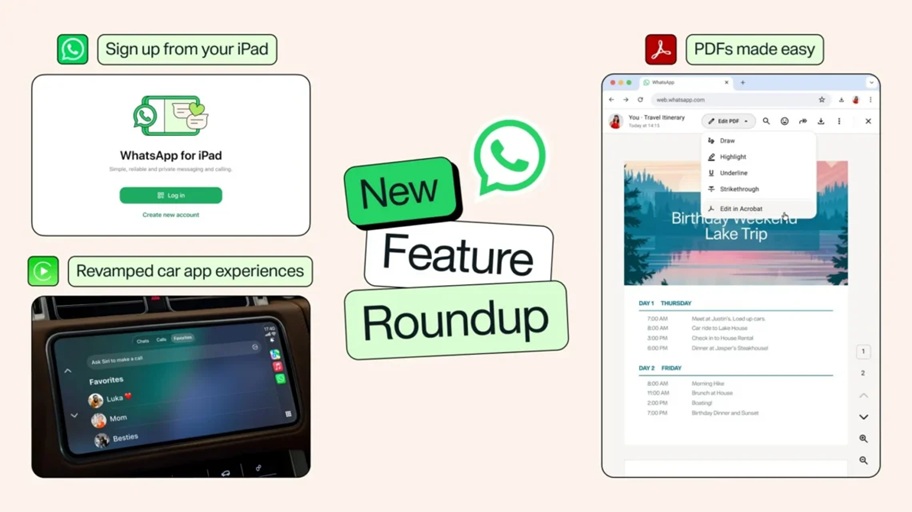
WhatsApp is gradually becoming less dependent on the smartphone as the centre of every conversation. Its latest round of updates focuses on making the messaging service feel more complete across tablets, computers and in-car displays, reflecting how people now move between devices throughout the day.
The update introduces direct account registration on iPad, Adobe Acrobat-powered PDF tools for WhatsApp Web and Windows, redesigned Apple CarPlay and Android Auto experiences, and easier music sharing through WhatsApp Status. The new features began rolling out on 22 July 2026, although availability may appear gradually depending on the user, platform and app version.
The iPad Can Finally Become a Primary WhatsApp Device
When WhatsApp released its dedicated iPad application in 2025, the tablet still functioned mainly as a linked companion device. Users first needed an existing WhatsApp account on a smartphone before connecting the iPad.
That limitation is now being removed.
Users can register and set up a WhatsApp account directly through the iPad app without first linking the tablet to an account already running on a phone. This makes the iPad a much more independent communication device rather than merely a larger secondary screen.
The change could be particularly useful for people who rely heavily on an iPad for work, education or family communication. A tablet with a keyboard can already function as a lightweight laptop, and direct WhatsApp registration makes it easier to use the device for messaging, calls, document sharing and group discussions.
It may also appeal to older users or families who prefer the iPad's larger display but do not necessarily want to manage WhatsApp through a separate smartphone.
WhatsApp Is Still Not Completely Moving Away From Phone Numbers
Standalone iPad registration does not necessarily mean WhatsApp has abandoned its phone-number-based account system.
The important change is that the iPad no longer needs to be paired with an already active phone installation before the account can be created. Users should still expect an identity-verification process during registration, while the exact steps may vary as the feature becomes available more widely.
WhatsApp has also been developing usernames, which could eventually reduce the need to reveal a personal phone number when communicating with someone new. However, usernames and direct iPad registration should be viewed as separate developments rather than proof that phone numbers are disappearing immediately.
For now, WhatsApp appears to be separating two ideas that were previously closely connected: the number used to establish an account and the physical smartphone used to operate it.
PDFs Can Now Be Opened Directly Inside WhatsApp
One of the most practical additions is the new native PDF experience for WhatsApp Web and the Windows desktop app.
Previously, receiving a PDF through WhatsApp usually meant downloading the document and opening it in a browser, Adobe Reader or another application. The conversation and the document therefore existed in separate windows, which could become inconvenient when reviewing contracts, invoices, quotations or reports.
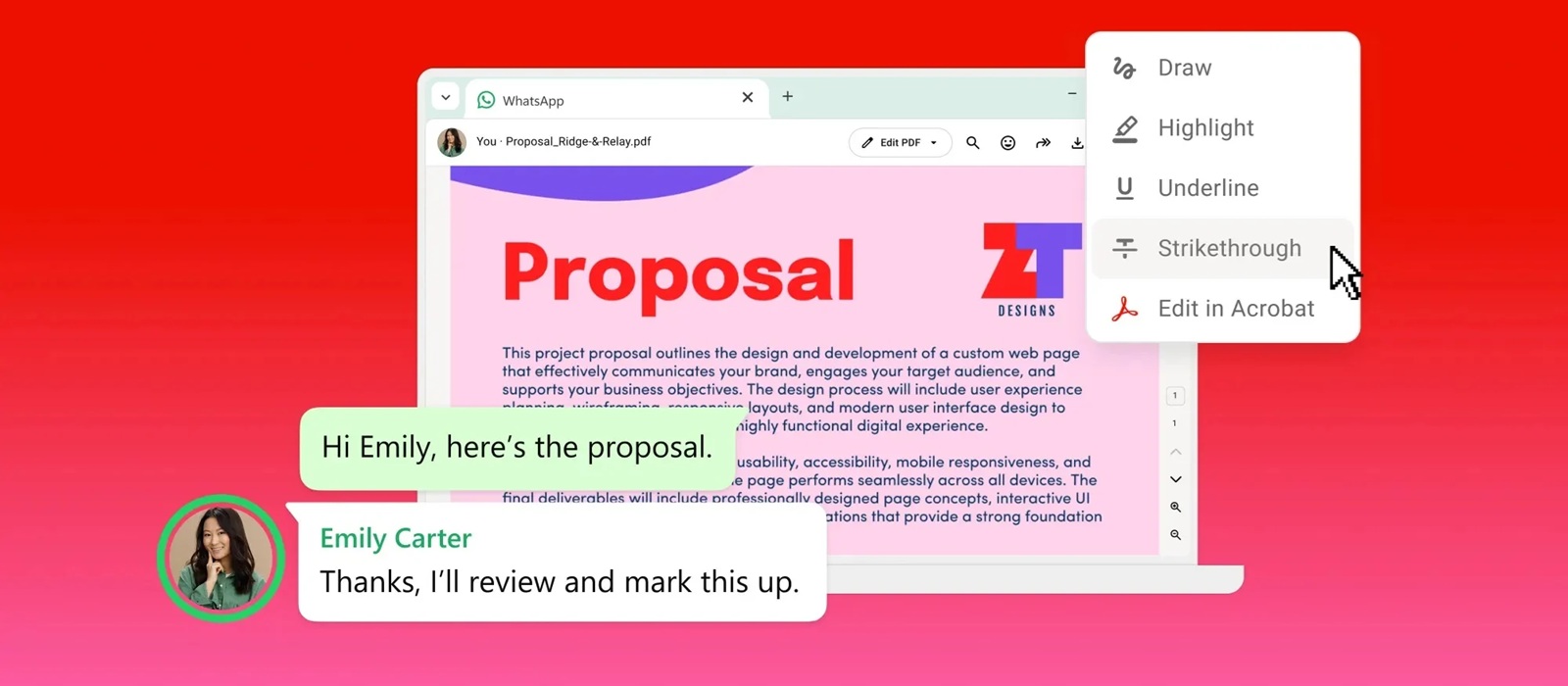
With the new Adobe Acrobat integration, users can open a PDF directly within the WhatsApp conversation. The viewer supports full-screen reading, scrolling and zooming without requiring the file to be manually downloaded first.
The feature is being made available globally on WhatsApp Web and Windows. WhatsApp's broader announcement describes it as a web-and-desktop capability, while Adobe specifically confirms the current integration for the browser-based service and Windows application.
Basic PDF Markup Can Be Completed Without Leaving the Chat
The integration goes beyond simply displaying documents.
Users can highlight text, draw on a page, underline important sections and strike through content directly from the WhatsApp interface. This allows someone to point out an incorrect amount on an invoice, mark a clause for review or annotate a design before replying in the same conversation.
For more complicated changes, an Edit in Acrobat option provides access to additional Adobe tools. Depending on the available Acrobat plan, these can include reorganising pages, signing documents, applying password protection and making more substantial edits.
Adobe's AI Assistant can also summarise documents, answer questions and identify key information, although advanced editing and AI functions may require a paid Acrobat subscription.
This distinction is worth noting. The built-in WhatsApp viewer and lighter annotation tools are designed for quick reviews, while more advanced PDF work still moves into the wider Acrobat environment.
A Useful Addition for Everyday Business Communication
Although WhatsApp began as a personal messaging application, it has become an important business communication channel in countries such as Malaysia.
Customers regularly send payment receipts, companies exchange quotations, suppliers share catalogues and employees distribute forms through WhatsApp. The ability to review and mark up a PDF without leaving the conversation could make these everyday workflows much faster.
For example, a manager could receive a proposal, highlight a section requiring revision and return feedback immediately. A customer could review an invoice while continuing to discuss it with the seller. A project team could mark changes on a document without opening several separate applications.
However, organisations should not treat convenience as a replacement for proper document governance. Sensitive records, patient information, financial documents and confidential contracts should still be handled according to company policy, access controls and regulatory requirements.
The feature may make document handling easier, but it does not automatically make WhatsApp the appropriate storage location for every type of business record.
PDFs Remain Protected by WhatsApp Encryption
WhatsApp says documents shared in personal conversations continue to receive the same end-to-end encryption as other supported messages.
This means the contents are intended to remain accessible only to the participants in the conversation. Adobe also states that password-protected PDFs can be opened through the viewer while retaining their existing protection.
Nevertheless, encryption does not eliminate risks at the user's end.
A document can still be exposed if a device is unlocked, compromised or shared with another person. Users should also remain cautious about unfamiliar PDF attachments, especially those sent with urgent requests involving payments, passwords or account verification.
The new viewer improves convenience, but recipients should still confirm the sender and the purpose of an unexpected document before interacting with it.
WhatsApp Gives CarPlay and Android Auto a Major Refresh
WhatsApp is also updating how the service works inside compatible vehicles.
The redesigned Apple CarPlay and Android Auto experiences allow drivers to hear incoming messages, respond using hands-free controls, make WhatsApp calls, view recent call history and access favourite contacts through the vehicle's display.
Previously, the in-car experience was more limited and often depended heavily on the voice assistant built into the connected phone. The refreshed interface brings more of WhatsApp's communication features into the dashboard while reducing the need to reach for the handset.
The update could be useful for people who spend significant time travelling between offices, meeting clients or commuting. Important calls and messages can be handled through voice controls while the phone remains stored away.
Hands-Free Does Not Mean Distraction-Free
Although the redesigned car apps are intended to reduce physical interaction with a phone, drivers should still use the features carefully.
Listening to a long message, joining an emotional conversation or making a complicated business call can still reduce concentration, even when the driver's hands remain on the steering wheel.
The safest approach is to keep replies brief and postpone anything that requires detailed attention. CarPlay and Android Auto provide a more appropriate interface than manually using a phone, but they do not remove the driver's responsibility to remain focused on the road.
Availability may also depend on the vehicle, infotainment system, connected phone and current versions of WhatsApp, CarPlay or Android Auto.
Apple Music and Spotify Tracks Can Be Shared to Status
WhatsApp is also making music sharing more direct.
Users can now share a song from Apple Music or Spotify to their WhatsApp Status with only a few taps. Friends viewing the Status can see what the person is currently listening to, adding another form of personal expression alongside photographs, videos and text updates.
The feature reflects WhatsApp's continuing effort to make Status more competitive with the temporary-post formats offered by other social platforms.
Instead of manually taking a screenshot of a song or copying a link, users can share it through a more polished integration. The final appearance and playback options may depend on the music service, account type and regional availability.
WhatsApp Is Becoming a Broader Communication Platform
Taken individually, these updates may appear unrelated. One affects tablets, another handles documents, two relate to vehicles and music sharing expands the social side of Status.
Together, however, they reveal a larger direction.
WhatsApp wants conversations to remain accessible wherever the user happens to be—on a tablet at home, a computer at work or a compatible display inside a car. At the same time, the platform is adding tools that allow people to complete more tasks without switching to another application.
The Acrobat integration is especially significant because it moves WhatsApp beyond basic file delivery. A PDF is no longer just an attachment waiting to be downloaded; it becomes an interactive document that can be reviewed and marked up within the conversation.
Direct iPad registration makes a similar change. The tablet is no longer simply borrowing access from a smartphone but can serve as the starting point for the account itself.
What Users Should Do
The new capabilities are rolling out rather than appearing for everyone simultaneously. Users should keep WhatsApp updated through the official App Store, Microsoft Store or WhatsApp website and check again if a particular option is not yet visible.
For iPad users, the registration option should appear during the account setup process once it reaches their device. WhatsApp Web and Windows users can test the Acrobat-powered viewer by opening a PDF received in a conversation.
CarPlay and Android Auto users may also need updated phone software and a compatible vehicle system before the redesigned interface becomes available.
Final Thoughts
WhatsApp's latest update is less about one headline feature and more about removing small frustrations across the devices people already use.
Standalone iPad registration gives tablet users greater independence. The Acrobat-powered PDF viewer makes document discussions faster. Refreshed CarPlay and Android Auto support improves hands-free access, while direct Apple Music and Spotify sharing adds a more personal touch to Status.
None of these changes completely transforms WhatsApp on its own. Combined, however, they bring the platform closer to becoming a device-independent communication service rather than an application that revolves almost entirely around a single smartphone.











Comments 0