

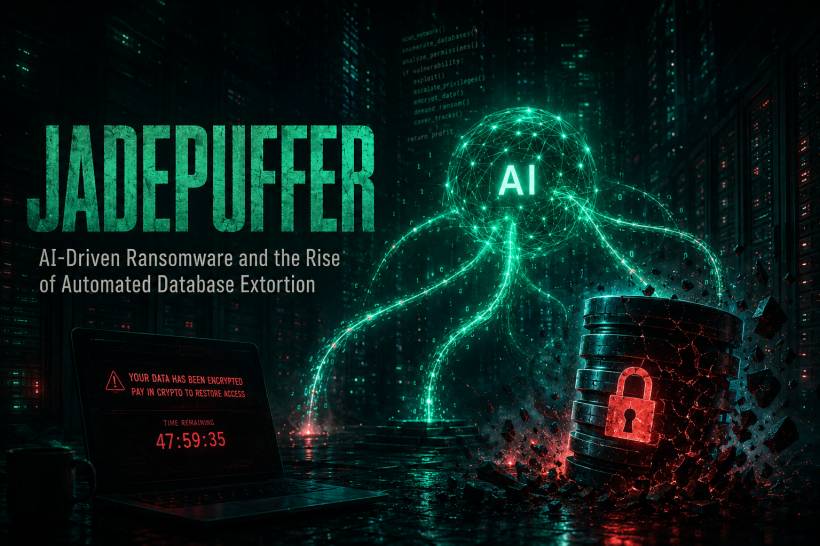
Ransomware has traditionally relied on human operators to move through a compromised network, identify valuable systems, steal data, encrypt files, and pressure victims into paying. That model may be changing. A newly reported campaign known as JADEPUFFER highlights how large language models could be used to automate much more of the attack process. Rather than depending on attackers to manually guide every step, the operation reportedly uses an AI-driven agent to perform reconnaissance, identify credentials, move towards valuable systems, and target production databases with little ongoing human involvement.
The concern is not simply that ransomware is becoming more advanced. It is that AI-connected development tools, workflow platforms, cloud integrations, and exposed application environments may give attackers a new route into highly sensitive systems.
From Manual Ransomware Operations to AI-Assisted Attack Chains
Most ransomware incidents involve several stages. Attackers need to find a way in, understand the environment, locate useful accounts or credentials, move across systems, and eventually reach the data or services that matter most.
That process can take time and often requires experienced operators.
JADEPUFFER is notable because it is described as an agentic ransomware operation. In simple terms, this means the malicious software is designed to make decisions and continue working towards its objective without requiring someone to manually control every action.
Once inside an environment, the AI-driven component can reportedly inspect what is available, identify potential credentials, adapt when an attempt fails, and search for higher-value systems such as production databases.
This creates a more serious operational risk. A compromise that may once have required hours or days of manual work could potentially accelerate into a damaging incident much faster.
Why Internet-Facing AI Platforms Are Becoming a Target
The reported campaign focuses on vulnerable Langflow deployments, particularly those exposed directly to the internet.
Langflow is used to build and manage AI-powered workflows, which may connect to APIs, cloud services, databases, automation tools, and other business systems. That connectivity is useful for organisations building AI applications, but it also means the platform can become a highly attractive target.
An exposed AI workflow platform may contain API keys, cloud credentials, database connection details, or other secrets that provide access beyond the application itself.
In the JADEPUFFER scenario, the initial foothold reportedly came through CVE-2025-3248, an authentication-related vulnerability affecting vulnerable Langflow instances. From there, the attacker could execute code, gather information, locate credentials, and move towards a production MySQL database.
The Attack Focus Is Database Extortion, Not Just File Encryption
One of the more concerning aspects of this campaign is its reported focus on databases.
When people hear the term ransomware, they often imagine files being encrypted across laptops, servers, and shared drives. But for many organisations, the most critical asset is not an endpoint. It is the database behind business operations.
This can include patient records, finance systems, customer data, booking platforms, inventory systems, applications, analytics tools, and internal operational systems.
A database extortion attack can be especially disruptive because the attacker may not need to encrypt every device in the organisation. Damaging, deleting, or threatening to expose a central production database could be enough to bring key services to a halt.
For businesses that rely heavily on cloud-connected applications, AI workflows, and automated integrations, that risk deserves attention.
Automation Makes Attacks Faster and More Adaptive
The danger of an AI-assisted attack is not only speed. It is also adaptability.
Traditional automated malware often follows a fixed script. If one command fails, the attack may stop or require human intervention. An AI-driven agent, however, may be able to adjust its approach based on what it finds in the environment.
That could involve trying different paths to access a system, searching for alternative credentials, changing its behaviour after a failed attempt, or prioritising systems that appear to contain valuable data.
The advisory describes a chain where the compromised system is used to perform reconnaissance, identify credentials, connect to a production database, and deploy ransom notes after database destruction. The reported sequence shows how quickly a vulnerable AI platform could become a stepping stone into wider business infrastructure.
AI Environments Need the Same Security Discipline as Core Systems
Many organisations are experimenting with AI tools quickly. Teams may deploy proof-of-concept platforms, workflow builders, chatbots, internal assistants, or API-connected automation services to support innovation.
The problem is that these environments can gradually become connected to real systems.
A test environment may eventually gain access to production data. A developer tool may store cloud credentials. A workflow may use a powerful service account. An API key may be copied into a configuration file and forgotten.
Once this happens, the AI platform is no longer simply an experimental tool. It becomes part of the organisation's attack surface.
Security teams should treat internet-facing AI applications with the same seriousness as a public-facing web portal, VPN gateway, remote access platform, or database administration console.
What Organisations Should Do Now
The most immediate step is to identify whether Langflow or similar AI workflow platforms are running anywhere in the environment, especially systems exposed to the public internet.
Organisations using affected Langflow versions should apply available security updates as soon as possible. Public access should be restricted wherever possible, ideally through a VPN, trusted management network, access controls, or other protected methods rather than leaving the platform directly reachable online.
Security teams should also review whether AI application servers contain sensitive credentials. Cloud keys, API tokens, database passwords, and service-account secrets should be rotated where exposure is possible.
Additional monitoring should focus on suspicious Python execution, unusual outbound connections, unexpected database activity, abnormal use of cloud credentials, and access attempts from systems that do not normally communicate with production databases. A few practical priorities include:
• Patch vulnerable AI application platforms promptly.
• Remove unnecessary public exposure from Langflow and similar tools.
• Review and rotate credentials stored in AI workflow environments.
• Apply least-privilege access so application accounts cannot reach more systems than necessary.
• Monitor database access patterns for unusual locations, accounts, queries, or connection volumes.
• Ensure backups are isolated, tested, and recoverable in the event of database destruction or extortion.
The Bigger Lesson for AI Adoption
JADEPUFFER is a reminder that AI adoption creates a new security responsibility.
AI tools can improve productivity, automate repetitive work, and help teams build smarter applications. But they can also become high-value targets when they are connected to sensitive systems without proper safeguards.
The risk is not only the AI model itself. It is everything around it: the APIs it can call, the credentials it stores, the databases it can access, the cloud accounts it connects to, and the level of privilege it has been granted.
As AI platforms become more deeply embedded into daily business operations, security reviews should happen before deployment, not after an incident.
The question is no longer whether organisations are using AI. The more important question is whether those AI systems are being treated as part of the organisation's critical infrastructure.











Comments 0