

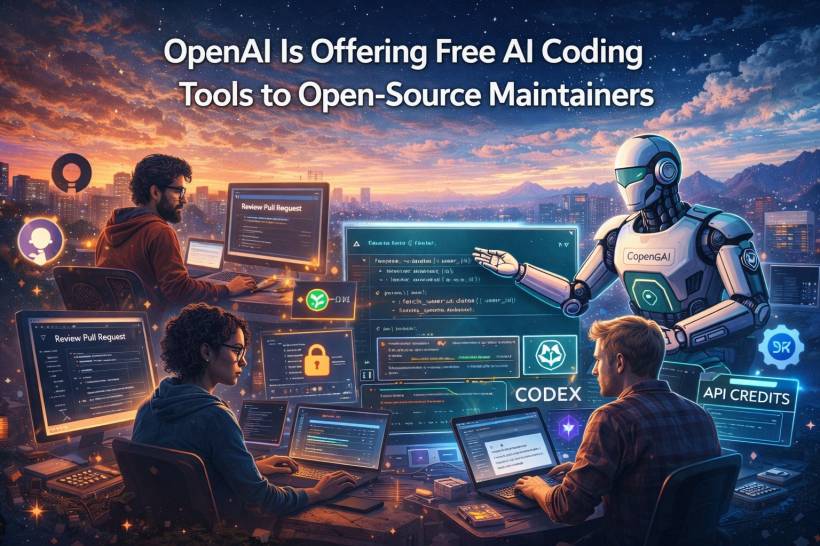
A lot of the software people use every day rests on open-source code maintained by small teams, and sometimes by just one or two people doing the work in their spare time. These maintainers are expected to review pull requests, sort through bug reports, keep releases moving, update documentation, and respond to security issues, often without the kind of resources that commercial software teams take for granted.
OpenAI is now stepping into that space with a program aimed directly at easing some of that burden.
Called Codex for Open Source, the initiative offers selected maintainers six months of free ChatGPT Pro access, API credits, and access to Codex-related tools designed to support real maintenance work. OpenAI says the program is meant for maintainers of critical public repositories and is focused on helping them reduce coding, review, and operational workload.
What the Program Actually Gives Maintainers
The offer is more than just a chatbot subscription. According to OpenAI's application page, selected maintainers receive six months of ChatGPT Pro, which includes Codex, along with API credits that can be used for coding, maintainer automation, release workflows, and other core open-source tasks. Some participants may also receive conditional access to Codex Security, depending on the repository and the maintainer's role.
That matters because maintainers are often overloaded by repetitive tasks rather than big glamorous engineering problems. Reviewing code, checking whether a contribution is actually useful, understanding unfamiliar parts of a large repository, and handling routine maintenance can consume huge amounts of time. OpenAI is clearly positioning Codex as something that can help with exactly those kinds of day-to-day responsibilities.
Why This Matters to Open-Source Communities
There is a bigger story behind this move. Open-source software is not some side corner of the tech world anymore. It is the infrastructure underneath modern development. Frameworks, libraries, utilities, tooling, deployment systems, and research stacks across the industry all depend heavily on code maintained in public repositories.
That includes the AI ecosystem itself. OpenAI has acknowledged that open source forms part of the foundation of modern systems, including its own, and says its support program is intended to help the contributors who keep that ecosystem running.
This is also where the conversation gets more interesting. AI companies benefit from a software world that was built in large part by open communities, and many developers have argued that those communities deserve more direct support in return. A program like this can be seen as one practical response: provide tools, compute, and workflow support to the maintainers whose projects the wider industry depends on.
The Timing Is Not Random
This initiative is arriving at a moment when many maintainers are dealing with a new kind of pressure: AI-generated contributions. Coding assistants have made it easier than ever for users to generate pull requests, patches, and repository activity at scale. That sounds useful in theory, but in practice it can create more review work, especially when submissions are low quality, repetitive, or disconnected from what the project actually needs.
OpenAI's messaging around Codex Security suggests it has heard that concern clearly. The company says maintainers repeatedly told it the problem is not a shortage of reports or suggestions, but an excess of low-quality ones and too much triage overhead. That feedback helped shape how OpenAI designed its support for open-source maintainers.
In other words, this is not just about helping maintainers write code faster. It is also about helping them filter noise, identify meaningful issues earlier, and avoid wasting time on work that should never have reached a human reviewer in the first place.
Security Is a Big Part of the Pitch
One of the more notable parts of the program is the possible inclusion of Codex Security, which OpenAI introduced in research preview. The company describes it as an AI application security agent that can analyze repository context, identify vulnerabilities, validate findings, and even propose fixes with better signal and less noise than many traditional tools.
That could be especially valuable for open-source maintainers, because security review is one of the most difficult and under-resourced parts of project maintenance. Vulnerability reports can be noisy, false positives are common, and smaller teams often do not have dedicated security staff. OpenAI says it has already been using Codex Security to scan important open-source repositories it depends on and share high-impact findings with maintainers. It also says some projects, including vLLM, have already used the tool in normal workflow to find and patch issues.
Of course, that does not mean AI replaces maintainers. Human maintainers still make the final call on what gets merged, what gets rejected, and what actually fits the intent of the project. But if these tools can reliably surface real issues while reducing low-value review work, they could meaningfully lighten the load.
This Is Also About Competition
There is another layer here, and it is hard to ignore. Developer workflow has become one of the hottest battlegrounds in AI right now. Coding agents are no longer limited to spitting out a function or fixing a syntax error. OpenAI's current developer documentation describes Codex as a software development agent that can help write, review, and debug code across interfaces including the IDE, CLI, web, mobile, and CI/CD pipelines.
That means open-source maintainers are not just being supported; they are also being courted. If OpenAI can get maintainers comfortable using Codex for triage, code review, security scanning, and release work, it strengthens Codex's role inside the broader software development lifecycle. In that sense, this program is both community support and strategic positioning.
And OpenAI is clearly serious about Codex as a platform. The company has continued expanding the product, releasing new Codex models and workflow features while pushing the tool more deeply into professional software development.
The Real Question Is Whether It Saves Time
That will be the real test. On paper, the idea is compelling. Give overworked maintainers tools that help them understand large repositories, review code more efficiently, automate repetitive tasks, and catch security problems earlier. That sounds like a very sensible use of AI.
But open-source maintainers are usually pragmatic people. They are unlikely to be impressed by marketing language alone. These tools will need to prove that they reduce workload instead of adding another layer of review, configuration, and cleanup.
If Codex for Open Source actually helps maintainers spend less time sorting through noise and more time making meaningful decisions, it could become a genuinely useful contribution to the ecosystem. If not, it risks becoming just another well-intentioned AI program that sounds better in a launch post than it feels in real project maintenance.
Final Thoughts
OpenAI's new support program shows that AI companies are beginning to engage more directly with the people who keep the software world running behind the scenes. That is a notable shift. Open-source maintainers have long carried enormous responsibility with limited support, and there is a strong case for giving them better tools.
Whether this turns into real relief will depend on how well Codex performs in messy, real-world repositories where context, judgment, and code quality matter more than flashy demos. Still, the direction is interesting. Instead of only targeting enterprise teams and paid engineering stacks, OpenAI is now making a visible play for the open-source communities that underpin much of modern software.











Comments 0