


A wave of social media posts has recently caused concern among Malaysians by suggesting that the National Registration Department, better known as JPN, had launched a nationwide operation against people whose MyKad still shows an old residential address.
Some versions of the claim went further, warning that affected cardholders could immediately face fines of up to RM20,000, imprisonment of up to three years or both. Unsurprisingly, the messages created confusion among people who had moved house but never updated the address printed on their identity card.
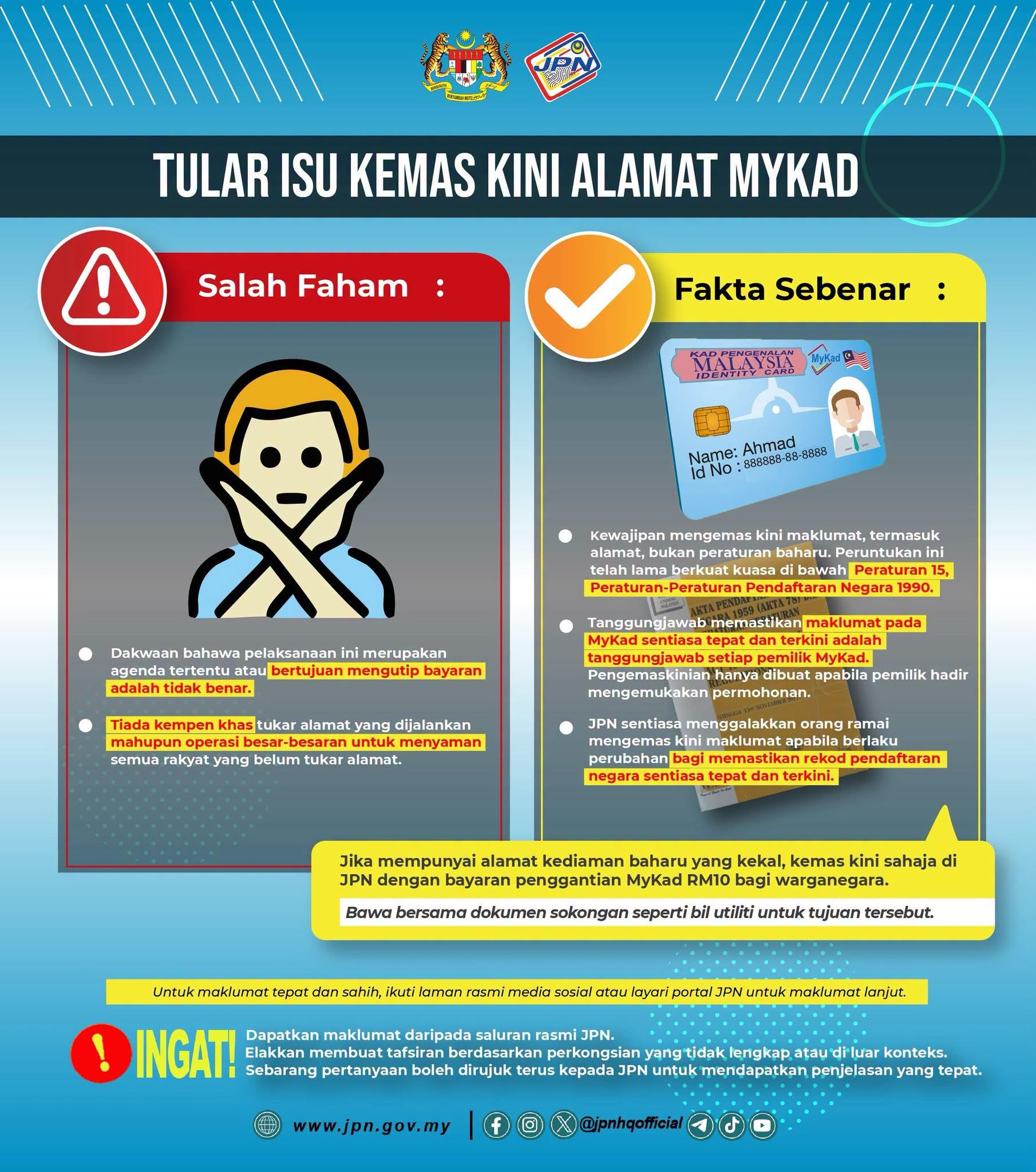
JPN has now stepped in to clarify the situation. The department says it is not conducting any special campaign, enforcement operation or nationwide crackdown requiring everyone to replace their MyKad immediately. It is also not presently taking broad enforcement action against people solely because their cards still carry an outdated address.
However, the clarification does not mean that residential addresses can simply be ignored. Malaysians are still responsible for keeping the information on their MyKad accurate, particularly after moving to a new permanent home.
No, JPN Is Not Forcing Everyone to Replace Their MyKad
The most important point is that there is currently no special address-update campaign being carried out by JPN.
According to the department, Malaysians are not being ordered to replace their identity cards as part of a new nationwide exercise. JPN also rejected claims that Regulation 15 of the National Registration Regulations 1990 was suddenly being used to collect replacement fees from the public.
This distinction matters because viral posts often present an old legal requirement as though it were a newly announced government policy.
Regulation 15 has existed for many years. What changed was not the law, but the attention it received after selected portions of the regulations began circulating online without sufficient explanation.
In other words, there is a difference between saying:
and saying:
The first statement reflects an existing responsibility. The second does not reflect JPN's current position.
What Regulation 15 Actually Requires
Regulation 15 of the National Registration Regulations 1990 applies when a person moves to another place of residence and intends to remain there for 90 days or longer.
In that situation, the cardholder is required to update the residential address associated with the identity card. Government guidance describes the address as a permanent residential address in Malaysia rather than a workplace, office, organisation address or post office box.
The regulation reportedly requires the address change to be made within 14 days after moving to the new residence. This requirement can apply whether the person owns the property, rents a home or stays at another permanent residential address for the relevant period.
A temporary hotel stay, brief work assignment or short visit would therefore be different from relocating to a place that has become the person's main residence.
The purpose is straightforward: the residential information held by JPN should reflect where the cardholder actually lives, rather than an address that may no longer have any connection to the individual.
Why Did the RM20,000 Fine Go Viral?
The widely circulated penalty was not completely invented, but it was presented without enough context.
Regulation 25 of the National Registration Regulations contains general offence and penalty provisions covering contraventions of the regulations. The maximum punishment cited in reports is a fine of up to RM20,000, imprisonment for up to three years, or both.
However, Regulation 25 is broader than the issue of outdated addresses alone.
The National Registration Regulations cover numerous obligations and offences involving identity documents. These can include giving false information, improperly using another person's identity card, possessing an identity card without lawful authority, forging or reproducing identification documents and failing to comply with requirements involving the surrender or production of a card.
This is why presenting the maximum general penalty as though it were an automatic fine imposed on every person with an old address can be misleading.
A maximum statutory penalty does not necessarily mean that every violation will receive that punishment. Actual enforcement and sentencing depend on the offence, evidence, surrounding circumstances, prosecutorial decisions and the court.
JPN's clarification is therefore not saying that Regulation 15 has no legal effect. It is saying that the public should not interpret the existence of the regulation as proof of a newly launched mass-enforcement campaign.
The Viral Claim Mixed Two Separate Issues Together
The confusion appears to have emerged because two technically related but separate facts were compressed into one alarming social media message.
The first fact is that Malaysians who relocate to a new permanent residence for at least 90 days have a responsibility to update their address.
The second fact is that the National Registration Regulations contain general penalties for contraventions.
When these two points are shared without explaining JPN's enforcement position, readers may reasonably assume that officers are actively searching for everyone who has failed to update their address.
JPN has made it clear that this is not currently happening. There is no special operation requiring all Malaysians to rush to a JPN office, and the government is not forcing every cardholder to obtain a new MyKad as part of a revenue-generating exercise.
Nevertheless, people whose MyKad genuinely shows a former permanent address should still consider updating it rather than waiting for a future situation where the discrepancy causes complications.
Why Keeping the Address Accurate Still Matters
A MyKad is not merely a piece of plastic displaying a name and identification number. It is connected to a person's official registration record and is used across many public and private services.
An outdated address may create inconsistencies when a person deals with government departments, financial institutions, employers, insurers or other organisations that require identity and address verification.
It can also become inconvenient when supporting information submitted for an application shows one address while the MyKad displays another. Although this does not automatically mean that the application will be rejected, the discrepancy may result in additional questions or a request for further documentation.
Keeping the address accurate can therefore reduce confusion and make identity verification more straightforward.
It is also useful to remember that the address printed on the card is visible to anyone who is shown the MyKad. Someone who has moved away from a former residence may not want that outdated location repeatedly used in official forms or copied into institutional records.
How to Update the Address on Your MyKad
A person who has moved to a new permanent residential address can apply for an address change at a JPN counter.
The applicant must attend a JPN office and bring the existing MyKad together with original supporting documents showing the new address. JPN states that the address must be a permanent residential location in Malaysia. Workplace addresses, business premises and post office boxes are not accepted as residential addresses.
Common forms of supporting evidence may include:
The replacement fee for Malaysian citizens is RM10, as a new card needs to be issued with the updated address printed on it.
Applicants should bring original documentation and ensure that the name, location and other details are sufficiently clear. Where the utility bill is not registered under the applicant's name, JPN may require other supporting evidence to establish the connection to the residence.
Requirements can vary depending on an individual's circumstances, so checking JPN's official address-change guidance before visiting the counter can prevent an unnecessary second trip.
What About Malaysians Who Frequently Move?
The issue may be less straightforward for students, renters, workers on temporary assignments or people who divide their time between several homes.
The key question is whether the new place has become the person's permanent or principal residence and whether the person expects to remain there for at least 90 days.
Someone staying temporarily in another state for a short project may not be in the same position as a person who has permanently relocated, signed a long-term tenancy and no longer lives at the address printed on the MyKad.
However, describing a residence as "temporary" does not necessarily make it temporary in practice. A person who has rented and lived in the same property for several years would find it difficult to argue that the address has no meaningful permanence simply because they do not own the home.
Where the circumstances are unclear, cardholders should seek confirmation directly from JPN rather than relying on interpretations circulated through social media.
Be Careful of Scams Following Viral Government Announcements
Viral concerns involving identity cards can also create opportunities for scammers.
Fraudsters may impersonate JPN officers and claim that a person is under investigation for failing to update a MyKad address. They may then request payment, personal details, photographs of the MyKad or a one-time password to supposedly "cancel the offence."
JPN's clarification means Malaysians should be especially suspicious of unsolicited calls or messages claiming that an immediate penalty must be paid because of the supposed address campaign.
Government departments do not require people to transfer money to personal bank accounts, reveal banking passwords or provide OTP codes through messaging applications.
Anyone receiving a suspicious message should avoid clicking links or sending copies of identity documents until the communication has been verified through an official government channel.
Social Media Posts Often Remove Important Legal Context
The incident is another example of how technically accurate information can still become misleading when shared without context.
A post may quote a genuine regulation and reproduce a real maximum penalty, yet still leave readers with the wrong impression about what the government is currently doing.
Headlines such as "Update Your MyKad Immediately or Face RM20,000 Fine" attract attention, but they fail to explain the difference between a longstanding legal obligation, a maximum penalty and an active enforcement operation.
JPN has advised the public to verify information through official sources instead of forming conclusions from incomplete screenshots, forwarded messages or edited extracts from the regulations.
The same approach should be taken with any viral claim involving fines, identity documents, government aid or new legal requirements: check the date, identify the original source and determine whether the announcement actually came from the relevant authority.
Final Thoughts
There is no need for Malaysians to panic over claims of an immediate nationwide MyKad address crackdown.
JPN has confirmed that it is not carrying out a special campaign or enforcement operation against everyone whose card still shows an old address. The department is also not forcing the entire population to replace their identity cards.
At the same time, the underlying responsibility remains real. Malaysians who move to a new permanent residence for 90 days or longer are expected to update their registered address under Regulation 15.
The sensible response is therefore neither panic nor complete dismissal. People whose MyKad already reflects their current permanent residence do not need to take action merely because of a viral post. Those who have genuinely relocated and still carry an outdated address should arrange an update through JPN when practical.
Most importantly, legal and government information should be read in its full context. A maximum penalty written in a regulation does not automatically mean that a nationwide crackdown has begun—and a viral message is not a substitute for an official announcement.











Comments 0