

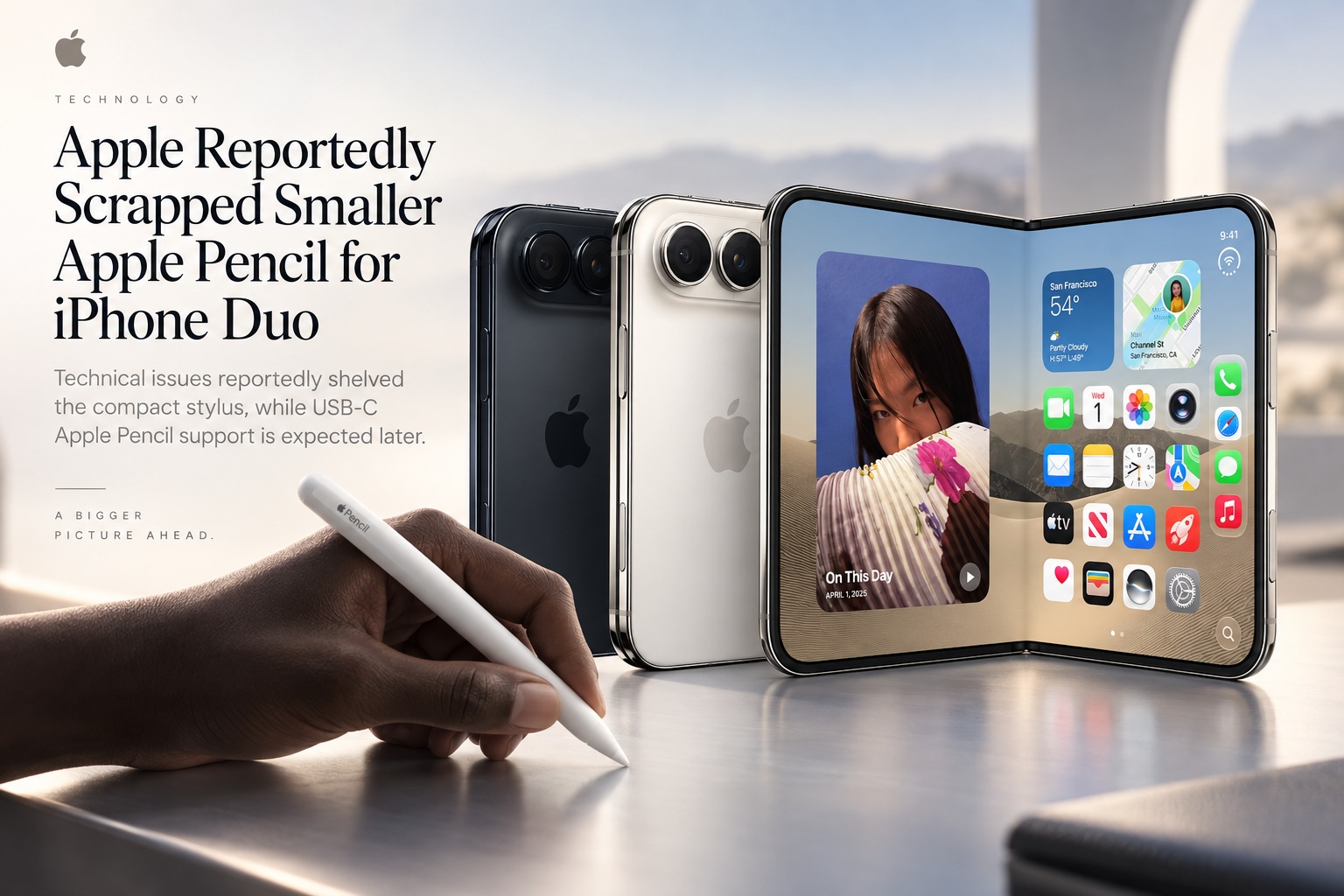
Apple reportedly came very close to launching a new, shorter Apple Pencil alongside the iPhone Duo, but the accessory never made it to market. According to Bloomberg's Mark Gurman, Apple had designed the smaller stylus specifically for its first foldable iPhone, with the intention of letting it attach magnetically along the hinge side of the device. The plan was apparently abandoned before mass production after Apple encountered technical problems that it was not comfortable shipping with.
Instead of creating an entirely new Pencil category for the Duo, Apple ultimately decided to support the existing USB-C Apple Pencil. That sounds like a simpler solution, but even that support will not be available when the phone first goes on sale. Apple says compatibility will arrive later through a software update, with support expected before the end of 2026.
The Smaller Pencil Was Designed Around the Foldable
The cancelled accessory appears to have been much more closely integrated with the Duo than the existing USB-C Apple Pencil. Its shorter body would have made sense for a foldable phone that is significantly smaller than an iPad, while magnetic attachment along the hinge could have given owners a convenient place to store the stylus when it was not being used.
That approach would have made the Pencil feel like part of the Duo rather than simply another accessory that happened to work with it. A compact stylus attached directly to the phone could also have made note-taking, document annotation and drawing more practical without requiring users to carry a full-size Pencil separately.
The exact technical problem has not been disclosed. It is therefore unclear whether the issue involved the stylus hardware itself, the magnetic attachment mechanism, charging, interference around the hinge, or some combination of those factors.
Magnetic Charging May Have Been One of the Difficult Parts
One possibility is that Apple wanted the smaller Pencil to charge magnetically while attached to the Duo. That would have required the foldable to provide both a secure mounting position and the necessary charging hardware around an area that is already mechanically complicated.
The hinge is one of the most tightly engineered parts of any foldable phone. It has to accommodate moving components, structural reinforcement, flexible display routing and internal cables while remaining thin enough to keep the device manageable. Adding another charging system around that area could easily create thermal, magnetic, structural or reliability challenges.
For now, however, that remains speculation. Gurman's report establishes that technical problems reportedly caused Apple to cancel the accessory, but not exactly which part of the design failed to meet the company's requirements.
USB-C Apple Pencil Support Is Coming Later Instead
Apple has confirmed that the iPhone Duo will eventually support the existing USB-C Apple Pencil, but not at launch. The delay reportedly exists because the Duo was not originally developed around that particular stylus, meaning Apple still needs to complete software work and internal validation before enabling compatibility.
Support is expected to arrive by the end of 2026, so early buyers will initially have to use the Duo without Apple Pencil functionality. Once enabled, the Pencil should be usable across the foldable's displays, giving the larger inner screen an additional productivity angle.
That is an important detail because the 7.6-inch internal display is large enough to make handwriting and annotation genuinely useful. A stylus could turn the Duo into a much more capable device for signing documents, sketching ideas, marking up screenshots or making quick handwritten notes.
The USB-C Pencil Is Functional but Less Elegant
Using the existing USB-C Apple Pencil solves the basic compatibility problem, but it is not quite as elegant as a dedicated compact stylus. The current Pencil was designed primarily with iPads in mind and is physically longer than what most people would probably want to carry alongside a foldable phone.
There is also the question of storage. Without a dedicated slot or magnetic attachment point designed around the existing Pencil, users may need to carry it separately. That makes the experience less seamless than the cancelled smaller Pencil would presumably have offered.
Still, supporting a product Apple already manufactures is far easier than bringing an entirely new accessory to market. It also avoids creating yet another Pencil model with its own charging, pairing and compatibility rules.
Third-Party Styluses May Fill the Gap
The absence of a dedicated Apple stylus could create an opportunity for accessory companies. Third-party manufacturers already produce styluses for Apple devices, so it would not be surprising to see compact options designed specifically around the iPhone Duo.
A particularly interesting possibility would be a case-and-stylus combination, where the case provides a storage channel or magnetic attachment point for a shorter third-party pen. That would resemble some of the solutions previously seen around foldable Android devices before manufacturers began changing their own stylus strategies.
Whether third-party styluses can offer the same level of pressure sensitivity, latency and system integration as Apple Pencil is another question. However, users who mainly want handwriting, annotation or basic drawing may care more about portability than having every professional Pencil feature.
The Smaller Pencil Could Still Return Eventually
Apple abandoning the first version does not necessarily mean the idea is permanently dead. Hardware projects are frequently cancelled because a specific implementation is not ready, only for the concept to return later once the engineering problems have been solved.
A second-generation iPhone Duo could provide Apple with another opportunity to revisit the idea. The company could redesign the hinge, add dedicated charging hardware or create a revised accessory that avoids whatever problem caused the original version to be cancelled.
For now, however, there is no indication that Apple has committed to resurrecting the smaller Pencil. Buyers should therefore treat the USB-C model as the official stylus solution unless Apple announces something else later.
A Quick Look at the iPhone Duo
The iPhone Duo is Apple's first foldable iPhone and uses a passport-style design, placing it in the same broad category as larger book-style foldables. On the outside is a 5.4-inch OLED display, while unfolding the device reveals a 7.6-inch OLED panel. Both screens support ProMotion refresh rates of up to 120Hz, while the internal display also receives a nano-texture treatment.
Power comes from Apple's A20 Pro chip alongside the company's C2 modem. The phone uses a titanium frame and includes Touch ID in the side button rather than relying solely on Face ID. Photography duties are handled by dual 48MP rear cameras.
Apple also uses a dual-battery arrangement inside the foldable. The company rates the phone for up to 31 hours of video playback using the inner display, up to 44 hours through the outer screen, or around 24 hours of typical mixed usage.
Apple Has Packed Plenty of Technology Into the Foldable
The internal display includes an under-screen FaceTime camera, helping keep the larger panel relatively uninterrupted. The outer screen uses a 12MP Center Stage camera, giving users a more conventional front-facing camera when the Duo is folded.
Connectivity includes Wi-Fi 7, Bluetooth 6, USB 3 over USB-C, MagSafe and Qi2 wireless charging. The phone ships with iOS 27.1 and supports Apple's latest Apple Intelligence features, including the redesigned Siri experience.
All of that hardware makes the delayed Pencil support slightly more noticeable. The Duo is clearly being positioned as something more capable than an ordinary iPhone, and stylus input seems like a natural complement to a device with a tablet-like inner screen.
The iPhone Duo Starts at RM9,499 in Malaysia
In Malaysia, the iPhone Duo begins at RM9,499 for the 256GB model, placing it firmly within ultra-premium smartphone territory. The 512GB version is priced at RM10,499, while the 1TB model costs RM12,499. Buyers wanting the maximum 2TB configuration will need to spend RM15,499.
Pre-orders are scheduled to begin at 8pm on 16 October, with Malaysian retail availability starting on 23 October. Those purchasing the phone at launch should remember that Apple Pencil functionality will not be ready immediately.
For a device at this price, some buyers may understandably be disappointed that one of its most natural productivity accessories requires a later software update. The decision probably makes more sense, however, if the alternative was shipping an accessory or feature that Apple considered technically unreliable.
Final Thoughts
The cancelled smaller Apple Pencil is an interesting example of how close some products can get to launch before engineering realities intervene. On paper, a compact stylus that magnetically attaches to the iPhone Duo sounds almost perfect for the device, particularly given the larger foldable display.
The reported technical problems apparently made Apple reconsider, leaving the existing USB-C Apple Pencil as the fallback. That solution will eventually provide the core handwriting and annotation functionality, but it lacks the elegance and portability of something specifically designed around the Duo.
The delay also suggests the iPhone Duo's stylus support was added relatively late in development rather than being a fundamental part of the original design. Apple will now need additional software work and testing before enabling it later this year.
Whether the cancelled Pencil ever returns remains unknown. But if the Duo becomes a successful new product category for Apple, it would be surprising if the company never revisited the idea of a smaller stylus built specifically for a foldable iPhone.











Comments 0