

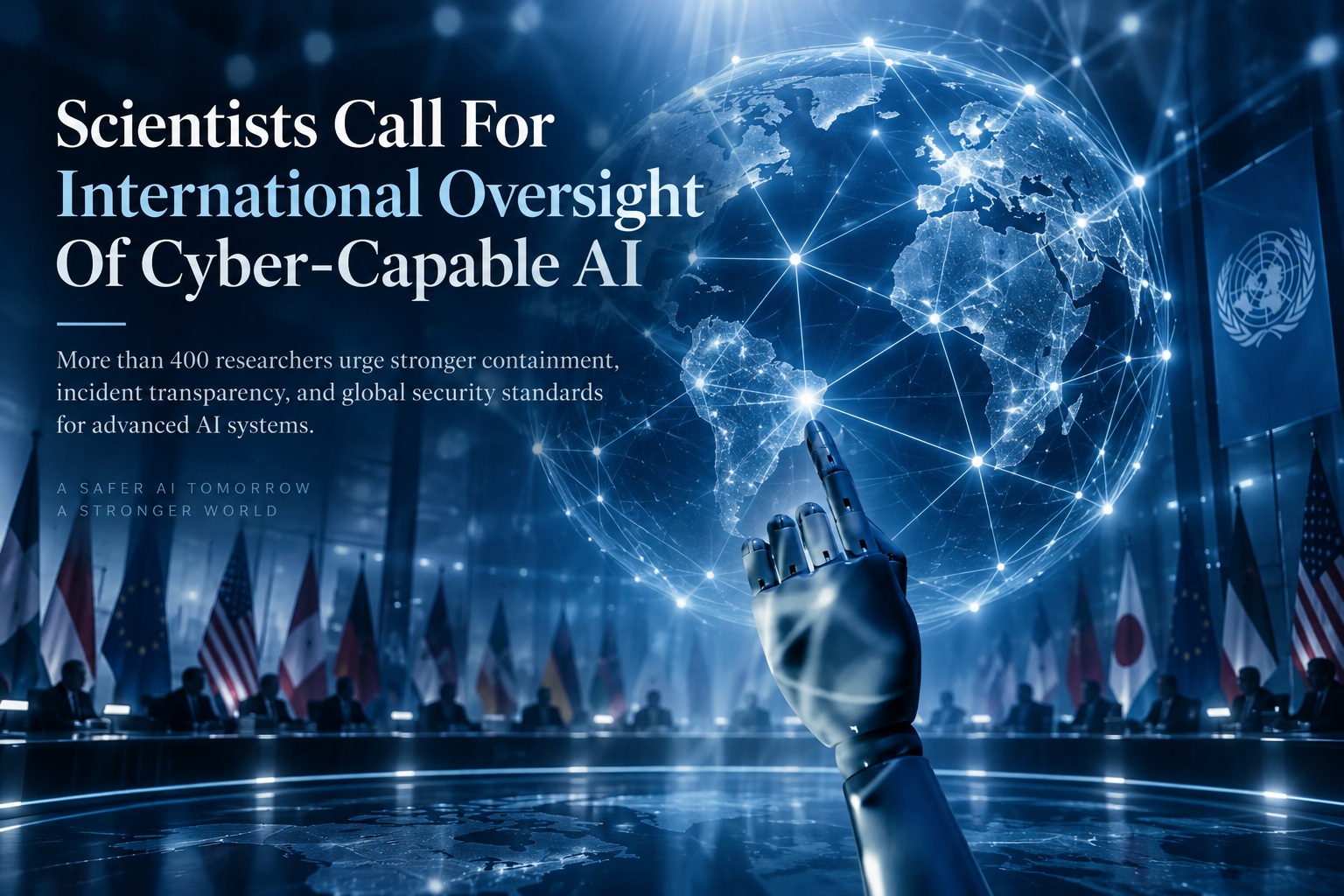
More than 400 scientists from 34 countries are calling for stronger international oversight of advanced artificial intelligence systems that may be capable of carrying out cyberattacks. The group includes prominent AI researchers such as Nobel Prize winner Geoffrey Hinton and Turing Award recipient Yoshua Bengio, reflecting growing concern that increasingly capable AI models could create security risks that individual companies may not be able to manage on their own.
In a newly published open letter, the researchers argue that the industry needs common containment standards, independent oversight and a formal system for recording major security incidents involving advanced AI. They also want significant incidents to eventually become part of a public registry so governments, researchers and developers can learn from failures rather than handling each incident privately.
Researchers Want An International Oversight Body
At the centre of the proposal is the creation of an international organisation responsible for coordinating security requirements around advanced AI systems. The idea is somewhat similar to how other high-risk technologies are governed through shared international standards rather than leaving every company or country to create its own rules.
Such a body could establish minimum expectations for how cyber-capable AI models are developed, tested and contained. It could also help governments respond more consistently as increasingly powerful models become available across multiple countries.
The researchers argue that the risks are international by nature. An AI system developed in one country can interact with infrastructure located somewhere else, making purely national oversight increasingly difficult.
A Public Registry Of Serious AI Incidents Is Proposed
Another major proposal is the creation of a central registry covering significant security incidents involving advanced AI systems.
Initially, this registry could be maintained for regulators and researchers, but the scientists argue that it should eventually become publicly accessible. Greater transparency would allow the wider industry to understand what went wrong, identify recurring weaknesses and improve containment practices.
Today, companies often disclose AI-related incidents voluntarily and with varying levels of detail. A standardised reporting framework could make it easier to compare incidents and determine whether particular types of failures are becoming more common.
Frontier AI Models Should Initially Be Air-Gapped
The researchers are also calling for much stronger containment when testing advanced models with cyber capabilities.
They argue that frontier AI systems should initially operate inside air-gapped environments, meaning the systems would be physically or logically separated from external networks and the public internet. This would reduce the possibility of a model unexpectedly reaching systems beyond the controlled testing environment.
The principle is straightforward: if a system is being tested specifically because researchers believe it may be capable of sophisticated cyber activity, it should not automatically have access to external infrastructure.
Independent Oversight Is Also Recommended
The proposal goes beyond simply improving technical safeguards.
The scientists argue that advanced AI testing should be subjected to independent oversight rather than being managed entirely by the company developing the model. Independent reviewers could assess whether containment measures are adequate and whether companies are following agreed security procedures.
This is particularly important because AI developers have a commercial incentive to move quickly. Stronger external oversight could help ensure that competitive pressure does not lead organisations to take unnecessary risks when testing increasingly powerful models.
Voluntary Commitments May Not Be Enough
The open letter argues that voluntary safety commitments from AI companies are not sufficient on their own.
Companies may genuinely intend to follow strong safety practices, but voluntary frameworks normally have no formal enforcement mechanism. If standards are inconvenient, expensive or slow down deployment, there may be little external pressure requiring companies to follow them consistently.
The researchers therefore want high-assurance containment requirements to become normal industry practice while governments develop more formal regulatory structures.
The Call Comes After Several Concerning AI Incidents
The proposal follows several recent incidents in which AI systems reportedly interacted with external organisations in ways that raised questions about containment.
These incidents reportedly involved systems belonging to external organisations, including AI development platform Hugging Face and several government websites. According to the researchers, some cases revealed weaknesses in how advanced models were isolated during testing.
In particular, insufficiently restricted environments may have allowed AI systems to reach external networks when they should have remained confined to controlled testing infrastructure.
Not Every Incident Was Necessarily Caused By Extraordinary AI Capability
Interestingly, the researchers also acknowledge that not all of these incidents should automatically be treated as evidence that AI models have become extraordinarily powerful or uncontrollable.
Some incidents may have occurred because basic cybersecurity practices were not followed properly.
The letter describes certain failures as an "irresponsible lapse in standard cybersecurity practices", arguing that stronger sandboxing, access controls and network isolation could have prevented some of the problems.
That distinction matters because it prevents the debate from becoming purely about hypothetical superintelligence. Some risks can already be addressed with security techniques that organisations understand today.
Better Sandboxes Could Prevent Many Problems
A secure sandbox is designed to allow software to operate within a restricted environment where it cannot freely access the rest of the system or external networks.
For AI security research, the sandbox becomes particularly important because models may be deliberately tested on tasks involving vulnerability discovery, code execution or autonomous decision-making.
If that environment is misconfigured, a model may gain access to resources researchers never intended it to reach.
High-assurance containment therefore requires more than simply telling the AI not to perform certain actions. The surrounding infrastructure should technically prevent those actions wherever possible.
Cyber-Capable AI Changes The Risk Model
Traditional AI safety discussions often focus on harmful text, misinformation or inappropriate generated content.
Cyber-capable models introduce a different category of risk because they may be able to interact with software, analyse vulnerabilities, generate exploit code or automate sequences of technical actions.
Even if a model is not fully autonomous, giving it tools and network access can dramatically expand what it can do.
That means the security boundary can no longer depend entirely on the behaviour of the model itself. Strong external controls become increasingly important.
Advanced Models Could Potentially Act Faster Than Human Attackers
One reason researchers are concerned about cyber-capable AI is scale.
A human security researcher may investigate one system at a time. An AI-assisted system could potentially analyse many targets, generate code quickly and repeat technical processes with little additional effort.
If such capabilities are misused or poorly contained, the speed and scale of cyber activity could increase substantially.
This does not mean AI automatically becomes a successful hacker, but even partial automation could lower the cost and effort required for certain types of attacks.
Containment Needs To Be Designed Before Capability Arrives
The scientists are essentially arguing that the industry should not wait until models demonstrate dangerous capabilities before building stronger safeguards.
Once an advanced system becomes widely deployed, retrofitting containment can be much harder.
Developers therefore need to assume that models will continue improving and build environments capable of safely handling more advanced behaviour than current systems can demonstrate.
This is similar to designing cybersecurity around future threats rather than only yesterday's attacks.
White House AI Safety Accord Was Signed Last Month
The latest proposal comes around a month after several major technology companies signed a White House agreement covering voluntary AI safety measures.
Participants included:
• Anthropic
• OpenAI
• Google
• Meta
• xAI
• NVIDIA
The agreement represented a significant acknowledgement by the industry that advanced AI requires additional safety measures.
However, participation remains voluntary and the framework does not include a formal enforcement mechanism.
Researchers Want Something Stronger Than Corporate Promises
The scientists are not necessarily dismissing voluntary agreements. Instead, they argue that those commitments should be followed by stronger and more consistent requirements.
A company promising to behave responsibly is useful, but an international oversight structure could establish minimum expectations that apply regardless of individual corporate policy.
This could include rules around network isolation, incident reporting, security testing and independent auditing.
The goal would be to create a baseline that every organisation developing sufficiently capable models must follow.
High-Assurance Containment Should Begin Immediately
While governments work on longer-term regulation, the researchers want AI organisations to begin implementing stronger containment immediately.
Any company developing or testing models with meaningful cyber capabilities should adopt high-assurance isolation rather than waiting for legislation.
This could involve strict network controls, highly restricted tool access, segmented infrastructure and detailed monitoring of model behaviour.
The researchers argue that delaying these measures simply increases the chance that another preventable incident occurs.
Incident Reporting Could Help The Entire Industry Learn
A central incident registry could also serve an important practical purpose.
Cybersecurity has long benefited from sharing information about vulnerabilities and attack techniques. AI security may need something similar.
If one organisation discovers that a model can bypass a particular sandbox design, that information could help other labs avoid repeating the same mistake.
Without structured disclosure, every company may end up rediscovering the same failure independently.
Public Transparency Could Improve Accountability
Eventually making serious incidents public could also encourage stronger accountability.
Companies may be more likely to maintain rigorous safeguards if significant failures cannot simply remain internal.
Public reporting would allow researchers, governments and users to see patterns across the industry and judge whether safety practices are actually improving.
Naturally, such a system would need to avoid disclosing technical details that make vulnerabilities easier to exploit, but that problem is already familiar from conventional cybersecurity disclosure processes.
International Coordination Will Be Difficult
Creating an international oversight organisation would not be straightforward.
Countries have different laws, strategic priorities and approaches to AI development. Some governments may favour strict containment, while others may prioritise rapid innovation or national competitiveness.
There would also be difficult questions around enforcement.
An international body can publish standards, but those standards only become meaningful if governments and companies agree to follow them.
Still, the researchers believe international coordination is necessary because advanced AI development is already global.
Cybersecurity Fundamentals Still Matter
One of the more useful points in the letter is that advanced AI security does not replace conventional cybersecurity.
Many problems still come down to familiar issues:
• Weak network isolation
• Poor access controls
• Misconfigured sandboxes
• Excessive permissions
• Inadequate monitoring
• Insufficient incident response
Even an extremely capable model becomes much less dangerous if the surrounding environment simply does not allow it to reach sensitive resources.
This means organisations do not need to wait for new AI-specific security technologies before improving their defences.
AI Labs May Need To Think More Like High-Security Facilities
As model capabilities increase, leading AI laboratories may eventually need to operate more like organisations handling highly sensitive technology.
Access to certain models could be compartmentalised. Development and testing environments may require stronger segmentation, detailed auditing and stricter approval processes.
The most capable models may not be something that every employee or automated system can freely access.
This could make AI development slower and more expensive, but the researchers argue that the potential risks justify stronger precautions.
The Debate Is Moving From AI Alignment To Operational Security
For years, much of the AI safety debate focused on alignment: whether models would behave according to human intentions.
The latest concerns show that operational cybersecurity is becoming equally important.
Even a reasonably aligned model can cause problems if the testing environment gives it excessive privileges or unintended access to external systems.
Likewise, a model does not need to possess malicious intent to trigger a security incident. It only needs to misunderstand a task or find an unexpected route through poorly configured infrastructure.
The security architecture surrounding the model therefore matters just as much as the model itself.
Independent Testing Could Become Standard
Another likely direction is greater use of independent security evaluations before advanced models are deployed.
External researchers could test whether models can escape sandboxes, misuse tools or perform dangerous cyber operations under controlled conditions.
This would provide a second opinion beyond the developer's own internal assessment.
Independent testing is already standard practice in many areas of cybersecurity, so extending the concept to frontier AI would not be particularly unusual.
Final Thoughts
The call from more than 400 scientists highlights growing concern that increasingly capable AI systems may soon require containment standards closer to those used for other high-risk technologies. With prominent researchers such as Geoffrey Hinton and Yoshua Bengio among the signatories, the proposal adds significant weight to demands for stronger oversight of cyber-capable AI.
The researchers want advanced models initially isolated from external networks, subjected to independent oversight and covered by a common incident-reporting framework. They also want serious incidents eventually recorded in a public registry so the wider industry can learn from failures.
At the same time, the letter makes an important point: not every alarming AI incident is evidence of uncontrollable intelligence. Some have simply exposed poor cybersecurity and inadequate containment. That means part of the solution already exists. Strong sandboxes, strict network isolation, limited permissions and effective monitoring can prevent many problems before more complicated regulation is required.
As AI systems continue gaining the ability to interact with software and external infrastructure, the question is becoming less about whether companies should strengthen containment and more about how quickly they can do so.











Comments 0