

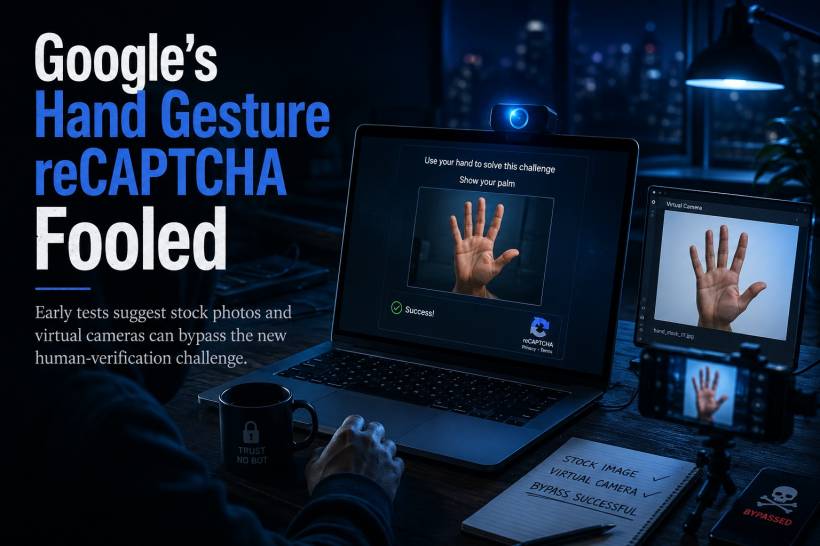
CAPTCHAs have been part of the internet for years. Whether it is ticking a box, selecting traffic lights in a grid of images or listening to distorted audio, the purpose has always been the same: prove that a real person is interacting with a website instead of an automated bot. As bots and AI systems become better at solving older CAPTCHA challenges, companies are experimenting with new verification methods. Google is reportedly testing one such idea for reCAPTCHA: a webcam-based "hand gesture verification" challenge.
The concept sounds more advanced than traditional image-selection tests. Users may be asked to allow camera access and perform a simple action, such as waving a hand, so the system can assess whether a real person is present.
However, early reports suggest the approach may already have weaknesses.
How Hand Gesture Verification Is Supposed to Work
Google's experimental verification method relies on a user's webcam to capture short video clips of their hand completing a requested gesture.
The system is designed to analyse hand landmarks, including detailed points around the fingers, knuckles and palm. In theory, this gives the verification model more information than a normal static image CAPTCHA. Instead of simply recognising an object, it can look for the movement and shape of a human hand.
This type of challenge is part of a wider effort to move beyond older CAPTCHA systems that are increasingly vulnerable to automated image-recognition tools.
A gesture-based check could potentially make it harder for basic bots to pass, particularly when the challenge requires a specific movement at a specific moment.
But the security of any verification system depends on whether it can reliably distinguish genuine activity from a convincing imitation.
Early Tests Show How a Still Image May Be Enough
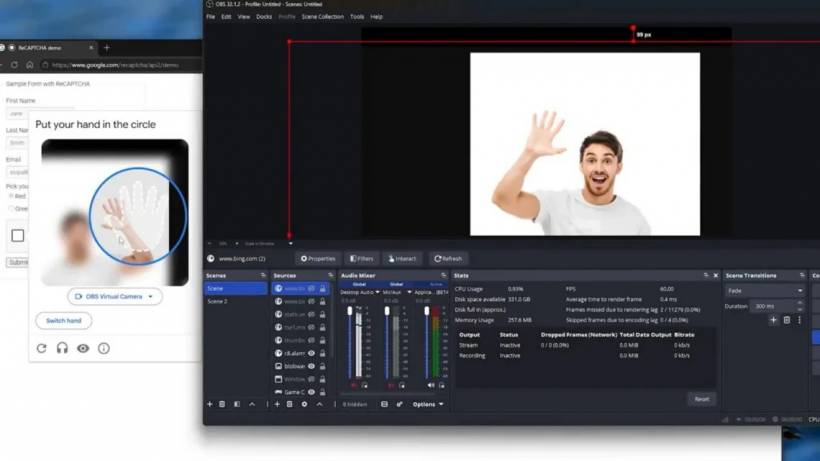
Researchers and early testers have reportedly found ways to bypass the hand gesture challenge using stock images and virtual camera software.
One method involves feeding a suitable hand image into a virtual webcam source through software such as OBS Studio. Instead of using a physical webcam, the browser sees the virtual camera feed as though it were a normal live camera.
That means a user may be able to present a stock photo of a hand to the verification system rather than performing the gesture in front of an actual camera.
The weakness is especially notable because it suggests the test may be relying too heavily on visual hand landmarks without reliably checking whether the source is a live, real-world camera feed.
If a static image can satisfy the model's checks, the intended benefit of asking users for a gesture becomes much less meaningful.
Why Automation Could Make the Problem Worse
The concern is not only that a person can manually bypass the test with a prepared image.
Once a challenge can be passed with a predictable image or virtual camera source, it may also become easier to automate. A script could potentially control a virtual camera feed, respond to the requested gesture and repeat the process at scale.
That is exactly the type of scenario CAPTCHA systems are intended to prevent.
Modern attackers do not necessarily need to break a verification system completely. They only need to make bypassing it cheap, repeatable and fast enough to support spam, fake account creation, scraping or other automated abuse.
This is why CAPTCHA design has become increasingly difficult. Every new layer of verification must balance resistance to automation with usability for ordinary people.
AI Is Making Traditional CAPTCHA Challenges Less Reliable
The rise of advanced AI has made CAPTCHA design more complicated across the industry.
Older challenges that asked users to identify cars, road signs, bicycles or other objects were once relatively effective against basic bots. But modern computer-vision models are increasingly capable of recognising the same images, sometimes with more consistency than human users.
Gesture verification is one attempt to introduce something that seems harder to fake: a real-time human action.
Yet real-time visual checks also create new attack paths. Virtual cameras, pre-recorded videos, deepfake tools and AI-generated imagery can all potentially be used to imitate live interactions.
The more sophisticated CAPTCHA systems become, the more sophisticated attackers become too.
It is an ongoing security race rather than a permanent solution.
The Privacy Trade-Off of Webcam-Based Verification
Even if gesture-based CAPTCHA technology becomes more resistant to stock images and virtual camera feeds, it may still face another challenge: user trust.
Many people are uncomfortable granting webcam access simply to open a webpage, submit a form or create an account.
Google has stated that the video clips used for this type of verification are intended only for verification purposes, that audio is not recorded, and that the clips are not tied directly to a user's identity. The company also says the recordings are deleted afterwards.
However, users generally have limited visibility into what happens behind the scenes once camera permission has been granted.
For privacy-conscious visitors, the issue may not be whether the verification system works technically. It may be whether the request feels proportionate to the task.
A user may accept camera access for a video meeting, telehealth appointment or identity verification process. They may be far less willing to allow it just to prove they are not a bot on a routine website visit.
Accessibility Must Also Remain Part of the Design
A system based on hand gestures may create difficulties for some users.
People with limited hand mobility, temporary injuries, visual impairments, older devices, inaccessible webcams or unreliable internet connections may find the challenge harder to complete. Public computers and workplace devices may also block camera permissions entirely.
This is why CAPTCHA providers need alternative methods rather than relying on a single verification path.
Google has indicated that it will continue offering visual and audio challenges while developing other verification options. That flexibility will be important if webcam-based checks become more widely used.
Final Thoughts
Google's hand gesture verification experiment shows how difficult it has become to separate humans from automated systems online.
The idea of using hand movements and webcam analysis may sound like a stronger alternative to traditional image CAPTCHAs. But early reports that stock photos and virtual cameras can bypass the test show that biometric-style verification is not automatically secure.
The real challenge is not just making CAPTCHA systems harder for bots to solve. It is doing so without creating unnecessary privacy concerns, accessibility barriers or frustrating extra steps for real users.
As AI continues to improve, the next generation of anti-bot systems will need to be smarter, more privacy-aware and far more difficult to imitate than a simple hand image on a virtual webcam.











Comments 0