

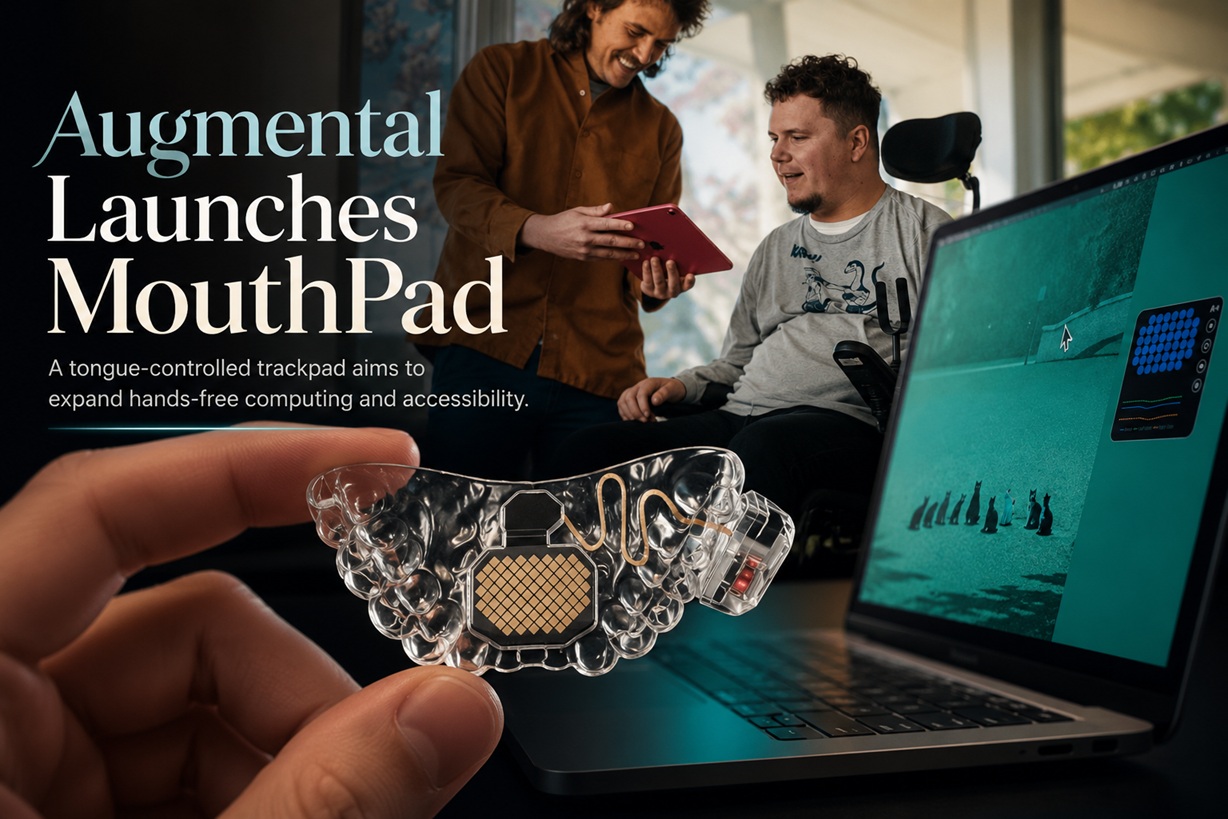
The computer mouse has changed shape many times over the years, moving from a rolling ball to optical sensors, touchpads, motion controllers and eye-tracking systems. Augmental, however, has taken the idea in an entirely different direction by placing the controller inside the user's mouth.
After several years of development, early-access testing and demonstrations, the US-based human-interface company has opened public sales of the MouthPad, a custom-fitted wireless controller operated using tongue, head and breath movements. Alongside it, Augmental has introduced VOX, a wearable microphone designed to act as a hands-free voice keyboard.
The MouthPad may look unusual, but its purpose is serious. It was primarily developed for people who cannot comfortably use a conventional mouse, keyboard or touchscreen because of limited hand or arm movement.
A Trackpad Worn Against the Roof of the Mouth
The MouthPad resembles a transparent dental retainer that fits over the upper teeth and sits against the palate. At its centre is a pressure-sensitive touch surface that responds to movements from the user's tongue.
Moving the tongue across the sensor can guide a cursor around the screen, while presses and holds can perform actions such as clicking, selecting and dragging. The device also supports scrolling, swiping and other gestures that would normally require a mouse, trackpad or touchscreen.
The concept takes advantage of the tongue's natural precision. Even people with significant mobility impairments may retain detailed control over tongue and head movements, making the mouth a potentially effective alternative input method.
Because the MouthPad functions like a standard wireless pointing device, it does not require software developers to redesign every application around it. Once connected, the computer or mobile device recognises it in much the same way as a Bluetooth mouse.
The User's Head Can Also Control the Cursor
Tongue input is only one part of the system.
The MouthPad includes head-tracking capabilities, allowing users to move the cursor by tilting or repositioning their head. This gives each person more flexibility in deciding which movements are comfortable and sustainable.
For example, someone may prefer to use head movement for wider cursor navigation and reserve tongue presses for clicking. Others may choose to control most functions using the tongue alone.
Augmental also supports breath-based commands. A small sipping gesture can be assigned to actions such as a right-click, while tongue presses can handle left-clicking or click-and-drag operations.
These controls can be adjusted through the MouthPad companion application. Users can change cursor speed, scrolling behaviour, touch sensitivity, click pressure and other settings. Once configured, the preferences are stored on the MouthPad itself, allowing it to retain the same behaviour when moved between compatible devices.
It Works Across Computers, Phones and Tablets
The MouthPad supports macOS, Windows, Linux, iOS and Android, covering most mainstream computers, smartphones and tablets.
It connects through standard Bluetooth and can be paired with several devices. A dedicated switching function allows the wearer to move between them without having to repeat the entire setup process each time.
This makes the MouthPad more than a specialised desktop accessory. A user could operate a computer for work, switch to a tablet for reading and then control a smartphone without relying on another person to handle the devices.
Beyond everyday navigation, Augmental says the controller can be used for activities such as gaming, creative work and applications that require more detailed pointer movement.
The company's website features users relying on the MouthPad for education, photography, communication, chess, employment and video games. The important point is not necessarily that tongue control is faster than every traditional mouse, but that it can provide independent access where a conventional mouse may not be practical.
Custom Manufacturing Is Necessary for Every User
Unlike a standard keyboard or mouse, the MouthPad cannot simply be removed from a box and used immediately.
Each unit must be manufactured to fit the individual wearer's mouth. After placing an order, the customer receives instructions to bring to a dentist or local dental-scanning provider. The provider performs a three-dimensional intraoral scan, similar to the process used when preparing certain retainers or dental appliances.
Augmental then uses the scan to produce a MouthPad shaped specifically for that customer. The completed device is 3D printed and encapsulated to make it suitable for regular use inside the mouth.
The dental scan is not included in the US$1,400 purchase price. Augmental estimates that providers generally charge between US$50 and US$150, depending on the clinic and location.
This customised process improves fit and stability, but it also introduces a significant waiting period. Augmental currently advises customers that their device will be manufactured and shipped within approximately six months after the necessary order and scan process has been completed.
Designed to Remain Discreet During Everyday Use
Since the MouthPad sits inside the mouth, one obvious question is whether the wearer can still speak normally.
Augmental says the device has been designed to have minimal impact on speech and can be worn while talking or using voice-recognition software. However, the company acknowledges that the experience will vary between individuals and that some users may require additional time to adjust.
The device itself is approximately 1mm thick, weighs around 10g and is manufactured using dental resin. Its relatively low profile allows most of the electronics and touch-sensitive components to remain hidden when the mouth is closed.
It is not intended to be worn while eating, sleeping or consuming hot drinks. Augmental advises users to remove it before sleeping and to clean it by hand using soap and water before and after use. It should also be dried before being returned to its charging case.
These maintenance requirements are reasonable for an intraoral device, but they also make the MouthPad more personal than most consumer electronics. It cannot be casually shared with another person, and proper cleaning becomes part of the normal operating routine.
Not Everyone Will Be Eligible to Use It
According to Augmental, the MouthPad is best suited to adults over 18 who have sufficient tongue movement, good oral health and no ongoing dental or orthodontic treatment.
The user must also be able to open their mouth sufficiently for the initial three-dimensional scan. People with braces, active orthodontic treatment or certain oral-health concerns may therefore need to wait or consult a dental professional before ordering.
The company also emphasises that the MouthPad is not a medical device. It is not marketed as diagnosing, treating or preventing any medical condition, even though many of its most important applications involve accessibility and independent device control.
That distinction matters because users should not assume that the product is automatically covered by medical insurance, disability funding or healthcare reimbursement programmes. Augmental currently states that the MouthPad is not covered by insurance, Flexible Spending Accounts or Health Savings Accounts in the US.
More Than Seven Hours of Continuous Operation
Battery performance is especially important for an accessibility device because losing control halfway through a work session could be far more disruptive than having an ordinary wireless mouse run out of power.
Augmental claims that the current MouthPad provides more than seven hours of continuous use and takes approximately one and a half hours to recharge. A charging case and cable are included with the device.
Seven hours should be sufficient for many daily sessions, although it may not cover an entire working day for users who depend on it continuously.
This appears to be one reason Augmental offers a two-unit package. A wearer can keep one MouthPad charged while using the other, then switch between them when necessary.
The Price Remains a Major Barrier
The MouthPad costs US$1,400 for one custom-built unit. Based on the conversion used in the original report, that is approximately RM5,700, before adding the dental scan and any related costs.
Augmental also offers two MouthPads for US$1,900, or roughly RM7,800 based on the same approximate conversion. The second device can serve as a backup or allow the user to continue working while the first unit is being recharged.
The two-unit package is significantly cheaper than purchasing two devices separately, but either option remains expensive for an ordinary input accessory.
It is more appropriate to compare the MouthPad with specialised accessibility equipment than with a standard Bluetooth mouse. Custom manufacturing, dental fitting, miniaturised electronics and low production volumes all contribute to the cost.
Even so, affordability could limit access among the people who may benefit most from it. A device intended to improve digital independence may still be out of reach for users without disability funding, institutional support or sufficient personal resources.
Augmental says proceeds from the first batch of its separate VOX beta programme will be used to fund MouthPads for people who need them.
Public Sales Are Currently Limited to the United States
The current launch applies only to customers in the United States.
Augmental says it can ship and accept returns only through US addresses because it is currently operating under US requirements. The company does not restrict the MouthPad from functioning outside the country once it has been purchased, but international customers cannot officially order it directly at this stage.
For Malaysian users, this means the MouthPad is not yet a straightforward retail purchase. Even if someone had access to a US delivery address, arranging the required dental scan, support, fitting process, warranty and return procedures could be complicated.
A meaningful Malaysian launch would likely require local dental-scanning partners, clearer support arrangements and a more accessible way to handle fitting or warranty problems.
VOX Is Designed to Become the Hands-Free Keyboard
While the MouthPad replaces the mouse, Augmental sees VOX as a possible replacement for the keyboard.
VOX is a small microphone pendant worn against the body. Inspired by the operating principle of a stethoscope, it captures sound through both the air and physical vibrations travelling through the wearer's body.
This design is intended to reduce interference from surrounding conversations and ambient noise. Augmental says users can dictate at much quieter volumes than they would with a conventional laptop or smartphone microphone.
That could make voice input more practical in shared environments. Speaking loudly to a voice assistant in an office, library or café can feel uncomfortable and may expose private information to nearby people. VOX is intended to let users speak softly or whisper while still producing usable text input.
The microphone does not continuously listen in the background. Voice capture begins only when the wearer deliberately presses its button or, when paired with the MouthPad, performs an assigned tongue gesture.
A Voice Interface Built With Accessibility in Mind
VOX is being developed for general voice-driven computing, but its accessibility applications are a major part of the concept.
Augmental says quieter and more reliable dictation could help people with limited lung capacity, speech differences or hand impairments. It could also give MouthPad users an efficient way to enter longer passages of text without relying entirely on an on-screen keyboard.
Together, the devices divide traditional computer interaction into two parts:
The MouthPad handles pointing, clicking, dragging and scrolling, while VOX handles text entry and spoken interaction with software or AI assistants.
VOX is currently in beta and costs US$200, or around RM800 based on the conversion used in the supplied report. Augmental expects beta units to ship in late 2026.
Unlike the MouthPad's broad operating-system support, VOX is initially focused on Apple's macOS and iOS ecosystem.
Augmental Calls the Combined Ecosystem "Skinware"
Augmental refers to its wider category of body-connected interfaces as Skinware.
The idea is to create technology that works through close physical contact with the user rather than relying on a conventional handheld controller, headset or visible wearable. In Augmental's vision, the MouthPad provides detailed movement input from inside the mouth, while VOX captures low-volume speech through the body.
This approach differs from smart glasses, AI pins and wrist-worn devices. Instead of placing another screen or camera in front of the wearer, Augmental is experimenting with signals that the body can generate naturally and discreetly.
The company is also exploring a longer-term concept involving silent speech. By combining acoustic information from VOX with patterns of tongue movement detected by the MouthPad, Augmental hopes that future systems could learn to interpret intended speech without requiring the user to produce audible words.
That remains a research ambition rather than a feature available in the products being sold today, but it provides a clearer picture of where the company believes human-computer interaction may eventually go.
Accessibility Technology Can Influence Mainstream Design
The MouthPad is a strong example of how products initially developed around disability access can introduce ideas that extend far beyond one user group.
Voice control, predictive text, screen readers, closed captions and touch interfaces have all become valuable to broader audiences after solving specific accessibility challenges.
A surgeon, mechanic or technician may need hands-free computer control while working. A designer may want an additional input method while manipulating a three-dimensional model. A gamer may experiment with tongue-based controls as part of a customised setup.
However, these secondary possibilities should not distract from the MouthPad's most meaningful contribution: allowing people with limited mobility to control their own devices more independently.
For someone who previously depended on a long mouth stylus, caregiver assistance or a fixed wheelchair-mounted controller, a discreet Bluetooth device may offer greater freedom in how and where they use a computer.
Several Practical Questions Remain
As impressive as the technology is, the MouthPad still faces challenges before it can reach a wider audience.
The price is high, production takes several months and the fitting process requires access to a compatible dental scanner. Long-term users must also manage cleaning, charging, oral comfort and possible changes to the shape of their teeth or mouth.
Support may become another important issue. A conventional mouse can be replaced almost immediately if it fails. A custom-made intraoral controller cannot.
The two-device bundle partly addresses that risk, but it also increases the initial cost. For users who depend on the MouthPad as their primary computer interface, reliable repairs and replacement options will be essential.
There are also personal comfort considerations. Augmental says many early users have worn the device for extended periods, but every mouth is different. Some people may adapt quickly, while others could require more practice or shorter sessions.
Final Thoughts
The MouthPad is one of those products that initially sounds futuristic or even slightly strange, but its purpose becomes much clearer once it is viewed through the needs of its users.
It turns movements that many people take for granted—sliding the tongue, tilting the head or taking a small sip—into precise computer commands. The result is a wireless controller capable of operating phones, tablets and computers without requiring the hands.
Its US$1,400 price, custom dental scan and six-month production period mean it is not yet an accessible option for everyone. International availability is also absent for now, making a Malaysian purchase particularly difficult.
Nevertheless, the public US launch marks an important step for a technology that has spent several years in development and limited testing. Together with VOX, Augmental is building an alternative computing system in which the mouth and body become practical input devices.
The MouthPad may not replace the conventional mouse for most people, but for users who cannot operate one, it could offer something far more valuable than novelty: greater control, privacy and independence.











Comments 0