

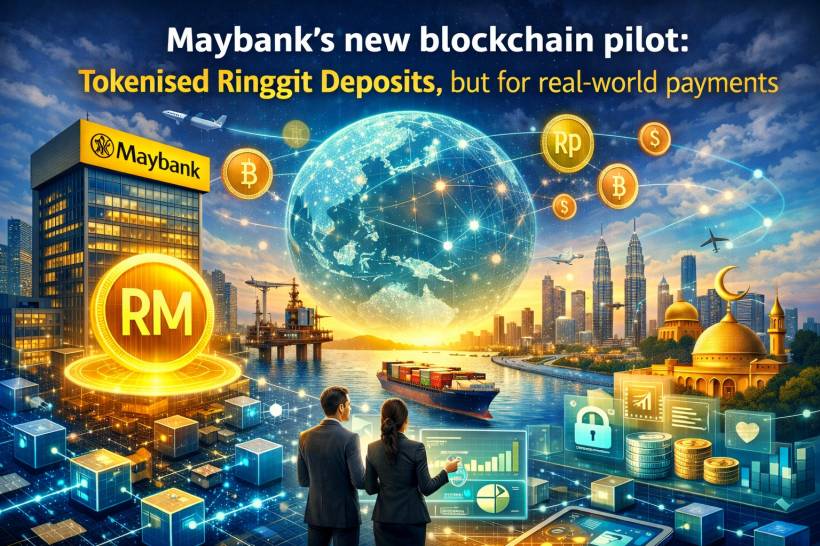
Maybank has kicked off a new pilot project that sounds very "future finance," but the goal is actually quite practical: make cross-border payments faster, safer, and more efficient for businesses that move money across multiple countries. The bank is testing ringgit tokenised deposits and cross-border payments using blockchain, as part of its ROAR30 roadmap into digital assets and modern payment infrastructure.
First up: what is a "tokenised deposit" anyway?
Think of a tokenised deposit as a normal bank deposit, but represented digitally "on-chain" (on a blockchain network). This isn't the same thing as public cryptocurrencies that anyone can trade anonymously. In this case, Maybank is using a permissioned blockchain, meaning only approved participants can access and transact on the network. The deposit still relates to real money held at the bank, just tracked and moved through a new digital rail.
What Maybank is actually testing in this pilot
In this pilot, Maybank is exploring whether it can use digital ringgit deposits on its permissioned blockchain to run cross-border payments that are secure and close to real-time. The project also looks at transactions involving the ringgit alongside other ASEAN deposit tokens, which hints at a future where banks in the region could exchange value across borders using compatible tokenised deposit systems.
Bank Negara's role: not "watching from the sidelines"
This is not Maybank doing a private experiment with no oversight. The pilot is being conducted under Bank Negara Malaysia's Digital Asset Innovation Hub (DAIH), which matters because cross-border payment systems touch regulation, security, fraud controls, and financial stability. A controlled hub or sandbox-style environment lets banks test the plumbing safely before anything scales up.
Why Yinson signed up as the first participant
Maybank's first participant is Yinson Holdings, an energy infrastructure group with operations across different jurisdictions. For companies like this, cross-border treasury work is rarely simple: settlement delays can lock up cash unnecessarily, currency swings can increase risk exposure, and transfer costs can stack up quickly.
Yinson's CEO highlighted a key benefit: if settlement can move closer to real time, the company can potentially manage working capital more tightly, reduce foreign exchange exposure, and lower transaction costs. In other words, this isn't "blockchain for blockchain's sake" — it's about fixing the boring-but-expensive parts of moving money internationally.
The bigger picture: this is about "next-gen money rails"
Maybank has been pretty clear that the pilot is meant to test whether these on-chain transactions can be executed securely and smoothly, while also helping build the foundation for future payment infrastructure. If it works, it sets up a blueprint for how tokenised deposits could plug into the region's payment networks over time.
Where Maybank wants to go next (beyond corporate payments)
The pilot is only the opening move. Maybank says tokenisation could expand into several areas:
SMEs and "programmable money"
For small and medium-sized businesses, Maybank is looking at the idea of programmable payment flows — basically, payments that can be automated based on agreed rules (for example, releasing payment when conditions are met). If implemented well, this could improve payment transparency and potentially help SMEs strengthen their financing access because their cashflow trail becomes clearer and more reliable.
Wealth management and tokenised investments (including Islamic finance)
Maybank is also exploring tokenised investment products, including Islamic finance assets like sukuk and funds. One commonly discussed advantage is fractional ownership, where smaller portions of an asset can be owned, making certain investment products more accessible to more investors (depending on product design and regulatory rules).
Why this matters for ASEAN (if it scales)
The regional angle is important. Maybank is positioning itself to use its ASEAN network as a gateway for tokenised ASEAN currencies and assets using blockchain-based solutions. If multiple banks and regulators across the region align on standards and interoperability, cross-border transfers could eventually become faster and more integrated — the kind of thing businesses notice immediately because it affects daily cash movement.
Final thoughts
Maybank's tokenised ringgit deposit pilot (announced February 11, 2026) is one of those finance stories that sounds futuristic, but the motivation is very down-to-earth: reduce delays, reduce friction, and make cross-border movement of money smoother for real companies.











Comments 0