

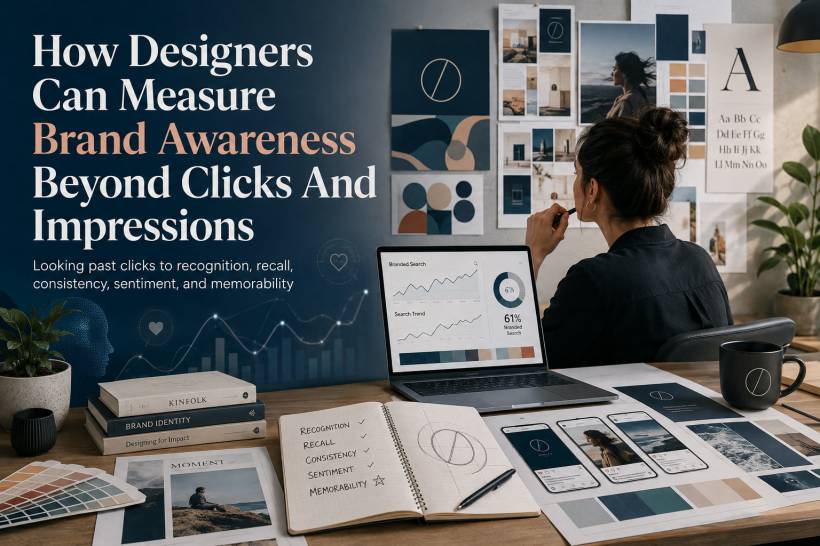
Designers are often judged by the things people can immediately see. A campaign looks cleaner. A landing page feels more polished. A social media asset gets approved faster. A brand system finally brings consistency across multiple channels. These are all visible signs of progress, and they matter.
However, when the conversation shifts to performance, the focus often becomes much narrower. Suddenly, everything is reduced to clicks, impressions, conversions, and other numbers that are easy to place inside a report. Those metrics are useful, but they do not always explain whether a brand is actually becoming more memorable.
Brand awareness is not always built at the moment someone clicks. Sometimes, it happens much earlier. A person might see a brand several times, remember its colours, recognise its tone, understand where it fits in the market, and feel more comfortable with it later. None of that may produce an immediate click, but it still has value.
Why Clicks Do Not Tell The Full Brand Story
Clicks are useful because they show immediate action. Impressions are useful because they show exposure. But brand awareness lives somewhere between those two things. It is about whether people remember the brand, understand what it represents, and can separate it from competitors when the time comes to make a decision.
A campaign can have low clicks and still improve recognition. A rebrand may not instantly increase sales, but it may make the company feel more trustworthy. A stronger visual identity may not show up immediately in revenue reports, but it can reduce confusion across customer touchpoints.
This is where designers need a wider way to measure impact. Creative work is not always instant. Brand design works through repetition, familiarity, consistency, and memory. It compounds over time. Because of that, judging design only by short-term performance metrics can make good brand work look weaker than it actually is.
Start By Measuring Recognition
One of the most practical ways to measure brand awareness is to test whether people can recognise the brand without being directly told what it is. This can be done by showing cropped visuals, colour palettes, partial logo marks, packaging details, ad layouts, motion styles, or small pieces of copy, then asking whether people know which brand they are seeing.
For designers, this is especially useful because it tests distinctiveness. A brand can look beautiful, modern, and professionally made, but if it looks like every other brand in the same industry, it may not be doing its job properly.
Strong brand design should create memory cues. A specific colour combination, shape, illustration style, tone of voice, layout structure, or animation style should help people connect the asset back to the brand. When that happens, design is no longer just decoration. It becomes a recognisable business asset.
Understand The Difference Between Recognition And Recall
Recognition and recall are related, but they are not the same. Recognition happens when someone sees a clue and realises which brand it belongs to. Recall is stronger because it happens when someone thinks of the brand without being shown anything first.
This matters because customers do not always act immediately after seeing a campaign. They may see an ad today, ignore it, then remember the brand weeks later when they need a product or service. They may ask a friend for recommendations, search within a category, or compare options long after the first brand exposure.
If the brand comes to mind during that later moment, the design work has created commercial value even if the original impression did not become a click.
Designers can track recall through prompted and unprompted surveys, brand lift studies, branded search growth, direct website traffic, social mentions, and customer interviews. These signals help show whether the brand is becoming more visible, more familiar, and more likely to enter the customer's mind when it matters.
Review Consistency Across Every Touchpoint
A brand becomes harder to remember when it feels different everywhere. If the website, ads, sales deck, email design, product interface, packaging, and social content all look unrelated, customers have to work harder to connect the dots.
This is why brand consistency should be measured as part of awareness. Designers can conduct a brand consistency audit across major channels. The audit should review visual identity, typography, colour use, imagery, tone of voice, layout structure, icons, motion, and message hierarchy.
The goal is not to make every asset look exactly the same. That would make the brand feel repetitive and boring. The goal is to make every asset feel recognisably connected.
Internal consistency matters too. A brand system only works when marketing teams, sales teams, product teams, and external partners know how to apply it properly. A well-designed brand is not only attractive. It is also easy to use correctly.
Measure Sentiment, Not Just Visibility
Being known is not always enough. People may recognise a brand, but still associate it with confusion, poor quality, high prices, or irrelevance. That is why awareness should be measured together with sentiment.
Designers should pay attention to how people describe the brand. Social listening, review analysis, customer interviews, community feedback, and support conversations can all reveal useful patterns. Are people using the words the brand wants to be known for? Do they describe it as premium, simple, reliable, playful, innovative, expert, or approachable?
These impressions are shaped by design. Before a customer reads the full product description, they have already reacted to the colours, typography, photography, spacing, interface details, animation style, and overall presentation.
Design influences feeling before it influences action. That makes sentiment a valuable signal for understanding whether the brand is being perceived in the right way.
Use Search And Direct Traffic As Awareness Signals
As awareness grows, people often begin searching for a brand by name. They may type the URL directly, search for branded phrases, return to the website later, or look up the company after seeing it elsewhere.
These are not purely design metrics, but designers should still care about them. A memorable campaign, a strong visual identity, or a clear brand promise can increase branded search over time. If more people are looking for the company without clicking directly from an ad, that may suggest the brand is becoming more memorable.
There is also the issue of dark social. Someone might see a campaign on LinkedIn, talk about it privately in a chat group, and visit the website days later. The analytics may not connect that visit back to the original design exposure, but the broader pattern can still show that awareness is growing.
This is why brand measurement should not rely only on clean click paths. Real customer behaviour is rarely that neat.
Turn Measurement Into Better Creative Decisions
Measuring brand awareness is not about forcing creativity into a spreadsheet. It is about helping designers understand what people remember, what they ignore, and what feels unclear.
If people recognise the logo but cannot explain what the company offers, the message may need work. If impressions are high but recall is low, the creative direction may not be distinctive enough. If sentiment is improving but conversions are still slow, the brand may be building trust before demand catches up.
Good measurement should support better creative decisions, not limit them. Designers should use it as feedback. It helps show which parts of the brand system are working, which assets are memorable, and where the brand is losing clarity.
Final Thoughts
Clicks and impressions are still important, but they only show part of the picture. They tell us whether people were exposed to something or whether they took immediate action. They do not fully show whether the brand is becoming easier to recognise, easier to remember, or easier to trust.
For designers, brand awareness should be measured through a wider lens. Recognition, recall, consistency, sentiment, branded search, direct traffic, and customer perception all help reveal whether creative work is doing its job.
The real value of brand design is not always instant. Sometimes, its biggest contribution is making a company more noticeable, more memorable, and more likely to be chosen when the customer is finally ready.











Comments 0