

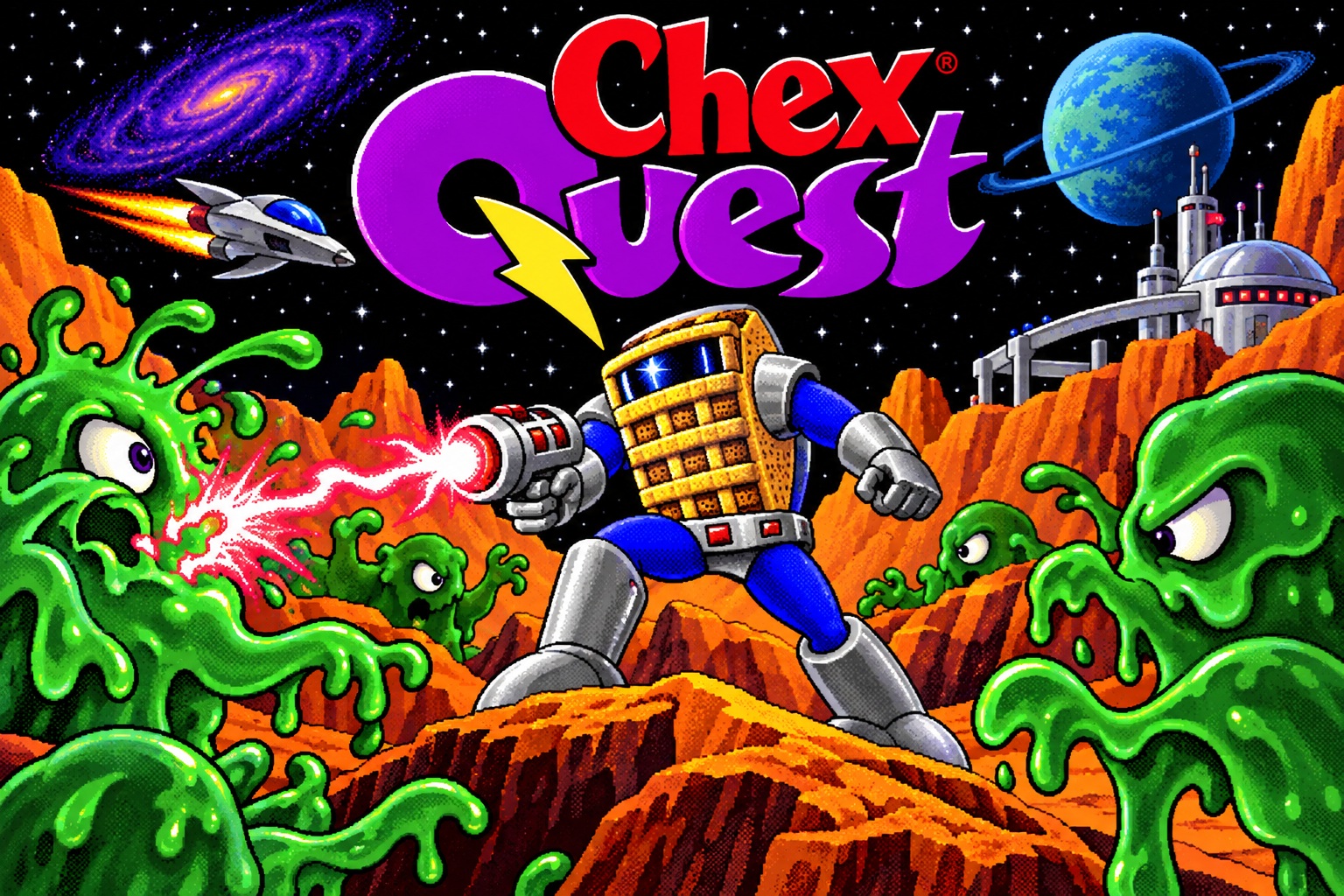
Chex Quest is one of the most unusual first-person shooters of the 1990s, created as a promotional game for Chex cereal but built with enough care and personality to become a cult classic in its own right. Released in 1996, the game uses modified DOOM technology to deliver fast movement, maze-like levels, key-based exploration, secret areas, weapon progression, and enemy encounters, but replaces the violence and horror with a colorful science-fiction adventure. Instead of demons, players fight slime-covered creatures called Flemoids, and instead of killing them, the Chex Warrior uses Zorchers to send the creatures back to their own dimension. The result is a surprisingly effective family-friendly reinterpretation of the classic FPS formula.
What makes Chex Quest so memorable is that it never feels like a completely disposable advertisement. The developers clearly understood what made DOOM-style gameplay satisfying, so the game preserves the speed, exploration, resource management, hidden rooms, and weapon progression that define the genre. At the same time, almost every element has been reworked around the cereal-themed science-fiction setting, creating something that feels both familiar and wonderfully strange. Its short campaign also gives the experience a focused pace that makes it easy to replay.
Now playable online through Lemon Web Games, Chex Quest can be experienced directly in your web browser as part of a growing collection of classic, retro, first-person shooter, science-fiction, family-friendly, and browser-playable games. Its browser-based format makes it easy to revisit the Chex Warrior's battle against the Flemoids while preserving the fast movement, secret hunting, key collection, Zorcher weapons, and maze-like level design that make the original game so enjoyable. Whether you remember discovering the game through a cereal box decades ago or are encountering it for the first time, Chex Quest remains one of the most charmingly unusual shooters from the classic PC era.
A First-Person Shooter Hidden Inside a Cereal Promotion
Chex Quest became famous partly because of the way it was distributed. Instead of appearing first on store shelves as a conventional commercial release, the game was included as a promotional CD-ROM with boxes of Chex cereal. That unusual distribution placed a genuine first-person shooter into the homes of families who might never have purchased a traditional PC action game. For many younger players, it became an unexpected introduction to the mechanics of classic FPS games.
The concept could easily have produced something forgettable, but Chex Quest went much further than a simple advertising gimmick. The levels, enemies, weapons, interface, and story were all redesigned to create a coherent experience around the Chex brand. The game still obviously promotes cereal, but the promotion is wrapped around real gameplay rather than replacing it. That is a major reason people still remember it today.
The Chex Warrior Becomes an Unlikely Hero
Players control the Chex Warrior, an armored hero sent to deal with an invasion of strange slime-covered creatures known as Flemoids. The character looks appropriately ridiculous in a way that perfectly matches the tone of the game, combining science-fiction armor with a cereal-piece head. Despite the joke, the Chex Warrior functions like any classic FPS protagonist, moving quickly through dangerous facilities and searching for weapons, keys, and exits. The contrast between serious shooter mechanics and the absurd hero is part of the charm.
The game never takes itself too seriously, but it still gives the player a clear objective. The Flemoids have invaded and must be removed before they cause further trouble, so the Chex Warrior travels through several increasingly hostile locations to stop them. The story is simple enough to stay out of the way of the action. Like many shooters of the era, the real focus remains on exploration and combat.
Flemoids Replace Demons
Instead of fighting demons or soldiers, Chex Quest fills its levels with Flemoids. These green, slime-covered creatures come in several different forms, each filling a familiar combat role while remaining appropriate for the lighter tone. Some approach the player directly, while stronger variants can attack from a distance or survive significantly more damage. Their exaggerated designs make them easy to recognize during combat.
The Flemoids help preserve the tactical clarity of classic shooters. Players can quickly learn which creatures are relatively harmless and which should be prioritized immediately. Stronger enemies can become dangerous when combined with weaker ones in narrow corridors or crowded rooms. The game may look cheerful, but the combat still requires awareness once several Flemoids appear at the same time.
Zorching Replaces Killing
One of Chex Quest's defining ideas is that the Chex Warrior does not technically kill enemies. Zorcher weapons are designed to send Flemoids back to their own dimension, allowing the game to maintain the mechanics of an FPS while avoiding graphic violence. When enough energy hits a creature, it disappears in a colorful burst rather than leaving behind a corpse. This small change completely alters the tone without changing the basic shooting mechanics.
The concept works remarkably well because players still receive immediate feedback when an enemy is defeated. Weapons fire quickly, enemies react clearly, and stronger Zorchers feel noticeably more powerful. The mechanics therefore remain satisfying even though the presentation has been softened. Chex Quest demonstrates that classic FPS combat does not necessarily require gore to remain engaging.
The Mini Zorcher Starts the Adventure
The Mini Zorcher serves as the basic ranged weapon and gives players a reliable way to handle early Flemoids. It is useful against weaker enemies but quickly begins to feel underpowered once stronger creatures appear. This naturally encourages exploration because discovering better weapons dramatically improves the player's ability to survive. Finding an upgraded Zorcher early can make a difficult section much easier.
The weapon also remains useful when conserving stronger ammunition. Chex Quest retains the classic shooter idea that every weapon can have value depending on available resources. Using a powerful weapon against every weak enemy can leave the player underprepared later. Efficient players quickly learn when the Mini Zorcher is enough.
The Large Zorcher Feels Like a Major Upgrade
The Large Zorcher provides significantly stronger firepower and becomes one of the most useful weapons for general combat. Its heavier shots can deal with stronger Flemoids more efficiently while still being practical enough for regular use. The weapon feels satisfying because it clearly communicates increased power without becoming difficult to control. It fills the role of a dependable mid-level weapon throughout the campaign.
Players often begin feeling much more confident once the Large Zorcher is available. Rooms that seemed dangerous with the starting weapon become much easier to manage, and stronger enemies no longer consume as much time or ammunition. The progression feels familiar to anyone who enjoys classic shooters. Better weapons create a noticeable sense of growing power.
Rapid-Fire Zorching Keeps Crowds Under Control
Chex Quest also includes faster weapons designed to deal with groups more efficiently. Sustained fire becomes especially useful when several Flemoids approach from different directions or when weaker creatures need to be cleared quickly. Rapid attacks can prevent enemies from closing the distance and give the player more room to move. This becomes increasingly valuable in cramped areas.
As always, ammunition remains part of the strategy. Holding the attack continuously may solve the immediate problem but consume resources that could be needed later. Chex Quest may be family-friendly, but it still expects players to think about efficiency. That continuity with classic FPS design gives the combat surprising depth for such a short promotional game.
The Phasing Zorcher Brings Heavy Firepower
More powerful Zorchers give the player the ability to deal with tougher Flemoids and crowded rooms much more quickly. These weapons consume more valuable ammunition but can dramatically reduce the danger of a difficult encounter. Saving stronger attacks for high-health enemies becomes an important habit. The player is constantly balancing immediate convenience against future resource needs.
This weapon progression mirrors the structure of many classic shooters without feeling completely copied. The cereal-themed naming and science-fiction presentation give each weapon its own identity within the world. Players still understand instinctively which weapons are stronger, but the game keeps the terminology playful. That balance between familiarity and novelty helps the arsenal remain memorable.
Keycards Still Structure Exploration
Chex Quest uses colored keys to control access through many areas, preserving one of the most recognizable mechanics of classic FPS level design. Players may encounter locked doors long before finding the correct key, forcing them to explore alternate routes first. This encourages memory and spatial awareness rather than simply following a straight path. Returning later with the required key often opens an entirely new section of the map.
The key system works especially well in the game's compact levels. Players rarely become completely lost, but the environment still provides enough branching paths to reward exploration. Locked doors become landmarks that help players understand the layout. This gives each map a clear structure without relying on modern objective markers.
Secret Areas Reward Curiosity
Hidden rooms and secret passages are scattered throughout the levels, rewarding players who examine unusual walls, suspicious corners, and environmental details. These secrets can contain additional ammunition, health, or useful equipment that makes later encounters easier. Discovering them also creates the satisfying feeling of finding something the level was deliberately trying to hide. Even a short campaign gains additional replay value through secret hunting.
Players who return to familiar maps can search more carefully for areas they missed during the first playthrough. Knowing where extra resources are hidden makes later runs faster and smoother. This encourages mastery without requiring complicated progression systems. Knowledge itself becomes the upgrade.
The Automap Helps With Navigation
Like many shooters built around classic DOOM-style technology, Chex Quest includes an automap that helps players understand explored areas. It becomes useful when several corridors or locked doors connect through the same level. Checking the map can reveal which routes have already been visited and where unexplored sections may remain. This reduces unnecessary backtracking while still leaving the player responsible for understanding the environment.
The automap can also support secret hunting. Suspicious empty spaces or unexplored sections may suggest that a hidden room exists nearby. Players who enjoy complete exploration can use these clues to investigate more carefully. The feature may be simple, but it remains extremely useful.
Fast Movement Keeps the Game Energetic
Chex Quest retains the fast movement associated with classic DOOM-style shooters. The Chex Warrior can move quickly through corridors, dodge enemy attacks, and reposition during fights without waiting for lengthy animations. This makes combat feel responsive and energetic even though the presentation is much more playful. Standing still for too long can still be dangerous when several Flemoids are attacking.
The speed also gives the game excellent replayability. Once players know a level well, they can move through it much faster, clearing enemies and collecting keys with confidence. Familiarity turns cautious exploration into smooth and efficient runs. The short campaign becomes especially enjoyable when approached this way.
Health Is Reimagined Through Food
Chex Quest replaces traditional medical supplies with food-themed health items that fit the cereal-inspired world. Instead of breaking the tone with realistic military equipment, recovery items reinforce the playful setting. Players still need to manage health carefully because taking unnecessary damage can make later encounters much harder. The mechanics remain familiar even though the presentation changes.
This is another example of the game's surprisingly consistent design. Nearly every major element has been adapted to fit the theme rather than simply retaining its original appearance. Health, weapons, enemies, and objectives all feel like parts of the same strange universe. The attention to detail helps the promotion feel more like a real game.
The Game Is Family-Friendly Without Feeling Empty
Chex Quest was specifically designed to be more appropriate for younger players than the violent shooters that inspired it. There is no gore, no demonic imagery, and no realistic killing, yet the game still preserves the movement, exploration, resource management, and combat loops that make the genre enjoyable. The result is lighter without becoming mechanically meaningless. That balance is one of the game's greatest achievements.
Younger players could enjoy the colorful presentation while still learning many of the same skills required by traditional first-person shooters. Navigation, ammunition management, target priority, and secret hunting all remain important. The game therefore works both as entertainment and as an introduction to the genre. Its family-friendly design never feels like an excuse for poor gameplay.
The Level Design Is Surprisingly Strong
For a promotional game, Chex Quest contains carefully constructed environments that make good use of corridors, rooms, keys, switches, and enemy placement. The maps are relatively compact, but they provide enough branching paths to encourage exploration. Different areas have recognizable visual identities, helping players remember where they have already been. The environments rarely feel completely random.
The level design also supports the game's short format. Players can complete a map without investing enormous amounts of time, but searching for secrets can extend the experience significantly. This makes the campaign approachable for beginners while still giving experienced players something to explore. The pacing remains one of the game's strongest qualities.
Five Main Levels Keep the Campaign Focused
The original Chex Quest campaign is relatively short, consisting of five main levels. Instead of feeling incomplete, the compact structure gives the game a focused and replayable quality. Each level introduces new environments and increasingly dangerous Flemoid combinations without stretching the concept too far. Players can complete the entire journey much more quickly than a full-length commercial shooter.
The short campaign also makes repeat play especially attractive. Returning to search for secrets, improve completion times, or experiment with different weapons requires relatively little commitment. Players can easily finish one level during a short session or replay the full campaign over a longer period. The experience remains satisfying precisely because it does not overstay its welcome.
The Difficulty Gradually Increases
Early levels introduce the controls and basic enemy types without overwhelming the player. Later areas introduce stronger Flemoids and more complicated layouts, forcing better weapon choices and faster reactions. The increase in difficulty is noticeable but remains approachable. This makes the game particularly suitable for players who may not have much experience with classic FPS mechanics.
Experienced players can still find enjoyment by moving quickly and trying to complete levels efficiently. The challenge may be lighter than more aggressive shooters, but the fundamentals remain strong enough to support skillful play. This broad accessibility helped Chex Quest reach a much wider audience than a conventional hardcore shooter. It is easy to understand but still rewarding to master.
The Humor Gives the Game Lasting Personality
Chex Quest never hides the fact that it is fundamentally a cereal-themed adventure. The hero has a Chex-shaped head, enemies are made of slime, weapons have ridiculous Zorcher names, and the entire premise sounds like something created as a joke. Instead of resisting that absurdity, the game embraces it completely. This confidence gives the experience far more personality than a generic promotional title would have.
The humor also helps explain why people still remember the game decades later. Many promotional games disappear because they feel like advertisements with gameplay attached, but Chex Quest became memorable because the concept itself is so strange and enjoyable. The game does not merely advertise cereal; it creates an entire science-fiction conflict around it. That commitment makes the joke work.
Its DOOM Heritage Is Easy to Recognize
Players familiar with classic DOOM will immediately recognize the movement style, map structure, weapon progression, hidden areas, and general flow of combat. Chex Quest uses that familiar foundation deliberately, which is one reason the game feels surprisingly polished. The mechanics had already proven themselves capable of supporting fast and satisfying first-person action. The developers then transformed the presentation around a completely different audience.
This recognizable foundation also makes Chex Quest historically interesting. It demonstrates how flexible early FPS technology could be when given a radically different theme. The same basic structure that supported horror and demonic violence could also support a bright cereal-themed science-fiction adventure. The result shows that strong mechanics can survive major changes in tone.
A Promotional Game Became a Cult Classic
Very few games created primarily for advertising develop a genuine long-term fanbase, but Chex Quest managed to do exactly that. Players remembered the strange premise, distinctive enemies, family-friendly action, and surprisingly good level design long after the original cereal promotion ended. The game gradually became a nostalgic favorite among people who discovered it during childhood. Its reputation eventually grew far beyond its original purpose.
Part of that appeal comes from the unexpected quality. Nobody expects a free cereal-box game to become a memorable FPS, which makes discovering that it is genuinely fun even more surprising. Chex Quest effectively became famous for exceeding expectations. The story surrounding the game is almost as entertaining as the game itself.
The Chex Warrior Became an Icon of Retro Gaming Oddities
The Chex Warrior may not be as famous as the protagonists of major commercial shooters, but he has become instantly recognizable among fans of unusual retro games. The combination of armored body, cereal-shaped head, and serious heroic pose perfectly summarizes the strange tone of the game. He looks ridiculous and heroic at the same time. That visual identity is difficult to forget.
The character also reflects the game's broader success. A promotional mascot could easily have been disposable, but the Chex Warrior developed enough personality to remain associated with the game decades later. Fans often remember him just as clearly as the Flemoids and Zorcher weapons. The character has become part of the game's cult status.
Why Chex Quest Still Feels Fun
Chex Quest remains enjoyable because its underlying gameplay is built around proven classic FPS mechanics. Movement is fast, weapons respond immediately, enemies have clear roles, and levels reward exploration without becoming excessively complicated. The game constantly gives players small objectives such as finding a key, clearing a room, discovering a secret, or reaching the next section. These simple goals create a satisfying rhythm.
Its shorter length also works in its favor today. Players can experience a complete retro shooter without committing to dozens of large maps, making it ideal for casual revisiting. The playful theme keeps the atmosphere light while the mechanics provide enough challenge to remain interesting. Chex Quest is easy to start and surprisingly easy to keep playing.
Playing Chex Quest Online Today
Through Lemon Web Games, Chex Quest can now be played directly in your web browser with no downloads or setup required. Features of the web-based version include:
• Browser-based play for quick access
• No installation required
• Fast classic first-person shooter movement and exploration
• Zorcher weapons that teleport Flemoids instead of killing them
• Colorful science-fiction levels featuring keys, secret rooms, power-ups, and hidden passages
• Family-friendly combat with a humorous cereal-themed presentation
• Accessible play through Lemon Web Games
Playing Chex Quest online today makes it easy to revisit one of the strangest and most memorable promotional games ever created. The browser format suits the compact campaign particularly well because players can jump into a level quickly without dealing with an original CD-ROM installation or older PC environment. Whether you are revisiting the game for nostalgia or discovering why a cereal promotion became a cult classic, the experience remains surprisingly enjoyable.
Who Should Play Chex Quest
• Players who enjoy classic first-person shooters
• Fans of DOOM-style movement, exploration, secrets, and key hunting
• Players looking for a family-friendly alternative to darker retro shooters
• Fans of strange promotional games and unusual pieces of gaming history
• Players who enjoy colorful science-fiction settings and humorous enemies
• Anyone looking for a short browser-playable FPS with strong nostalgic appeal
Chex Quest is particularly suitable for players who enjoy the mechanics of classic shooters but prefer a lighter presentation. It is also an excellent introduction to old-school FPS design because the campaign is compact, enemies are easy to understand, and the difficulty remains approachable. Retro gaming fans should especially appreciate the unusual story behind its creation. Few games combine genuine historical curiosity with such an entertaining premise.
Play Chex Quest Online Now
Chex Quest is now available to play online through Lemon Web Games, giving players an easy way to experience the Chex Warrior's battle against the Flemoids directly in the browser. Its web-based format preserves the fast movement, keycard exploration, Zorcher weapons, secret rooms, colorful environments, and lighthearted combat that make the original game so distinctive. Players can jump directly into the action and quickly understand why this unusual cereal promotion developed such a lasting following.
For players exploring the Lemon Web Games library, Chex Quest offers a refreshing alternative to darker retro shooters. It uses familiar first-person mechanics but transforms them through humor, family-friendly design, and one of the strangest premises in PC gaming. Whether you are clearing Flemoids from a facility, searching for another hidden passage, or upgrading to a stronger Zorcher, the game continually proves that a promotional title can still deliver real entertainment.
Final Thoughts
Chex Quest remains one of gaming's greatest promotional oddities because it succeeded where so many advertising games failed. Instead of relying entirely on branding, it built a real first-person shooter around responsive movement, satisfying weapons, compact levels, hidden secrets, and recognizable enemy roles. The cereal theme could have made the game feel disposable, but the developers committed so thoroughly to the idea that the absurdity became part of the appeal. The result is a family-friendly FPS that still feels genuinely playable decades later.
Its greatest strength is the way familiar mechanics are transformed without losing their effectiveness. Demons become Flemoids, firearms become Zorchers, health items become food-themed pickups, and violent combat becomes dimensional teleportation. Yet exploration, key hunting, ammunition management, secret searching, and fast movement remain completely intact. Chex Quest proves that tone can change dramatically while strong game design continues to work.
Through Lemon Web Games, Chex Quest can be enjoyed directly in the browser as one of the most unusual pieces of classic PC gaming history. It remains a strong choice for retro FPS fans, nostalgic players, families, and anyone curious about how a cereal-box promotion became a genuine cult classic. For players ready to become the Chex Warrior, grab a Zorcher, and send every invading Flemoid back where it came from, Chex Quest remains a wonderfully strange adventure worth experiencing.











Comments 0