

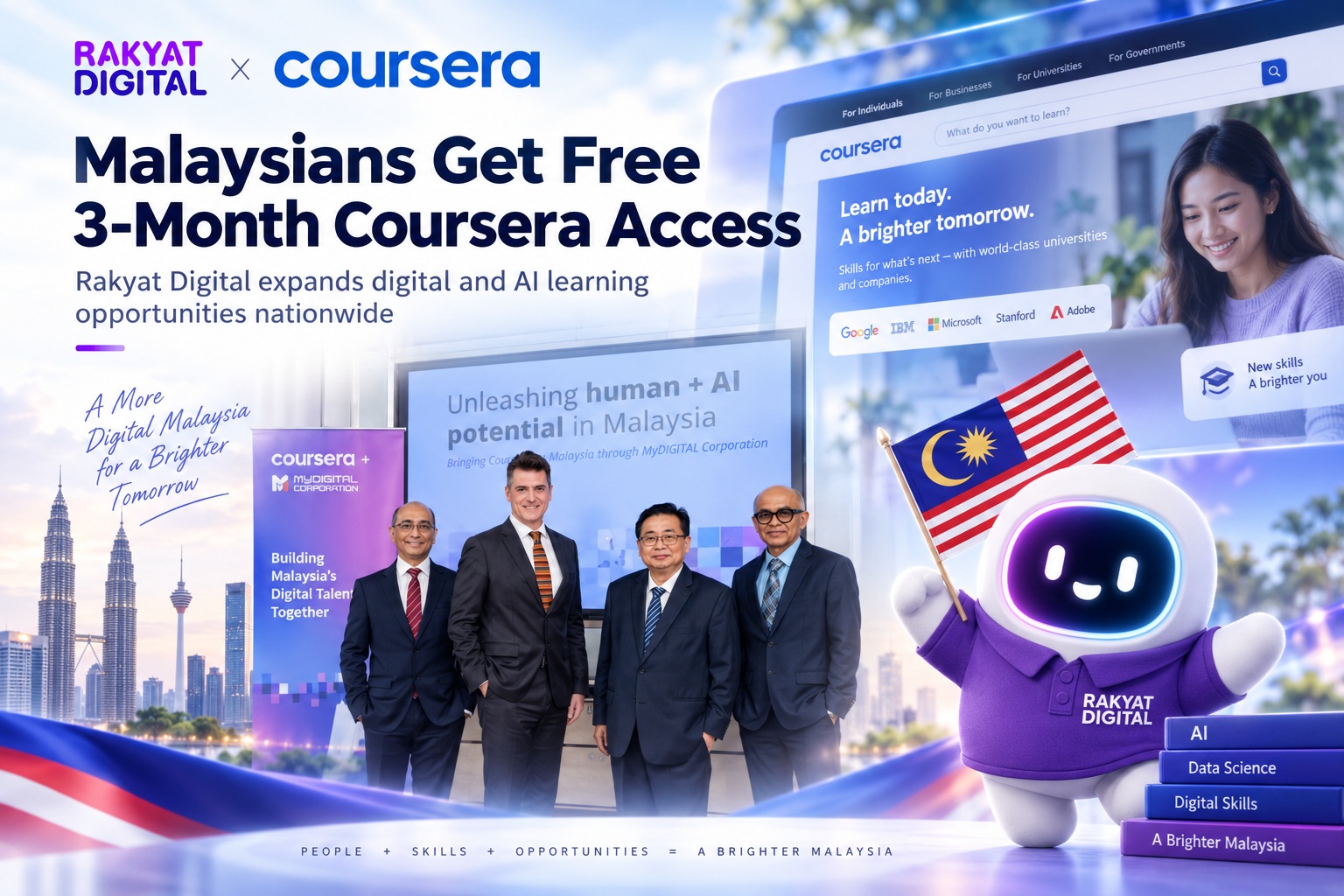
Malaysians can now receive three months of complimentary Coursera access through the government-funded Global Learning Pass, offered under the Rakyat Digital platform. The initiative is funded by the Ministry of Digital through MyDIGITAL Corporation and is intended to strengthen digital, technology and artificial intelligence skills across the country. Coursera serves as the online learning provider, with access available to eligible Malaysians who have a MyDigital ID.
A total of 100,000 licences are being distributed in phases beginning from 16 September 2026, subject to eligibility and availability. The programme gives participants temporary access to a large catalogue of courses and professional credentials that would normally require paid subscriptions. It forms part of a broader government effort to help Malaysians prepare for changing workplace requirements and an increasingly AI-driven economy.
Three Months Of Coursera Access At No Cost
Through the Global Learning Pass, eligible participants receive three months of access to Coursera without having to pay the usual subscription fees. Registration is handled through the Rakyat Digital portal, while MyDigital ID is used as part of the eligibility and identity verification process. Once approved, users can begin accessing the learning content included under the programme.
The rollout is limited to 100,000 licences and will take place progressively. This means availability may depend on when users register and whether licences remain available at that stage of the programme. Malaysians interested in participating are therefore encouraged to register while places are still open.
More Than 16,000 Courses And Professional Certificates
Participants can access more than 16,000 courses and Professional Certificate programmes during the three-month period. The available subjects include artificial intelligence, technology, data science, business and digital literacy, with content developed by universities and industry organisations from around the world. This gives learners the flexibility to focus on either basic digital skills or more specialised professional capabilities.
For working professionals, the Professional Certificate programmes may be particularly useful for structured upskilling in areas directly related to employment. Students and business owners can also use the programme to build technical knowledge or strengthen their understanding of emerging technologies. The broad catalogue means the initiative is not limited only to people already working in the technology sector.
Coursera Has Grown Into A Major Global Learning Platform
Coursera was launched in 2012 with the goal of making high-quality learning more accessible to people around the world. Over the years, it has expanded beyond individual online courses to include professional certificates, career-focused programmes and learning content from universities and industry partners. The platform has become widely used by both individuals and organisations looking to build new skills.
Following its combination with fellow online learning platform Udemy in 2026, the two platforms collectively reach more than 300 million learners worldwide. They also serve more than 12,000 enterprise customers. This scale gives Malaysian participants access to a learning ecosystem covering both academic and industry-focused content.
Rakyat Digital Has Expanded Beyond Basic Digital Literacy
Rakyat Digital first launched in 2024 as a centralised government learning platform providing free courses in areas such as cybersecurity, generative AI and basic AI literacy. The platform was expanded in August 2026 into a broader digital learning hub, bringing together digital literacy resources, specialised skills training and AI-related initiatives. The expansion reflects the government's effort to make digital learning more structured and easier to access from one place.
The platform now includes dedicated Digital Literacy and Digital Skills hubs. It also features an AI Builder designed to allow users to explore and develop AI-enabled products. Together, these components form part of the Awareness, Access and Adoption framework used to guide users from basic understanding towards practical use of digital technologies.
Malaysia's Workforce Skills Are Expected To Change Rapidly
The programme is being introduced at a time when workplace skill requirements are changing quickly. According to the World Economic Forum's Future of Jobs Report 2025, around 41% of core skills in Malaysia are expected to change by 2030. This is higher than the global average of 39%.
That figure highlights why continuous learning is becoming increasingly important for workers across many industries. Artificial intelligence, automation, data analytics and digital platforms are changing how jobs are performed, even outside traditional technology roles. Programmes such as the Global Learning Pass are intended to help Malaysians adapt before these changes become more disruptive.
Supporting Malaysia Digital 2030 And The National AI Action Plan
The Global Learning Pass is part of the wider Rakyat Digital ecosystem and supports the Malaysia Digital 2030 Action Plan, or MD2030. It also aligns with the National AI Action Plan 2026–2030, which focuses on strengthening the country's capabilities in artificial intelligence and digital adoption. The goal is not simply to teach people what AI and digital technologies are, but to help them apply those tools in practical settings.
MyDIGITAL says the programme is structured to help participants progress from awareness towards real-world adoption. This could include applying digital skills in education, professional careers, entrepreneurship or business operations. The initiative therefore sits within a larger effort to improve Malaysia's overall digital readiness rather than functioning as a standalone training promotion.
Other Free AI Initiatives Are Also Available Through Rakyat Digital
The Global Learning Pass is one of several initiatives introduced through the expanded Rakyat Digital platform. Earlier, the government announced free three-month access to selected AI tools for up to 100,000 Malaysians aged between 18 and 30. Participants in that programme are required to complete several AI-related learning modules before receiving access to the tools.
The combination of structured training and access to AI platforms reflects a more practical approach to digital education. Rather than limiting users to theory, the programmes are designed to give participants opportunities to apply what they learn. This could help build confidence among people who may be interested in AI but have not previously had access to paid tools or formal training.
How Malaysians Can Register
Malaysians interested in the Global Learning Pass can register through the Rakyat Digital portal. Participants will need a MyDigital ID and must meet the programme's eligibility requirements. Access is also dependent on licence availability because the current rollout is capped at 100,000 users.
Once approved, participants can begin using Coursera for the three-month access period and choose from the available courses and certificate programmes. The flexibility of online learning means users can study according to their own schedules, making the initiative suitable for students, employees and working professionals.
Final Thoughts
The Global Learning Pass gives Malaysians an opportunity to access thousands of Coursera courses and Professional Certificate programmes for three months without paying a subscription fee. With more than 16,000 courses covering AI, data science, technology, business and digital literacy, the programme provides a practical way for users to develop skills that are becoming increasingly important in the workplace.
More importantly, the initiative forms part of a wider effort to move Malaysia beyond basic digital awareness towards practical adoption of AI and emerging technologies. With workplace skills expected to change significantly by 2030, programmes such as Rakyat Digital and the Global Learning Pass could give more Malaysians the opportunity to reskill, upskill and prepare for the next stage of the digital economy.











Comments 0