

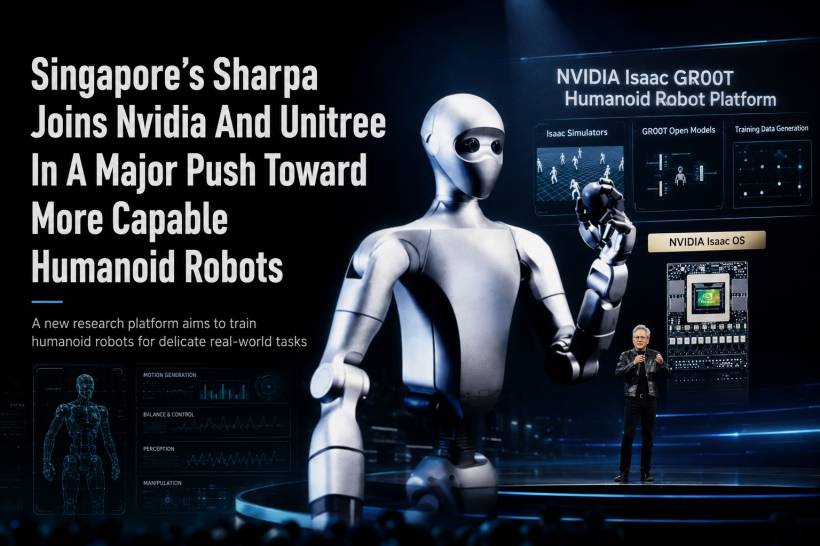
Humanoid robots have been talked about for years, but one of the hardest parts of making them useful in the real world has always been the hands. Walking, balancing and recognising objects are already difficult problems, but getting a robot to pick up, grip, adjust, assemble and handle objects with the kind of subtlety humans take for granted is another level entirely.
That is why the latest collaboration involving Singapore-based robotic hands company Sharpa, Nvidia and Chinese robot maker Unitree is worth paying attention to. The three companies are working together on a humanoid robot project that aims to give researchers a more complete platform for training robots to perform delicate physical tasks.
The project was announced during Nvidia CEO Jensen Huang's keynote at Computex in Taipei, one of Asia's biggest technology events. The timing is important because the AI conversation is clearly shifting beyond chatbots and text generation. The next big frontier is physical AI, where artificial intelligence does not just answer questions on a screen, but learns to act in the physical world.
Why Robotic Hands Matter So Much
When people imagine humanoid robots, they often focus on the full body. They think about robots walking through factories, helping in hospitals or doing household chores. But the real usefulness of a humanoid robot depends heavily on what its hands can do.
A robot that can walk but cannot handle objects carefully has limited value. Many real-world jobs require small, precise movements. Assembling electronics, preparing food, cleaning surfaces, folding fabric, handling medical equipment or even inserting an IV drip all require a level of dexterity that is difficult for machines to master.
This is where Sharpa's technology comes into the picture. Its robotic hands are designed with 22 degrees of freedom, giving them a more human-like range of movement. The goal is not simply to make a robot hand look realistic. The real challenge is to make it capable of touching, sensing, gripping and manipulating objects in ways that can generate useful training data for robot learning.
In robotics, the hand is not just a tool at the end of the arm. It is also a source of feedback. When a robot interacts with an object, it needs to understand not only what it is seeing, but also how pressure, contact, resistance and movement behave in the real world. That feedback is essential if researchers want robots to move from basic demonstrations to reliable practical work.
The H2 Plus Humanoid Robot Project
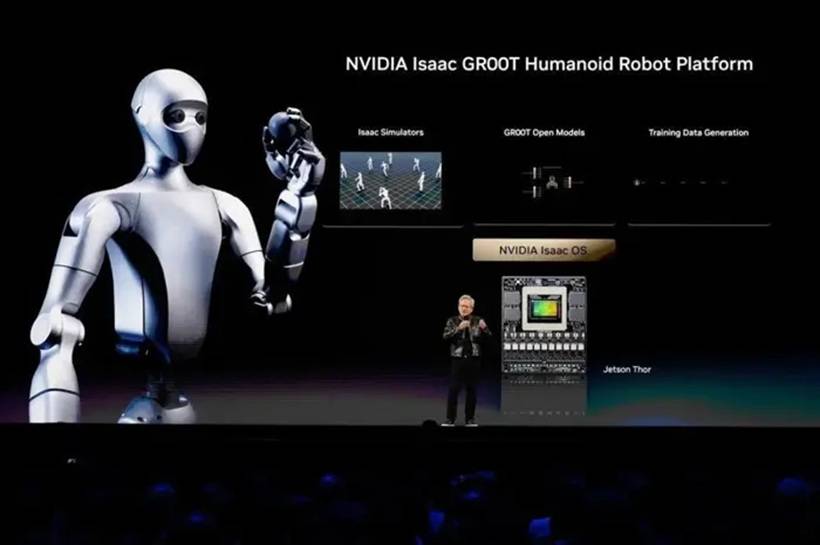
The new humanoid robot platform, known as the Nvidia Isaac GR00T Reference Humanoid Robot or H2 Plus, brings together several important pieces of hardware and software.
Sharpa contributes the robotic hands. Unitree provides the human-sized H2 humanoid robot body, which stands about 1.83 metres tall and weighs around 68kg. Nvidia supplies the AI computing backbone through Jetson Thor, along with simulation tools, AI models and robotics software designed to help researchers train and operate humanoid systems.
This combination is significant because humanoid robotics is not just about building a body. It requires a full stack. The robot needs mechanical hardware, artificial intelligence models, simulation environments, real-world training data, sensors, computing power and software tools that allow researchers to experiment without spending years assembling everything from scratch.
For universities and research labs, that matters a lot. Building a humanoid robot platform from separate parts can be extremely difficult. Researchers may spend too much time trying to make hardware, software and computing systems work together before they even begin their actual research. A reference platform like H2 Plus could reduce that barrier.
Making Humanoid Research More Accessible
One of the most interesting parts of this project is that it is aimed at researchers rather than mass-market consumers. The H2 Plus is expected to be rolled out to research groups in late 2026, giving universities and advanced robotics labs a more complete platform for training robot intelligence.
This reflects a practical reality. We are not yet at the point where humanoid robots can be easily deployed everywhere. They still need a lot of training, testing and refinement. But by giving researchers better hardware and tools, companies like Nvidia, Unitree and Sharpa are trying to accelerate the path toward useful real-world robotics.
Early adopters include major research institutions such as Ai2, ETH Zurich, Stanford University's robotics research centre and the University of California San Diego's Advanced Robotics and Controls Lab. These are the kinds of environments where new robot behaviours can be tested, improved and eventually transferred into industrial or commercial use.
In other words, this is not only about showing off a futuristic robot on stage. It is about creating a platform that researchers can actually use to teach robots how to perform more meaningful physical tasks.
Sharpa's Growing Role In Robotics
For Sharpa, this collaboration is a major step forward. The company was founded in 2024 and has research and development operations in Shanghai, while also maintaining business operations in California. Although it is still a young company, its work on robotic hands has already attracted attention.
Earlier in 2026, Sharpa demonstrated its robotic hands at CES in Las Vegas, where they were shown dealing blackjack cards and assembling pinwheels. Those demonstrations may sound playful, but they are useful examples of fine motor control. Handling cards and assembling small objects require delicate movement, controlled pressure and careful positioning.
That is exactly the kind of capability humanoid robots need if they are ever going to move beyond simple lifting and walking tasks. A robot that can handle a rigid box is one thing. A robot that can manipulate small, fragile or flexible objects is much harder.
Sharpa's role in the H2 Plus project shows how important specialised components are becoming in the robotics race. The future of humanoid robots will not be built by one company doing everything alone. It will likely depend on collaborations between AI computing firms, robot body manufacturers, sensor developers, hand designers, simulation platforms and research institutions.
Why Nvidia Is Betting Big On Physical AI
Nvidia's involvement is also part of a much larger strategy. The company has already become one of the biggest names in AI computing, especially for data centres and large model training. But Jensen Huang has been increasingly talking about physical AI, which refers to AI systems that can understand, reason and act in the physical world.
Humanoid robots fit neatly into that vision. If AI agents are software systems that can carry out digital tasks, humanoid robots are one possible form of AI agents in the physical world. They could one day perform tasks in factories, warehouses, hospitals, labs, homes and service environments.
That future is still difficult, but the economic opportunity is enormous. Industries such as manufacturing, healthcare, logistics, elder care and facility maintenance all involve repetitive or labour-intensive tasks where robotics could eventually play a bigger role.
However, physical AI requires more than powerful chips. It needs simulation, training environments, robot bodies, sensors and data from real-world interaction. That is why a humanoid robot platform with capable hands, a standardised body and Nvidia's AI stack is strategically important.
From AI On Screens To AI In The Real World
The broader theme behind this announcement is that AI is moving from the digital world into the physical one. For the past few years, most public attention has focused on generative AI tools that create text, images, code or video. But robotics adds a new layer of complexity because mistakes can have physical consequences.
A chatbot that gives a wrong answer is one kind of problem. A robot that grips too tightly, drops a medical tool or misjudges a human movement is another. That is why training humanoid robots safely and reliably requires a lot of research.
Simulation plays a big role here. Before robots are tested in the real world, researchers can train and evaluate behaviours in virtual environments. But eventually, robots still need to learn from real hardware. This is where tactile hands, physical feedback and real-world manipulation become crucial.
The H2 Plus project sits at this intersection. It is not only a robot. It is a training platform for developing the "brain" of robots that need to understand how actions feel and behave in real environments.
The Road Ahead For Humanoid Robots
Even with this collaboration, humanoid robots are not going to become common overnight. Many challenges remain. Robots need to become more reliable, safer, cheaper, easier to maintain and better at adapting to messy real-world environments.
Factories, hospitals and homes are not perfectly controlled laboratories. Objects vary in shape, weight, texture and position. Humans move unpredictably. Tasks often require judgement, timing and coordination. A humanoid robot must handle all of that without becoming a risk.
Still, the industry is clearly moving forward. By combining Unitree's humanoid body, Sharpa's robotic hands and Nvidia's AI computing and software stack, the H2 Plus gives researchers a stronger foundation to work from.
That could shorten the distance between robotics research and practical deployment. Instead of every lab building its own "Frankenstein" robot from disconnected parts, researchers can start with a more complete platform and focus more directly on training, behaviour and real-world manipulation.
Final Thoughts
The collaboration between Sharpa, Nvidia and Unitree is a strong sign of where robotics is heading. The next phase of AI will not only be about smarter models running in data centres or personal computers. It will also be about machines that can move, sense, touch and interact with the physical world.
Sharpa's robotic hands may seem like one component in a larger humanoid system, but they represent one of the most important missing pieces. If robots are going to help in factories, hospitals or homes, they need more than legs and cameras. They need hands that can handle real objects with care.
The H2 Plus project is still aimed at researchers, not everyday consumers. But that is exactly where this kind of technology needs to begin. Before humanoid robots can become useful at scale, they need to be trained, tested and improved by the people pushing the limits of robotics.
For Singapore's Sharpa, this partnership places the company in an important position within the global robotics ecosystem. For Nvidia and Unitree, it strengthens the push toward physical AI. And for the wider technology industry, it is another reminder that the future of AI may not stay behind a screen for much longer.











Comments 0