

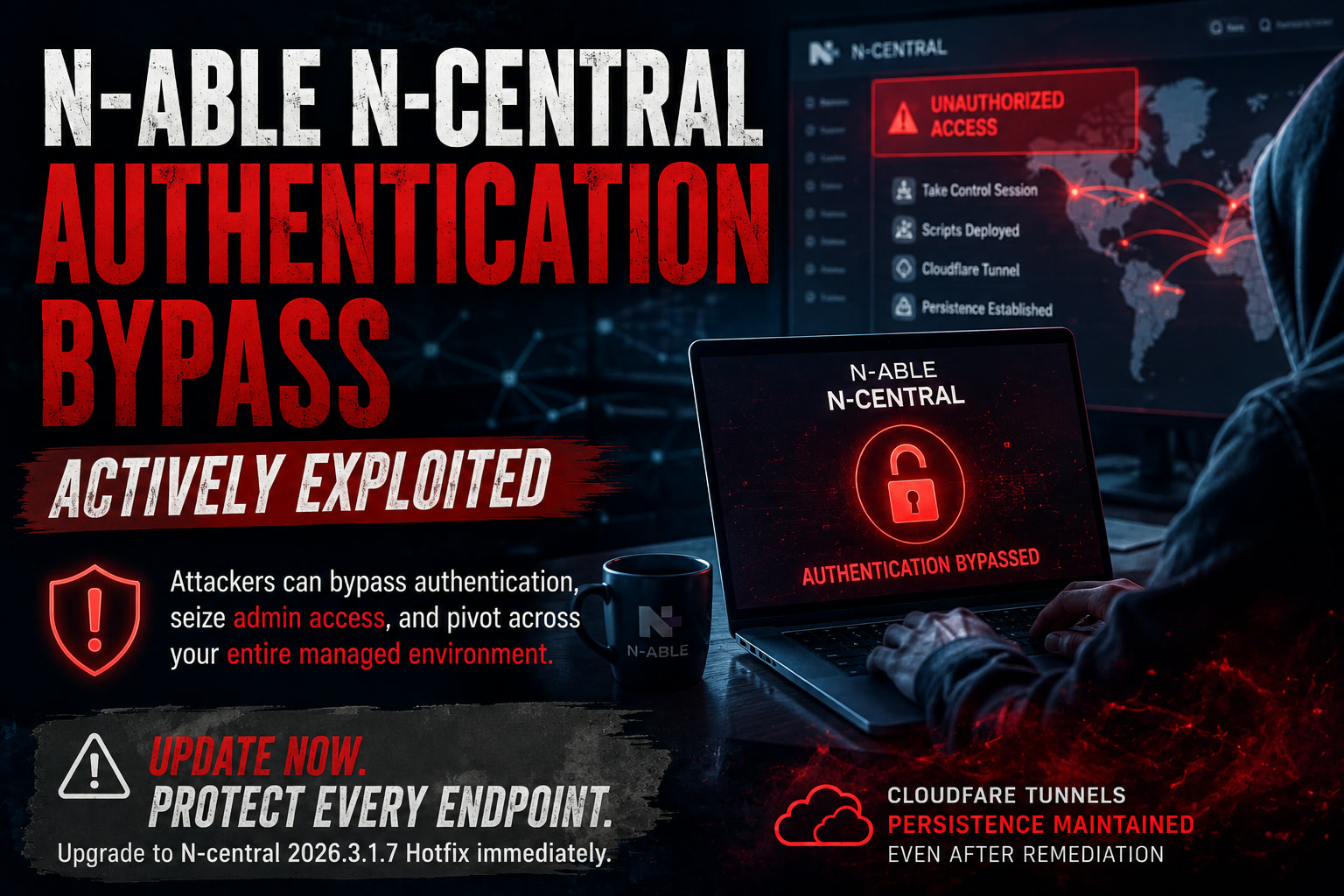
N-able has released an urgent security update for a serious authentication-bypass vulnerability affecting its N-central remote monitoring and management platform. The flaw is especially concerning because N-able has confirmed that attackers are already exploiting it in real-world environments.
Tracked as CVE-2026-18556, the vulnerability could allow a remote attacker to gain administrative access to an exposed N-central server without completing the normal authentication process. From there, the attacker may be able to use the platform's own remote-management capabilities to reach servers, workstations and other critical systems belonging to managed customers.
This turns a single compromised N-central console into a potential gateway across many connected environments.
Why N-central Is Such a Valuable Target
N-central is a remote monitoring and management platform commonly used by managed service providers.
An MSP may use one N-central deployment to monitor endpoints, install updates, run maintenance tasks, execute scripts and remotely access systems across several customer environments. The platform is designed to provide trusted administrators with centralised control over large numbers of devices.
That centralisation is highly efficient for legitimate support teams, but it also makes RMM platforms attractive to attackers.
Instead of compromising every customer individually, an attacker who gains control of the management platform may inherit the same reach as the MSP. The tools intended for support, patching and troubleshooting can then be repurposed to execute commands or establish persistence across multiple endpoints.
The vulnerability therefore affects more than the N-central server itself. Its real danger comes from what that server is authorised to control.
CVE-2026-18556 Bypasses Normal Authentication
CVE-2026-18556 has been assigned a CVSS 4.0 score of 8.2, placing it in the High-severity category.
The advisory attributes the vulnerability to an alternate path or communication channel that allows attackers to bypass authentication. Complete technical details and the precise root cause have not been publicly disclosed by N-able.
What has been confirmed is serious enough: a remote attacker can obtain administrative access to a vulnerable N-central server.
This means the attacker may reach the same console and functionality normally reserved for highly trusted users without first possessing legitimate administrative credentials.
Multifactor authentication remains an important security control, but an authentication-bypass flaw may allow an attacker to reach protected functions through a route that does not properly enforce the usual login process.
That is why patching remains essential even in environments where MFA is already enabled.
Administrative Access Opens the Door to Managed Endpoints
Once an attacker controls the N-central console, the problem no longer remains confined to the management server.
According to the advisory, full administrative access could allow a threat actor to push scripts or scheduled jobs to many—or potentially all—managed endpoints. The attacker could also deploy dual-use utilities, initiate remote-control sessions and modify roles, accounts or security policies.
Potential attacker actions include:
These actions may appear to originate from the legitimate N-able agent already installed on the device.
That could make malicious activity harder to distinguish from ordinary administrative work, especially in environments where N-central regularly runs automated jobs.
The Built-In Take Control Feature Was Abused
N-able's investigation found that attackers used the platform's Take Control capability after obtaining administrative access.
Take Control is intended to help authorised support personnel remotely access managed computers. In the observed attack, the same feature was used to move from the compromised N-central server into systems inside customer environments.
This demonstrates why attacks against RMM platforms can escalate so quickly.
The attacker does not necessarily need to deploy a separate remote-access product immediately. The platform already provides a trusted and approved path into the managed systems.
Security monitoring that focuses only on unknown remote-access software may therefore miss suspicious sessions initiated through a legitimate RMM console.
Organisations should examine not only whether Take Control was used, but whether every session can be matched to a known support request, authorised technician or approved maintenance activity.
Cloudflare Tunnels Were Used to Maintain Access
The attackers reportedly registered new services on managed endpoints to establish Cloudflare-based tunnels.
A tunnel can create an outbound connection from the compromised system to external infrastructure. Because the connection begins from inside the network, it may bypass some inbound firewall restrictions.
In this incident, the tunnel was used as a persistence mechanism. Even after the vulnerable N-central server was patched or remediated, the attacker could potentially retain access through the service already installed on downstream endpoints.
This is one of the most important findings in the advisory.
Updating N-central closes the original access path, but it does not automatically remove tools, services or accounts created after exploitation.
A successful response must therefore address both layers:
Treating the hotfix as the entire remediation could leave previously established access untouched.
All Versions Through N-central 2026.3 Are Affected
N-able has confirmed that every N-central version up to and including version 2026.3 is affected.
Customers are instructed to upgrade immediately to N-central 2026.3.1.7 Hotfix.
Organisations should verify the running version directly rather than assuming that routine updates have already installed the correction.
This is particularly important in environments where N-central upgrades are manually scheduled, delayed for compatibility testing or managed by another service provider.
A deployment labelled simply as "2026.3" remains vulnerable according to the advisory. The corrected target is specifically the 2026.3.1.7 Hotfix.
Temporary Isolation May Be Necessary
Where the hotfix cannot be installed immediately, N-able recommends restricting access through a firewall or temporarily taking the N-central instance offline.
Taking an RMM platform offline may interrupt monitoring and support operations, but leaving an actively exploited management server exposed presents a much greater risk.
Temporary network controls should restrict access to the smallest possible set of authorised administrative systems.
However, isolation should be treated only as a short-term risk reduction measure. It does not remove the vulnerability and does not address any persistence already established on managed endpoints.
Every Managed Endpoint May Need Review
Because attackers used N-central to pivot into connected devices, security teams should examine managed endpoints for unexpected Cloudflare tunnel services.
The review should cover both servers and workstations, especially systems that received unexplained Take Control sessions or unusual jobs during the suspected compromise period.
The advisory also recommends reviewing N-central logs for remote-control activity that cannot be matched to legitimate administrative work.
Suspicious signs could include:
The source does not provide a complete forensic procedure, so organisations may need to involve their incident-response teams or N-able support when evidence of compromise appears.
User Accounts and Privileges Must Be Audited
N-able recommends reviewing every N-central user account for unfamiliar additions or unexpected privilege changes.
Attackers with administrative access may create another account, elevate an existing account or modify roles so they can return later.
Security teams should verify:
The advisory explicitly recommends confirming that multifactor authentication is enabled.
MFA may not stop the disclosed bypass itself, but it can still reduce the risk of attackers reusing stolen or newly created credentials after the vulnerable path is patched.
Indicators of Compromise Provided by N-able
The advisory includes four IP addresses identified by N-able as known malicious infrastructure associated with the activity:
173.249.252[.]200 87.249.138[.]34 37.19.210[.]32 68.235.46[.]214These indicators can be searched across firewall, proxy, DNS, endpoint and network-monitoring logs.
A match should be investigated, but absence of a match does not prove that an environment was unaffected. Attackers can change infrastructure, use additional addresses or route traffic through services not listed in the advisory.
Similarly, an IP match alone should be assessed in context before concluding that compromise occurred.
The indicators are most useful when combined with unexpected Take Control activity, new tunnel services, suspicious account changes and unusual jobs pushed through N-central.
MSPs Face a Wider Downstream Responsibility
The incident has particular significance for managed service providers.
An MSP may patch its own N-central server quickly, yet still need to determine whether any customer endpoint was reached before remediation.
That creates a broader investigation involving multiple environments, different retention periods and potentially thousands of managed devices.
MSPs may need to establish:
The platform's centralised design means incident response must consider the entire management scope—not only the server hosting N-central.
Legitimate RMM Features Can Hide Malicious Activity
This incident illustrates a persistent challenge in modern cybersecurity: trusted administrative tools can be extremely useful to attackers.
Remote-control software, scripting engines and deployment platforms are not malicious by themselves. They become dangerous when an attacker gains the authority to use them.
Traditional detection may focus on unknown malware files or clearly unauthorised applications. Activity performed through N-central may instead resemble legitimate maintenance.
Defenders therefore need behavioural context.
A script pushed by N-central may be ordinary when sent by a known administrator during an approved change window. The same script becomes suspicious when sent by a newly created account to every domain controller at an unusual hour.
Logging should make it possible to connect every privileged action to an authorised person, request and business reason.
Patching Must Be Followed by Validation
After installing N-central 2026.3.1.7, administrators should verify that the deployment is actually running the corrected version.
They should also confirm that the application remains operational, administrative access is restricted and MFA is enforced.
More importantly, patching should be followed by an investigation of recent activity.
The advisory states that attackers established persistence on downstream systems. That means restoring the N-central server does not guarantee that the wider environment is clean.
Where credible evidence of compromise is found, N-able recommends contacting its support channels immediately.
Final Thoughts
CVE-2026-18556 is a high-severity authentication-bypass vulnerability with an unusually broad potential impact.
The flaw affects all N-central versions through 2026.3 and is already being actively exploited. A remote attacker may gain administrative access to the RMM console, use built-in management functions to reach customer endpoints and establish persistent Cloudflare tunnels that remain active even after the original server is fixed.
N-able customers should upgrade immediately to N-central 2026.3.1.7 Hotfix.
However, the response cannot stop at patch installation. Organisations must also review Take Control sessions, audit accounts and privilege changes, inspect managed systems for unexpected tunnel services and investigate communications with the malicious IP addresses supplied in the advisory.
RMM platforms are trusted because they need extensive control to perform their job. That same authority makes them exceptionally dangerous when compromised.
The safest assumption is therefore that any successful exploitation may have extended beyond the N-central server. Patch the management platform, then examine every downstream system the attacker could have reached through it.











Comments 0