

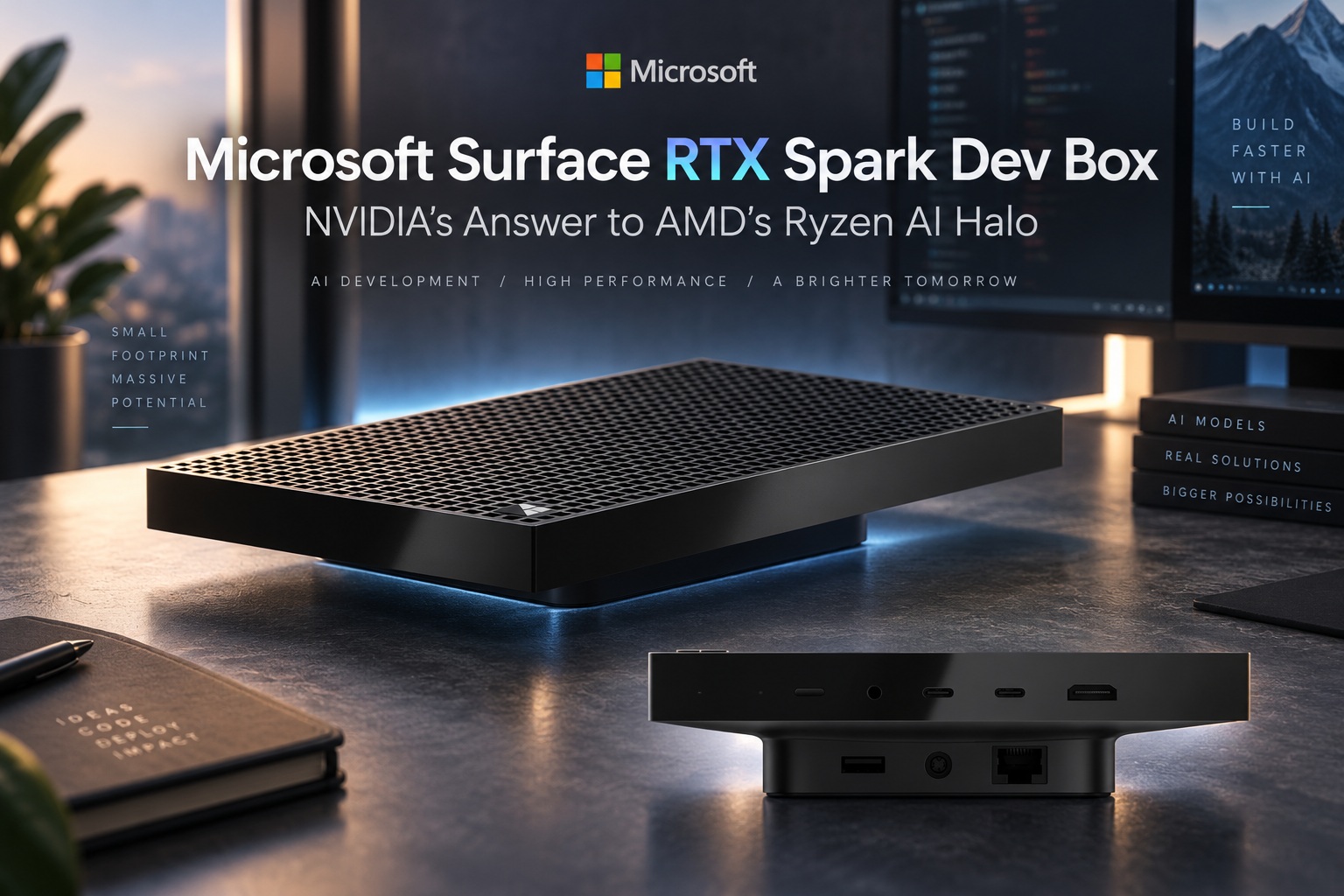
Microsoft has expanded its Surface hardware lineup with a new compact AI workstation called the Surface RTX Spark Dev Box. Announced alongside the Surface Laptop Ultra, the desktop system is built around NVIDIA's RTX Spark platform and is aimed at developers working with large AI models locally. It also comes with a very premium price tag of US$5,999, or approximately RM24,546, placing it firmly in workstation territory rather than the mainstream PC market.
The new machine arrives as direct competition to AMD's Ryzen AI Halo workstation platform, which was introduced earlier this year. On paper, the AMD alternative starts at a considerably lower US$3,999, around RM16,539, while offering up to 192GB of unified memory. That makes the comparison especially interesting for developers deciding between NVIDIA's established CUDA ecosystem and AMD's increasingly capable Ryzen AI platform.
Powered By NVIDIA's RTX Spark N1X
At the centre of the Surface RTX Spark Dev Box is the NVIDIA RTX Spark N1X, which combines a 20-core Arm CPU with 6,144 Blackwell-generation CUDA cores. The processor is designed specifically around accelerated AI and GPU workloads rather than traditional desktop computing alone. Microsoft pairs it with 128GB of LPDDR5X unified memory shared between the CPU and GPU.
That unified architecture allows both sides of the processor to access the same memory pool without constantly copying large datasets between separate system and graphics memory. For AI development, this can be particularly useful when working with large models that would otherwise exceed the capacity of conventional discrete GPU memory. The system also includes a 2TB PCIe 5.0 SSD that can be removed and replaced.
Built For Sustained AI Workloads
Unlike thinner RTX Spark laptops, the Surface RTX Spark Dev Box uses a compact desktop design intended to sustain demanding workloads for longer periods. Microsoft says the system operates within a 100W thermal envelope, giving the hardware more room to maintain performance compared with mobile implementations constrained by battery life and chassis size. This makes the Dev Box more appropriate for lengthy AI inference, model experimentation and other compute-heavy tasks.
The machine remains relatively compact despite being designed for continuous workloads. That could make it attractive to developers who want something more powerful than a laptop but do not need a full-sized workstation tower. Its small footprint also fits the growing trend towards miniature AI development systems that can sit directly on a desk.
Modern Connectivity With Wi-Fi 7
Connectivity includes two USB-C ports together with one 5Gbps USB-A port. Microsoft has also included HDMI 2.1b, wired LAN and Wi-Fi 7, covering both high-speed networking and modern peripheral requirements. Power is supplied through a 165W PSU.
The inclusion of fast networking is particularly relevant for AI development environments where datasets, containers and model files can be very large. A workstation like this may frequently move data between local storage, network-attached systems or cloud infrastructure. Wi-Fi 7 and wired Ethernet therefore complement the high-performance compute hardware rather than simply serving as general-purpose connectivity features.
AMD's Ryzen AI Halo Comes In Cheaper
The most obvious rival is AMD's Ryzen AI Halo workstation platform. Depending on configuration, these systems can be powered by either the Ryzen AI Max+ 395 or Ryzen AI Max+ Pro 495. AMD supports up to 192GB of LPDDR5X-8000 unified memory, significantly more than the 128GB included with Microsoft's RTX Spark Dev Box.
Storage support reaches up to 2TB of PCIe 4.0 capacity, while the platform operates with a 120W TDP. Starting prices begin at US$3,999, approximately RM16,539, giving AMD a substantial price advantage over Microsoft's US$5,999 system. The Ryzen AI Max+ 395 configuration typically pairs with 128GB of unified memory, while higher-end Max+ Pro 495 systems from companies such as Framework and Minisforum can reach 192GB.
Similar Pricing Can Buy More Memory On AMD
This creates an awkward comparison for Microsoft. Some Ryzen AI Max+ Pro 495 systems with 192GB of memory are expected to cost roughly the same as the Surface RTX Spark Dev Box, meaning buyers could receive 64GB more unified memory without spending significantly more. For large AI models, memory capacity can sometimes matter more than raw processor specifications because it determines whether the workload fits locally at all.
The Microsoft system therefore needs to justify its premium through NVIDIA's software ecosystem and Blackwell GPU architecture. Developers heavily invested in CUDA-based workflows may be willing to accept less memory in exchange for broader software compatibility and mature NVIDIA tooling. Those with more flexible workloads may find AMD's additional memory difficult to ignore.
120 Billion Versus 300 Billion Parameter Claims
Microsoft and NVIDIA claim that the RTX Spark platform can work with AI models containing up to around 120 billion parameters. AMD, by comparison, claims its Ryzen AI Halo platform can handle models with as many as 300 billion parameters. These headline figures give AMD a clear numerical advantage, although model size alone does not determine real-world performance.
Actual usability depends heavily on quantisation, memory requirements, framework optimisation and the specific workload being run. A system that technically supports a larger model may still perform very differently depending on inference speed and software efficiency. The figures should therefore be viewed as maximum platform capabilities rather than direct performance comparisons.
CUDA And TensorRT Versus ROCm And PyTorch
The software ecosystems are another major difference between the two platforms. NVIDIA's RTX Spark hardware is built around CUDA and TensorRT, giving developers access to an extremely mature GPU-compute environment. CUDA remains widely used across AI research, machine learning and professional GPU workloads, which could be one of the Surface Dev Box's strongest selling points.
AMD's alternative relies on ROCm and PyTorch, with the company continuing to expand software support around its AI hardware. The Ryzen AI Halo platform can also operate on both Windows 11 and Linux, providing greater operating-system flexibility. For developers already working comfortably with ROCm, the lower price and larger memory configurations may make AMD's platform especially attractive.
The Real Battle Is Software Versus Hardware Value
On specifications alone, AMD appears to offer more memory and potentially larger supported AI models for less money. NVIDIA, however, has spent years building an enormous software ecosystem around CUDA, and that ecosystem continues to matter heavily for professional AI development. Many existing projects, libraries and workflows are already optimised around NVIDIA hardware.
Microsoft's Surface RTX Spark Dev Box therefore seems less focused on winning a pure specifications battle and more on providing a compact, turnkey development system built around NVIDIA's platform. The target audience is likely developers who want a ready-to-use local AI workstation without assembling their own hardware or dealing with more experimental software stacks.
Preorders Are Already Open
Microsoft has already opened preorders for the Surface RTX Spark Dev Box. The first batches are expected to begin shipping by 24 November 2026. At US$5,999, it is clearly aimed at professional developers, research teams and organisations rather than typical home users.
The price will likely be the biggest obstacle, particularly when competing Ryzen AI Halo machines can provide more unified memory at a lower or comparable cost. Whether buyers consider the premium worthwhile will largely depend on how important NVIDIA's software ecosystem is to their workloads.
Final Thoughts
The Surface RTX Spark Dev Box is an interesting addition to Microsoft's growing AI hardware strategy. With a 20-core Arm CPU, 6,144 Blackwell CUDA cores, 128GB of unified memory and a replaceable 2TB PCIe 5.0 SSD, it offers substantial local AI capability in a compact desktop format. Its biggest advantage is likely the mature NVIDIA ecosystem surrounding CUDA and TensorRT rather than the raw specification sheet alone.
AMD's Ryzen AI Halo systems remain very strong competitors, offering up to 192GB of unified memory and claimed support for much larger models at significantly lower starting prices. For buyers already committed to NVIDIA workflows, the Surface RTX Spark Dev Box could be a compelling turnkey workstation. For everyone else, AMD's stronger memory-to-price ratio may be difficult to overlook.











Comments 0