

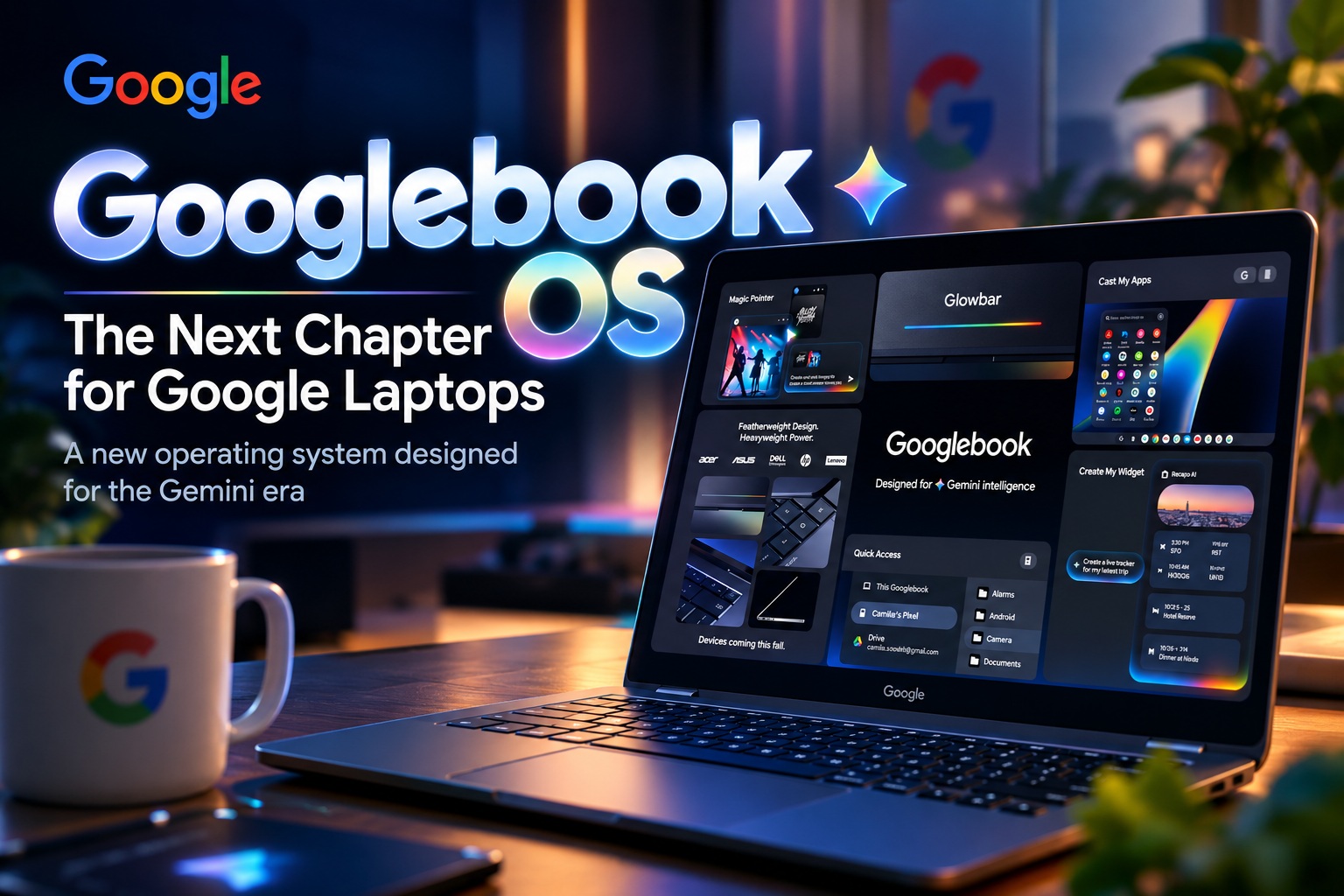
Google has officially outlined what will happen to ChromeOS as the company begins shifting its laptop strategy toward the newly introduced Googlebook OS. With the first wave of Googlebooks announced earlier this month, existing Chromebook owners have naturally been wondering whether ChromeOS is approaching an early end.
For now, Google is making it clear that current ChromeOS devices are not being abandoned. The company says supported devices will continue receiving regular operating-system updates and security patches through mid-2034, giving organisations and existing Chromebook users several more years before the transition becomes unavoidable.
ChromeOS Is Not Disappearing Anytime Soon
Google's support documentation for enterprise and education customers confirms that ChromeOS will remain supported through mid-2034. During that period, qualifying devices will continue receiving software improvements and security updates under their existing support lifecycle.
That timeline gives schools, businesses and other organisations plenty of time to plan their migration instead of suddenly having to replace entire fleets of Chromebooks. ChromeOS remains widely used in education in particular, where devices are often purchased in large quantities and expected to remain operational for many years.
There is still one unanswered question, however. Engadget reportedly contacted Google to determine whether the same mid-2034 commitment applies specifically to consumer ChromeOS devices, but had not received clarification at the time of the report.
Some Chromebooks Will Eventually Move to Googlebook OS
The transition becomes more interesting for newer Chromebooks whose normal 10-year support lifecycle would extend beyond 2034.
Google says customers with qualifying devices will be supported in moving to Googlebook OS rather than simply losing software support once ChromeOS reaches the end of its broader lifecycle. According to the company's FAQ, many supported devices are expected to offer a direct migration path to the new operating system.
That could significantly reduce the disruption for users who purchase Chromebooks close to the end of the ChromeOS era. Instead of replacing perfectly usable hardware, they may be able to install Googlebook OS and continue receiving software support.
Google has not yet published the complete compatibility list, so exactly which Chromebook models will qualify remains unclear.
Newer Chromebooks Are More Likely to Be Eligible
The company says many of its latest Chromebook devices will be able to transition to Googlebook OS.
That makes sense because newer hardware is more likely to meet whatever processor, memory, storage and security requirements Google establishes for the new operating system. Older Chromebooks may not receive the same option, particularly if their normal update lifecycle already ends before 2034.
Google says additional information about eligible devices and the migration process will be shared later.
For consumers considering a Chromebook today, that future compatibility could become an important purchasing factor. Buyers may increasingly want to know not only when ChromeOS support ends, but whether their particular machine can eventually become a Googlebook.
Googlebook OS Represents the Company's New Direction
Googlebooks are intended to represent the next stage of Google's laptop platform rather than simply becoming another Chromebook product family.
The initial Googlebook launch is focused primarily on consumers, with the first devices expected to arrive on 4 October. Unlike the mature ChromeOS ecosystem, however, the new platform will not immediately include every enterprise and education management capability organisations currently depend on.
Domain enrolment, in particular, will not be supported during the initial consumer-focused launch.
That limitation means Googlebook OS is not yet ready to replace ChromeOS across large managed deployments. Schools and businesses therefore have little reason to rush away from their existing Chromebook environments.
Enterprise Management Will Arrive Later
Google says more comprehensive administrative capabilities are planned from the second half of 2027.
Those controls will be essential if Googlebook OS is eventually expected to replace ChromeOS within education and enterprise environments. Administrators need centralised tools for managing devices, enforcing security policies, deploying applications, controlling user accounts and maintaining large fleets.
ChromeOS has spent years developing those capabilities, particularly through Google Admin. Googlebook OS will need to provide comparable management functionality before organisations can consider widespread migration.
The gradual timetable suggests Google understands that changing an operating system across thousands of managed devices requires significantly more preparation than introducing a new consumer laptop.
The Transition Is Designed to Be Gradual
Supporting ChromeOS until 2034 gives Google roughly eight years to establish Googlebook OS before the older platform reaches its planned endpoint.
That is a substantial transition window.
Consumers can continue using supported Chromebooks normally, while schools and businesses can wait until Googlebook OS receives the administrative tools they require. Meanwhile, hardware manufacturers have time to release new systems designed specifically around the newer operating system.
Google can also use the period to refine compatibility and determine how many existing Chromebook models can realistically migrate.
Rather than abruptly replacing ChromeOS, Google appears to be planning a long overlap where both platforms remain relevant.
The 10-Year Chromebook Support Promise Still Matters
Google expanded Chromebook support in recent years so eligible devices can receive automatic updates for as long as 10 years.
The Googlebook transition does not appear to erase that commitment. Devices purchased now whose normal support window stretches beyond ChromeOS' planned 2034 timeline may instead transition to Googlebook OS if they qualify.
This distinction is important because users purchasing hardware today should not assume that ChromeOS ending in 2034 automatically means their laptop becomes obsolete at the same time.
For supported hardware, Googlebook OS could effectively become the continuation of that update lifecycle.
Hardware Compatibility Will Be the Big Question
The biggest unanswered issue is exactly what determines whether a Chromebook qualifies for migration.
Google has only said that many newer devices will be eligible. It has not yet revealed detailed processor generations, minimum memory requirements or other hardware conditions.
Compatibility could become complicated because Chromebooks have shipped with a wide variety of Intel, AMD, Qualcomm and MediaTek processors over the years.
Google will also need to consider firmware, security hardware and driver support rather than simply raw processor performance.
Until a formal compatibility list appears, Chromebook owners should avoid assuming their device will automatically receive Googlebook OS just because it remains within its normal ChromeOS support period.
There Is No Immediate Reason for Chromebook Users to Worry
For existing users, the most important takeaway is that ChromeOS still has a long life ahead of it.
Mid-2034 is far enough away that many current Chromebooks will reach the end of their normal update lifecycle before the operating system itself is retired. Newer devices may receive the option to transition instead.
That gives Google considerable time to make Googlebook OS more mature before expecting users to depend on it.
The introduction of Googlebooks therefore does not immediately turn Chromebooks into legacy hardware.
Googlebook OS Still Has Plenty to Prove
While Googlebook OS represents Google's future laptop direction, the platform will need time to establish itself.
Consumers will get the first opportunity to experience it when the initial Googlebooks arrive in October. Enterprise and education users will likely be watching from the sidelines until features such as domain enrolment and deeper administration become available.
The eventual migration experience will also be critical. If supported Chromebooks can transition smoothly without losing applications, settings or important functionality, Google could make the move relatively painless.
If compatibility becomes fragmented or migration requires significant manual work, the transition could become much more complicated.
Final Thoughts
Google's decision to keep ChromeOS supported through mid-2034 provides welcome clarity for Chromebook owners concerned about the arrival of Googlebook OS.
The company is clearly moving toward a new laptop platform, but it is not forcing existing users to follow immediately. ChromeOS will continue receiving updates for years, while qualifying newer Chromebooks may eventually receive a direct migration path to Googlebook OS.
The first Googlebooks are expected to arrive on 4 October, but the new platform will initially remain consumer-focused. More complete enterprise administration is not expected until the second half of 2027, reinforcing the idea that this will be a gradual transition rather than an overnight replacement.
For Chromebook owners, the message is fairly reassuring: ChromeOS still has years of support ahead, and newer hardware may have a future beyond ChromeOS itself.











Comments 0