

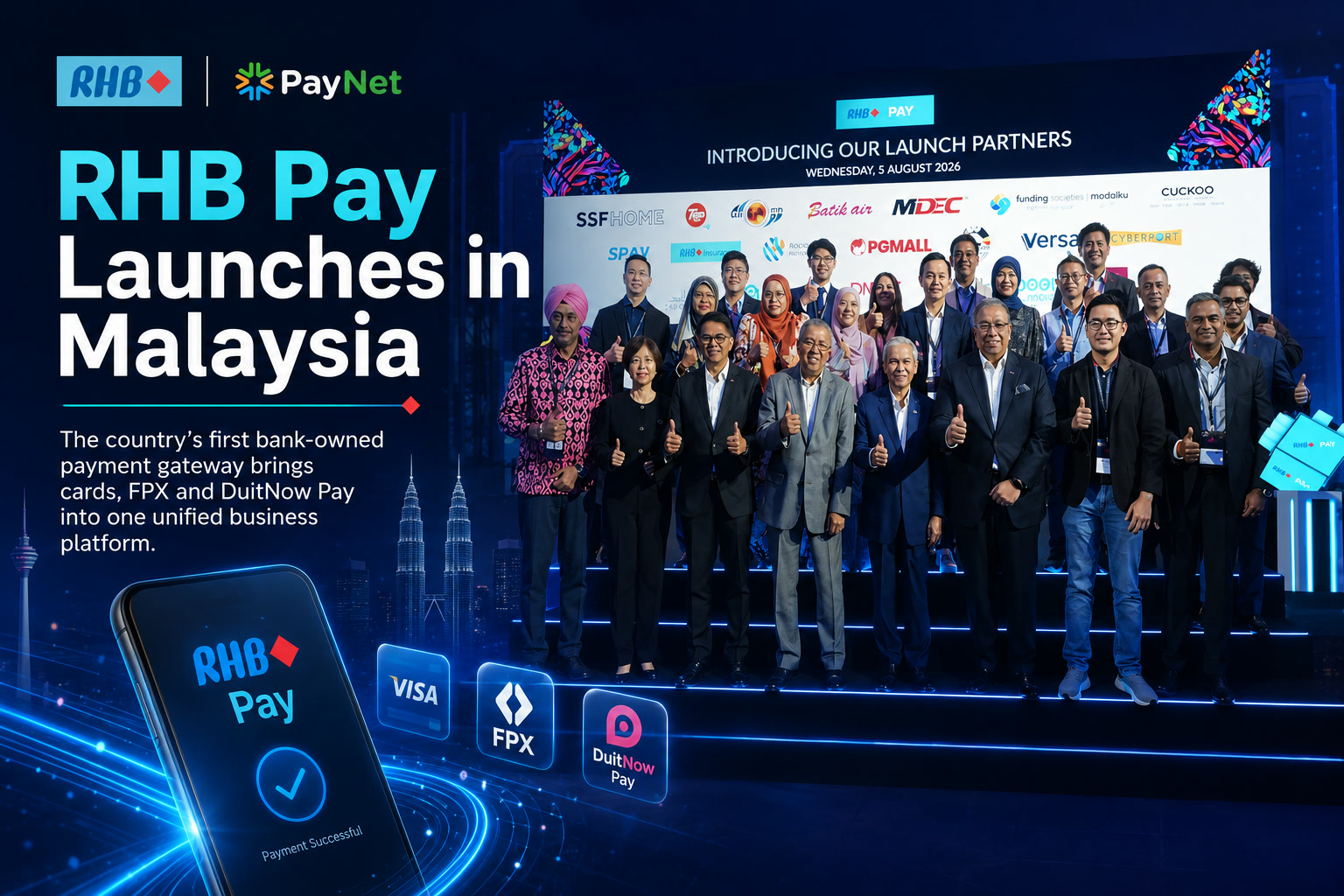
Malaysia's digital-payment landscape has gained another major player with the launch of RHB Pay, a unified online payment gateway developed and operated directly by RHB Bank.
The new platform allows businesses to accept card payments, FPX transfers and DuitNow Pay transactions through a single integration. Payments are settled directly into an RHB account, while automated reconciliation is included to help merchants match incoming transactions with their business records.
RHB describes the service as Malaysia's first bank-owned unified online payment gateway, positioning it as an alternative to payment platforms operated by independent fintech companies and third-party payment processors.
One Gateway for Several Payment Methods
Businesses commonly need to support several ways of paying because Malaysian customers do not all use the same method.
Some prefer debit or credit cards, while others use FPX to transfer money directly from their bank accounts. DuitNow Pay has also become an increasingly familiar option for online transactions.
Without a unified platform, a merchant may need separate arrangements, integrations and reporting tools for each payment channel. This can complicate technical maintenance and make transaction monitoring more difficult.
RHB Pay brings the currently supported methods into one gateway:
For customers, the experience remains familiar because they can choose a payment method that suits them. For businesses, the more important benefit is having those transactions processed and recorded through one central platform.
Built and Operated by RHB Bank
The defining feature of RHB Pay is that it is owned and operated by the bank itself.
Many payment gateways sit between the merchant and several financial institutions. RHB Pay instead connects the payment-acceptance service more closely with RHB's existing banking infrastructure.
According to RHB Banking Group's Group Managing Director and Group CEO, Dato' Mohd Rashid Mohamad, the bank-owned structure gives businesses greater assurance over how their funds and payment data are managed.
He highlighted RHB's banking infrastructure, governance standards and regulatory oversight as important foundations for the platform.
For businesses handling a large number of transactions, the identity and regulatory position of the gateway operator can be just as important as the available payment features. Companies must consider where their money is being held, how payment data is protected and who is responsible when a transaction requires investigation.
Direct Settlement into RHB Accounts
Funds collected through RHB Pay are settled directly into the merchant's RHB account.
That creates a more closely connected flow between accepting a customer's payment and receiving the resulting funds.
For a business already using RHB for its banking operations, direct settlement could simplify the overall process by reducing the number of separate platforms involved. Finance teams can monitor incoming payments through the same banking relationship used for other business activities.
The value becomes more noticeable as transaction volume increases. A small merchant may be able to review payments manually, but a larger company receiving hundreds or thousands of transactions each day requires a more structured settlement process.
RHB Pay is aimed primarily at organisations operating at that broader scale.
Automated Reconciliation Reduces Manual Finance Work
One of the platform's most practical features is automated reconciliation.
Payment reconciliation involves comparing transactions recorded by the payment gateway with customer orders, invoices and amounts credited into the business's bank account.
The process can become complicated when customers use several payment methods or when a company operates across multiple systems.
Without automation, finance teams may need to download separate reports, compare transaction references and manually investigate differences. Common issues can include failed payments, duplicate attempts, delayed settlements, refunds or mismatched reference numbers.
Automated reconciliation helps organise this information and reduce repetitive administrative work.
It does not eliminate the need for financial oversight, but it can allow teams to spend less time matching routine transactions and more time examining genuine exceptions.
Designed for Larger Business Customers
RHB Pay is targeted at:
This positioning suggests that the service is intended for organisations requiring more than a simple payment link or basic checkout function.
Larger businesses often need stronger reporting, formal governance, predictable settlement and payment tools that can integrate with existing operational processes.
Government-related institutions may also place particular emphasis on security, auditability and working with regulated financial institutions.
RHB's direct involvement could make the platform attractive to organisations that prefer their payment gateway and banking services to sit within the same institutional relationship.
A Unified Gateway Can Simplify the Customer Journey
Customers expect online payments to be quick and uncomplicated.
A checkout process that supports only one method may cause some buyers to abandon the transaction. On the other hand, presenting many payment methods through poorly connected systems can make the experience confusing.
A unified gateway allows businesses to offer several familiar options without building completely separate checkout processes for each one.
A customer can choose between a card, FPX or DuitNow Pay while the merchant receives the payment information through the same platform.
This consistency can be useful across e-commerce websites, service portals, online billing systems and institutional payment pages.
The gateway becomes the common layer connecting the customer's preferred payment method with the business's settlement and reporting process.
PayNet Provides the National Payment Rails
RHB Pay uses infrastructure operated by Payments Network Malaysia, better known as PayNet, for its FPX and DuitNow Pay capabilities.
PayNet operates key components of Malaysia's national payment ecosystem, connecting banks, businesses and consumers through widely adopted services.
By building on PayNet's payment rails, RHB does not need to create a completely separate network for bank transfers and DuitNow transactions. Instead, RHB Pay provides the merchant-facing gateway while the underlying payment movement uses established national infrastructure.
PayNet described the launch as an example of how an established financial institution can respond to changing business needs and create new growth opportunities through national payment rails.
The collaboration also reflects the broader relationship between banks and payment-network operators. Banks provide customer accounts and financial services, while PayNet supplies shared infrastructure that enables payments to move across institutions.
More Payment Options Are Coming Later
The first version of RHB Pay supports cards, FPX and DuitNow Pay, but RHB plans to expand the platform further.
A second phase is targeted for the fourth quarter of 2026, with planned support for:
These additions would significantly widen the platform's use cases.
E-wallet support could make the gateway more convenient for customers who prefer app-based payments. QR payments would extend RHB Pay beyond conventional online checkout flows and could support situations where customers scan a code to complete a transaction.
Direct Debit and Auto Debit would be particularly useful for recurring payments.
Businesses offering subscriptions, memberships, insurance, education, utilities or regular services often need to collect the same amount—or a changing amount—from customers on an agreed schedule.
Instead of asking the customer to initiate every payment manually, an authorised debit arrangement can support repeat collection.
Why Recurring Payment Support Matters
The planned addition of Direct Debit and Auto Debit could make RHB Pay relevant to businesses beyond standard e-commerce.
A one-time online store purchase is relatively straightforward: the customer selects an item, pays and completes the transaction.
Recurring services create a more complicated relationship. The business needs to know when payments are due, whether collection succeeded and what action to take when a payment fails.
A gateway that combines recurring collection with direct settlement and reconciliation could help businesses manage these processes more consistently.
However, RHB has not yet published the full implementation details for the second phase. Businesses will need to wait for information about onboarding, supported payment arrangements and how recurring mandates will be handled.
Malaysia's E-Payment Activity Continues to Grow
The launch comes as electronic payments continue expanding rapidly across Malaysia.
According to Bank Negara Malaysia figures cited during the announcement, the country recorded 18.4 billion e-payment transactions in 2025. That represented a 25% increase from the 14.7 billion transactions recorded in 2024.
The increase demonstrates that digital payment is no longer limited to occasional online purchases.
Consumers now use electronic methods for retail purchases, bills, transport, food delivery, government services, subscriptions and transfers between individuals.
As transaction volume grows, businesses need payment systems capable of handling more channels without creating additional operational complexity.
A unified gateway is therefore not only about giving customers more choices. It is also about helping merchants manage the increasing scale of digital transactions.
Banks Are Moving Deeper into Payment Technology
RHB Pay also illustrates how traditional banks are extending their role within the digital economy.
Banks have always handled settlement and account services, but payment gateways have often been associated with specialised fintech providers.
By developing its own gateway, RHB is moving closer to the transaction's starting point—the moment a customer pays the merchant.
This gives the bank an opportunity to provide a broader business relationship covering payment acceptance, settlement, reconciliation and account services.
For merchants, the model may reduce the separation between the company that processes the payment and the institution that ultimately receives the money.
It could also encourage greater competition within Malaysia's gateway market, pushing providers to improve their integrations, reporting and merchant support.
Security and Trust Will Be Central to Adoption
A payment gateway handles sensitive operations.
It connects customers, merchants, banks and payment networks while processing financial information throughout the transaction.
RHB is emphasising its banking governance and regulatory oversight as key reasons for businesses to trust the service.
That positioning may appeal to organisations that are cautious about introducing another third party into their payment process.
Still, businesses evaluating RHB Pay will need to consider the complete operational picture. Security is not determined solely by who owns the gateway. It also depends on how the merchant integrates it, manages administrator access, protects its website and monitors suspicious transactions.
A bank-owned platform can provide a strong foundation, but merchants remain responsible for securing their own systems and accounts.
Integration Will Determine the Merchant Experience
The long-term success of RHB Pay will depend partly on how easily businesses can connect it to their existing systems.
A gateway may need to work with websites, mobile applications, enterprise platforms, billing systems and internal financial processes.
Larger organisations may also require testing environments, technical documentation and support for customised workflows.
The announcement establishes the platform's main capabilities but does not provide detailed information about integration methods, pricing or merchant fees.
Those factors will be important when businesses compare RHB Pay with existing gateway providers.
A strong product needs to be secure and reliable, but it must also be practical for development and finance teams to implement.
A Potential Advantage for Existing RHB Business Customers
RHB's current business customers may be the most natural early adopters.
They already maintain accounts and a banking relationship with the institution. Adding a payment gateway operated by the same bank could simplify onboarding and provide a more connected financial setup.
Direct settlement into RHB accounts may also make cash-flow monitoring more straightforward.
However, the platform must still compete on functionality and overall value. Businesses will compare transaction costs, settlement schedules, support quality, payment success rates and integration options before changing their existing gateway.
Being bank-owned provides differentiation, but merchants will ultimately judge the service by how effectively it supports daily operations.
Final Thoughts
RHB Pay marks an important expansion of RHB Bank's role in Malaysia's digital-payment ecosystem.
The platform gives businesses one gateway for card payments, FPX and DuitNow Pay, with funds settled directly into RHB accounts and automated reconciliation included.
Its initial target market—mid-sized enterprises, commercial businesses, corporates and government-related institutions—reflects a focus on organisations requiring structured payment management rather than only basic online checkout.
The planned second phase should make the platform more versatile by adding e-wallets, QR payments, Direct Debit and Auto Debit during the fourth quarter of 2026.
RHB describes the service as Malaysia's first bank-owned unified online payment gateway. That bank-operated model may provide additional confidence to businesses concerned about payment security, data governance and settlement.
With Malaysia recording 18.4 billion electronic-payment transactions in 2025, the demand for integrated payment infrastructure is clearly growing.
RHB Pay's real impact will depend on its merchant pricing, technical integration, reliability and future feature rollout. Nevertheless, its launch demonstrates that Malaysia's established banks are no longer content to remain only at the final settlement stage. They increasingly want to provide the complete digital-payment journey from customer checkout to the business account.











Comments 0