

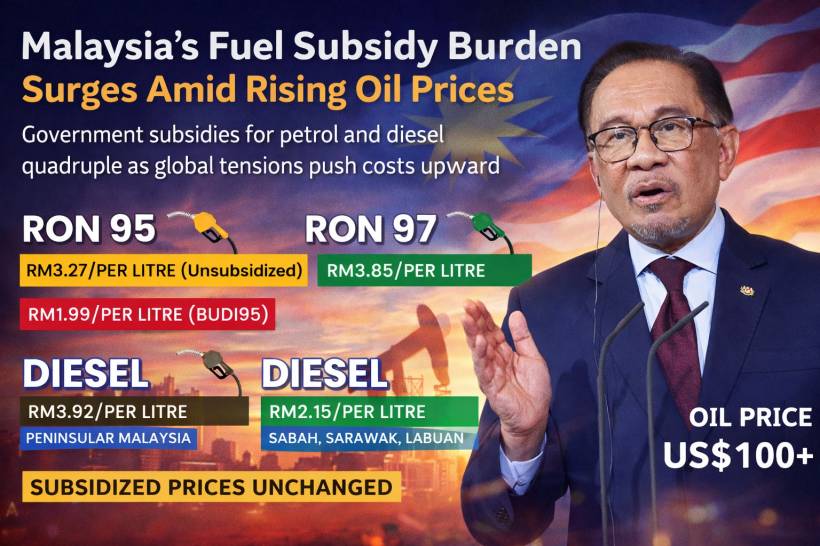
Malaysia's fuel subsidy bill is rising dramatically as the government moves to shield consumers from the impact of higher global oil prices. With tensions in the Middle East pushing energy costs upward, the country is now expected to spend about RM3.2 billion a month on fuel subsidies, a steep jump from the roughly RM700 million it was paying previously.
That increase shows just how costly it has become for the government to keep local fuel prices stable while the global market grows more volatile. Even so, Putrajaya says it will continue absorbing the pressure for now, rather than passing the full burden directly to consumers.
Subsidised Fuel Prices Will Stay Unchanged
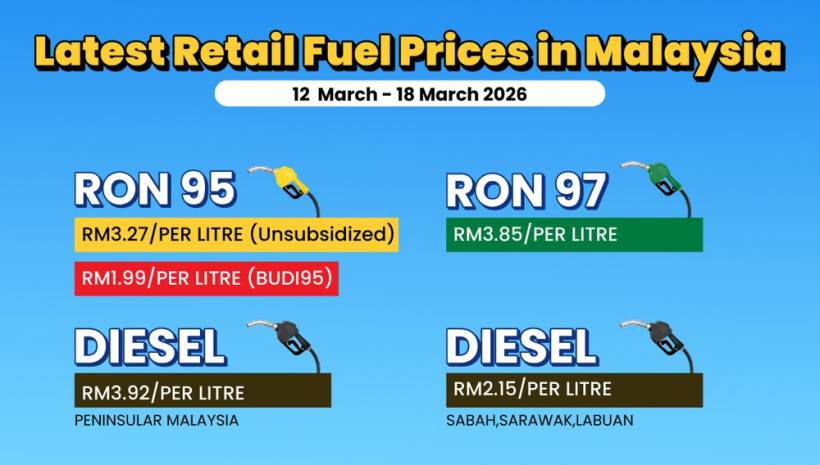
Despite the surge in costs, the government has decided to maintain current subsidised fuel prices. Finance Minister II Amir Hamzah Azizan said eligible Malaysians will continue to enjoy RON95 petrol at RM1.99 per litre under the BUDI95 subsidy scheme.
This decision is clearly meant to protect households from sudden cost-of-living shocks. Fuel prices affect far more than what drivers pay at the pump. They also shape transport costs, logistics expenses, food distribution, and overall inflation. By keeping prices steady, the government is trying to prevent broader knock-on effects across the economy.
Still, that stability comes at a heavy price. According to Amir Hamzah, petrol subsidies are now costing the government around RM2 billion per month, while diesel subsidies have climbed to about RM1.2 billion monthly.
Why the Subsidy Bill Has Spiked So Much
The sharp rise is tied to surging oil prices amid growing conflict involving Iran. With crude hovering around the US$100 level, governments that subsidise fuel are under greater strain because the gap between the market price and the price consumers actually pay becomes much wider.
For Malaysia, this means the state has to absorb far more of the cost difference than before. The basic policy may look unchanged from the public's perspective, but behind the scenes the fiscal burden has grown substantially.
This is one of the major trade-offs of broad fuel support. It helps households and businesses weather external shocks, but it also puts pressure on public finances if high prices persist for a long period.
Government Says It Can Still Absorb the Pressure
Amir Hamzah stressed that Malaysia remains in a position to manage the higher subsidy burden, pointing to fiscal consolidation efforts and reforms introduced over the past three years. In other words, the government believes recent improvements in financial management have given it enough room to respond without immediately destabilising the budget.
That is an important point politically and economically. By saying the country still has fiscal space, the government is trying to reassure the public that the subsidy increase, while large, is not yet beyond what Malaysia can handle.
At the same time, officials are being careful not to suggest that the current arrangement can continue indefinitely without consequences. The message seems to be that Malaysia can absorb the pressure for now, but it must also think seriously about what comes next if the crisis drags on.
Supply Remains Stable Despite Global Tension
Another point the government has been eager to emphasise is that fuel supply inside Malaysia remains stable. Authorities say there is no shortage of petrol or diesel, and domestic availability has not been disrupted.
Officials have pointed to continued support from Petronas and other companies in maintaining and extending supply where needed. The government has also said the country's gas position remains steady, helped by domestic production, refinery capability, and storage capacity.
This distinction matters. Rising prices and supply disruptions are not always the same thing. Malaysia may be feeling the cost impact of global turmoil, but according to the government, it is not currently facing a physical shortage of fuel.
Budget Pressure Is Growing
Even with stable supply, the financial pressure is becoming harder to ignore. Maintaining subsidised prices may help protect the public, but it also means a larger burden on government spending at a time when policymakers are trying to balance support measures with fiscal discipline.
Amir Hamzah acknowledged that keeping prices unchanged has budget implications. That is a polite way of saying the government must now commit much more money each month just to maintain the status quo.
This is why officials are increasingly framing the current situation not only as a short-term support issue, but also as a policy challenge that may require more forward-looking decisions. If the conflict continues and prices remain elevated, Malaysia may need to consider reforms or adjustments that reduce long-term exposure without causing unnecessary public hardship.
A "No-Regret Move" Approach to Reform
Amir Hamzah also suggested that this period of uncertainty should be used to think about practical reforms that can reduce future strain. He described the need for what he called a "no-regret move," meaning measures that make sense even if the external crisis continues longer than expected.
That idea is important because it signals the government is not treating this as just a temporary oil spike. Instead, it appears to be considering ways to use current fiscal space wisely while preparing for more uncertainty ahead.
In practical terms, that could mean looking at how subsidies are structured, improving efficiency in public-sector energy use, or exploring ways to reduce overall fuel dependence without destabilising the economy.
Energy Saving Measures Are Already Being Considered
As part of that broader response, the government is reportedly encouraging energy-saving measures in public offices. These include reviewing work-from-home arrangements and adjusting air-conditioning settings to reduce power consumption.
That may sound like a small step compared with billions in subsidy spending, but it reflects a larger policy message. The government is signalling that while it is willing to protect the public from immediate pain, it also expects the public sector to respond more carefully and responsibly to rising energy costs.
Prime Minister Anwar Ibrahim has also reportedly instructed top civil service officials to review work-from-home policies to see whether a more coordinated approach can be implemented across government agencies. A decision on that review is expected soon.
Wider Economic Effects Are Starting to Show
The pressure from higher fuel prices is not limited to motorists or public spending. Other sectors are also beginning to feel the strain, especially transport and aviation.
Transport Minister Anthony Loke has already warned that airlines may have to suspend some flight operations if fuel prices keep rising. That is a serious concern because fuel makes up a huge share of airline operating costs. When jet fuel becomes more expensive, airline margins can narrow quickly, especially for carriers already facing stiff cost pressures.
To address this, the transport ministry has been meeting with airline operators, airport authorities, fuel suppliers, and aviation regulators to assess the risks and coordinate next steps. Authorities and industry players have reportedly agreed to meet weekly while the crisis remains unstable.
This shows how a global geopolitical conflict can ripple through multiple parts of the domestic economy, even when local fuel supply remains secure.
Spending Controls Are Also Being Tightened
The government is not only spending more on subsidies. It is also trying to send a signal of caution in other areas of public spending. Anwar has announced precautionary measures that include cancelling Hari Raya open houses hosted by government agencies and limiting overseas travel for ministers and officials.
These steps are partly symbolic, but they also reflect a broader effort to show fiscal restraint at a time when subsidy commitments are rising sharply. The message is straightforward: if the government is absorbing major costs to shield the public, it also wants to be seen managing its own spending more carefully.
That kind of messaging can matter politically, especially when large support measures are being funded during a period of uncertainty.
Final Thoughts
Malaysia's fuel subsidy bill has surged because the government has chosen to protect consumers from the immediate effects of rising global oil prices. That decision provides short-term relief, but it also places far greater pressure on public finances.
For now, Putrajaya says it has the fiscal strength to absorb the burden, and there is no sign of domestic fuel shortages. But if the crisis in the Middle East drags on and oil prices stay elevated, the challenge will become less about whether Malaysia can cope today and more about how long it can sustain the current model without deeper changes.
This is why the latest statements from ministers matter. They are not only about reassuring the public. They also hint at a larger policy crossroads, where fuel support, fiscal discipline, energy conservation, and future reform may all have to move together.











Comments 0