

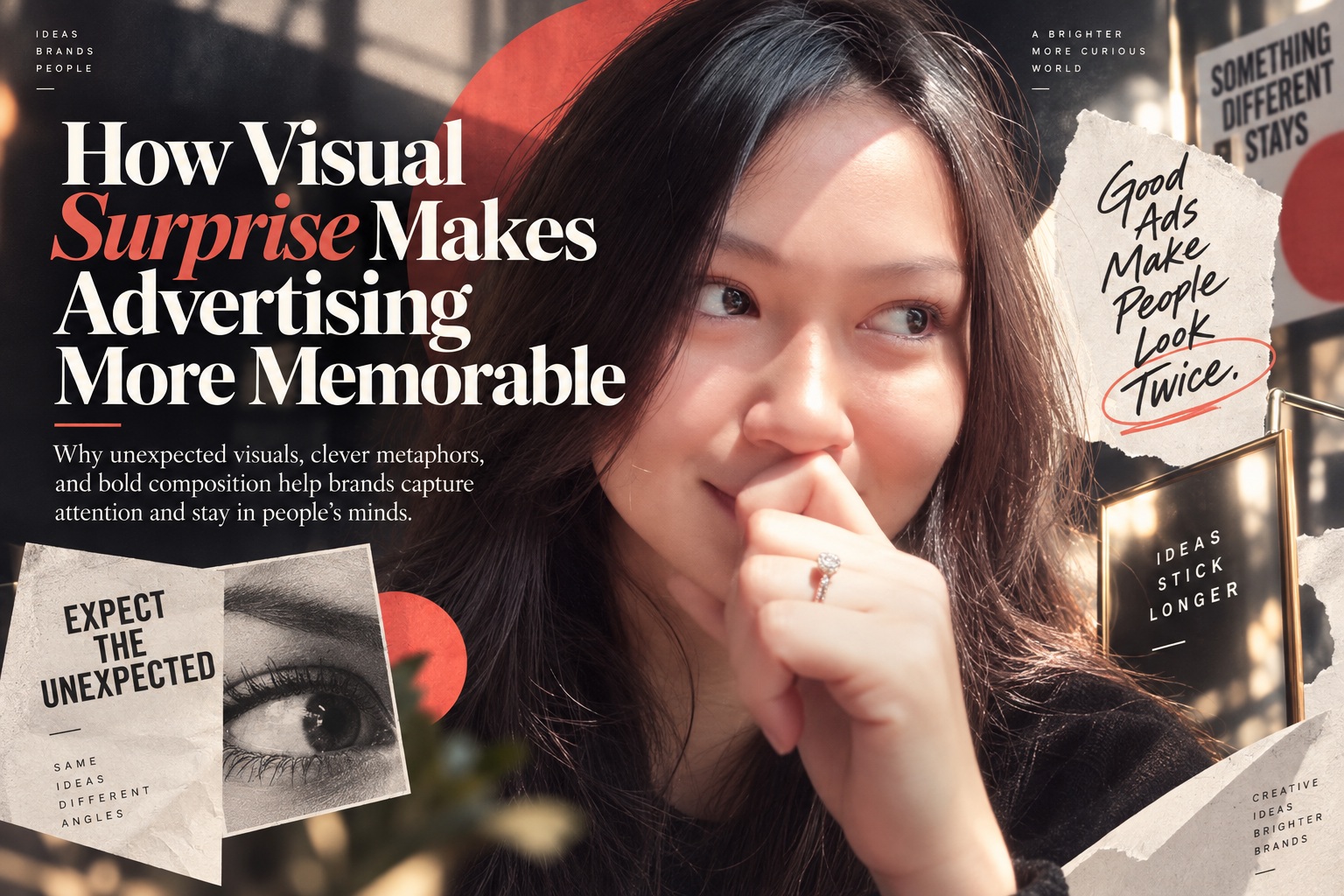
Advertising has always had one fundamental problem: nobody is required to pay attention. A sponsored post can disappear beneath a thumb in less than a second, a magazine ad can be skipped without conscious thought, and a billboard can blend into the visual background of a familiar commute. Even when someone technically sees an advertisement, there is no guarantee they will remember anything about it a few minutes later.
That is why visual surprise can be such a powerful creative tool. An unexpected image, unusual composition, clever metaphor, or dramatic shift in scale can interrupt familiar patterns and make the viewer hesitate for just a little longer. But effective surprise is not about being strange for the sake of it. The best advertising uses the unexpected to make an idea clearer, more engaging, and easier to remember.
Why Familiar Advertising Becomes Invisible
People are surrounded by visual messages throughout the day. Social feeds, websites, emails, packaging, billboards, television, apps, and physical spaces all compete for attention. To cope with that volume, the brain becomes extremely good at filtering information that looks predictable or irrelevant.
Advertising often makes this easier by repeating familiar formulas. A product sits in the centre, an attractive person stands beside it, a headline appears above, the logo goes into a corner, and the call to action sits underneath. There is nothing fundamentally wrong with that structure; in many cases it is clear and perfectly functional.
The problem is repetition. Once viewers have encountered the same structure hundreds of times, they begin recognising the pattern before consciously processing the message. The advertisement is identified as advertising and mentally dismissed almost instantly.
Visual surprise breaks that automatic response. Something does not behave the way the viewer expects, which creates a moment of uncertainty. That moment can be enough to earn another second of attention, and in advertising, an extra second can be enormously valuable.
Surprise Should Have a Reason
There is an important distinction between something being unexpected and something being merely random. A bizarre image may attract attention, but if viewers cannot understand why they are seeing it, the surprise contributes very little to the actual message.
Imagine an advertisement for a storage company showing a tiny apartment somehow containing an absurd amount of furniture. The impossible visual creates immediate curiosity, but the concept also communicates the benefit: more can fit into a limited space.
Now imagine the same company using a completely unrelated surreal image simply because it looks interesting. People may remember the visual, but there is no reason for them to connect that memory with storage.
That is the test designers should apply. The unexpected element should strengthen the idea. If removing it leaves the message almost unchanged, the surprise may be decoration rather than communication.
Visual Metaphors Invite the Viewer to Participate
One of the strongest ways to create surprise is through visual metaphor. Instead of explaining the product literally, the advertisement creates a visual connection between two ideas that do not normally belong together.
A cybersecurity company might show an umbrella protecting digital files from a storm. A delivery company could depict a parcel overtaking a racing car. A cleaning product might turn a dirty surface into something so reflective that it behaves like a mirror.
The audience has to perform a small piece of interpretation. They recognise the objects, notice the unusual relationship, and then understand what the combination is trying to say.
That moment of interpretation matters because people tend to remember ideas they have actively processed more easily than information they simply received passively. The advertisement gives the viewer a tiny problem to solve, then rewards them with the answer.
The best visual metaphors feel obvious after they are understood. You look at them and think, "Of course." That moment is usually a sign that the concept is working.
Changing Scale Can Make Ordinary Objects Interesting Again
Scale is another simple way of disrupting expectation. We know roughly how large familiar objects should be, so exaggerating or reducing their size immediately creates tension.
A giant pair of headphones towering over a city could communicate powerful sound. A tiny smartphone surrounded by an enormous amount of content could suggest storage capacity. A small security device protecting a huge building can reinforce the idea that physical size does not determine effectiveness.
The technique works particularly well because the concept can often be understood without much copy. The relationship between the product and its exaggerated scale becomes the message.
Scale also transforms otherwise ordinary subjects. A product that might look boring in a conventional studio photograph can become visually dramatic when placed in an environment where its proportions feel impossible.
The important part is connecting the scale change to something meaningful about the product rather than simply using it as spectacle.
Juxtaposition Creates a Question
Another effective technique is placing two things together that viewers do not expect to coexist. A business suit underwater. An expensive armchair in the middle of a desert. A flower growing through a concrete floor.
These images create an immediate question: why are these things together?
That question is useful because questions create engagement. The viewer is no longer simply receiving an advertisement; they are trying to resolve the relationship between the objects.
Good juxtaposition normally creates two stages. First comes tension, where the combination feels unusual. Then comes resolution, when the message explains why the relationship makes sense.
If the second stage never arrives, the advertisement risks becoming confusing. But when the connection is clear, the contrast can create a much stronger memory than a straightforward product demonstration.
Negative Space Can Hide the Surprise
Visual surprise does not always need to be loud. Some of the most memorable advertising uses negative space to hide a second image or meaning inside what initially looks like a simple composition.
A logo may contain another shape between its letters. Two objects may create a third symbol in the space between them. A background may appear ordinary until the viewer notices that the empty area forms something completely different.
This kind of surprise rewards attention. The first glance establishes one interpretation, while the second changes it.
That second discovery can be particularly memorable because the viewer feels as though they found something rather than being shown everything immediately. The design becomes a small interaction even though nothing physically moves.
The key is subtlety. If the hidden element is so obscure that almost nobody discovers it, the concept fails. The surprise should reward closer inspection, not require forensic analysis.
The First Glance Gets Attention, the Second Delivers the Idea
Many strong advertisements create a tiny narrative within a single image.
At first glance, the viewer notices that something feels unusual. Maybe an object is constructed from unexpected materials, an image contains an impossible scale relationship, or two unrelated environments have somehow been combined.
Then comes the second look.
The viewer realises what they are actually seeing and understands why the visual decision was made. That sequence — attention followed by interpretation — is one of the reasons visual surprise works so effectively.
It allows the advertisement to communicate twice. The first impression says, "Look at this." The second says, "Here is what it means."
That is particularly valuable in crowded environments such as social feeds, where earning a second look can make the difference between being remembered and disappearing immediately.
Do Not Turn the Advertisement Into Homework
There is a limit to how much work an audience is willing to do. A visual metaphor may be clever, but if understanding it requires thirty seconds and a paragraph of explanation, it is probably too complicated for most advertising contexts.
People do not approach advertisements expecting puzzles. They are usually doing something else when the ad appears, which means the concept needs to resolve quickly.
A useful test is to show the idea to someone unfamiliar with the campaign and ask what they think it means. If they recognise the relationship within a few seconds, the concept may be strong. If you need to explain the entire strategy afterward, the design probably needs another round of simplification.
The best surprise creates a satisfying moment of recognition rather than frustration.
Memorable Does Not Automatically Mean Effective
One of the biggest dangers in creative advertising is producing something people remember while forgetting the brand behind it.
Someone may say, "I saw this incredible ad where a giant elephant was sitting inside a tiny car," but if they cannot remember what the advertisement was selling, the concept succeeded as entertainment and failed as marketing.
Brand connection therefore needs to be built into the idea. The product itself, packaging, brand colours, visual identity, tone, or distinctive brand behaviour should have a meaningful relationship with the surprise.
This does not mean placing an enormous logo in the corner. In fact, the strongest campaigns often make the product or brand so central to the concept that removing it would cause the entire visual idea to collapse.
That is a much stronger form of branding than simply attaching a logo after the creative work is finished.
Surprise Can Also Come From Behaviour
Visual surprise is not limited to static images. Digital advertising opens up opportunities for unexpected movement, interaction and transformation.
A banner might initially look like part of the surrounding website before changing shape. A product could react to scrolling. An animation might break an expected interface pattern in a controlled way. Augmented reality can place products into environments where they would normally be impossible.
These techniques can be powerful because the surprise unfolds over time rather than appearing all at once.
However, motion needs the same discipline as static visual design. Movement that exists only to demand attention can quickly become irritating. The behaviour should reveal the idea rather than simply interrupt the user.
The difference between surprise and annoyance is often intention.
Cultural Context Changes What Feels Unexpected
Designers also need to remember that surprise is contextual. Something that feels unusual in one culture, industry, or audience may feel completely normal somewhere else.
A visual metaphor may rely on a cultural reference that one audience instantly understands while another misses entirely. Humour can behave the same way. An unexpected image may feel playful in one market and inappropriate in another.
This makes audience understanding particularly important when campaigns are adapted internationally. The goal is not simply to translate the copy while leaving the concept untouched. Designers need to consider whether the visual surprise itself still makes sense.
Sometimes localisation requires changing the metaphor entirely while preserving the underlying advertising idea.
When Surprise Is the Wrong Tool
Not every advertisement benefits from being clever or unexpected. Some situations demand trust, speed, or absolute clarity instead.
Emergency communication, healthcare information, financial instructions, regulatory notices, and highly technical products may require more direct communication. Surprise can still be used thoughtfully in those categories, but it should never make essential information harder to understand.
Even consumer advertising does not always need a visual twist. Sometimes a beautiful product photograph and a clear statement are exactly what the audience needs.
Good designers do not ask, "How can I make every advertisement surprising?" They ask whether surprise will improve the communication objective.
That difference is important.
The Goal Is Not Weirdness — It Is Memory
Visual surprise is valuable because it creates a break in expectation. The brain notices when something does not fit the normal pattern, and that interruption can create curiosity long enough for the message to land.
But being unusual is not the final objective.
The strongest advertisements create a sequence: notice, understand, connect, remember.
If the audience notices the ad but cannot understand it, the idea is too obscure. If they understand it but cannot connect it to the product, the branding is too weak. If they remember the strange image but not what was being sold, the surprise has taken over the advertisement instead of supporting it.
The sweet spot is an unexpected visual that makes the product benefit easier to grasp.
Final Thoughts
Great advertising often begins by recognising what the audience expects and then deliberately breaking that expectation in a meaningful way. Visual metaphors, unexpected scale, unusual juxtaposition, hidden negative-space imagery and surprising interactions can all interrupt familiarity and create that valuable second look.
The important word is meaningful.
Surprise should not compete with the message. It should reveal it. The strange element should eventually feel inevitable once the viewer understands the idea.
That leads to a more useful question for designers than simply asking how to make an advertisement more eye-catching:
What could we show that the audience would not expect — but would immediately make the message clearer once they understood it?
That is where visual surprise becomes more than decoration.
It becomes communication people actually remember.











Comments 0