

The MSQH 7th Edition marks an important update in Malaysia's hospital accreditation journey. Developed under the Malaysian Society for Quality in Health, or MSQH, this latest edition reflects how healthcare quality has changed over the years. Hospital accreditation is no longer just about having policies, procedures, and folders ready for surveyors. It is now much more focused on whether those documents are translated into safe, consistent, measurable, and patient-centred practices.
For hospitals in Malaysia, MSQH accreditation has long been used as a structured way to measure healthcare quality, patient safety, governance, and operational performance. The accreditation process itself is voluntary, but it carries strong value because it shows that a healthcare organisation is willing to be assessed against recognised national standards and improve continuously. Hospital accreditation under MSQH has been part of Malaysia's healthcare quality landscape for many years, and each new edition has gradually pushed hospitals to become more mature in how they manage care, safety, leadership, and risk.
The 7th Edition continues that evolution. It moves the conversation away from simple documentation compliance and into a more mature model of clinical governance, risk management, digital readiness, accountability, and outcome-based improvement. In simple terms, the question is no longer only "Do you have a policy?" but also "Is the policy working, is it monitored, are risks being managed, and are patients actually safer because of it?"
When Was the MSQH 7th Edition Officially Introduced?
Based on currently available public information, MSQH's 7th Edition standards were made visible through the official MSQH platform, with several standard documents carrying the date 17 April 2026. MSQH also invited healthcare professionals and the public to participate in the National Consensus for the MSQH Hospital Accreditation Standards 7th Edition from 17 April 2026 to 4 May 2026.
This is important because major accreditation standards usually do not appear overnight and immediately become enforceable without a transition period. They typically go through development, review, stakeholder engagement, publication, training, familiarisation, and then wider implementation. For the 7th Edition, the available information suggests that 2026 is the key transition year.
However, until MSQH publishes a direct final notice stating the exact enforcement date, it is better to describe the 7th Edition as the upcoming or transitioning standard rather than claiming that every hospital survey is already fully enforced under it. For hospitals preparing for accreditation or re-accreditation, the safest approach is to start aligning early instead of waiting for the final implementation date.
What's New in the MSQH 7th Edition
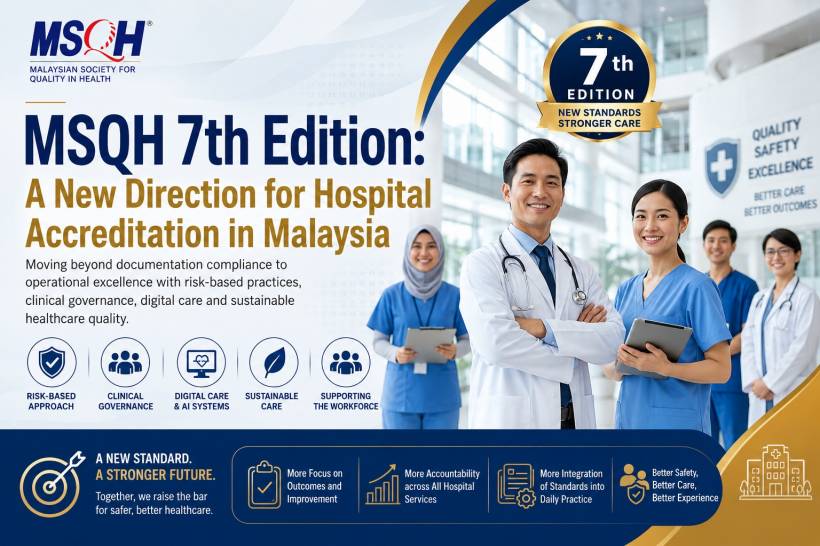
The MSQH 7th Edition introduces a more modern and practical way of looking at hospital accreditation. It is not simply a refresh of older standards. It brings in newer healthcare priorities that are now becoming essential for hospitals, especially in areas such as digital care, sustainability, workforce support, clinical governance, and risk-based operations.
Some of the key new or strengthened areas introduced in the 7th Edition include:
• Stronger risk-based thinking across hospital services, where departments are expected to identify, assess, monitor, and reduce risks as part of their daily operations.
• Greater emphasis on clinical governance, including leadership accountability, clinical audit, patient safety indicators, quality improvement, and monitoring of clinical outcomes.
• More focus on operational excellence, meaning hospitals are expected to show that policies are not only documented, but actually implemented, measured, and improved.
• Expanded attention to digital care, reflecting the growing use of hospital information systems, electronic medical records, digital workflows, online platforms, and integrated healthcare technology.
• Inclusion of artificial intelligence systems for care, recognising that AI and digital tools may become part of clinical or operational decision-making and therefore require proper governance, validation, and safety controls.
• Stronger focus on sustainable care, encouraging hospitals to think about long-term service quality, resource use, environmental responsibility, and continuity of healthcare delivery.
• More attention to supporting the healthcare workforce, including staff competency, training, wellbeing, workforce readiness, and the ability of staff to deliver safe care in a changing healthcare environment.
• More detailed service-specific standards, allowing departments such as critical care, operating suite, ambulatory care, clinical services, health information management, food services, radiology, pathology, rehabilitation, and allied health services to be assessed according to their actual risks and responsibilities.
• Greater expectation for root-cause analysis and corrective action, especially when incidents, near misses, complaints, or audit findings occur.
• Better linkage between documentation, evidence, performance indicators, and actual patient outcomes, so that accreditation becomes less about file preparation and more about measurable improvement.
These changes show that the 7th Edition is trying to bring Malaysian hospital accreditation closer to the realities of modern healthcare. Hospitals today are not only judged by whether they have written policies. They are judged by how well they manage risk, how safely they deliver care, how they use data, how they support staff, and how they respond when something goes wrong.
Why the 7th Edition Matters
Healthcare today is more complex than it was even a decade ago. Hospitals are dealing with more advanced treatments, higher patient expectations, digital systems, cybersecurity concerns, incident reporting requirements, clinical risk, infection control challenges, and increasing pressure to prove quality through data.
This is where the 7th Edition becomes important. It recognises that hospital quality cannot depend only on written SOPs. A hospital may have a complete set of policies, but if staff are not trained, incidents are not analysed properly, audits are not followed up, or risk registers are not actively used, then the system is weak.
The 7th Edition pushes hospitals to demonstrate that quality is embedded into daily operations. This means risk assessment, clinical audit, incident review, patient feedback, documentation quality, staff competency, and performance indicators all need to connect with one another. It is a more integrated view of hospital management, where patient safety is not treated as one department's job, but as a shared responsibility across the entire organisation.
From Documentation Compliance to Operational Excellence
Older accreditation preparation often had a strong documentation culture. Hospitals would prepare files, update policies, organise evidence, and ensure that departments could show surveyors the required documents. While documentation remains important, the 7th Edition appears to place greater emphasis on whether documentation reflects real practice.
This is a big shift. For example, it is no longer enough for a hospital to show that it has an incident reporting policy. The hospital must also show that incidents are reported, reviewed, investigated, trended, and used to prevent recurrence. Similarly, having a clinical audit calendar is useful, but the real value comes from whether audit findings lead to corrective actions and measurable improvement.
In this sense, the 7th Edition encourages hospitals to move from "paper readiness" to "practice readiness." Surveyors will likely be interested not only in what is written, but also in what staff understand, what leaders monitor, and what improvements have actually taken place.
A Stronger Risk-Based Approach
One of the most important themes of the 7th Edition is risk-based thinking. Hospitals are naturally high-risk environments because patient care involves clinical decisions, medication use, procedures, infection risks, equipment dependency, emergency response, and human factors.
A risk-based approach means hospitals must be proactive instead of reactive. Rather than waiting for an incident to happen, departments should identify potential risks early, assess the likelihood and impact, introduce controls, and monitor whether those controls are effective.
This can apply across many areas. In the operating theatre, risks may involve wrong-site surgery, equipment failure, infection prevention, anaesthetic safety, or emergency preparedness. In pharmacy, risks may involve high-alert medication, look-alike and sound-alike drugs, controlled substances, or medication reconciliation. In health information management, risks may involve incomplete documentation, confidentiality breaches, wrong patient data, or poor record retrieval.
The 7th Edition encourages hospitals to make risk management part of daily work rather than something done only before an audit. It also strengthens the importance of root-cause analysis, corrective action, preventive action, and continuous monitoring.
Clinical Governance Becomes More Central
Clinical governance is another major area that becomes more visible under modern accreditation standards. It refers to the structures and processes that ensure clinical care is safe, effective, ethical, monitored, and continuously improved.
In practical terms, this means hospital leaders, medical advisory committees, nursing leadership, quality teams, and department heads must work together to monitor clinical performance. It is not enough for quality improvement to sit only with the Quality Department. Clinical governance requires involvement from doctors, nurses, allied health professionals, management, and board-level leadership.
Hospitals will need to show that they track key quality indicators, review clinical outcomes, manage credentialing and privileging, monitor adverse events, and ensure that clinical audits are not just performed but acted upon. This creates a more accountable healthcare environment where leadership can identify problems earlier and support departments in improving patient care.
More Detailed Service Standards
Another major feature of the 7th Edition is its more specific breakdown of service standards. Instead of treating hospital operations too broadly, the standards are organised into more detailed service areas. This helps hospitals assess departments according to the actual nature of their work.
For example, the standards include areas such as governance, environmental and safety services, nursing services, prevention and control of infection, patient and family rights, health information management, operating suite services, ambulatory care services, critical care, radiology, pathology, blood transfusion, rehabilitation medicine, and multiple allied health professional services.
This level of detail matters because each hospital service carries different risks. An intensive care unit cannot be assessed in the same way as a general outpatient clinic. An operating suite has different safety requirements compared with food services. A health information management department has different responsibilities compared with physiotherapy or dietetics.
By separating standards more clearly, the 7th Edition allows hospitals to prepare in a more focused way. Each department can understand what is expected from its own service area and build evidence around actual practice, not just generic hospital-wide policies.
Digital Care and Artificial Intelligence Enter the Conversation
One of the more modern aspects of the 7th Edition is the inclusion of digital care and artificial intelligence within the healthcare quality conversation. This reflects the changing reality of hospitals in Malaysia and globally. A public post by a contributor to the MSQH 7th Edition standards also described three newer principles associated with the standards: sustainable care, digital care and AI systems for care, and supporting the care workforce.
Hospitals are no longer purely paper-based environments. Many now use hospital information systems, electronic medical records, digital radiology systems, laboratory systems, online appointment platforms, dashboards, and integrated reporting tools. With this shift, healthcare quality must also include digital governance.
This means hospitals need to think about data accuracy, access control, cybersecurity, system downtime procedures, privacy, record integrity, audit trails, and safe use of digital tools. If artificial intelligence is used in any clinical or operational process, hospitals must also consider accountability, validation, ethical use, and patient safety.
This is a timely addition because digital transformation is not automatically safe just because it is modern. A hospital can become more efficient through digital systems, but if those systems are poorly governed, they can create new risks. The 7th Edition appears to recognise that digital care must be managed with the same seriousness as clinical care.
Sustainable Care and Workforce Support
Another important direction in the 7th Edition is the recognition that healthcare quality must be sustainable. Hospitals cannot only focus on short-term compliance before a survey. They need systems that can continue functioning safely and efficiently over time.
Sustainable care includes continuity of services, responsible resource use, long-term planning, resilience during disruptions, and the ability to maintain quality even when the hospital faces pressure. This is especially relevant after the healthcare sector's experience with pandemics, workforce shortages, supply chain issues, and increasing service demand.
The 7th Edition also places attention on the healthcare workforce. This matters because patient safety depends heavily on people. Well-written policies will not protect patients if staff are not trained, competent, supported, and able to work safely. Supporting the care workforce means looking at competency, training, role clarity, staffing readiness, wellbeing, communication, and leadership support.
MSQH Avaiilable Trainings
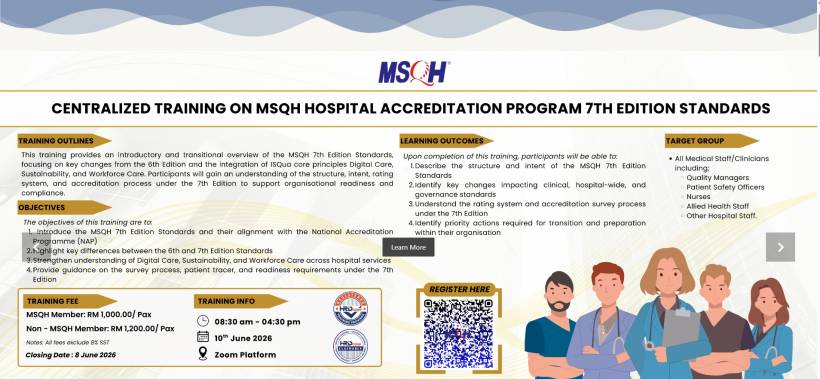
A Centralized Training on MSQH Hospital Accreditation Program 7th Edition Standards, designed to help hospital staff understand the transition from the 6th Edition to the 7th Edition. The training covers key changes such as the integration of ISQua core principles, Digital Care, Sustainability, and Workforce Care, while also guiding participants on the new structure, accreditation intent, rating system, survey process, patient tracer approach, and organisational readiness. The session is targeted at medical staff, clinicians, quality managers, patient safety officers, nurses, allied health staff, and other hospital personnel.
Self-Assessment Becomes a Practical Readiness Tool
The MSQH Self-Assessment Tool for the 7th Edition is designed to help healthcare facilities evaluate their readiness before going through an external accreditation survey. This is useful because accreditation preparation should not begin only when the survey date is near.
A proper self-assessment allows each department to review its own compliance, identify missing evidence, recognise workflow gaps, and plan corrective actions. It also helps hospital leadership understand which areas are ready and which require support.
The value of self-assessment is not only in scoring. Its real value is in the discussion that happens after the gaps are found. For example, if a department scores poorly in incident review, the next question should be why. Is it because incidents are not reported? Are staff afraid to report? Is the form too complicated? Are corrective actions not tracked? These discussions are what turn accreditation into real quality improvement.
What Hospitals Should Start Preparing Now
Hospitals that want to be ready for the 7th Edition should begin by reviewing their existing 6th Edition documents, but they should not stop there. They need to check whether each policy is actually implemented and whether evidence is available to prove it.
Departments should start updating their risk registers, reviewing incident trends, strengthening root-cause analysis, improving clinical audit follow-up, and ensuring that staff understand the standards relevant to their work. Training is also important because accreditation readiness cannot depend only on managers. Frontline staff must be able to explain their processes clearly and confidently.
Hospitals should also improve how they manage evidence. Instead of rushing to collect documents near the survey period, evidence should be maintained continuously. Meeting minutes, audit reports, training records, competency assessments, maintenance logs, patient feedback, incident reviews, and improvement plans should be organised as part of normal operations.
Why This Matters for Patients
For patients, accreditation may sound like an administrative exercise, but it has a real impact on care. Strong standards help ensure that hospitals have proper systems for infection prevention, medication safety, emergency response, patient rights, clinical governance, and safe service delivery.
When accreditation is done properly, it supports a safer hospital environment. Patients benefit from clearer processes, better communication, reduced risk, more accountable leadership, and stronger monitoring of care quality.
The 7th Edition's focus on operational excellence and risk-based practice is especially important because patients do not experience policies on paper. They experience the actual care process, from registration to consultation, treatment, procedure, discharge, billing, follow-up, and complaint handling. A good accreditation framework should improve that full journey.
Final Thoughts
The MSQH 7th Edition represents more than a routine update to hospital accreditation standards in Malaysia. It reflects a broader shift in healthcare quality, where hospitals are expected to prove that safety, governance, risk management, digital care, workforce support, sustainability, and continuous improvement are part of everyday operations.
The transition from documentation-based compliance to operational excellence is a healthy and necessary move. Hospitals cannot rely only on prepared files and last-minute audit readiness. They need systems that work every day, for every patient, across every department.
While the final enforcement timeline should still be confirmed directly through MSQH's official notices, hospitals should already treat the 7th Edition as a signal of where accreditation is heading. The best approach is to start preparing early, strengthen internal self-assessment, close operational gaps, and build a culture where quality is not just something done for surveyors, but something practiced daily for patient safety.











Comments 0