

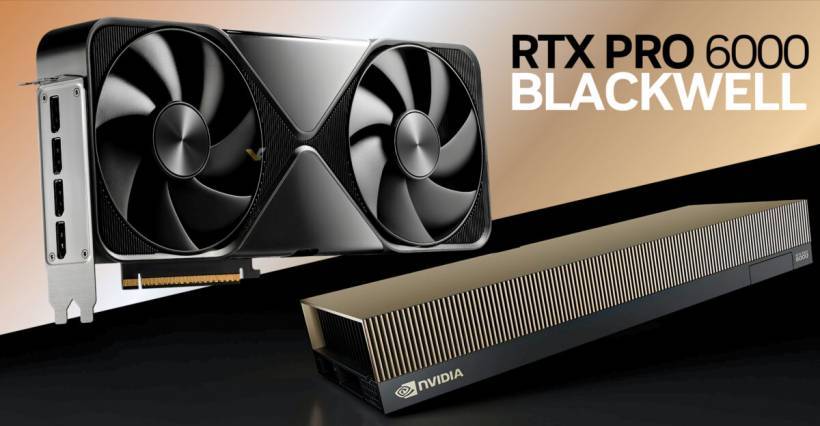
Let's address the headline first: an RTX Pro 6000 priced around MYR 40,000 is not a "gaming GPU with a ridiculous price tag." It's a workstation-class accelerator built for people who make money when projects render faster, simulations converge sooner, AI models fine-tune locally, or huge scenes stop crashing halfway through a deadline week. In other words, it's less "frame per second" and more "hours saved, jobs delivered, clients happy."
Also worth noting: street pricing swings a lot by region, reseller margin, and whether you're looking at a specific edition (Workstation, Max-Q, Server), availability, and bundle/support terms. In Malaysia, I'm seeing listings for the RTX Pro 6000 Blackwell well above RM40k (often closer to the high-RM40k to RM50k range), so your RM40k tag could be a "good deal," a promo, or a different supply channel.
What you're paying for: the "Pro" bits that actually matter
The RTX Pro 6000 Blackwell Workstation Edition's headline spec is its massive 96GB GDDR7 memory with ECC. That combination is basically the superpower: it lets you load bigger datasets, bigger scenes, larger textures, higher-res geometry, and more demanding AI workloads without immediately hitting the wall. NVIDIA's own product page calls out 96GB GDDR7 ECC, DisplayPort 2.1, and a hefty 600W power draw.
A few practical "Pro" advantages that tend to justify the cost in real workplaces:
• Certified drivers and pro app optimizations (think CAD, DCC, visualization, virtual production).
• Serious multi-display and high-resolution workstation setups (DP 2.1 support is part of the platform story).
• The kind of compute + memory bandwidth combo that's aimed at "big workloads," not "best value."
Performance: yes, it's fast… but that's not the whole point
If you only judge it like a gamer, you'll end up with a very expensive conclusion: "it's faster, but not that much faster than top consumer cards." That's exactly what some benchmark coverage shows when comparing it to halo gaming GPUs. For example, GamersNexus found the RTX Pro 6000 landing slightly ahead of an RTX 5090 in a 4K gaming test, but the cost-per-gain is obviously brutal if your goal is purely gaming.
But flip the lens to workstation reality and it starts making sense:
• Pro visualization/rendering and complex scenes often scale better with memory capacity than with raw "gaming FPS."
• Stability and predictability matter when you're running long jobs overnight (or for days).
StorageReview's workstation-focused testing highlights strong results in AI-style workloads (their review includes benchmarks such as Stable Diffusion performance).
The "hidden" cost: power, cooling, and the rest of the workstation
This GPU is rated up to 600W on its own. That means you're not just buying the card:
• You're buying airflow and thermal design that can handle sustained loads.
• You're buying a case and motherboard layout that won't turn into a space heater puzzle box.
NVIDIA lists 600W max power for the Workstation Edition, and that's a real planning number, not a suggestion.
Should you buy it at ~RM40,000?
Here's the simplest way to decide. It's worth it if the answer is "yes" to at least one of these:
• Your work involves large AI, massive 3D scenes, heavy simulation, or multi-app pipelines where stability is money.
• You need ECC VRAM for reliability expectations, enterprise workflows, or client deliverables.
• You're in a studio/enterprise environment where certified drivers and predictable behavior are part of the requirement, not a nice-to-have.
It's probably not worth it if:
• Your "workloads" are light content creation that already runs fine on a high-end consumer card.
• You don't need the 96GB VRAM headroom (because that's a major chunk of what you're paying for).
What about alternatives?
If your goal is "serious workstation, but less wallet damage," consider these typical alternatives:
• Top-end GeForce cards: great raw performance per ringgit, but you give up the pro stack benefits (and the giant ECC VRAM safety net).
• Data center/workstation crossover cards depending on your use case (especially if your workflow is more compute than graphics).
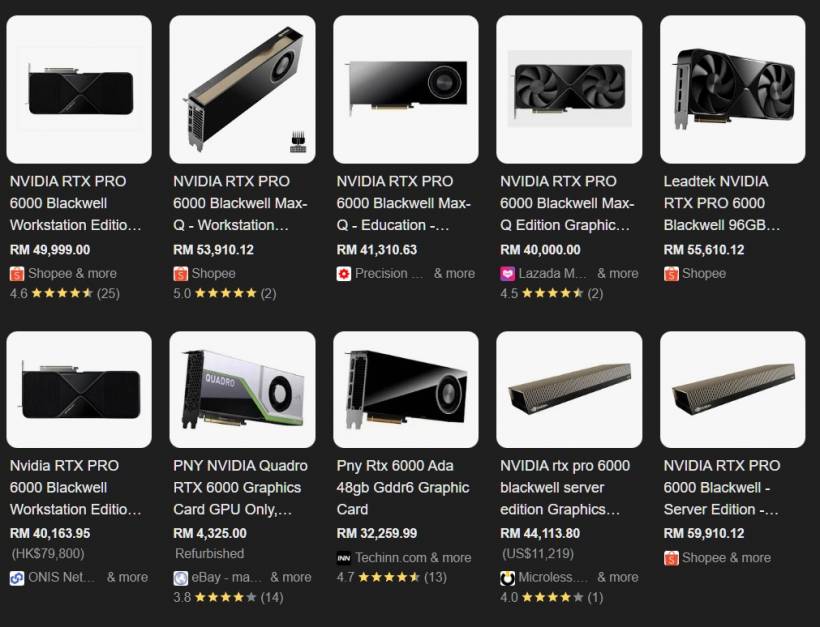
One caution: pricing can be wildly inconsistent. I've seen Malaysia listings for RTX 6000 Ada at extremely high numbers too, so it's worth comparing multiple local sellers and checking what's included (warranty terms, tax, availability, support).
Final thoughts
At around MYR 40,000, the RTX Pro 6000 is only "reasonable" in one context: when it directly reduces expensive time. If your day-to-day work regularly pushes VRAM limits, or your projects are large enough that stability and memory headroom are the difference between smooth delivery and constant firefighting, this GPU earns its keep. If not, it's going to feel like buying a heavy-duty crane to hang a framed picture: impressive, but wildly unnecessary.
If you tell me what you'll actually run on it (Blender scenes, Unreal virtual production, SolidWorks, local LLM fine-tuning, medical imaging, etc.), I can sanity-check whether the 96GB ECC VRAM is a must-have or just a very expensive flex.











Comments 0