

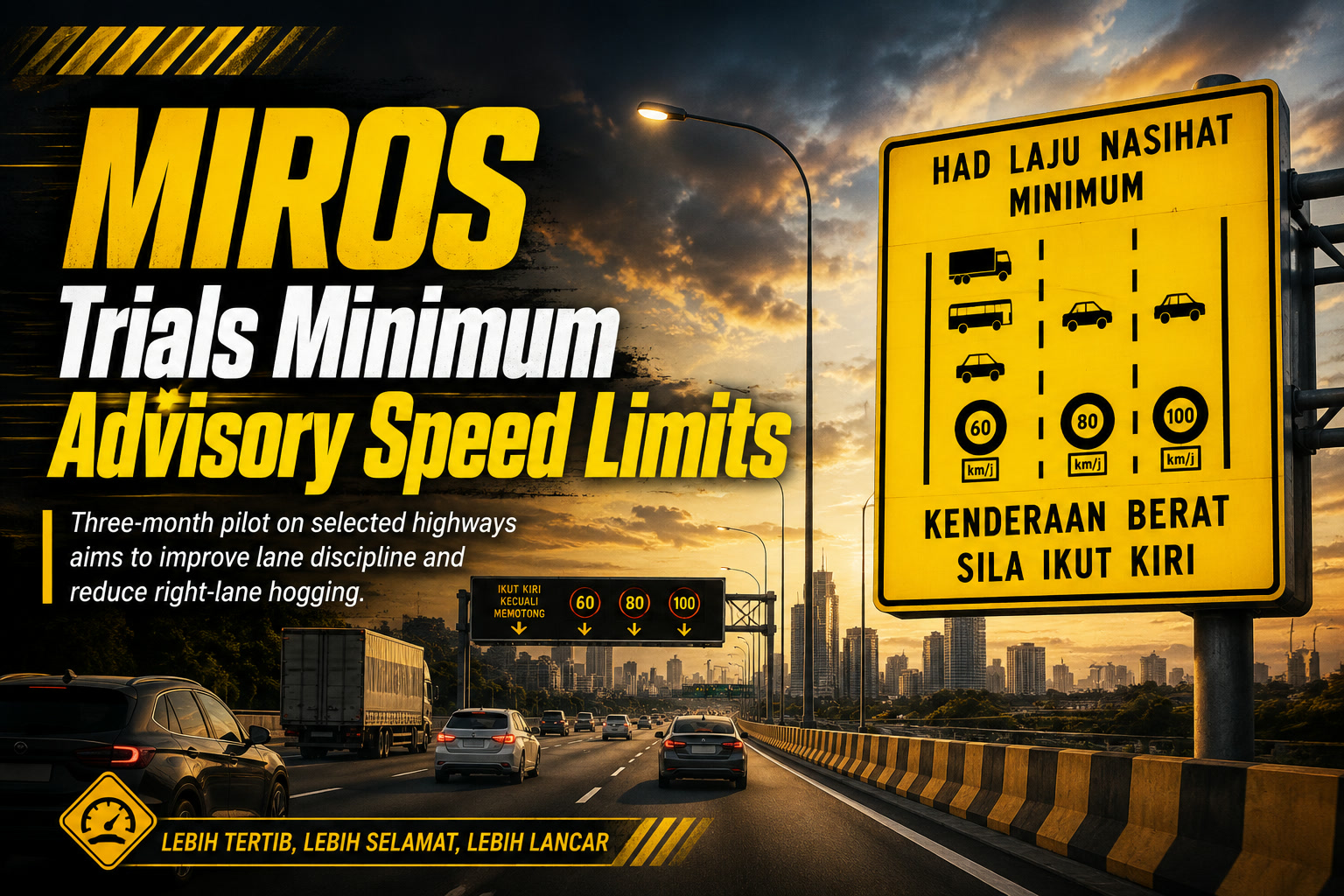
Anyone who regularly drives on Malaysian highways has probably encountered the same frustrating situation: the right lane is clear ahead, but one slower vehicle continues cruising there while faster traffic builds up behind it. MIROS is now testing whether clearer speed guidance can help reduce that behaviour.
The Malaysian Institute of Road Safety Research has started a three-month pilot programme introducing minimum advisory speeds according to highway lane, with the aim of encouraging motorists to choose lanes that better match their travelling speed.
The trial began on 1 August 2026 and will continue until 31 October 2026 across selected stretches of three highways. For now, this remains a proof-of-concept rather than a change to Malaysia's road laws.
The Main Target Is Lane Hogging, Not Slow Driving Itself
The idea is not simply to tell everyone to drive faster.
Instead, MIROS wants motorists to better understand that different lanes serve different traffic flows. A driver travelling considerably slower than surrounding vehicles may be perfectly fine doing so in the left lane, but occupying the rightmost lane at the same speed can disrupt traffic and encourage risky overtaking.
This is where the minimum advisory speeds come in.
Rather than treating every lane as interchangeable, the guidance essentially tells motorists: if you are travelling at this sort of speed, this is the lane you should probably be using.
That could make lane discipline easier to understand than relying only on the familiar "keep left unless overtaking" message.
How The Recommended Speeds Work
The advisory speeds differ depending on how many lanes the highway has.
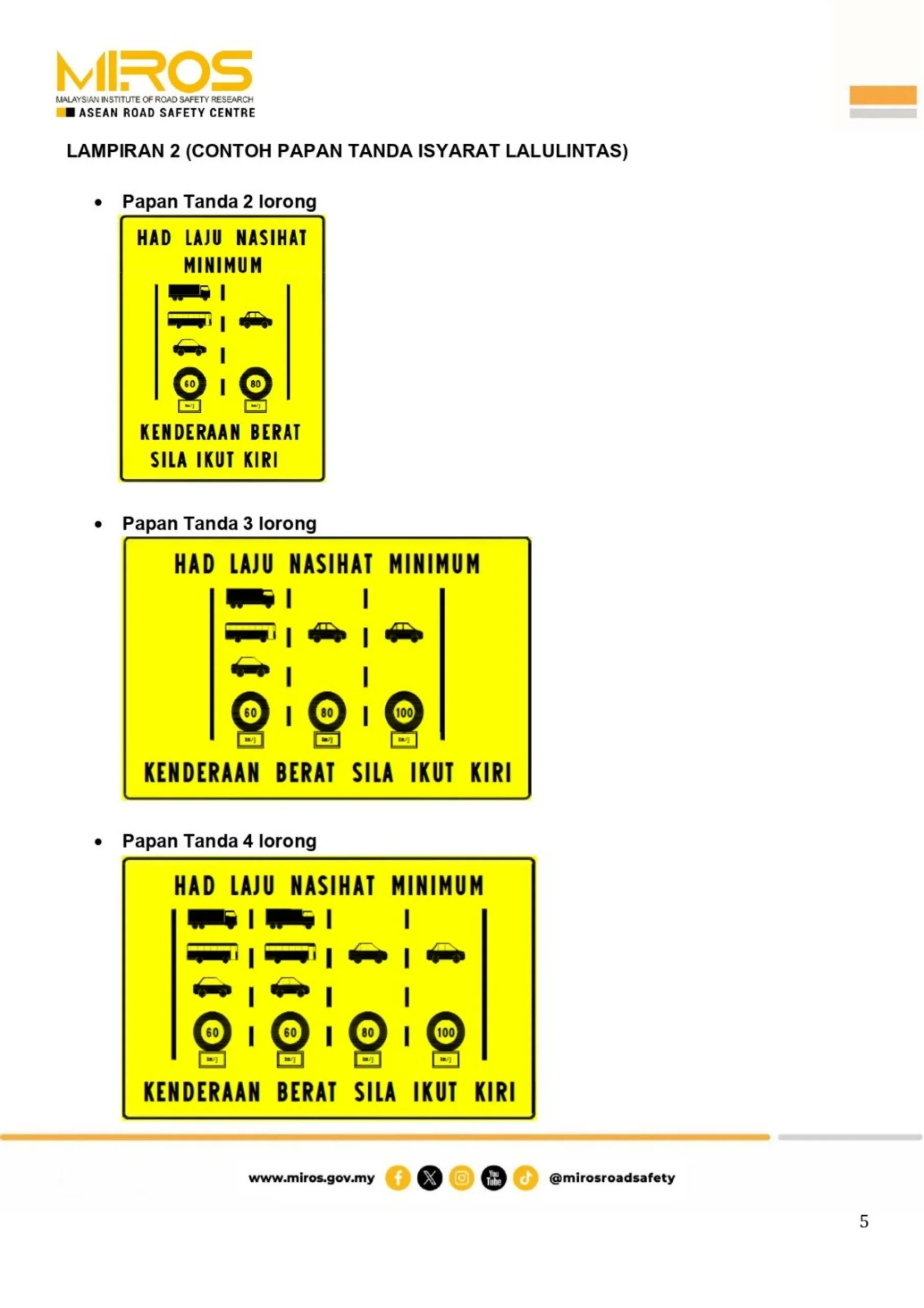
For a two-lane highway, MIROS recommends:
For a three-lane highway, the recommendation becomes:
On a four-lane highway, MIROS recommends:
The intention is straightforward. Faster-moving traffic should generally remain toward the right, while motorists travelling at lower speeds should keep further left.
This should theoretically reduce situations where vehicles travelling at 70km/h or 80km/h remain in a lane being used by traffic moving much faster.
Three Highway Stretches Have Been Selected
MIROS is not implementing the system nationwide yet.
Instead, the pilot is being conducted along three specific highway sections where traffic behaviour can be monitored closely.
The first is on the PLUS Expressway E1, covering approximately KM400.3 to KM388.0 northbound between Tanjung Malim and Behrang.
The second involves the South Klang Valley Expressway (SKVE) E26, from KM10 to KM16.7 between the Ayer Hitam Toll Plaza and Bandar Saujana Putra.
The third location is another PLUS section on E2, covering KM268.5 to KM278.8 northbound between Bandar Ainsdale and Nilai.
MIROS is working together with the Malaysian Highway Authority (LLM), PLUS Malaysia Berhad and SKVE during the project.
Drivers using those stretches should also begin seeing dedicated signage informing them of the recommended speeds for each lane.
This Is Not A New Minimum Speed Law
The most important thing to understand is that the numbers are currently advisory.
A 100km/h recommendation on the right lane does not mean a driver is legally required to maintain exactly 100km/h at all times.
Traffic conditions still come first.
If there is heavy rain, poor visibility, congestion, an accident, roadworks or another hazard, motorists are expected to slow down accordingly.
Likewise, instructions from police officers, highway personnel or emergency responders take priority over the advisory signs.
So if traffic is crawling at 30km/h because of an accident ahead, nobody is expected to somehow maintain the suggested minimum speed just because the sign says 100km/h.
The system is designed to improve normal traffic flow, not override basic road safety.
The Existing Maximum Speed Limit Still Applies
There is another potential misunderstanding MIROS will need to make very clear.
A sign recommending 100km/h in the right lane does not turn that lane into an unrestricted fast lane.
Malaysia's existing legal maximum speed limits remain unchanged.
If a particular stretch has a maximum limit of 110km/h, motorists must still remain within that limit regardless of which lane they are using.
The advisory minimum is therefore best understood as lane-selection guidance rather than permission to travel faster.
In practical terms, MIROS is trying to create a sensible speed range for each lane while keeping the existing legal ceiling intact.
Why Lane Hogging Can Become A Safety Problem
Lane hogging is often discussed as an annoyance, but it can also affect road safety.
When a slow-moving vehicle remains in the right lane, faster motorists begin forming a queue behind it. Some drivers then attempt to overtake from the left, weave between lanes or follow the slower vehicle too closely.
That introduces additional lane changes and speed differences into the traffic flow.
A highway where vehicles with similar travelling speeds naturally group themselves into appropriate lanes should theoretically experience smoother traffic movement.
It also makes other motorists' behaviour more predictable.
Drivers can reasonably expect the right lane to carry faster-moving traffic while slower vehicles remain toward the left.
The challenge, of course, is getting motorists to actually follow that convention.
Why Advisory Speeds May Work Better Than Another Enforcement Campaign
Malaysia already has plenty of road signs reminding motorists to keep left unless overtaking.
Yet anyone who uses the highways regularly knows that lane discipline remains inconsistent.
One reason may be that some motorists do not consider themselves to be lane hogging.
Someone travelling at 90km/h may believe that their speed is perfectly reasonable and therefore see no problem remaining in the right lane, even if several vehicles are travelling faster behind them.
Lane-specific advisory speeds make the message more concrete.
Instead of simply saying "keep left", motorists are given a clearer indication of how traffic is expected to distribute itself.
Whether that actually changes behaviour is precisely what MIROS now wants to find out.
Other Countries Already Use Minimum Speed Rules
Minimum speed requirements are not particularly unusual internationally.
In the United States, minimum speed limits can be introduced in areas where excessively slow-moving vehicles could interfere with normal traffic flow. Traffic authorities have dedicated road signage for minimum speeds, although the specific regulations vary between states and jurisdictions.
Japan also allows minimum speeds to be established through road signs or markings. Drivers are generally expected to comply unless slowing down becomes necessary because of traffic conditions, legal requirements or hazards.
The United Kingdom similarly has recognised minimum-speed signs, although they are used only in specific locations rather than automatically applying across every motorway.
Malaysia's experiment is somewhat different because the current MIROS project is focused on advisory lane guidance rather than immediate legal enforcement.
That gives researchers an opportunity to see whether motorists voluntarily adjust their behaviour before policymakers consider anything more formal.
MIROS Will Be Watching How Drivers React
During the three-month trial, MIROS will collect traffic data and observe how motorists respond to the new signage.
Researchers will presumably be interested in whether vehicles begin distributing themselves more appropriately across lanes, whether average traffic flow improves and whether fewer slow vehicles remain in the rightmost lane.
The findings could then help authorities determine whether the system deserves a wider rollout.
It may also reveal whether simply providing advisory speeds is enough, or whether additional measures such as public education, clearer signage or eventual enforcement would be necessary.
The Real Test Is Whether Malaysians Actually Follow It
The concept itself is fairly logical.
If motorists travelling at similar speeds use the same lanes, highway traffic should become smoother and overtaking behaviour more predictable.
The difficult part is changing habits.
Because the current recommendations carry no new penalties, drivers who routinely cruise slowly in the right lane technically have little additional enforcement pressure compelling them to move over.
Much will therefore depend on whether the new signage is clear enough to influence behaviour voluntarily.
And that could ultimately be the most valuable part of this pilot.
Rather than immediately introducing another regulation, MIROS gets three months of real-world data showing whether Malaysian motorists actually respond to lane-specific speed guidance.
Final Thoughts
The minimum advisory speed trial looks like a sensible attempt to tackle one of the more persistent frustrations on Malaysian highways without immediately creating another offence or issuing more summonses.
It also addresses the problem from a slightly different angle.
Instead of focusing entirely on maximum speed, MIROS is looking at speed differences between lanes and how those differences affect overall traffic flow.
If motorists understand that the right lane is intended for faster-moving traffic while lower-speed vehicles should stay further left, highways could become both smoother and more predictable.
Whether advisory signs alone can convince habitual lane hoggers to change their behaviour is another question entirely.
That is exactly what the next three months should help MIROS find out.











Comments 1