

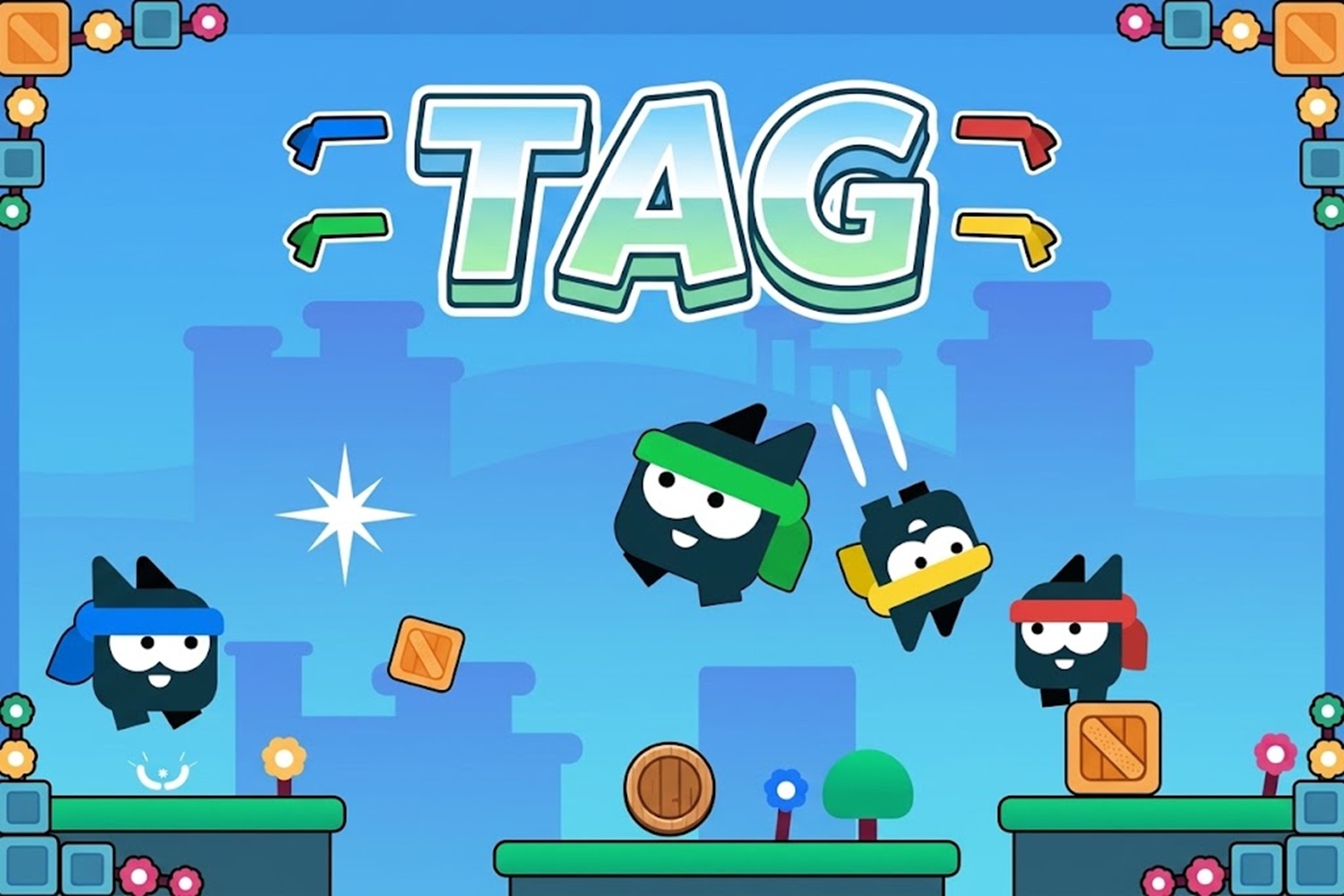
TAG takes one of the simplest playground games imaginable and turns it into a frantic local multiplayer platforming contest. Two to four players share the same device, running and jumping around compact arenas while one unlucky participant becomes the active tagger. Touch another player and the role immediately transfers, transforming the hunter into the hunted without interrupting the match. The concept takes only seconds to understand, but once several players start predicting one another's movements, cutting off routes, and making desperate escapes, the simplicity quickly develops into genuine competition.
Instead of introducing complicated weapons, character abilities, or lengthy objectives, TAG concentrates almost entirely on movement and positioning. Three different levels provide platforms, shortcuts, bounce points, and opportunities to approach another player from unexpected directions, while a one-use teleport can completely change a chase when activated at the right moment. Because everyone is playing together on the same keyboard, the game naturally creates the kind of noisy, unpredictable atmosphere that works particularly well with friends sitting around one screen. Short rounds make losing easy to accept because another rematch can begin almost immediately.
Now playable online through Lemon Web Games, TAG brings its fast local multiplayer chasing directly into the web browser, allowing two, three, or four players to compete together without needing a complicated setup. Each player receives their own controls, while the white arrow identifies whoever is currently "it," making the situation easy to understand even when several characters are moving through the arena simultaneously. The goal is not simply to run faster than everyone else but to use the stage intelligently, anticipate where opponents are going, and avoid holding the tag when the decisive moment arrives. For anyone looking for a simple browser party game that can become competitive within minutes, TAG delivers a surprisingly effective multiplayer experience.
The Rules Are Instantly Understandable
TAG succeeds because almost no explanation is necessary before the first round. One player begins as the tagger, the game clearly marks that character, and touching another participant transfers the role. Everyone immediately understands why they should either chase someone or run away. The basic objective is as intuitive as the playground game that inspired it.
That accessibility makes TAG especially suitable for mixed groups where not everyone plays games regularly. Experienced players do not need to sit through lengthy tutorials, while newcomers can understand what is happening simply by watching for a few seconds. Movement and jumping are the only essential skills needed to participate. Strategy develops naturally after players become comfortable with the maps.
Simple rules also make every mistake easy to understand. If someone gets tagged, there is usually an obvious reason: they were cornered, took the wrong route, mistimed a jump, or failed to notice the tagger approaching from another direction. The game provides immediate feedback without needing complicated statistics.
The White Arrow Makes the Tagger Impossible to Miss
With several players moving through the same compact arena, identifying the current tagger needs to be effortless. TAG solves this using a white arrow above the character who is presently "it." That simple visual indicator keeps everyone informed regardless of how chaotic the match becomes. Players can immediately adjust their behavior depending on who is being marked.
For the tagger, the arrow effectively announces their intentions to everyone else. Other players know exactly who should be avoided and can begin moving before the chase even reaches them. This prevents the role from feeling hidden or confusing. The challenge comes from escaping someone whose identity is completely obvious.
The arrow also creates amusing moments when the role changes rapidly. A player can confidently chase someone into a corner, make contact, and instantly discover that the target has become the new hunter. The visual switch reinforces that reversal immediately.
Touching Another Player Instantly Reverses the Chase
The most important mechanic is the immediate transfer of the tag. There is no waiting period after a successful catch and no separate scoring screen interrupting the action. The moment the tagger touches another player, the entire relationship changes. The former hunter suddenly needs to escape from the person they were just chasing.
This creates constant reversals. A player who appeared completely safe can become the centre of attention within seconds, while someone trapped moments earlier may suddenly have the advantage. Because the game never pauses for these changes, everyone needs to remain aware of the situation continuously. There is rarely a completely safe moment.
That instant role reversal is also where much of the humor comes from. Two players can repeatedly tag one another in a small space while everyone else takes advantage of the chaos to disappear across the map. Even simple contact can trigger a chain of frantic reactions.
Running Away Is Only Half the Challenge
At first, escaping seems straightforward: move in the opposite direction from the tagger. That approach works temporarily, but it becomes less effective once players understand the map. A skilled chaser can predict where a fleeing opponent is likely to land and move toward the destination rather than following directly behind. Running becomes more about route selection than raw speed.
Players also need to consider where other opponents are positioned. Escaping toward a crowded section may create additional obstacles or leave the player with fewer routes. Moving into an apparently quiet corner can be equally dangerous if there is no easy exit. Good positioning means preserving options.
Experienced players therefore begin thinking several seconds ahead. Instead of asking only where the tagger is now, they consider where everyone will probably be after the next jump. This turns a very simple chase game into a surprisingly tactical platforming contest.
The Tagger Needs to Predict Rather Than Follow
Chasing directly behind another player can work against beginners, but experienced opponents quickly become difficult to catch that way. The better strategy is often to intercept rather than follow. A player heading toward an upper platform may already have committed to a jump, giving the tagger a chance to approach the landing point instead. Prediction becomes the most important offensive skill.
Shortcuts make this especially valuable. The tagger might deliberately take a different route and reach the target from the opposite side. A player who thinks they have created distance can suddenly discover the hunter waiting ahead. These moments make learning each stage extremely important.
The strongest taggers also observe individual habits. One player may always escape upward while another prefers dropping to lower platforms. Recognizing these patterns makes interception much easier. Playing repeatedly against the same friends naturally creates additional mind games.
Three Levels Keep the Chases Varied
TAG includes three different levels, giving players several environments in which to compete. Although the core rules remain identical, each layout changes how players move and where dangerous situations develop. Platforms, vertical routes, bounce opportunities, and shortcuts can make one arena feel substantially different from another. Learning all three adds replay value.
A route that works brilliantly on one map may not exist on another. Players need to adapt rather than relying on the same escape strategy every round. Some areas encourage vertical movement, while others create tighter confrontations where opponents are difficult to avoid. The stage becomes part of the competition.
Changing maps also prevents the same players from always dominating through one memorized strategy. Someone particularly strong on one level may struggle more on another. This gives groups a reason to rotate through the available arenas rather than staying in one place.
Platforms Turn Tag Into a Movement Game
The arenas are built around platforming rather than flat ground, giving players multiple heights and routes through the same area. Jumping upward can create distance from a pursuing opponent, while dropping to a lower platform can unexpectedly reverse direction. Vertical movement makes direct pursuit much less predictable. Players need to watch more than one path at once.
Platforms also create commitment. Once a player jumps toward a certain location, their options become temporarily limited. A tagger who correctly predicts that movement can be waiting at the landing point. Poorly chosen jumps can therefore be more dangerous than simply staying on the same level.
This structure prevents the game from becoming a basic race around a rectangular room. Movement constantly involves decisions about height, direction, and momentum. The arenas effectively become small playgrounds designed around pursuit.
Shortcuts Reward Players Who Learn the Maps
Knowing the fastest way between two points can completely change a chase. TAG's shortcuts allow experienced players to reach areas that might take someone else considerably longer using the obvious route. A fleeing player can use one to suddenly create distance, while the tagger can use the same knowledge to intercept. Map familiarity becomes a genuine advantage.
Shortcuts are especially effective because the arenas are compact. Saving even a small amount of travel time can determine whether a tag succeeds. Players gradually stop moving randomly and begin using specific routes depending on where the chase is heading. Movement becomes more deliberate.
This creates a satisfying learning curve without requiring character upgrades. The game itself does not need to make players faster. They become effectively faster because they understand how to navigate the stage more efficiently.
Bounce Points Create Sudden Changes in Direction
Bounce areas add another unpredictable movement option. Instead of relying entirely on standard jumping, players can use these points to move rapidly through parts of the level or reach different elevations. A well-timed bounce can create an impressive escape. A badly judged one can send the player directly toward danger.
These mechanics are especially useful when the tagger is approaching from a predictable direction. Launching away can instantly break the normal chase pattern. However, experienced opponents may begin anticipating where the bounce will send the player. What initially feels like an automatic escape eventually becomes another tactical choice.
Bounce points also contribute to the game's playful feel. Characters flying through the arena make the action more visually energetic and create situations that would not be possible on flat terrain. They fit naturally with the exaggerated party-game design.
The One-Use Teleport Can Save a Desperate Escape
One of TAG's most interesting tools is the single-use teleport. Because it cannot simply be activated repeatedly, players need to think carefully about when it is worth spending. Using it too early may waste a potentially match-saving option, while waiting too long can result in being tagged before it ever becomes useful. Timing matters enormously.
The teleport is particularly effective when a player has been trapped or when the tagger believes a catch is guaranteed. Activating it at the last possible moment can completely reverse the situation and leave the hunter moving toward empty space. Those escapes can become some of the funniest moments in a match.
Its limited availability also prevents it from dominating the entire game. Players still need strong movement and map knowledge for most of the round. The teleport acts as an emergency trick rather than a permanent solution.
Saving the Teleport Becomes a Mind Game
Once players know everyone has access to a one-use escape, chasing becomes more psychological. The tagger may deliberately pressure an opponent without fully committing, hoping to force the teleport early. If that happens, the target loses an important defensive option for later. Resource management becomes part of the chase.
The escaping player faces the opposite decision. They need to judge whether the current situation is genuinely dangerous enough to justify using the teleport. Sometimes a normal jump or shortcut would have been sufficient. Wasting it can become painful later.
This adds strategic depth without adding complicated controls. One simple limited-use mechanic creates decisions that can influence the entire round. Strong players learn to treat it as something valuable rather than immediately activating it under pressure.
Two-Player Matches Become Direct Duels
With only two participants, TAG becomes an extremely focused contest. There is nowhere else for the tagger to look and no third player who can accidentally become involved. Every movement is directly connected to one opponent. The result feels almost like a platforming duel.
Two-player games place even greater importance on prediction. Because each player is always watching the other, obvious escape patterns become easy to recognize. Players begin faking one direction before suddenly changing course. The chase can become surprisingly psychological.
This mode is also excellent for learning the maps. With fewer characters creating visual chaos, players have more time to understand shortcuts, jumps, bounce points, and teleport opportunities. Skills developed here transfer naturally into larger matches.
Three Players Add Opportunistic Movement
Adding a third participant changes the dynamic considerably. The tagger now needs to choose which opponent to pursue, while the other two players can position themselves according to that decision. Someone who is currently being ignored may move toward a strategically useful area in preparation for the next role change. The match becomes less predictable.
The presence of another player can also accidentally interfere with escape routes. Two runners may move toward the same platform and block one another's preferred path. A tagger can exploit that confusion. Crowding becomes another hazard.
Three-player games also create interesting moments after a successful tag. The former tagger may suddenly disappear while the newly tagged player chooses which of two opponents to chase. Alliances do not formally exist, but temporary patterns can emerge naturally.
Four-Player Matches Become Proper Party-Game Chaos
With four players sharing the arena, TAG becomes its most chaotic. Several characters can cross paths simultaneously, making it difficult for the tagger to maintain one clean pursuit. An intended target may suddenly disappear behind another player, while a shortcut can bring someone else unexpectedly into the chase. The arena feels constantly occupied.
Four-player rounds also make positioning more complicated for runners. Escaping from the tagger is not enough if another player is blocking the obvious route. Moving toward the wrong area can effectively trap someone between the hunter and the rest of the group. Awareness of everyone becomes increasingly important.
This is where TAG works especially well as a social game. Even players waiting safely on the opposite side of the arena remain involved because the chase can reach them quickly. Everyone tends to react vocally when the role suddenly changes.
Shared Keyboard Controls Make It a True Local Multiplayer Game
TAG is designed around multiple people playing together on the same device. Each player receives their own keyboard controls, allowing everyone to move simultaneously rather than taking turns. This creates an experience closer to classic couch multiplayer than online matchmaking. The social environment around the screen becomes part of the game.
Shared controls also make the game easy to start with friends. There are no accounts to create, teams to organize, or remote lobbies to manage. Players simply gather around the same computer and begin. That immediacy suits the simple tag concept perfectly.
The physical closeness can even add to the entertainment. Players can see one another reacting in real time, laugh at mistakes, and immediately demand rematches. TAG is designed as much for the people sitting around the keyboard as the characters on the screen.
Short Rounds Keep Everyone Involved
A party game needs to avoid leaving players waiting too long after a mistake, and TAG's quick match structure helps keep the entire group engaged. There is no lengthy elimination period where one person stops playing while everyone else continues. The role simply transfers and the chase goes on. Everyone remains part of the action.
Short rounds also make rematches almost automatic. A player who loses because of one poor jump does not need to wait through a long tournament before trying again. Another game can begin immediately. This keeps competitive frustration relatively light.
Repeated rounds naturally create rivalries. Someone who was consistently difficult to catch may become the group's main target in the next match. The rules stay the same while the social strategy changes around them.
The Timer Creates Pressure Near the End
The match timer is important because it turns ordinary chasing into a much more stressful situation as the final moments approach. Being tagged early is inconvenient, but being tagged with only a few seconds remaining can be disastrous. Players begin treating time differently depending on the current role. The later stages of a round become noticeably more tense.
A player who is safe may become more cautious near the end, choosing secure routes instead of risky shortcuts. The tagger becomes increasingly aggressive because there is less time available to transfer the role. This creates natural escalation without the game needing to increase speed artificially.
Final-second tags are particularly memorable. Someone can spend most of the round successfully avoiding danger and still lose because of one mistimed movement just before time expires. Those dramatic reversals make immediate rematches difficult to resist.
Map Knowledge Eventually Matters More Than Raw Reactions
Beginners often rely almost entirely on quick reflexes. They see the tagger approaching and move in whichever direction appears open. Experienced players begin treating the map more deliberately. They know where certain platforms connect and which routes leave multiple escape options.
This knowledge can make someone appear much faster even though every character moves according to the same basic rules. The advantage comes from choosing efficient paths and avoiding dead ends. A strong player rarely needs desperate last-second movements because they positioned themselves well earlier.
The game therefore provides a meaningful skill curve without complicated mechanics. Learning the environment becomes progression. The more familiar the stage becomes, the more tactical each chase feels.
Corners Can Become Dangerous Traps
Moving away from the tagger does not always mean moving toward safety. A route that creates immediate distance may lead into a section with limited exits. Once there, the fleeing player can become easy to predict. Good taggers deliberately pressure opponents toward these areas.
Escaping players need to recognize these traps before entering them. Staying in more open sections can provide several possible directions when the tagger approaches. Freedom of movement is often more valuable than temporary distance.
This adds another strategic layer to level design. The safest location is not always the point farthest from the hunter. It is often the area that provides the most options.
Fake Movements Can Confuse Experienced Opponents
Once players become familiar with one another's habits, straightforward movement becomes easier to predict. This creates opportunities for deception. A player can begin moving toward a familiar shortcut, encourage the tagger to intercept, then suddenly reverse direction. Even simple controls can support effective feints.
The tagger can use similar tricks. Approaching from one side may push the target toward a predictable escape route, allowing the hunter to change direction and meet them there. The chase becomes a small battle of expectations.
These mind games become especially effective between friends who have played several rounds together. Everyone begins remembering previous mistakes and successful tricks. The social familiarity adds depth that the game itself does not need to program explicitly.
Jump Timing Can Determine Whether a Chase Succeeds
Jumping is fundamental because platforms exist at different heights throughout the arenas. Leaving the ground too early can result in missing a platform, while jumping too late can allow the tagger to make contact before the escape begins. Timing therefore matters almost constantly. Players need to become comfortable with movement rather than simply pressing jump whenever danger appears.
The tagger can also use jump timing offensively. If a target has already committed to an aerial path, the hunter can sometimes position beneath or ahead of the landing point. Aerial movement looks safe but can actually make the fleeing player more predictable. This creates interesting risk.
Better players eventually begin varying their jumps. Sometimes the correct choice is not to jump at all. Keeping movement unpredictable is often more valuable than always choosing the visually fastest route.
TAG Rewards Aggressive and Defensive Players Differently
Some players naturally enjoy chasing aggressively and taking direct routes toward opponents. Others prefer cautious movement, maintaining distance and waiting for danger before reacting. TAG supports both styles because roles change constantly. Someone may be forced to switch from patient defense to aggressive pursuit within seconds.
Aggressive players often excel at forcing mistakes. By staying close to the target, they reduce the time available for decisions. However, excessive commitment can make them vulnerable when the role transfers. The former target may immediately tag them back.
Defensive players tend to preserve space and choose safer routes, but waiting too long can eventually allow the tagger to control the map. Successful play usually requires a mixture of both approaches. Adaptability becomes more valuable than one permanent strategy.
There Is No Need for Complicated Power-Ups
Many modern party games fill arenas with random weapons or temporary abilities. TAG largely avoids that complexity and lets movement remain the central mechanic. The teleport provides one significant tactical tool, but it does not overwhelm the basic pursuit. Players still win primarily by navigating well.
This makes victories easier to understand. When someone escapes brilliantly, it usually happened because of movement, timing, or prediction rather than a random powerful item. The game remains competitive without becoming difficult to read.
The absence of excessive mechanics also makes it easier to introduce new players. Nobody needs to memorize a list of power-ups before they can compete. Running, jumping, chasing, and escaping are enough.
The Visual Simplicity Helps During Chaotic Matches
Multiplayer games with several characters on one screen can become difficult to follow if the presentation contains too much unnecessary detail. TAG keeps attention focused on the players, platforms, and current tagger. The white arrow provides immediate information about the most important role. Players can understand the state of the match at a glance.
Clear visuals become particularly valuable with four participants. Everyone is already moving quickly, so the screen does not need additional distractions. The environment supports the gameplay rather than competing with it for attention.
This simplicity also helps the game remain approachable. New players can quickly identify their own character and the person they need to avoid. The visual language works without lengthy explanation.
Winning Requires Staying Calm Under Pressure
The most dangerous moments often happen when the tagger is extremely close. New players tend to panic, making large movements or jumping without considering where they will land. That panic frequently creates the exact mistake the hunter needs. Remaining calm can produce much better escapes.
A small direction change may be enough to make the tagger miss. Using a nearby platform intelligently can create more distance than rushing toward the opposite edge of the level. The player who stays composed usually has more options.
This becomes especially important during the final seconds of a match. Knowing that time is nearly finished can encourage desperate decisions. Experienced players learn to keep using the same controlled movement that worked earlier.
TAG Is Easy to Learn but Creates Its Own Skill Ceiling
Nothing about the basic control scheme is difficult to understand. Players can move and jump almost immediately, while the tag mechanic requires no explanation beyond contact transferring the role. Yet becoming genuinely difficult to catch takes much longer. Strong play depends on route knowledge, timing, prediction, and awareness of every opponent.
This creates an ideal structure for a casual multiplayer game. Beginners can participate without feeling completely lost, while experienced players still have room to improve. Skill is visible without becoming inaccessible.
The lack of complicated mechanics also makes improvement satisfying. When someone becomes better, they know it came from understanding movement and the maps. There are no character statistics hiding the difference.
Why TAG Works So Well as a Party Game
The best party games produce memorable interactions between players rather than relying entirely on scripted content. TAG provides a simple framework and lets the group create the entertainment. Chases, narrow escapes, accidental collisions, failed teleports, and last-second tags naturally become stories people remember after the round ends. The mechanics create opportunities for social reactions.
The short match length is equally important. Nobody needs to make a long commitment before understanding whether they enjoy the game. A group can play one round or twenty. The experience expands according to how competitive everyone becomes.
Most importantly, TAG is understandable even to someone watching from nearby. A spectator can immediately see who is being chased and why everyone is reacting. That makes it easy for another person to join the next round.
Playing TAG Online Today
Through Lemon Web Games, TAG can now be played directly in your web browser with no downloads or setup required. Features of the web-based version include:
Playing TAG through a browser makes it particularly convenient for spontaneous multiplayer sessions. There is no lengthy campaign to prepare and no requirement for everyone to understand complicated controls. Two players can turn the game into a focused chase, while four players transform the same mechanics into complete chaos. The game adapts naturally to the size and experience of the group.
New players should concentrate first on learning the layout rather than simply running away from the tagger. Understanding where platforms connect and which routes leave multiple exits makes survival considerably easier. Save the teleport for situations where ordinary movement is unlikely to work, and avoid jumping simply because the hunter is nearby. Small improvements in route selection can quickly make a player much more difficult to catch.
Who Should Play TAG
TAG is particularly suitable for groups that want something everyone can understand immediately. A player does not need experience with platformers to understand that the person under the white arrow should be avoided. Within a few rounds, however, everyone begins discovering better routes, shortcuts, and ways to trick the tagger. That natural learning process keeps the game competitive without making it intimidating.
It is also a strong choice for friends playing together around one computer. Because everyone shares the same screen, reactions become part of the entertainment. Narrow escapes, bad jumps, and unexpected role reversals tend to generate immediate laughter or frustration. TAG works best when the competition extends beyond the characters and into the room itself.
Play TAG Online Now
TAG turns the classic playground chase into a compact multiplayer platforming battle where movement, prediction, and timing determine who gets caught. Two to four players share the same arena, one person carries the tag, and touching another character instantly transfers the role. Three different levels provide platforms, shortcuts, bounce points, and tactical routes, while the one-use teleport creates opportunities for spectacular escapes when used at exactly the right moment. The rules remain simple even when the matches become chaotic.
Through Lemon Web Games, players can jump directly into TAG through a modern browser and begin competing together without lengthy setup. Short rounds make it easy to keep playing after narrow defeats, while repeated matches gradually reveal more tactical possibilities within each arena. Learning how friends move becomes just as important as learning the map itself. What begins as basic chasing can quickly become a game of interception, deception, and last-second survival.
Final Thoughts
TAG shows how effective a multiplayer game can be when it concentrates on one strong idea instead of surrounding it with unnecessary systems. Running, jumping, touching another player, and transferring the tag are enough to create constant competition. Platforms and shortcuts add route decisions, bounce points create sudden movement changes, and the limited teleport adds one valuable tactical option without distracting from the chase. Everything supports the central question of whether the current target can escape.
The game becomes more interesting as the players become more familiar with one another. Beginners simply run away, while experienced groups begin predicting routes, forcing teleports, controlling important platforms, and deliberately misleading the tagger. Two-player rounds feel like direct duels, while four-player matches become chaotic social contests where the safest person can suddenly become the target. The same basic mechanics support both experiences.
Through Lemon Web Games, TAG can be enjoyed directly in the browser as a quick local multiplayer challenge that requires almost no explanation before the fun begins. Its short rounds, shared-keyboard controls, three arenas, and constant role reversals make it especially well suited to friends playing together on one device. For players who enjoy simple party games where skill grows naturally through repeated matches, TAG proves that sometimes all a multiplayer game really needs is someone to chase and somewhere clever to run.











Comments 0