

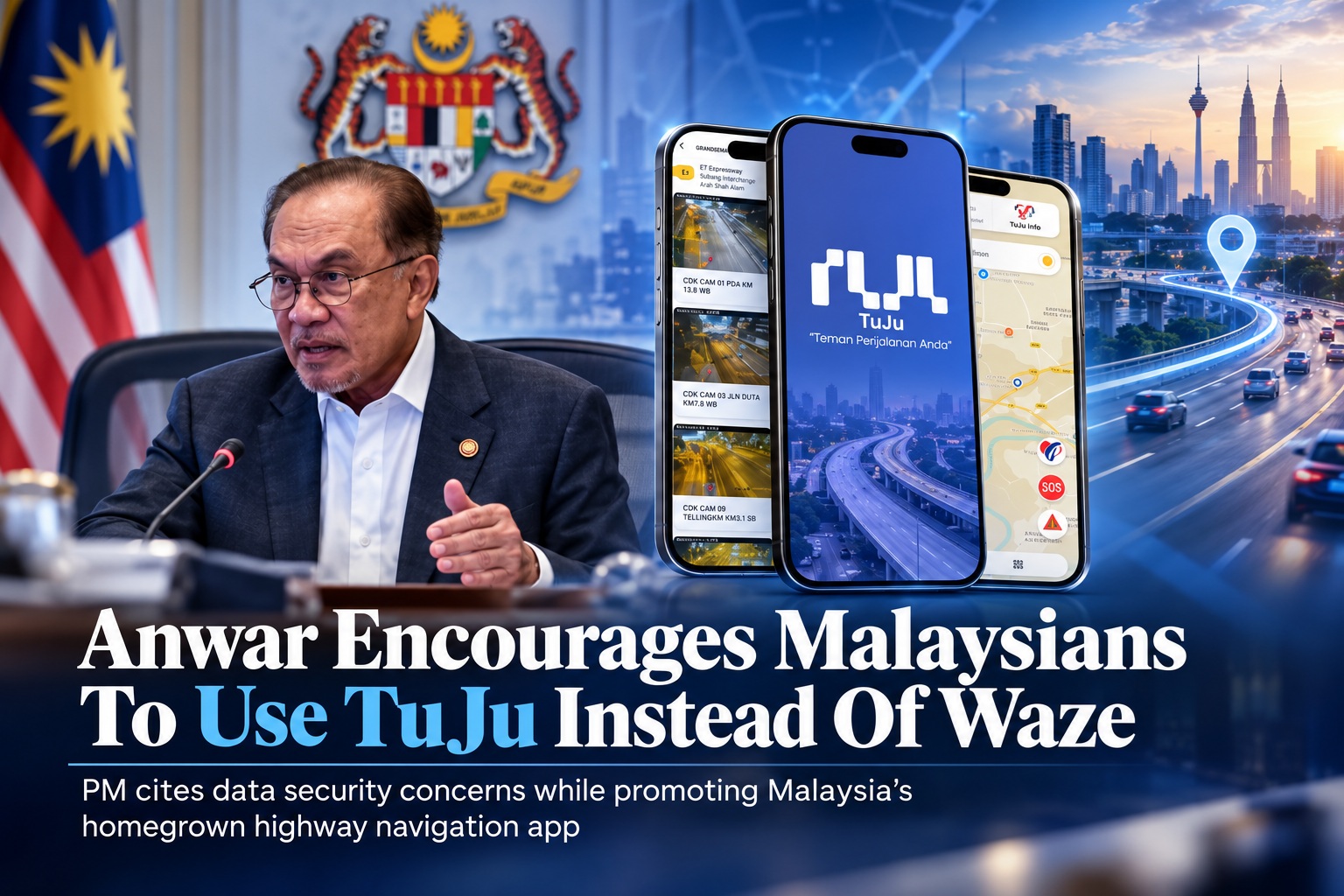
Prime Minister Datuk Seri Anwar Ibrahim has encouraged Malaysians to consider using the locally developed TuJu highway navigation app instead of Waze, citing concerns surrounding the security of data generated from users' movements.
The matter was raised during the latest National Cyber Security Committee meeting, where the government reviewed Malaysia's cybersecurity preparedness and emerging digital risks. Anwar argued that navigation platforms collecting large amounts of location and movement data deserve greater scrutiny, particularly when that information is handled by foreign technology companies.
While Waze's origins and ownership have become part of the discussion, the Prime Minister did not provide details of any specific security incident involving Malaysian users or evidence that Waze data has been misused.
Government Raises Concerns Over Movement Data
Navigation applications naturally process significant amounts of location information.
To provide accurate directions, traffic predictions and route recommendations, the software needs to understand where users are, where they are travelling and how quickly traffic is moving.
When millions of people use the same platform, those individual journeys collectively produce enormous amounts of mobility data.
Aggregated over time, this information can reveal broader patterns such as:
• Popular travel routes
• Traffic congestion patterns
• Frequently visited locations
• Peak movement periods
• Travel habits
• Regional transportation trends
This type of information is extremely useful for navigation.
It can also become sensitive when viewed through the lens of national cybersecurity and data sovereignty.
Why Waze Was Specifically Mentioned
Waze was originally developed in Israel before being acquired by Google in 2013 for close to US$1 billion.
Today, the service operates as part of Google rather than as an independent Israeli startup.
However, Anwar raised concerns over the application's historical and legal connections, suggesting that the platform may be subject to laws outside Malaysia that could create information-security considerations.
No specific mechanism or legal provision was detailed in the statement.
That distinction is important because concerns about jurisdiction are not the same as evidence that user information has actually been misused.
Waze Collects Location And Route Information
Like virtually every real-time navigation platform, Waze needs extensive location information to function.
Depending on account settings and usage, the platform may process information such as:
• Current location
• Travel routes
• Destinations
• Search history
• Device information
• Traffic reports
• Road incidents
Much of the platform's usefulness comes from crowdsourcing this information.
When thousands of drivers report congestion, accidents or road hazards, Waze can dynamically recommend alternative routes.
This crowdsourcing model helped distinguish the service from traditional navigation systems.
Movement Data Can Become Sensitive At Scale
One person's journey may not reveal very much.
Millions of journeys collected over months or years are different.
Large datasets can show when populations move, which routes are important and how traffic patterns change during particular events.
That does not automatically mean the information is dangerous.
But governments increasingly treat large-scale location datasets as strategically sensitive because patterns can reveal more than individual records do.
This is especially relevant as countries become more focused on cybersecurity, digital sovereignty and control over strategically important datasets.
No Publicly Reported Misuse Has Been Established
It is also important not to overstate the concern.
There have been no publicly reported cases in the supplied information showing Waze mobility data being misused in the manner suggested by the broader security discussion.
The government's position appears to be precautionary.
That is different from responding to a confirmed breach.
For users, the decision ultimately becomes one of balancing convenience, trust, functionality and preference.
Malaysia Is Not Alone In Raising Concerns
Malaysia is not the only country where Waze's origins have become part of political or security discussions.
Iraq is reportedly planning to block the application by the end of December 2026.
Communications Minister Mustafa Sanad cited the platform's Israeli origins when announcing the plan.
Iraq's broader legal and political relationship with Israel provides important context.
The country introduced legislation in 2022 criminalising various forms of diplomatic, political, military, economic and cultural ties with Israel.
However, the planned Waze restriction has not been explicitly described as an enforcement action under that particular law.
Malaysia Is Taking A Different Approach
Malaysia has not announced a ban on Waze.
Instead, Anwar is encouraging users to consider a local alternative.
That is a significantly different approach.
Rather than preventing access to an international service, the government appears to be promoting Malaysian-developed technology as the preferred option.
For consumers, Waze remains available.
The question is whether TuJu has become good enough to replace it for everyday navigation.
So What Exactly Is TuJu?
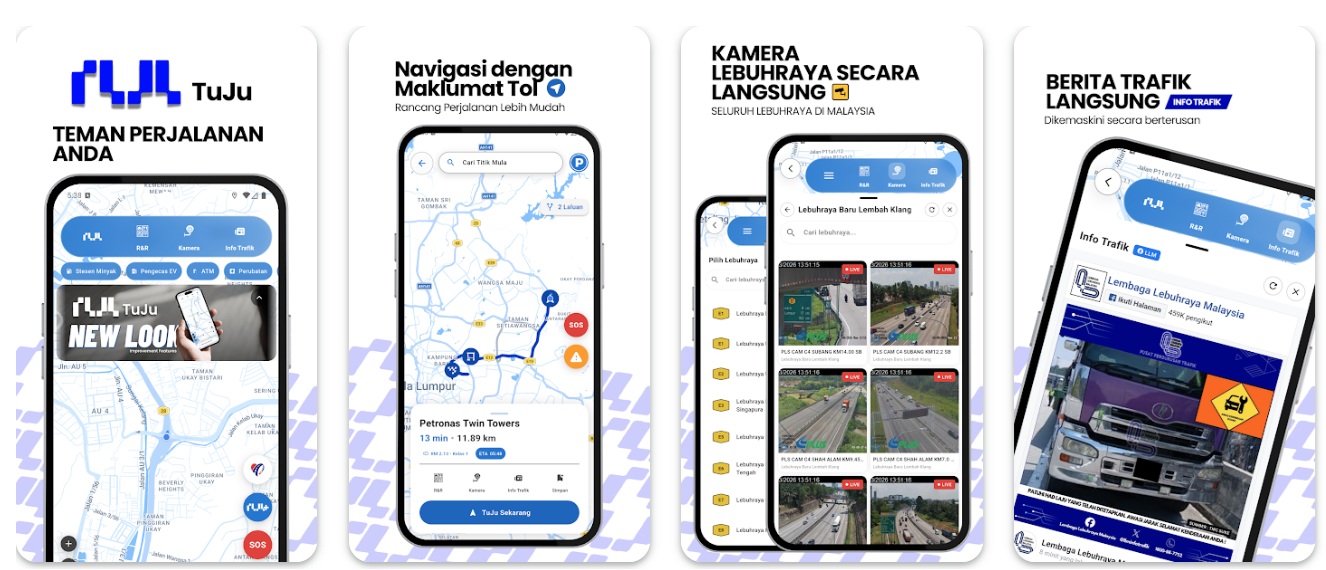
TuJu is a Malaysian highway navigation application developed by the Malaysian Highway Authority, or LLM, together with Prosignal Consortium Sdn Bhd.
The name comes from the Malay word tuju, referring to heading or moving towards a destination.
The application was first introduced in November 2025.
It provides many of the basic functions users would expect from a modern navigation platform, including route guidance, travel distance information and estimated arrival times.
Where it becomes more interesting is its focus on Malaysia's highway network.
TuJu Is Designed Specifically Around Malaysian Highways
Instead of attempting to be a universal mapping platform for every country and every road, TuJu includes features particularly useful for local highway users.
These include:
• Route information
• Estimated travel times
• Toll calculations
• Toll plaza locations
• Rest and service area information
• Nearby petrol stations
• Facility information
• Traffic updates
• Road incident reporting
This local focus could become one of its main advantages.
A Malaysian highway user may care about information that a global navigation platform treats as secondary.
Toll Calculation Is A Particularly Useful Feature
One of the most practical TuJu features is the ability to calculate the total toll cost for a journey.
For frequent Malaysian highway users, that information can be just as useful as the estimated travel time.
Drivers can potentially compare routes not only according to distance and congestion but also according to how much the journey will cost.
That can be especially valuable for longer interstate trips where several toll roads may be involved.
A local navigation service has an obvious advantage when integrating directly with Malaysia's highway ecosystem.
R&R Information Is Built Into The Platform
TuJu also provides information about rest and service areas, commonly known as R&R stops.
This can include nearby facilities and petrol stations.
For longer journeys, knowing where the next rest stop, fuel station or available facility is located can be extremely useful.
These are exactly the kinds of features that could help TuJu differentiate itself from general-purpose navigation applications.
Instead of merely telling you how to reach the destination, the app can potentially become a companion specifically designed around highway travel.
Highway CCTV Snapshots Are Available
Another notable feature is access to highway CCTV snapshots.
Users can check actual traffic conditions along selected routes before or during a journey.
This provides an additional way of verifying congestion rather than relying entirely on automated traffic estimates.
Traffic data derived from smartphones can be very accurate, but seeing an actual camera image provides additional context.
Drivers can potentially determine whether a slowdown is caused by heavy traffic, weather, an incident or another issue.
Users Can Also Report Road Incidents
Like Waze, TuJu includes options for users to report incidents.
Crowdsourced information is one of the reasons modern navigation systems can respond so quickly to changing road conditions.
Users can help identify:
• Traffic accidents
• Road obstructions
• Congestion
• Other highway incidents
The usefulness of crowdsourcing naturally depends on how many people actively use the platform.
This creates one of the biggest challenges for any navigation app attempting to compete with established services.
Navigation Apps Need A Large User Base
The more drivers using a navigation platform, the more real-time traffic information it receives.
That creates a powerful network effect.
Waze became particularly effective because millions of drivers continuously contribute anonymous movement information and road reports.
A new platform starts with fewer users, which means less real-time data.
TuJu therefore needs widespread adoption if it wants to compete with the accuracy and responsiveness users expect from larger global services.
Government encouragement could help accelerate that adoption.
A Local App Could Offer Greater Data Sovereignty
The strongest strategic argument for TuJu may not be navigation features.
It may be data sovereignty.
A locally developed platform gives Malaysian authorities and developers more control over how traffic and mobility information is managed.
Depending on the underlying architecture, this could potentially make it easier to ensure that sensitive datasets remain subject to Malaysian governance and security requirements.
This fits into a much wider government conversation around digital sovereignty.
Malaysia has recently placed increasing emphasis on where government information is stored, how AI processes data and who controls encryption keys.
Location information naturally falls into the same broader discussion.
Local Does Not Automatically Mean Secure
However, being Malaysian-developed does not automatically guarantee stronger cybersecurity.
A local service still needs:
• Secure application development
• Strong encryption
• Proper identity management
• Secure cloud infrastructure
• Data minimisation
• Regular penetration testing
• Vulnerability management
• Transparent privacy policies
Security depends on implementation.
A badly secured local app could theoretically expose more information than a well-secured international platform.
Consumers therefore still need confidence in how TuJu protects data.
Transparency Will Be Important
If TuJu is promoted partly as a more secure alternative, users will reasonably want greater transparency about its privacy and data-handling practices.
Important questions include:
• What location information is collected?
• How long is it retained?
• Where is it stored?
• Who can access it?
• Is information anonymised?
• Is data shared with third parties?
• Can users delete their history?
Clear answers would help distinguish the platform through trust rather than nationality alone.
The National Cyber Security Committee Reviewed Wider Risks
The discussion around Waze and TuJu formed part of a much broader National Cyber Security Committee meeting.
The committee reviewed several areas involving Malaysia's cyber resilience.
Topics included:
• Cyber Security Act 2024 implementation
• MyDigital ID security
• National Critical Information Infrastructure protection
• Post-quantum cryptography
• Autonomous AI risks
• Digital identity security
This shows that the navigation-app discussion was not happening in isolation.
It forms part of a larger government effort to examine technology that processes sensitive or strategically important information.
Post-Quantum Cryptography Is Also Being Prepared
Anwar also highlighted preparations for potential cybersecurity threats created by future quantum computing.
Malaysia is exploring post-quantum cryptography, or PQC, to protect digital systems against attacks that could eventually become possible with sufficiently powerful quantum computers.
This is particularly relevant for long-lived systems such as digital identity platforms.
Information encrypted securely today may need to remain protected for many years.
Preparing for quantum-resistant cryptography before the threat becomes practical gives organisations more time to migrate safely.
Autonomous AI Is Another Emerging Concern
The meeting also covered emerging cybersecurity risks associated with autonomous artificial intelligence.
AI agents are becoming increasingly capable of performing multi-step actions with limited human supervision.
That brings enormous potential benefits.
It also introduces new risks if agents are compromised, misused or given excessive permissions.
Recent cybersecurity discussions have increasingly focused on autonomous agents conducting reconnaissance, finding vulnerabilities or interacting with systems without constant human control.
Malaysia is therefore beginning to consider AI as part of national cyber preparedness rather than treating it solely as an economic opportunity.
MyKad And MyDigital ID Form A Connected Identity Ecosystem
The government is also continuing to strengthen Malaysia's digital identity infrastructure.
The broader approach involves MyKad serving as the physical identity credential while MyDigital ID provides authentication for online transactions.
As more government services move online, securing that relationship becomes increasingly important.
A compromised digital identity could potentially affect access to multiple services.
The government therefore needs to protect not only the underlying infrastructure but also the information linking physical and digital identities.
MyDigital ID Is Becoming More Important
MyDigital ID is already being integrated into a growing number of government applications.
The MyGOV platform, for example, relies on MyDigital ID authentication while consolidating services such as MyKad replacement applications, driving information and other government services.
As adoption grows, MyDigital ID becomes increasingly important national infrastructure.
That makes security, cryptography and governance critical.
The same broader philosophy is behind the government's concern about where sensitive data travels and who controls it.
eKYC Could Expand To Online Gaming
Another issue being considered is extending electronic Know Your Customer, or eKYC, requirements to online gaming services.
Age verification is also under consideration.
Communications Minister Datuk Seri Fahmi Fadzil said the proposal is intended to improve child safety while reducing opportunities for gaming platforms to be misused by extremist, radical or terrorist groups.
The idea reflects the wider trend towards requiring stronger identity verification across online services.
However, any expansion of eKYC will also need appropriate privacy protections because verification inevitably involves additional personal information.
Digital Sovereignty Is Becoming A Bigger Malaysian Policy Theme
Taken together, these policies point towards a broader government direction.
Malaysia increasingly wants greater control over strategically important digital infrastructure and information.
That includes:
• Government cloud data
• Digital identity
• Encryption keys
• AI processing
• Location information
• Critical infrastructure
• Online identity verification
Promoting TuJu therefore fits into a much larger picture.
It is not merely about replacing one navigation app with another.
It reflects increasing concern over dependency on foreign digital platforms.
TuJu Still Needs To Win Users On Quality
National interest may encourage people to try TuJu.
Keeping them there will depend on the product itself.
Navigation software is highly competitive because users immediately notice when routes are inaccurate, traffic information is outdated or the interface becomes inconvenient.
TuJu therefore needs to compete on:
• Routing accuracy
• Traffic responsiveness
• Ease of use
• Reliability
• Mapping coverage
• Performance
• Privacy
• Highway-specific features
If it does those things well, its Malaysian identity becomes an added advantage.
If the experience is noticeably weaker than alternatives, encouraging adoption will be much harder.
Waze And TuJu Can Also Coexist
Users do not necessarily have to choose one platform permanently.
Some drivers may continue using Waze for city navigation while choosing TuJu for interstate highway travel.
TuJu's highway-specific features could make it particularly useful for long-distance journeys, while Waze's large crowdsourced user base may remain attractive for local congestion.
Competition between platforms could ultimately benefit users.
A strong domestic navigation service gives Malaysians another option rather than reducing choice.
Final Thoughts
Prime Minister Anwar Ibrahim's encouragement for Malaysians to consider TuJu instead of Waze reflects growing government concern about data sovereignty, cybersecurity and dependence on foreign digital platforms.
Waze remains one of the world's most popular navigation services and there is no publicly established evidence in the supplied information that its Malaysian user data has been improperly exploited. The government's concern appears primarily focused on jurisdiction, movement data and the potential sensitivity of aggregated location information.
TuJu offers an interesting local alternative. Developed by LLM together with Prosignal Consortium, it combines navigation with features specifically designed for Malaysian highways, including toll calculations, R&R information, petrol station details, CCTV snapshots and traffic updates.
The bigger challenge will be adoption. Navigation platforms become more powerful as more people use them, and Waze already has a substantial crowdsourcing advantage.
Still, TuJu does not necessarily need to become a perfect Waze clone. Its biggest opportunity may be becoming something more specifically Malaysian — a navigation service built around our highways, local infrastructure and increasing emphasis on keeping strategically important digital information closer to home.











Comments 0