

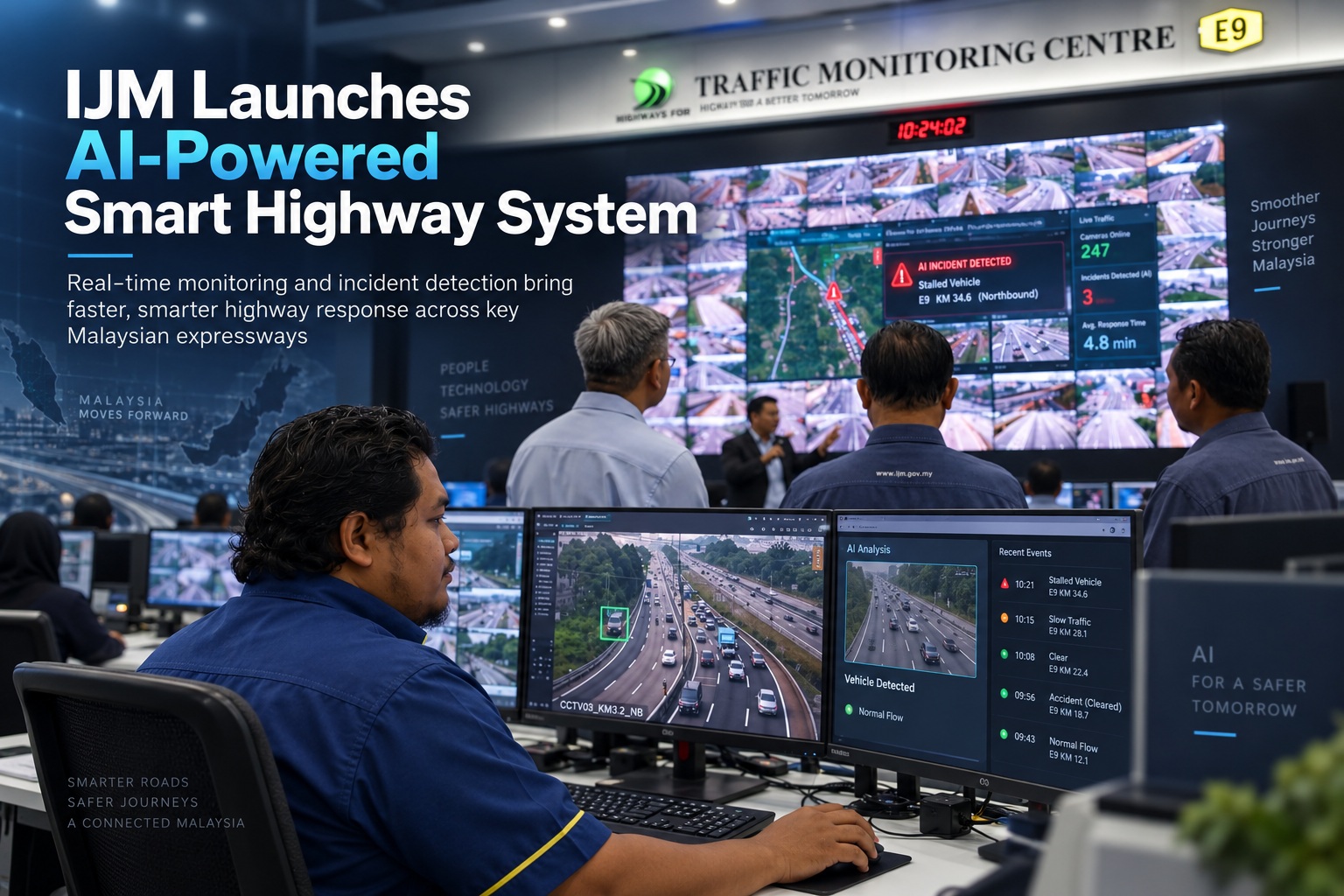
IJM Corporation Bhd has launched a new Smart Highway Traffic Control Centre that uses artificial intelligence, data analytics and Internet of Things technology to monitor traffic conditions and detect incidents across three major highways in real time.
The system was launched at the Sungai Besi Expressway (Besraya) Loke Yew toll plaza lay-by and is designed to help highway operators respond more quickly to accidents, breakdowns, flooding and other hazards. Compared with conventional manual monitoring, the new platform can automatically identify unusual conditions as they happen and alert operators sooner.
Three Highways Are Covered by the System
The new control centre currently supports Besraya, the New Pantai Expressway (NPE) and the Kajang-Seremban Expressway (LEKAS).
IJM has invested around RM14.3 million since 2025 to upgrade monitoring infrastructure across the three highways. The system is based on Globalcomm Solutions' HyperLane technology, which uses AI-powered video analytics to continuously analyse road conditions.
Instead of requiring operators to watch every CCTV feed manually, the system can automatically flag incidents that need attention.
AI Can Detect a Wide Range of Road Incidents
The platform is capable of identifying several types of traffic and safety issues, including:
It can also classify vehicles and monitor vehicle speeds, giving highway operators a clearer picture of what is happening across the network at any given time.
This kind of automation is particularly useful because some incidents may develop quickly and become dangerous before a human operator notices them on screen.
Emergency Response Times Could Improve Significantly
One of the biggest benefits of the system is faster incident response.
IJM says the improved detection and coordination process could reduce emergency response times to around eight to 10 minutes, which is roughly 33% faster than before.
That could make a meaningful difference during accidents, breakdowns or flooding events, where every minute matters. Faster detection allows highway patrol teams, emergency responders and traffic-control operators to coordinate earlier and manage the situation before congestion or secondary accidents worsen.
144 CCTV Cameras Feed Into the Control Centre
The Smart Highway Traffic Control Centre is connected to a large network of monitoring equipment across the three highways.
This includes 144 CCTV cameras, 87 Video Incident Detection Systems, 35 Automatic Number Plate Recognition systems and 22 Variable Message Signs.
Together, these systems allow operators to monitor road conditions, identify vehicles, detect incidents and communicate warnings or traffic information directly to motorists.
The data is also connected to the Malaysian Highway Authority's traffic management centre, which links 873 CCTV cameras and 278 Variable Message Signs nationwide.
That wider integration means IJM's system is not operating in isolation. Information can be shared within a larger national traffic-management network.
Guard Expert Pro Adds Another Layer of Smart Highway Management
The platform is also supported by Guard Expert Pro, a smart highway-patrolling management system developed by IJM together with Universiti Teknologi Malaysia.
This gives highway operators another digital layer for coordinating patrol activities and managing road safety operations.
The combination of AI-powered detection, connected CCTV infrastructure and smart patrol management is intended to create a more coordinated response system rather than relying on separate tools working independently.
Vehicle Speed Data Is Not Automatically Shared With Police
Although the system can monitor vehicle speeds, IJM said that this data is not currently shared with law enforcement agencies in real time.
That means the technology is primarily being used for highway operations and safety monitoring rather than automatic speed enforcement.
However, IJM said it would cooperate with the police where necessary to maintain highway safety. That leaves open the possibility for relevant information to be shared during investigations or specific incidents.
AI Will Not Replace Highway Patrol Workers
Works Minister Datuk Seri Alexander Nanta Linggi, who officiated the launch, stressed that the new AI system will not result in highway patrol officers or other staff losing their jobs.
Instead, IJM plans to focus on upskilling employees and moving them into higher-value responsibilities.
This is an important point because automation projects often raise concerns about job displacement. In this case, AI is being positioned as a tool that helps workers detect incidents and make decisions faster rather than a replacement for human operators.
Highway staff will still be needed to respond physically to accidents, manage road closures and coordinate emergency services.
The Project Supports Malaysia's ITS Roadmap 2030
The smart highway initiative also aligns with the Malaysia Intelligent Transport System Roadmap 2030.
The national roadmap includes technologies such as:
The long-term goal is to make Malaysia's road infrastructure more connected, intelligent and responsive.
With millions of vehicles using the highway network every day, automation can help operators manage road conditions more efficiently than relying entirely on manual monitoring.
Malaysia's Highway Network Handles Massive Daily Traffic
Nanta noted that around six million vehicles use Peninsular Malaysia's highway network every day.
The country currently has 34 tolled highways covering around 2,151 kilometres, operated by 28 concessionaires.
Managing that amount of traffic manually is becoming increasingly difficult, especially during peak periods, accidents and severe weather.
Smart monitoring systems can help concessionaires identify problems earlier, coordinate responses faster and provide motorists with more accurate traffic information.
AI Could Change How Highways Are Managed
Traditional highway monitoring depends heavily on operators watching CCTV feeds and receiving reports from motorists or patrol teams.
AI changes that model by continuously analysing video feeds and automatically detecting unusual behaviour.
For example, the system may recognise a stationary vehicle on the hard shoulder or a vehicle travelling in the wrong direction within seconds. Operators can then verify the alert and dispatch help immediately.
That reduces the delay between an incident happening and someone noticing it.
Flood Detection Could Become Particularly Useful
Malaysia's weather conditions make flood monitoring especially important.
Heavy rainfall can quickly create dangerous conditions on highways, particularly in low-lying areas. If the system can identify early signs of rising water, operators may be able to issue warnings or close affected lanes before conditions become dangerous.
Combining camera analytics with IoT sensors could eventually make this kind of early-warning system even more effective.
It also shows how smart highways can go beyond traffic management and become part of broader infrastructure resilience.
Variable Message Signs Can Warn Drivers Faster
Once an incident is detected, the system can also use connected Variable Message Signs to warn motorists.
Drivers approaching an accident, flood or road obstruction can receive information before reaching the affected area.
This can help reduce sudden braking, secondary accidents and unnecessary congestion.
In the future, similar information could potentially be integrated more deeply with navigation apps and connected vehicles, creating a more dynamic traffic-management ecosystem.
VR Highway Safety Programme Also Launched
Alongside the new control centre, IJM and the Malaysian Highway Authority introduced a Virtual Reality Highway Safety Programme aimed at schoolchildren.
The programme is designed to improve awareness of road and highway safety through an interactive learning experience.
Using VR can make safety education more engaging by placing students in simulated road situations without exposing them to real danger.
This complements the technology-focused highway initiative by addressing another important part of road safety: user behaviour.
Smart Highways Will Require Collaboration
Nanta emphasised that the transition towards smarter highways cannot be handled by concessionaires alone.
Successful implementation will require collaboration between the Works Ministry, Malaysian Highway Authority, highway concessionaires, police, emergency responders and technology companies.
That cooperation is important because road incidents often involve several organisations at the same time. A traffic accident may require highway patrol teams, police, ambulances and traffic-control operators to work together.
Technology can detect the incident, but effective coordination is still what determines how quickly the situation is resolved.
Final Thoughts
IJM's new Smart Highway Traffic Control Centre represents another step toward making Malaysia's highway network more intelligent and responsive.
By combining AI, video analytics, IoT and connected traffic-management systems across Besraya, NPE and LEKAS, the platform can automatically detect accidents, congestion, breakdowns, flooding and other hazards before they escalate.
The biggest benefit may be speed. If incident-response times can genuinely be reduced by around a third, the system could improve both safety and traffic flow across some of the country's busiest highways.
More importantly, IJM is treating AI as a tool to support highway workers rather than replace them. The technology detects the problem faster, while people still make the decisions and carry out the response.
As Malaysia continues implementing its Intelligent Transport System Roadmap 2030, systems like this could become increasingly common across the national highway network.











Comments 0