

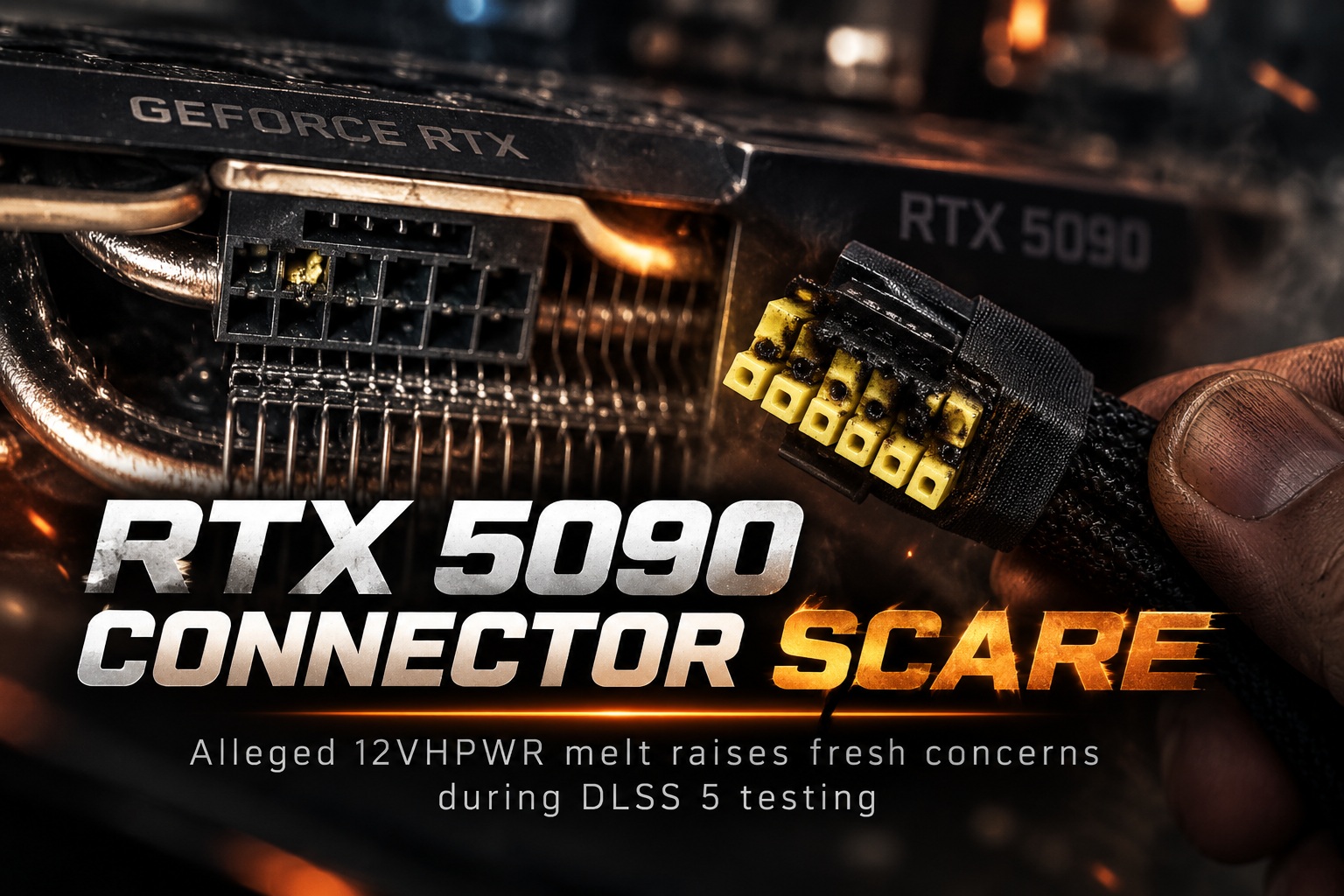
NVIDIA's new DLSS 5 technology has only just started rolling out, but an unusual hardware failure has already attracted attention. According to a report shared through Videocardz, an owner of an MSI RTX 5090 Gaming Trio OC claims the card's 12VHPWR power connector melted while they were testing DLSS 5 Neural Rendering in NBA 2K27.
The timing immediately raises questions about whether DLSS 5 had anything to do with the failure. However, the available evidence does not prove that the upscaling technology itself caused the connector to melt. RTX 5090 power-connector failures have already been reported in other situations, making this another case where high power draw, connector behaviour and system conditions all need to be considered.
The RTX 5090 Was Reportedly Pulling Much More Power
The user, who goes by the handle erek, was reportedly monitoring the card while testing DLSS 5. Before the failure occurred, GPU power consumption apparently increased from around 450W under normal load to a sustained level close to 600W.
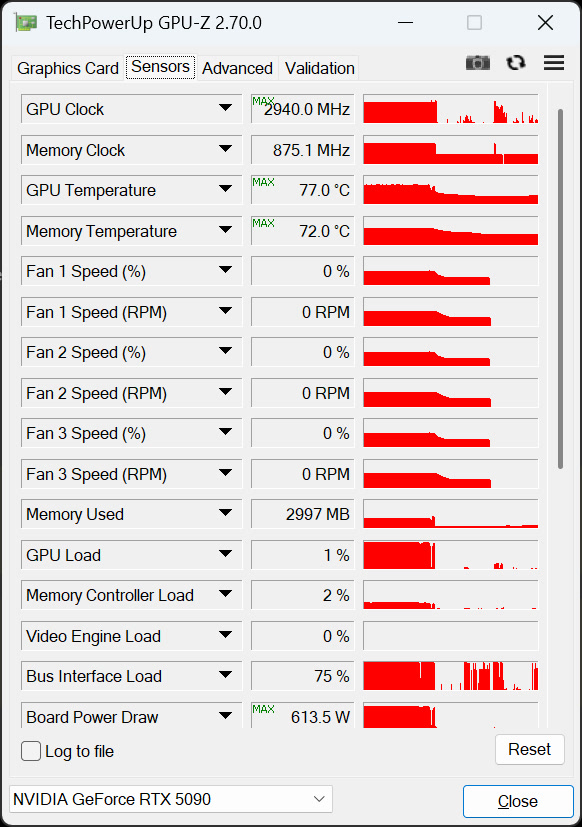
That is notable because the MSI RTX 5090 Gaming Trio OC itself is rated for a sustained power level of around 575W. A GPU-Z screenshot reportedly showed the card reaching a maximum board power draw of 613.5W, with the high consumption remaining there for a period of time rather than appearing as a momentary spike.
Even so, board power should not be confused with power flowing exclusively through the 12VHPWR connector. The reading represents total GPU board consumption, so the figure does not automatically mean that more than 600W was travelling through the connector itself.
The Connector Eventually Melted
Not long after the high-power readings were recorded, the graphics card reportedly stopped working. The user also noticed the smell of burnt plastic around the PC, which is usually a clear sign that something had gone badly wrong.
When they attempted to remove the 12VHPWR cable, the connector was apparently difficult to pull free. Once removed, visible melting could be seen around the plastic surrounding the power connection.
That kind of failure is particularly concerning because the 12VHPWR connector has already been one of the more controversial components associated with recent high-end NVIDIA GPUs. Problems involving loose connections, uneven current distribution and excessive heat have previously resulted in damaged cables and connectors.
Did DLSS 5 Cause the Failure?
At this stage, there is no solid evidence that DLSS 5 directly caused the connector to melt. The technology may have increased GPU utilisation and power demand, but that does not necessarily mean it created the underlying hardware problem.
A demanding rendering workload can push a GPU closer to its configured power limits, and DLSS 5 Neural Rendering may have contributed to that heavier load. However, a correctly functioning power connector should still be expected to operate safely within the card's designed limits.
The more reasonable conclusion for now is that DLSS 5 may have been part of the workload that exposed the problem rather than the root cause itself.
Another RTX 5090 User Also Reported Higher Power Draw
Videocardz also referenced another RTX 5090 owner who reportedly experimented with DLSS 5 in Hitman 3. In that case, the card's total graphics power reportedly increased from around 435W to 520W after the feature was introduced.
That second report does not involve a melted connector, but it does suggest that DLSS 5 can significantly increase workload intensity in certain situations. If the technology causes more of the GPU to remain active or pushes additional neural rendering operations through the hardware, increased power consumption would not be particularly surprising.
What matters is whether those higher power levels remain within safe electrical and thermal operating conditions.
The 12VHPWR Connector Already Has a Complicated History
The 12VHPWR connector was introduced to deliver large amounts of power through a relatively compact plug, but its reputation has been mixed. Previous-generation cards, especially very high-power models, have produced reports of melted connectors when plugs were not fully inserted or when cables experienced excessive bending near the connection point.
The RTX 5090 raises the stakes because it is one of the most power-hungry consumer graphics cards available. When a GPU can operate close to or above 500W for sustained periods, even relatively small increases in electrical resistance at the connector can generate significant heat.
That does not mean every 12VHPWR connector is unsafe. It does mean installation quality, cable condition and current distribution become extremely important at these power levels.
High Board Power Does Not Automatically Mean Connector Overload
The reported 613.5W board power figure sounds alarming, but it needs to be interpreted carefully. Graphics cards can receive some power from the motherboard PCIe slot, while the remainder comes through the dedicated GPU power connector.
This means total board power and connector power are not identical measurements. Without direct current monitoring across the individual connector pins, it is difficult to determine exactly how much electrical load the 12VHPWR cable was carrying when the failure occurred.
That distinction matters when trying to establish causation. A high board-power reading may indicate a heavy workload, but it does not prove that the connector exceeded its specification.
Connector Seating Can Still Be a Major Factor
One of the most common explanations for previous 12VHPWR failures has been incomplete insertion. If the plug is not fully seated, the effective electrical contact area can become smaller, increasing resistance and generating heat.
At lower power draw, the problem may remain unnoticed. Under a sustained high-load workload, however, the additional current can expose the weak connection much more quickly.
This could potentially explain why a connector might appear stable during normal gaming but fail when the GPU suddenly begins drawing significantly more power. Again, there is currently not enough information to confirm whether that happened in this particular case.
Cable Bending and Adapter Quality Also Matter
The physical routing of the power cable can also contribute to problems. A 12VHPWR cable that is bent sharply immediately after the connector may place mechanical stress on the contacts or make it harder to maintain a perfectly even connection.
Third-party adapters, extension cables and power supplies with different connector implementations introduce additional variables. With a card as demanding as the RTX 5090, every part of the power-delivery chain needs to be capable of handling sustained load safely.
This is why isolated failure reports can be difficult to interpret without knowing the exact power supply, cable, adapter and installation conditions.
DLSS 5 Could Simply Be Exposing Marginal Power Setups
If DLSS 5 does consistently push GPU power consumption higher than previous workloads, one possibility is that it could expose systems that were already operating close to the limit.
A connector with slightly poor contact, a marginal cable or a power supply struggling under sustained load may appear completely fine under lighter workloads. Increase the GPU's demand by another 50W or 100W, however, and the weakness becomes much easier to reveal.
In that scenario, DLSS 5 would not really be the cause. It would simply be the workload that pushed the system hard enough for an existing problem to become visible.
It Is Too Early to Call This a DLSS 5 Problem
One melted connector is not enough evidence to establish a pattern. Without multiple confirmed cases showing the same behaviour under similar conditions, blaming DLSS 5 would be premature.
There are too many other possible explanations, including connector seating, cable condition, power supply behaviour, manufacturing tolerances and the already-known sensitivity of high-power 12VHPWR connections.
If more RTX 5090 owners begin reporting connector failures specifically while using DLSS 5, then the situation would deserve much closer scrutiny. For now, this looks more like an interesting and concerning incident than evidence of a widespread defect.
RTX 5090 Owners Should Still Check Their Power Connections
Even if DLSS 5 turns out to be completely unrelated, RTX 5090 owners should treat the report as a useful reminder to inspect their power connections carefully. The 12VHPWR plug should be fully inserted with no visible gap, and the cable should not be sharply bent immediately after leaving the connector.
Using the power supply manufacturer's native cable is generally preferable to unnecessary adapters or extensions, particularly with GPUs drawing several hundred watts. Users should also avoid repeatedly unplugging and reconnecting the cable unless necessary, as connector wear can become another variable over time.
Any signs of discolouration, unusual heat or the smell of burnt plastic should be taken seriously.
Final Thoughts
The reported failure involving an MSI RTX 5090 Gaming Trio OC while testing DLSS 5 is concerning, especially because the card reportedly sustained board power above 600W before the connector melted. The timing naturally makes DLSS 5 look suspicious, but the available information does not prove that NVIDIA's new neural rendering technology caused the failure.
What the incident does show is how little margin high-end GPUs may have when operating at extreme power levels. A workload that pushes consumption significantly higher can expose weaknesses in connectors, cables or power delivery that may never appear during lighter use.
For now, the safest conclusion is that DLSS 5 may have contributed to the conditions surrounding the failure, but it should not yet be blamed as the direct cause. Until more evidence emerges, RTX 5090 owners are better served by making sure their 12VHPWR connection is properly seated, undamaged and capable of handling the kind of sustained power draw these cards can demand.











Comments 0