

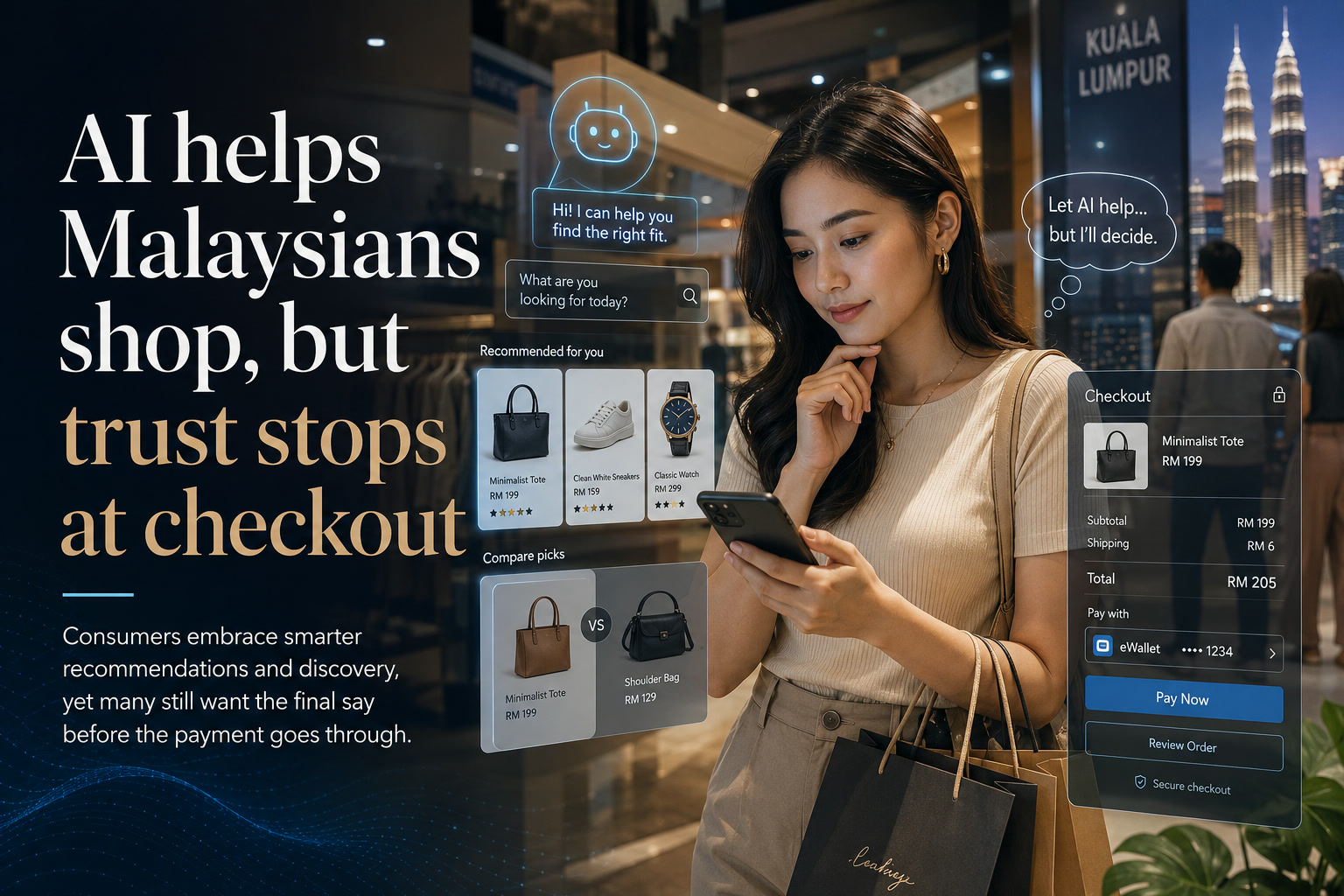
Artificial intelligence is becoming a familiar part of the Malaysian shopping journey. Consumers are using it to compare products, discover unfamiliar brands, filter overwhelming amounts of information and find recommendations more quickly. Yet when the technology moves from offering advice to actually spending money, confidence drops sharply.
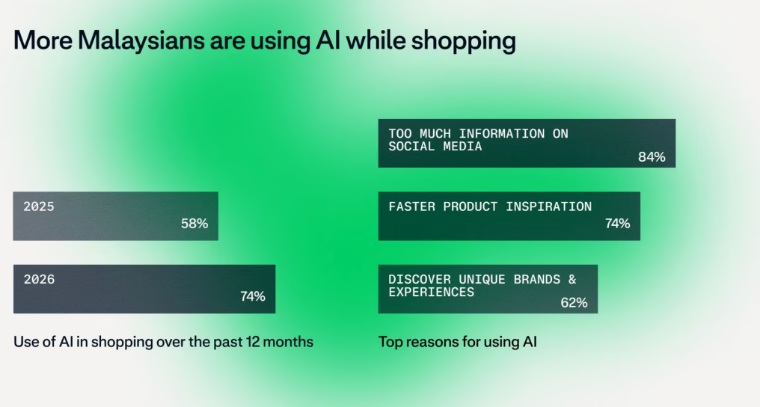
According to the Adyen Index 2026 Malaysia Retail Report, 74% of Malaysian consumers now use AI in some form while shopping. However, 52% remain uncomfortable with allowing an AI system to complete a purchase on their behalf.
That contrast reveals where Malaysian consumers currently draw the line. They are increasingly comfortable treating AI as a shopping assistant, but many are not yet ready to treat it as an autonomous buyer with permission to select products, enter payment details and approve transactions.
From Shopping Assistant to Autonomous Buyer
Most people are already familiar with basic forms of AI-assisted shopping.
A customer might ask a chatbot to recommend a smartphone within a specific budget, compare two insurance plans, suggest clothing for an upcoming event or identify a replacement part for a household appliance.
In these situations, the AI provides information, but the consumer remains responsible for the final decision.
Agentic commerce goes several steps further.
An AI agent could search multiple stores, compare prices, check stock availability, select the most suitable item and complete the payment with little or no additional input from the shopper.
A user might eventually give an instruction such as:
"Find a reliable air purifier suitable for my living room, keep the price below RM800, use my loyalty points and arrange delivery before Friday."
The AI agent would then attempt to handle the entire process.
That level of convenience is appealing, but it also requires consumers to surrender a degree of control. The agent must understand the shopper's priorities, access personal information, communicate with retailers and potentially authorise payment.
For many Malaysians, that final step remains uncomfortable.
The Survey Captures Both Consumer and Retailer Views
The findings come from research commissioned by Adyen and conducted online by YouGov during March and April 2026.
The Malaysian portion of the study included 1,031 consumers aged 18 and above. It also surveyed 314 senior retail employees working at manager level or higher in businesses with annual turnover of at least RM75 million.
This provides a useful view from both sides of the transaction.
Consumers explained how they use AI, what they expect from retailers and what causes them to abandon a purchase. Retail leaders described their investment plans, operational difficulties and concerns about handing more of the customer journey to automated systems.
The results suggest that both groups believe AI will play a major role in the future of retail. They simply remain uncertain about how much responsibility it should receive.
AI Helps Shoppers Cut Through Digital Overload
One reason consumers are turning to AI is that shopping online has become exhausting.
Social media platforms, marketplaces, brand websites, livestreams, influencer recommendations and targeted advertisements expose shoppers to an enormous amount of information. The problem is no longer finding products. It is deciding which information deserves attention.
Among Malaysian consumers who use AI while shopping, 84% said social media contains too much information to process comfortably.
Another 74% said AI allows them to find inspiration more quickly than other sources, while 62% expressed interest in using it to discover unique brands and shopping experiences.
AI therefore serves as a filter.
Instead of opening ten browser tabs and comparing hundreds of listings manually, a shopper can describe what they need and ask the system to narrow down the options.
This becomes especially useful for products that involve complicated specifications. A consumer buying a laptop, camera, television or home appliance may not understand every technical term. An AI assistant can translate those details into practical differences and explain which features are relevant to the buyer's intended use.
Consumers Want Better Recommendations, Not More Advertising
Retailers have spent years collecting information to personalise promotions, but many recommendation systems still feel repetitive or commercially driven.
A shopper who searches for one sofa may continue seeing sofa advertisements for weeks, even after making a purchase. A customer browsing affordable smartphones may be shown expensive flagship devices because the retailer wants to increase the transaction value.
AI creates an opportunity to make recommendations more useful, but only when the system genuinely understands the customer's needs.
A good shopping assistant should be able to consider:
The experience must feel like assistance rather than manipulation.
Consumers are likely to reject AI systems that constantly push more expensive items, hide cheaper alternatives or prioritise sponsored products without explaining why they are being recommended.
Trust will depend heavily on transparency.
Retailers Are Already Integrating AI into Shopping Interfaces
Six in ten Malaysian AI-assisted shoppers said the brands they use have already introduced AI-powered search features into their websites or applications.
This reflects a wider shift in digital retail.
Traditional search depends heavily on exact keywords. A customer searching for "comfortable shoes for standing all day" may receive poor results when the catalogue is organised only around product names and categories.
AI search can interpret the intention behind the request. It may understand that the customer values cushioning, arch support and durability rather than simply looking for any pair of shoes.
Retailers are also using AI in customer service, promotional planning, product descriptions and inventory management.
According to the report, 40% of Malaysian retailers already apply AI to marketing and promotions, while 39% use it in customer service and support.
These are relatively low-risk areas because the technology assists employees or customers without necessarily controlling a financial transaction.
The next stage—allowing AI to purchase independently—requires a much higher level of confidence.
Convenience Is Becoming the Minimum Expectation
AI is not the only retail technology gaining acceptance.
Self-checkout was the most commonly used technology identified in the report, reaching 39% of respondents. Brand applications used for checkout and loyalty-point collection followed at 26%, while AI tools stood at 19%.
These figures show that Malaysian shoppers increasingly value speed and independence.
Many customers no longer want to wait for an employee when they can scan an item, check their rewards and complete payment themselves. They expect digital tools to remove unnecessary steps.
However, convenience works only when the system is reliable.
A self-checkout terminal that repeatedly rejects valid items creates frustration. A loyalty application that forgets earned points reduces confidence. An AI assistant that recommends unavailable products wastes the customer's time.
Technology must simplify the experience rather than merely appearing modern.
Malaysians Still Want the Final Decision
The reluctance to let AI complete a transaction should not be interpreted as rejection of the technology.
It suggests that consumers want a clear boundary between advice and authority.
A shopper may be comfortable allowing AI to compare washing machines, but still want to confirm the model, delivery date and warranty before payment.
That desire for control is understandable because a purchase involves more than selecting an item.
Consumers may need to consider:
An AI agent could technically verify these details, but consumers may still prefer to review them personally.
The future of agentic commerce may therefore begin with assisted approval rather than completely autonomous buying.
An AI could prepare the transaction and present a final summary, but the customer would still press the button that authorises payment.
Checkout Is Where Trust Becomes Most Important
The report indicates that payment problems have a direct effect on how consumers perceive a business.
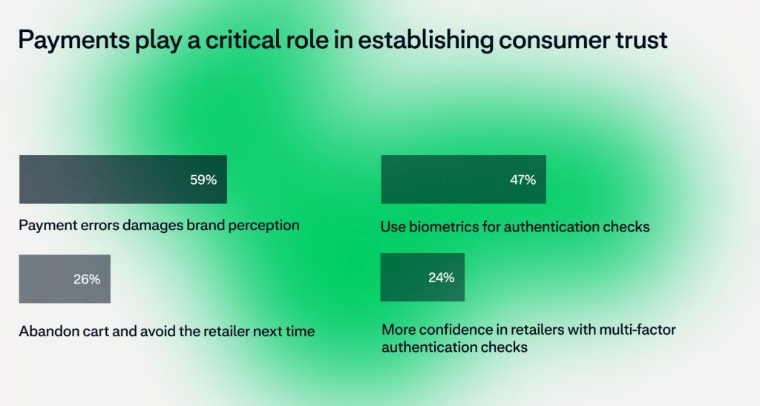
Around 59% of Malaysian consumers said payment errors damage their opinion of a retailer. Another 26% had abandoned a purchase because of security or trust concerns, while 15% said they would move to a competitor after a poor payment experience.
These are not small consequences.
A retailer may spend heavily on advertisements, attractive product pages and AI recommendations, only to lose the customer when the payment page is slow, confusing or unreliable.
At checkout, shoppers are asked to provide some of their most sensitive information. They may enter card details, approve a bank transaction, select an instalment plan or authorise access to a digital wallet.
When that step fails, consumers may question whether the retailer is technically competent enough to protect their money and personal data.
For agentic commerce, the same concern becomes even more serious because the AI may be acting without the shopper watching every screen.
Payment Problems Are Also Hurting Retailers
Retailers are facing the same issue from the operational side.
An overwhelming 97% of surveyed Malaysian retail organisations said they had experienced payment-performance problems during the previous year. Meanwhile, 94% reported that they had either been targeted by payment fraud or had fallen victim to it.
The cost extends beyond the failed transaction.
Payment difficulties can lead to abandoned baskets, customer-support enquiries, refund requests, disputed transactions and chargebacks. They can also damage long-term loyalty when shoppers decide that another retailer offers a safer or smoother experience.
If AI agents are eventually permitted to transact independently, retailers will need payment systems capable of distinguishing between legitimate agent activity and automated fraud.
They will also need clear processes for answering difficult questions:
These issues will need to be addressed before agentic commerce becomes widely trusted.
Identity and Authorisation Will Need to Evolve
Traditional e-commerce assumes that a person is directly interacting with the checkout page.
Agentic commerce introduces another participant: software acting on the consumer's behalf.
Retailers must therefore verify not only the customer's identity but also the authority given to the AI agent.
A secure system may need to confirm:
Consumers may be comfortable allowing an agent to reorder cat food every month but not to purchase an expensive television without confirmation.
This means authorisation cannot be treated as a simple yes-or-no decision. It must be specific, limited and easy to revoke.
Retailers See Growth Potential but Also New Risks
Malaysian retailers appear highly aware of agentic commerce.
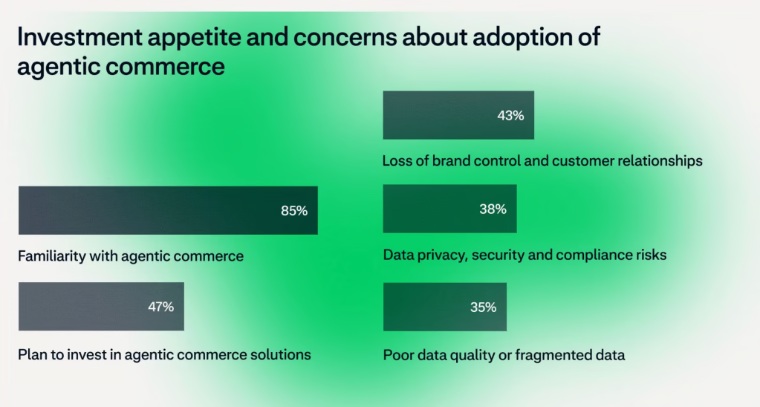
Around 85% said they were familiar with the concept, while 51% believed they could explain it confidently. Nearly half were planning to invest in AI-driven or agentic commerce technologies during 2026.
That interest is understandable.
AI agents could bring customers directly to a retailer, complete purchases more quickly and reduce the friction that causes people to abandon baskets.
However, retailers also recognise the risk of losing control over their customer relationships.
When an AI compares several stores and selects one automatically, the consumer may never visit the retailer's website, see its advertisements or interact with its loyalty programme.
The agent becomes the main interface.
Retailers could eventually find themselves competing for the approval of algorithms rather than the attention of human shoppers.
Price, availability, delivery reliability and machine-readable product information may matter more than a visually attractive website.
Around 38% of surveyed retailers also cited privacy, security and regulatory compliance as major concerns.
Brands Risk Becoming Invisible Behind AI Agents
Today, consumers often build relationships with specific retailers because they enjoy the store, trust the service or identify with the brand.
Agentic commerce could weaken that connection.
A shopper may tell an AI to buy "the best-value running shoes under RM350" without specifying where they should come from. The agent may select whichever retailer meets its criteria at that moment.
The customer receives the product but may barely notice the company that sold it.
This creates a strategic challenge.
Retailers must make their offers understandable to AI systems while still giving customers reasons to remember and trust the brand.
Good after-sales service, straightforward returns, reliable delivery and meaningful loyalty benefits may become more important than ever.
A retailer cannot rely entirely on attracting someone to a beautifully designed homepage when the AI agent may never display it.
Shoppers Expect Every Channel to Work Together
The report also highlights the growing importance of omnichannel retail.
A customer's journey rarely begins and ends in one place.
Someone may discover a product through social media, compare it through an AI assistant, inspect it at a physical store and complete the purchase through an application two weeks later.
Consumers increasingly expect the retailer to remember the relationship across all those interactions.
A voucher shown online should work in the store. Loyalty points earned through an application should appear at the physical checkout. Product availability should be accurate regardless of which platform the customer uses.
When each channel operates separately, the experience becomes frustrating.
A shopper may be told that an item is available online but discover that the store has no stock. Another may collect points through the website but find that the retail outlet cannot access the same account.
These inconsistencies will become even more problematic when AI agents begin navigating across channels on behalf of customers.
Fragmented Systems Are a Bigger Barrier Than the AI Model
Around 35% of Malaysian retailers said their current operations suffer from fragmented systems or poor-quality data.
This may be one of the most important findings in the report.
Retailers often focus on purchasing an AI tool, but the model can only work with the information it receives.
When product descriptions are incomplete, stock data is outdated and customer records are spread across several systems, the AI will produce unreliable results.
An agent may recommend a product that is no longer available or promise a delivery option that the physical store cannot fulfil.
Before adopting autonomous shopping agents, retailers need a strong digital foundation.
Their online store, mobile application, marketplace listings, physical outlets, inventory systems, loyalty programme and payment platform should share consistent information.
Without that integration, AI simply automates the confusion.
Unified Commerce Creates the Foundation
Adyen argues that unified commerce should come before agentic commerce.
Unified commerce connects all major customer and transaction channels to a shared platform. Instead of maintaining isolated systems for online and physical sales, the retailer works from one consistent view of the customer, stock and payment activity.
This provides several advantages.
A store employee can see what the customer ordered online. A customer can return an online purchase at a physical outlet. Loyalty points remain consistent across platforms. Fraud detection can examine behaviour across all channels rather than treating each one separately.
For AI agents, connected systems make it easier to obtain accurate information and complete a transaction correctly.
The agent cannot deliver a smooth experience when the retailer itself does not know which products are available or which vouchers apply.
Retailers Should Stop Chasing Every New Channel Separately
Retail technology changes quickly.
A few years ago, businesses rushed to social commerce. Customers would discover products through a post or livestream and then be redirected to a conventional website to complete the purchase.
Now, retailers are trying to keep the entire transaction within the social platform, chat or livestream.
AI agents may become the next major channel.
The danger is that retailers respond to each trend by building another disconnected system.
One platform handles the website, another manages the mobile application, a third supports social commerce and a fourth controls AI interactions. Data becomes fragmented, and customers receive inconsistent treatment depending on where they appear.
A stronger strategy is to build a flexible, connected commerce foundation.
The retailer can then add new channels without rebuilding the entire transaction process each time consumer behaviour changes.
AI Agents Must Be Designed Around Consumer Consent
For Malaysian consumers to trust agentic commerce, control must remain visible.
Customers should be able to understand why an AI selected a particular product, what information it used and which alternatives it rejected.
They should also be able to set firm boundaries.
An AI agent might be allowed to purchase household essentials below RM100 without additional approval, while higher-value transactions require confirmation.
The system should provide a clear summary before or immediately after the transaction, including:
Cancelling the agent's authority should be simple. Consumers should not have to search through several menus to stop automated purchases.
Trust will grow only when the technology feels accountable rather than mysterious.
The Best Early Use Cases May Be Routine Purchases
Completely autonomous shopping may gain acceptance first in situations where the risk is low and the customer's preferences are already well understood.
Examples could include:
Consumers are likely to be less comfortable allowing AI to independently purchase clothing, expensive electronics, jewellery or products where personal taste matters greatly.
Retailers should therefore avoid assuming that every category will adopt agentic commerce at the same pace.
The successful approach will begin with predictable, reversible and low-risk transactions before expanding to more complex purchases.
Retailers Need to Prove Reliability Before Asking for More Trust
Consumers are unlikely to grant autonomous purchasing authority to retailers whose existing checkout systems already fail regularly.
The path to agentic commerce begins with basic competence.
Payments must work. Refunds must be straightforward. Delivery information must be accurate. Customer support must respond when something goes wrong.
AI cannot compensate for weak operations.
A highly advanced shopping agent connected to an unreliable inventory or payment system may create more problems than it solves.
Retailers should view every successful conventional transaction as part of building the trust required for future automated commerce.
Final Thoughts
Malaysian consumers are clearly ready to use AI as part of the shopping process.
They appreciate its ability to reduce information overload, discover products and provide recommendations more efficiently. What they are not yet ready to surrender is the final decision over how their money is spent.
That reluctance is reasonable.
Allowing an AI to complete purchases requires confidence in identity, security, payment reliability, retailer data and the agent's understanding of personal preferences.
For retailers, the immediate priority should not be rushing to let AI agents spend autonomously. It should be building the connected systems, reliable payments and transparent controls that make such transactions trustworthy.
Agentic commerce may eventually become a normal part of retail, but adoption will not be driven by technology alone.
It will depend on whether consumers continue to feel informed, protected and firmly in control—even when the AI is doing most of the shopping for them.











Comments 8