

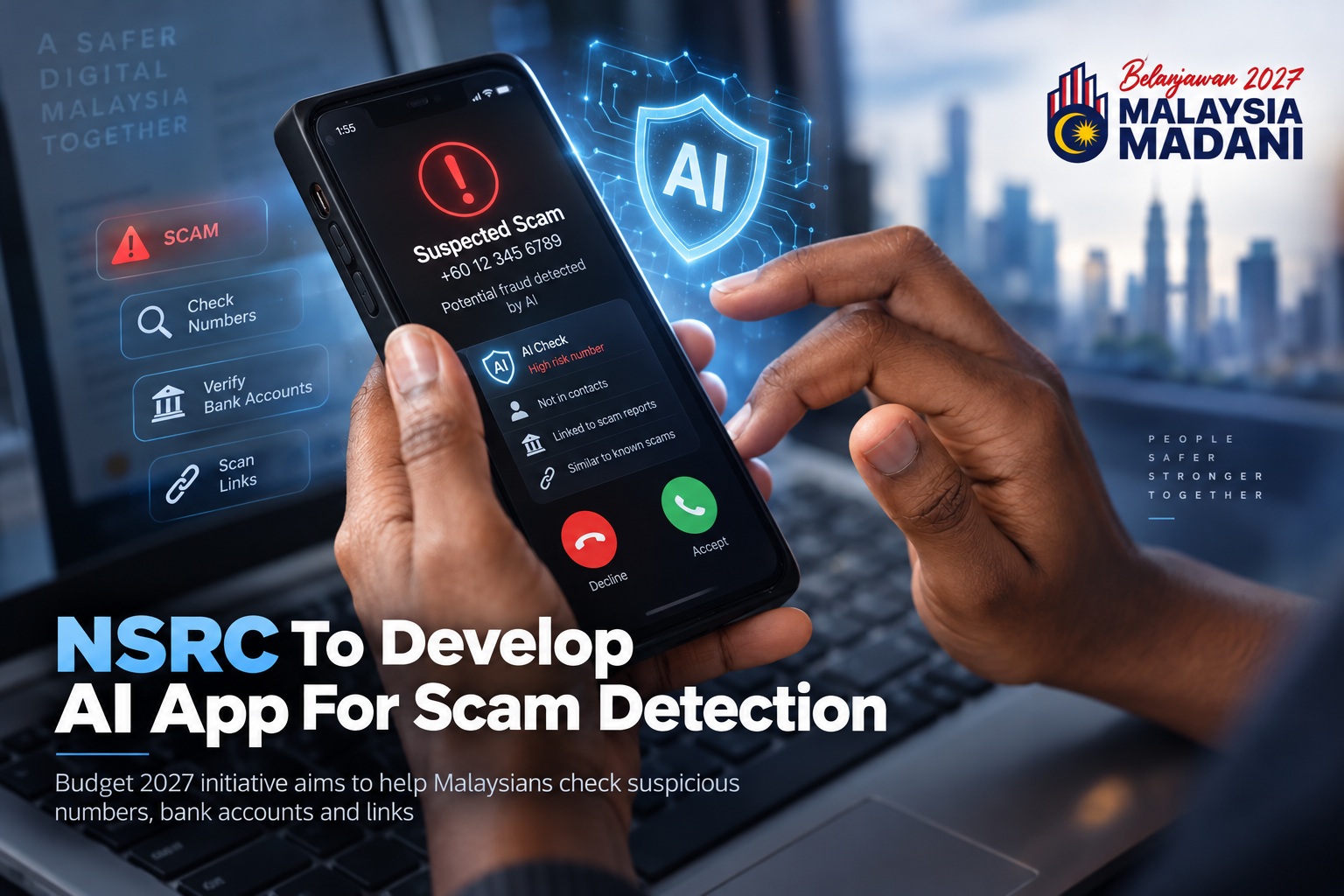
The Malaysian government is developing a new artificial intelligence application designed to help the public identify possible scams before money changes hands. The tool will allow users to check suspicious phone numbers, bank accounts and links before proceeding with a transaction, giving them another layer of protection against increasingly sophisticated scam tactics. The initiative was announced by Prime Minister Datuk Seri Anwar Ibrahim during the tabling of Budget 2027 in Dewan Rakyat.
The National Scam Response Centre, or NSRC, will be responsible for developing the application. The broader goal is to help Malaysians identify warning signs earlier and make it harder for cybercriminals to exploit victims through fraudulent calls, messages, websites and payment requests.
AI To Help Users Check Suspicious Details Before Paying
One of the most useful aspects of the planned application is that it is intended to work before a transaction is completed. Users will be able to check a phone number, bank account or suspicious link and assess whether it may be associated with scam activity. This gives the public an opportunity to stop and verify information instead of reacting only after money has already been transferred.
That preventive approach is particularly important because many scams rely on urgency and social engineering. Victims may be pressured to act quickly, transfer funds or click a link before they have time to think through the situation. A simple verification tool could give users another reason to pause and confirm whether something looks suspicious.
NSRC Will Lead Development Of The Application
Anwar said the NSRC will take responsibility for developing the AI-powered service. The centre already plays an important role in coordinating responses to financial scams, particularly cases involving fraudulent transactions and suspicious money transfers. Expanding its role into public-facing AI tools would move some of that capability closer to users themselves.
The application could also help centralise scam-related information that is currently spread across different sources. If designed effectively, users may be able to perform a quick check without needing to search manually across several websites or services. The value of such a system will depend heavily on how current and accurate the underlying information remains.
MCMC Has Blocked More Than 5.7 Billion Scam Calls And SMS Messages
The government is also continuing large-scale efforts to reduce scam activity at the telecommunications level. According to Anwar, the Malaysian Communications and Multimedia Commission, or MCMC, has already blocked more than 5.7 billion scam-related calls and SMS messages. That figure highlights the scale of unwanted and potentially malicious communications targeting Malaysian users.
Blocking scam traffic before it reaches the public remains an important first line of defence. However, not every malicious call, message or link can necessarily be stopped automatically. The planned NSRC application therefore provides an additional layer that allows users to verify suspicious information for themselves.
Scammers Are Becoming More Difficult To Identify
Modern scam campaigns can be increasingly convincing because attackers often impersonate banks, government agencies, delivery companies or well-known brands. Some schemes also use compromised social media accounts, fake websites or manipulated caller information to appear legitimate. AI-generated text and voice technology can potentially make these scams even harder for ordinary users to recognise.
This makes early verification increasingly important. Instead of depending solely on visual clues or instinct, users could have access to a dedicated tool that helps assess whether a phone number, account or link has already been associated with suspicious activity. The application would not eliminate scams entirely, but it could make common fraud techniques more difficult to execute successfully.
Bukit Aman D11 To Strengthen Online Child Protection
Budget 2027 also includes measures aimed at improving the detection of online crimes involving children. Anwar said Bukit Aman's D11 Division is strengthening the Malaysia Internet Crime Against Children system with more advanced data analysis capabilities. The objective is to identify individuals and networks involved in online sexual exploitation at an earlier stage.
More advanced analysis could help investigators process larger amounts of digital information and identify connections that may be difficult to detect manually. Earlier identification can be particularly important in cases involving organised networks or repeat offenders. The government is positioning technology as a key part of improving enforcement in this area.
MCMC Safe Internet Campaign To Expand In Schools
MCMC will also intensify its Safe Internet Campaign in schools. The initiative will focus on issues such as cyberbullying and the exploitation of children, helping students better understand the risks they may encounter online. Education is especially important because children and teenagers spend increasing amounts of time on social media, messaging platforms and online communities.
Preventing online harm requires more than technical filtering alone. Young users also need to recognise suspicious behaviour, understand when personal information should not be shared and know how to report abusive or exploitative activity. Expanding awareness programmes in schools can therefore complement enforcement and technological protections.
A Broader Push Against Cybercrime
The planned NSRC scam-detection app, MCMC's telecom blocking measures and the strengthening of child-protection systems all form part of a broader effort to improve Malaysia's online safety environment. Rather than focusing on only one type of cybercrime, the government is addressing financial fraud, malicious communications and online exploitation through several different channels.
AI and data analysis are becoming increasingly important within that strategy. These technologies can help authorities process large volumes of information more quickly and identify patterns that would otherwise take far longer to investigate. Their effectiveness, however, will still depend on accurate data, regular updates and clear procedures for handling false positives.
Final Thoughts
The NSRC's planned AI-powered scam detection application could become a useful tool for Malaysians who want to verify suspicious phone numbers, bank accounts and links before completing a transaction. Combined with MCMC's efforts to block billions of scam-related communications, the initiative adds another preventive layer aimed at stopping fraud before financial losses occur.
At the same time, the government is strengthening online child protection through more advanced data analysis and expanded Safe Internet campaigns in schools. Together, these measures show a broader shift towards using AI, data and public education to tackle cybercrime earlier rather than relying solely on action after an incident has already happened.











Comments 0