

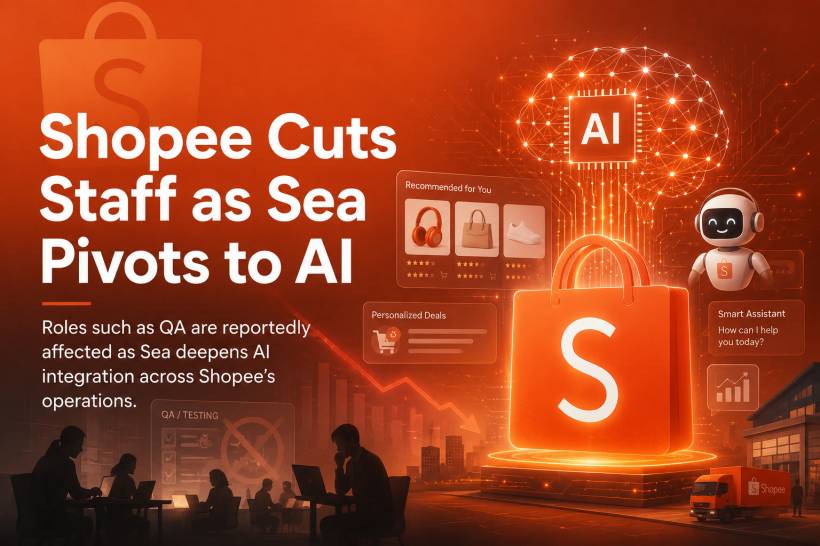
Sea Ltd, the parent company behind Shopee and Garena, appears to be moving deeper into artificial intelligence. But as with many large tech companies making that shift, the transition seems to be coming with a difficult consequence: job cuts.
According to reports cited by The Edge from Bloomberg, Shopee has started reducing staff as Sea restructures parts of its workforce. The cuts reportedly began this week and have already affected around 8% of Shopee's developer workforce.
The affected roles are said to include quality assurance positions, with the possibility that more roles could be impacted later.
While the report does not confirm that AI adoption is the direct cause of the layoffs, the timing is hard to ignore. Across the wider tech industry, many companies have been trimming teams while increasing investment in automation, AI tools and more efficient operating models.
Sea's AI Ambition Is Becoming Clearer
Sea's direction became more obvious after CEO Forrest Li reportedly said that the company could one day reach a trillion-dollar market capitalisation if it fully committed to AI.
That is a huge ambition, and it shows how seriously Sea is treating artificial intelligence as part of its future strategy. For a company that runs large-scale platforms like Shopee and Garena, AI could be used across many areas of the business.
Some possible areas include:
• Seller tools and automation
• Customer service support
• Shopping assistants
• Internal developer tools
• Fraud detection and platform optimisation
For Shopee, the AI opportunity may be especially obvious. E-commerce platforms handle massive amounts of product, seller, buyer and behavioural data. AI can help personalise shopping experiences, automate repetitive processes and improve operational efficiency.
Shopee May Benefit More Directly Than Garena
Sea has said that it is working with Google to integrate AI across its operations. One area mentioned is the development of AI shopping agents.
This kind of feature would likely benefit Shopee more directly than Garena. While gaming can also use AI in areas such as moderation, player support and content tools, e-commerce has more immediate and practical use cases.
For example, AI shopping agents could help users search for products, compare prices, summarise reviews or recommend items based on user behaviour. Sellers could also use AI to improve product listings, generate descriptions, analyse demand or manage customer queries.
At this stage, Sea is reportedly embedding AI in smaller ways rather than making one massive shift overnight. But even small changes can eventually reshape how teams work, especially if AI starts handling tasks that were previously done manually.
Why Quality Assurance Roles May Be Vulnerable
The reported impact on quality assurance roles is notable.
QA teams traditionally play an important role in testing software, identifying bugs, checking user flows and making sure features work before they are released. However, this is also an area where automation and AI-assisted testing tools have been gaining traction.
AI does not completely remove the need for human testers, especially for complex judgement-based testing. But it can reduce the number of repetitive manual checks required.
That means companies may start rethinking how many people they need in certain testing and engineering support roles. Instead of large manual QA teams, they may move toward smaller teams supported by automated testing systems and AI-driven tools.
This does not necessarily mean AI is replacing every role directly. In many cases, companies may simply use AI as part of a broader restructuring effort to reduce costs and improve productivity.
Sea Says It Regularly Reviews Staffing Needs
A Sea spokesperson said the company regularly reviews and adjusts its staffing requirements. The spokesperson also said such decisions are made carefully and that affected employees will receive support during the transition.
That is a fairly standard corporate response, but it also reflects the reality of the current tech environment. Many companies are under pressure to operate more efficiently while still investing in future growth areas such as AI.
For Sea, this balancing act is especially important. The company needs to keep improving profitability while also staying competitive in e-commerce, gaming, fintech and digital services.
The Wider Pattern Across the Tech Industry
Shopee's reported cuts are not happening in isolation.
Over the past few years, the global tech industry has seen repeated rounds of layoffs. Many companies hired aggressively during the pandemic, then later had to reduce headcount as growth slowed and costs came under pressure.
More recently, AI has added another layer to the restructuring trend. Some companies are investing heavily in AI while reducing roles that may be automated, streamlined or reorganised.
This pattern has appeared across different industries, including technology, energy and corporate services. The article notes that Petronas previously cut part of its workforce, with AI adoption among the factors mentioned. Globally, major technology companies such as Microsoft have also carried out large-scale job cuts while continuing to invest heavily in AI.
AI Is Becoming Both an Opportunity and a Risk
For companies, AI offers a clear business opportunity. It can improve productivity, reduce operating costs, enhance customer experience and create new products.
But for employees, the shift can feel more uncertain. Workers in roles involving repetitive processes, manual testing, operational support or routine content handling may face greater pressure as AI tools become more capable.
The challenge for companies is not only adopting AI, but managing the human impact of that adoption. Restructuring may improve efficiency, but it can also affect morale, trust and long-term talent retention.
Shopee's Next Chapter May Look Very Different
Shopee has already grown into one of Southeast Asia's most recognised e-commerce platforms. But its next phase may be shaped less by aggressive expansion and more by automation, efficiency and AI-driven personalisation.
If Sea succeeds in integrating AI across Shopee, the platform could become more intelligent for buyers, more useful for sellers and more efficient internally. However, the reported job cuts show that this transformation may also come with painful changes behind the scenes.
For now, the key question is whether Sea can use AI to strengthen its business without creating too much disruption within its workforce.
The AI pivot may help Shopee become leaner and more competitive, but it also highlights a wider reality in today's tech industry: the same tools that promise growth and efficiency are also forcing companies to rethink what kind of workforce they need for the future.











Comments 0