

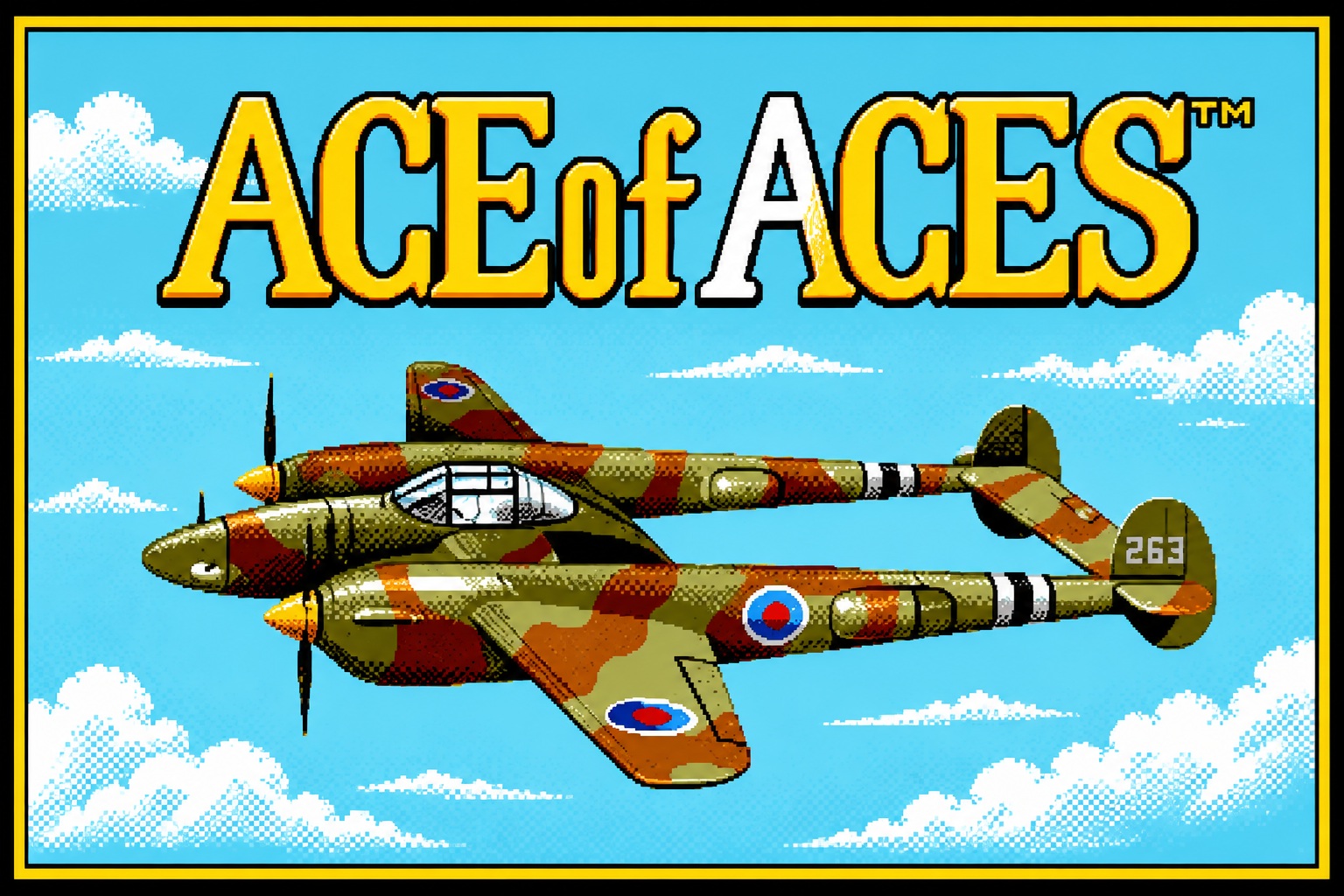
Ace of Aces brings World War II aerial combat to the Sega Master System with a surprisingly detailed combination of dogfighting, bombing, navigation, ammunition management, and aircraft damage. Released for the console in 1991, the game puts players inside a Royal Air Force de Havilland Mosquito fighter-bomber and sends them on dangerous operations over enemy territory. Instead of behaving like a simple scrolling shooter, Ace of Aces attempts to make the player feel responsible for an actual combat aircraft. Weapons, fuel, speed, navigation, target selection, and survival all matter once the Mosquito leaves the safety of its base.
Ace of Aces – Take the Mosquito Into World War II Combat on the Sega Master System
Ace of Aces brings World War II aerial combat to the Sega Master System with a surprisingly detailed combination of dogfighting, bombing, navigation, ammunition management, and aircraft damage. Released for the console in 1991, the game puts players inside a Royal Air Force de Havilland Mosquito fighter-bomber and sends them on dangerous operations over enemy territory. Instead of behaving like a simple scrolling shooter, Ace of Aces attempts to make the player feel responsible for an actual combat aircraft. Weapons, fuel, speed, navigation, target selection, and survival all matter once the Mosquito leaves the safety of its base.
The result is a very different experience from most 8-bit action games. Players can fight enemy aircraft, intercept bombers and V-1 flying bombs, attack trains, and conduct low-level strikes against German U-boats while switching between several useful views inside and around the aircraft. Before a mission even begins, the amount of fuel, ammunition, bombs, and rockets carried affects how the Mosquito performs. Taking everything available may sound sensible, but additional weight can reduce speed and make the aircraft less effective during combat.
Now playable online through Lemon Web Games, Ace of Aces can now be played directly in your web browser with its cockpit-based flight combat, bombing missions, dogfights, navigation, aircraft management, and World War II setting intact. Players can prepare the Mosquito for different objectives, take off with a carefully chosen weapon load, search for targets, engage enemy fighters, and attempt to return after completing the mission. The game requires more patience than a conventional arcade shooter because learning how to read the instruments and select the correct view is just as important as pulling the trigger. Once those systems begin to make sense, Ace of Aces becomes an interesting example of how ambitious an 8-bit flight game could be.
Flying the de Havilland Mosquito
The aircraft at the centre of Ace of Aces is the famous British de Havilland Mosquito. Historically known for combining high speed with tremendous versatility, the Mosquito was used for roles ranging from reconnaissance and bombing to night fighting and precision attacks.
In the game, that versatility allows one aircraft to perform several very different mission types. One operation may require engaging aircraft at altitude, while another sends the player toward a surface target that needs bombs or rockets.
This makes the Mosquito an excellent choice for the game's structure. Instead of changing aircraft for every assignment, players learn one machine and gradually discover how to use it effectively in different situations.
The Cockpit Is Your Main View of the Battle
Most of the action is experienced from inside the aircraft rather than from an external third-person viewpoint. The cockpit displays important information while the world ahead shows enemy aircraft, targets, and the horizon.
This perspective immediately makes Ace of Aces feel closer to a flight simulator than a traditional action game. Players need to pay attention to where the aircraft is pointing instead of simply moving a sprite around the screen.
The limited visibility also makes situational awareness important. An enemy fighter can move away from the forward view, forcing the player to reposition instead of expecting every threat to remain conveniently visible.
Different Views Serve Different Purposes
Ace of Aces allows players to change viewpoints depending on what they are trying to accomplish. The forward cockpit is useful for flying and attacking airborne targets, while other views help with navigation, monitoring the aircraft, or preparing attacks against ground and sea targets.
Learning when to change views is one of the game's most important skills. Staying in the wrong position for too long can make it difficult to locate a target or prepare an accurate bombing run.
The system may initially feel complicated compared with a straightforward shooter, but it becomes much more natural after several missions. Each viewpoint exists because the Mosquito is expected to do more than simply fire forward.
Mission Preparation Matters Before Takeoff
Players are given some control over the supplies carried into combat. Fuel, ammunition, bombs, and rockets all need to be considered before committing to a mission.
The obvious temptation is to carry as much as possible, but additional equipment makes the aircraft heavier. A heavily loaded Mosquito cannot perform exactly like one carrying a lighter combat load.
This creates an interesting trade-off. Extra weapons provide more options once a target is reached, while reduced weight can improve the aircraft's ability to move and survive.
Fuel Creates Another Strategic Consideration
Flying requires enough fuel to reach the target, complete the mission, and return safely. Carrying too little may make the aircraft lighter, but it also creates the possibility of running out before the operation is complete.
Too much fuel contributes additional weight. Players therefore need to find a sensible balance instead of automatically maximizing every available resource.
This small preparation mechanic gives Ace of Aces more depth than its simple graphics initially suggest. The mission can begin going wrong before takeoff if the aircraft has been prepared poorly.
Dogfighting Requires Control and Patience
Enemy fighters can turn an otherwise straightforward mission into a dangerous aerial engagement. Players need to manoeuvre the Mosquito until an enemy aircraft enters a useful firing position.
Holding the trigger while the target is nowhere near the guns wastes ammunition. The better approach is to line up the enemy, fire when there is a reasonable opportunity, and continue adjusting as the engagement develops.
Dogfighting takes practice because the game does not provide the effortless tracking found in many arcade shooters. Learning how the aircraft responds is part of becoming effective.
Enemy Bombers Become Large Aerial Targets
Bomber interception provides another form of air combat. These larger aircraft may be easier to identify than fighters, but reaching a good attack position can still be dangerous.
The Mosquito needs to approach while avoiding unnecessary damage and then remain aligned long enough to deliver effective fire. Moving directly behind an enemy aircraft may create a convenient target but can also expose the player to return fire.
Successful interception therefore involves more than simply finding the bomber. Positioning still matters even against something larger and slower.
V-1 Flying Bombs Demand Quick Interception
The V-1 threat provides a very different type of mission. Instead of fighting an aircraft trying to outmanoeuvre the Mosquito, the objective is to intercept a fast-moving flying bomb before it reaches its destination.
These missions emphasize speed and accurate positioning. Time spent wandering in the wrong direction makes the interception increasingly difficult.
The scenario also fits the Mosquito's reputation as a fast aircraft. Chasing a V-1 gives Ace of Aces another mission type that feels different from conventional dogfighting.
Train Attacks Bring the Battle Down to Ground Level
Some assignments take the player away from aerial targets and toward enemy trains. These operations require the Mosquito to attack targets positioned on the ground rather than simply remaining at comfortable altitude.
Approaching correctly becomes extremely important because the aircraft needs enough time to line up the strike while remaining clear of terrain and defensive threats. Rushing the attack may result in missing the target entirely.
Ground missions demonstrate why the game includes multiple weapons. Machine guns alone are not always the best solution when the objective requires heavier firepower.
U-Boat Missions Require Bombing Skill
German U-boats provide another major target. Striking a submarine from the air requires a very different approach from chasing a fighter.
Players need to locate the target, establish the correct approach, and use the appropriate bombing view to release weapons accurately. The aircraft continues moving during the attack, so timing is critical.
Dropping too early or too late can waste valuable bombs. Learning to judge the approach transforms bombing from guesswork into one of the game's most rewarding mechanics.
Bombs and Rockets Expand the Mosquito's Role
The ability to carry different weapons is what allows the Mosquito to handle such varied assignments. Guns are useful against aircraft, while bombs and rockets provide the power needed against larger surface targets.
Those weapons are not unlimited, so careless attacks can leave the aircraft without the equipment needed to complete its main objective. It is often better to reposition and make another approach than to release everything during a poorly aligned attack.
This encourages players to treat each weapon as a resource. Ace of Aces rewards preparation and accuracy more than constant firing.
Aircraft Damage Can Turn a Mission Into a Fight for Survival
Taking enemy fire can affect more than a simple health meter. Damage to the Mosquito may create problems that make the remainder of the operation increasingly difficult.
An aircraft that begins a mission fully operational can become much harder to control after a damaging engagement. Engine trouble and other failures can transform the journey home into a challenge of its own.
This means surviving an attack is not always the same as escaping unharmed. Damage accumulated earlier may become important long after the enemy aircraft has disappeared.
Navigation Is Part of the Challenge
Finding the objective is another responsibility placed on the player. Ace of Aces expects some understanding of where the aircraft is travelling instead of automatically placing every target directly ahead.
The navigation display helps determine direction and position during longer operations. Checking it occasionally can prevent a great deal of wasted fuel.
This requirement slows the pace compared with arcade shooters, but it also adds to the feeling of conducting an actual mission. Reaching the battlefield is part of the experience rather than merely a transition between action scenes.
Practice Modes Help New Pilots Learn
The game includes opportunities to practise important skills before attempting more demanding operations. Learning basic dogfighting and bombing separately can make the full missions much easier to understand.
This is especially useful because Ace of Aces comes from an era when flight controls were often less immediately intuitive than modern games. A few unsuccessful attempts are normal while learning how the views, weapons, and aircraft movement interact.
Practising one mechanic at a time is far more effective than trying to understand everything during a complicated mission. Once basic flying becomes comfortable, the larger operations are much easier to approach.
The Graphics Focus on Functional Information
Ace of Aces does not attempt to overwhelm the player with visual effects. The cockpit, instruments, horizon, aircraft, and targets are presented in a functional style suited to the capabilities of the Sega Master System.
The visual simplicity helps keep important information readable. Players can quickly identify the horizon, locate targets, and determine what the aircraft is doing without excessive decoration.
There is also something charming about the game's attempt to represent serious flight simulation concepts using limited 8-bit hardware. The ambition is often more impressive than the visual complexity.
The Game Rewards Learning Rather Than Reflexes Alone
Fast reactions certainly help during dogfights, but Ace of Aces is equally interested in preparation and understanding.
Knowing which weapon to carry, when to change views, how to navigate, when to attack, and when to disengage can matter just as much as firing accurately. A player who understands the systems will usually perform better than someone relying purely on reflexes.
This gives the game a slower learning curve than many Sega Master System action titles. Progress comes from gradually becoming a better pilot.
Playing Ace of Aces Online Today
Through Lemon Web Games, Ace of Aces can now be played directly in your web browser with no downloads or setup required. Features of the web-based version include:
New players should spend some time learning how each viewpoint works before worrying about completing every objective. The controls become much easier once the relationship between the cockpit, map, bombing view, and aircraft movement is understood.
It is also worth resisting the temptation to carry the maximum possible load on every mission. Consider the objective first and equip the Mosquito for what it actually needs to accomplish.
Who Should Play Ace of Aces
Ace of Aces is particularly suitable for players who enjoy games that require a little learning before everything becomes clear. It is not designed around immediate arcade spectacle, and understanding the aircraft is part of the challenge.
It should also appeal to anyone interested in seeing how developers attempted to represent flight simulation on limited hardware. The game squeezes an impressive number of aviation concepts into an 8-bit console experience.
Play Ace of Aces Online Now
Ace of Aces places the player in control of a versatile Mosquito and leaves much of the mission planning and execution in their hands. Choose the appropriate weapons, manage fuel, navigate toward the objective, engage enemy aircraft, attack surface targets, and try to bring the damaged aircraft safely home.
Through Lemon Web Games, the Sega Master System version can be experienced directly in the browser as a fascinating example of early console flight combat. The controls may require practice, but learning how to complete an operation successfully provides a sense of accomplishment that simpler shooters rarely attempt.
Final Thoughts
Ace of Aces stands out because it tries to do much more than provide a stream of targets to shoot. Its cockpit view, navigation, fuel management, selectable weapons, different mission types, bombing mechanics, and aircraft damage all contribute to the feeling of operating a combat aircraft rather than controlling a conventional arcade character.
The Sega Master System version inevitably simplifies real aviation, but that is also part of its charm. Dogfighting, V-1 interception, train attacks, bomber hunting, and U-boat strikes give the Mosquito a varied workload while keeping the player responsible for preparation and execution.
Through Lemon Web Games, Ace of Aces remains an interesting choice for anyone curious about early combat flight games. It demands patience and practice, but pilots willing to learn its systems will find a surprisingly ambitious World War II experience hiding inside this classic 8-bit release.











Comments 0