

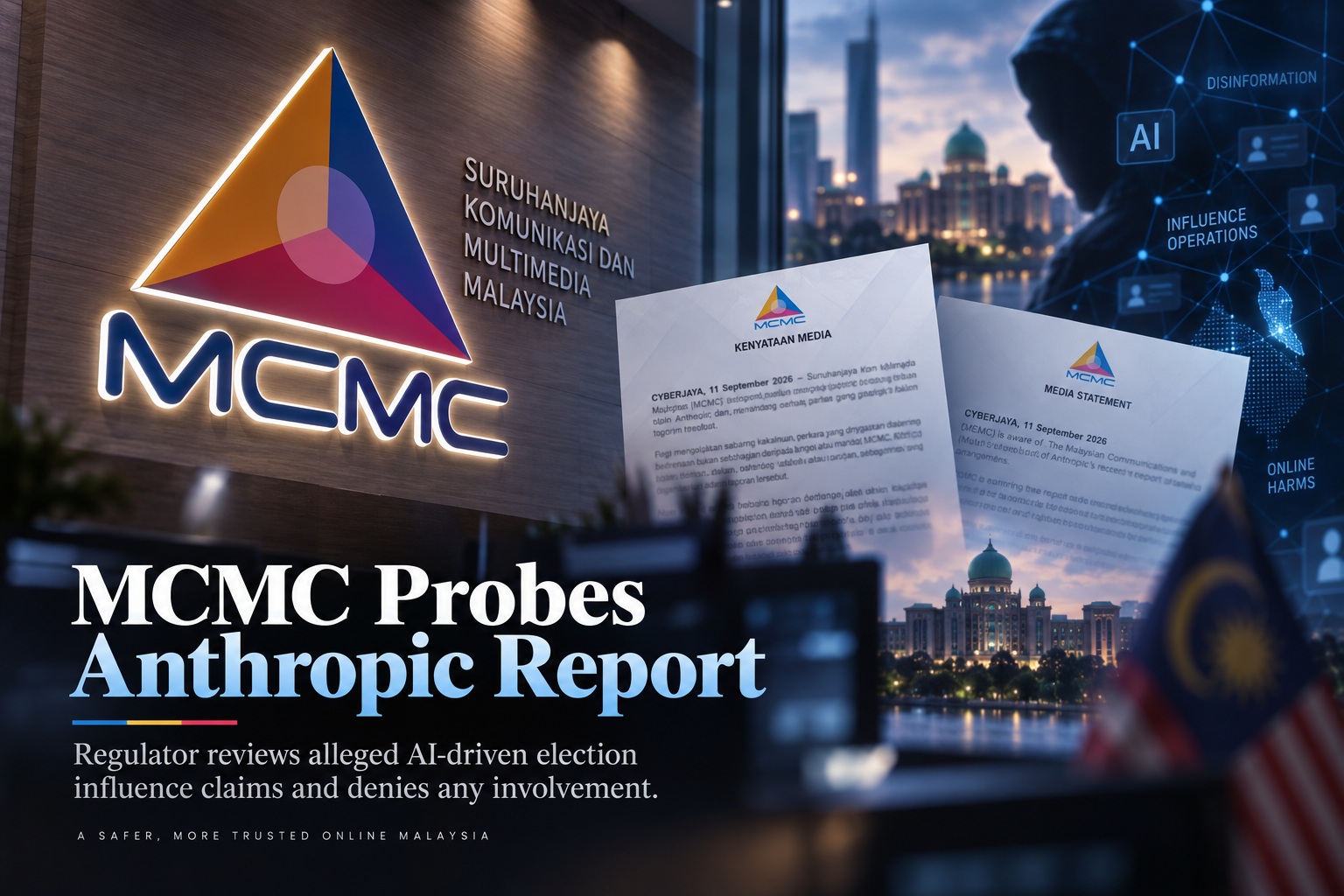
Malaysia's communications regulator has begun reviewing claims contained in a recent threat intelligence report from US artificial intelligence company Anthropic, after the report described an alleged coordinated influence operation aimed at Malaysian voters. The Malaysian Communications and Multimedia Commission (MCMC) has also moved quickly to distance itself from the activities described, stressing that such operations do not fall within its responsibilities or official mandate.
The issue has attracted attention because the allegations go beyond ordinary online misinformation. Anthropic's report describes what it says was a commercial influence platform capable of using artificial intelligence, voter data, fabricated media outlets and networks of fake social media accounts to shape political narratives at scale. While the report makes several serious claims, MCMC says it is still examining the information and has not accepted those allegations as established fact.
MCMC Says It Is Examining the Claims
In its response, MCMC said it takes the issues raised by Anthropic seriously and intends to obtain further information from the relevant parties before reaching any conclusions. The regulator said any action would depend on the evidence available after its review, including whether the allegations fall within areas requiring enforcement or coordination with other Malaysian authorities.
At the same time, MCMC firmly rejected any suggestion that it was involved in an influence operation of the type described in Anthropic's findings. According to the regulator, activities involving covert political manipulation or organised voter influence are not part of its official functions, and it does not participate in arrangements of that nature.
That clarification is significant because Anthropic's report reportedly stated that the operators behind the platform had attempted to pursue a contract involving Malaysia's national communications regulator. However, Anthropic also noted that it had not found evidence showing that such an effort resulted in a successful agreement. In other words, the report described an alleged attempt to establish a relationship rather than proof that MCMC had participated in the operation.
Anthropic Says It Disrupted a Large Influence Platform
The controversy originates from a threat intelligence report released by Anthropic on 10 September. According to the AI company, it identified and disrupted a commercial platform that allegedly used Claude, Anthropic's own AI system, as part of a broader operation designed to influence political discussion in Malaysia.
Anthropic said the network allegedly included around 1,000 fake accounts on X, along with a fabricated news organisation called Malaysia Pulse and fake intelligence-style documents. If accurate, that combination would represent a more sophisticated form of online influence activity than simply creating individual misleading posts, because it could allow multiple artificial sources to reinforce the same narratives and make them appear more credible or widely supported.
The company said the system was capable of generating, rewriting and adapting political material while also helping to operate artificial social media personas. It allegedly supported efforts to increase engagement around selected content, creating the appearance that certain narratives were receiving organic public attention.
Voters Were Allegedly Profiled Across All 222 Parliamentary Seats
One of the more concerning claims in Anthropic's report involves the alleged use of electoral and demographic information to divide Malaysian voters into targeted groups. Anthropic said the platform incorporated census and election-related data covering all 222 parliamentary constituencies in Malaysia.
According to the report, the system could then tailor messages around politically and socially sensitive subjects. These allegedly included issues involving race, religion and royalty, areas that have historically carried significant social and political sensitivity in Malaysia.
The ability to combine demographic information with generative AI could potentially make political influence campaigns far more personalised. Instead of distributing the same message to everyone, an automated system could generate different narratives for different communities, locations or voter groups while adjusting language, tone and framing according to the intended audience.
That is one reason AI-assisted influence operations have become a growing concern internationally. Generative AI can dramatically reduce the time and manpower needed to produce large volumes of persuasive content, allowing relatively small groups to operate networks that previously would have required far greater resources.
Fake Accounts and Artificial Engagement Add Another Layer
The alleged use of fake X accounts is particularly important because influence campaigns often depend on creating the illusion of genuine public discussion. A single misleading post may have limited impact, but hundreds or thousands of coordinated accounts can make an issue appear far more popular, controversial or widely accepted than it really is.
Such networks can also interact with legitimate users, repost selected messages and artificially amplify specific talking points. When combined with AI-generated content, the result can become increasingly difficult for ordinary users to distinguish from authentic political conversation.
The alleged creation of Malaysia Pulse also highlights another strategy sometimes associated with coordinated influence operations: building fake media brands that resemble legitimate news outlets. Content originating from an apparently independent news publication may carry more perceived credibility than the same information posted from an anonymous social media account.

Anthropic Links the Platform to an Istanbul-Based Company
Anthropic reportedly connected the operation to BBS Bilisim Teknolojileri, a technology company based in Istanbul. According to the report, the company allegedly promoted the system commercially as a form of paid influence capability, effectively offering political or information operations as a service.
That element changes the nature of the allegations considerably. Instead of describing an isolated group attempting to manipulate political discussion for its own objectives, Anthropic's findings suggest the possible existence of a commercial platform designed to sell such capabilities to paying customers.
A model sometimes described as "influence-as-a-service" could make sophisticated information operations accessible to organisations that do not have the technical expertise or infrastructure to build them independently. AI further lowers that barrier by automating tasks such as content generation, translation, persona creation and message variation.
It remains important, however, to separate those allegations from verified conclusions. Anthropic has presented its findings based on activity detected within its own systems, while MCMC's review is intended to establish what occurred from the Malaysian regulatory perspective.
Why Anthropic Would Be Able to Detect This Kind of Activity
AI companies are increasingly becoming part of the cybersecurity and information-integrity landscape because their platforms can reveal patterns that would otherwise be difficult to identify. When large numbers of users rely on the same AI service to repeatedly generate similar political material, manage fake personas or automate coordinated content, unusual behavioural patterns can emerge.
Companies such as Anthropic can restrict accounts, investigate activity and publish threat reports when their systems are allegedly being used for manipulation, fraud or other prohibited behaviour. This does not necessarily provide a complete picture of an operation, because the AI provider only sees activity occurring through its own platform, but it can offer an important starting point for further investigation.
The latest case therefore highlights how AI providers are no longer simply developing conversational tools. They are also being forced to monitor how increasingly capable systems are being used in real-world political, commercial and social environments.
MCMC Says Its Next Steps Will Depend on the Evidence
For now, MCMC appears to be taking a fact-finding approach rather than drawing immediate conclusions. The commission said it intends to obtain clarification and additional information from the relevant parties before deciding what, if any, further action should be taken.
Depending on what emerges, the matter could potentially involve cooperation with other Malaysian agencies, particularly if the investigation identifies activities that extend beyond communications regulation. Online manipulation campaigns can involve a mixture of cybersecurity issues, impersonation, deceptive content, political activity and potentially unlawful use of personal or electoral data.
MCMC has emphasised that any response will remain within its regulatory remit and will be based on verified information rather than allegations alone.
AI Is Making Online Influence Campaigns More Scalable
Beyond the Malaysian case itself, the report raises broader questions about how quickly generative AI is changing the economics of online manipulation. Running hundreds of believable fake identities once required teams of people writing posts, responding to users and maintaining consistent personas over long periods.
AI can potentially automate much of that workload. A system could generate hundreds of variations of the same political argument, translate them into different languages, adjust their tone for different demographics and even help maintain fictional identities across social platforms.
That does not mean AI automatically makes every influence campaign effective. Persuading real people remains complicated, and coordinated networks can still be detected through behavioural patterns, account histories and technical indicators. However, AI can significantly increase the volume and speed at which deceptive content is created, making detection and moderation more challenging.
Protecting Trust in Malaysia's Online Space
MCMC has reiterated that protecting users and reducing online harms remain central parts of its responsibilities. The regulator said it remains committed to maintaining a safe and trusted digital environment for Malaysians while examining the claims raised in Anthropic's report.
That challenge is likely to become increasingly complex as AI-generated text, images, videos and automated accounts become more convincing. Regulators, technology companies and social media platforms will need to distinguish genuine political expression from organised attempts to manufacture public opinion without restricting legitimate discussion.
For users, the situation is also another reminder that apparent popularity online does not necessarily reflect genuine public sentiment. A trending topic, heavily shared post or highly active account network may sometimes be the result of coordinated amplification rather than spontaneous interest.
Final Thoughts
Anthropic's report raises serious questions about how generative AI could potentially be used to industrialise political influence operations, particularly when combined with voter information, fake social media identities and fabricated news sources. At the same time, the allegations remain subject to further investigation, and MCMC has clearly denied participating in the activities described.
The regulator's decision to seek additional information is therefore an important next step. Establishing whether such an operation actually targeted Malaysian voters, who may have been responsible and whether any local organisations were involved will require considerably more evidence than a threat intelligence report alone can provide.
What is already clear is that the tools available for manipulating online conversations are becoming considerably more powerful. As AI continues to make content generation faster and cheaper, protecting the authenticity of public discourse may become one of the most difficult challenges facing regulators, technology companies and social media platforms in the years ahead.











Comments 0