

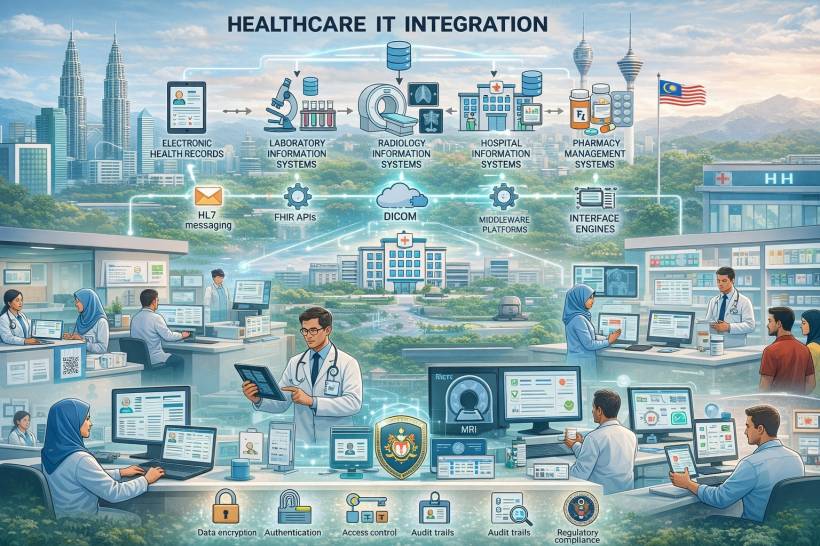
Healthcare IT integration may sound like a very technical phrase, but the image you shared actually explains it in a simple and practical way. At its core, it is about making different hospital and clinical systems talk to each other properly. Instead of each department working in isolation, healthcare IT integration connects registration, consultation, lab testing, radiology, pharmacy, billing, and reporting into one smoother digital flow.
When this works well, doctors get the information they need faster, nurses spend less time chasing records, pharmacists can verify prescriptions more easily, and patients experience fewer delays. In a country like Malaysia, where healthcare services exist across government hospitals, private hospitals, specialist centres, GP clinics, diagnostic labs, and community care providers, this kind of integration is becoming increasingly important.
What the Image Is Really Showing
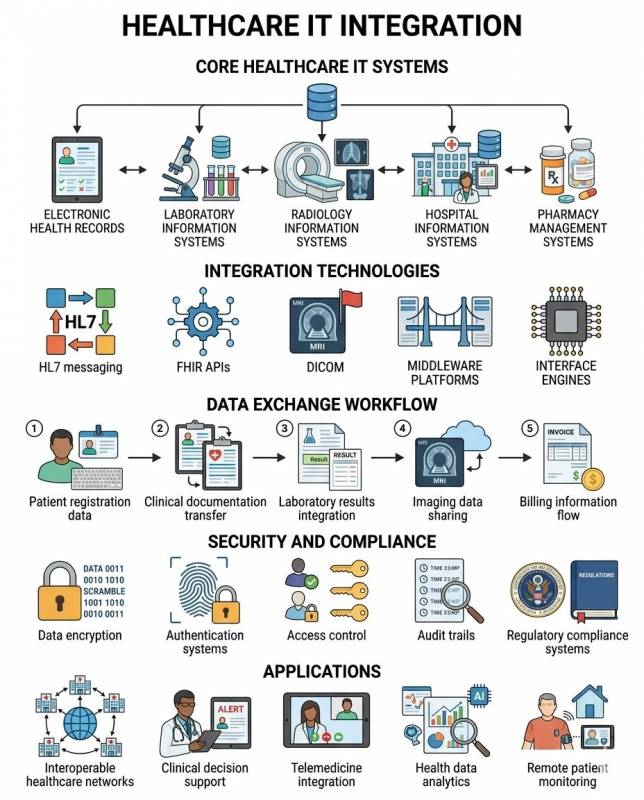
The image breaks healthcare IT integration into five major parts.
First, it shows the core healthcare IT systems. These include electronic health records, laboratory systems, radiology systems, hospital information systems, and pharmacy management systems. These are the main platforms that handle patient data across a hospital or clinic environment.
Next, it highlights the technologies that help these systems communicate. Terms like HL7, FHIR APIs, DICOM, middleware platforms, and interface engines may sound intimidating, but they are simply the tools and standards that allow one system to send data to another in a structured way.
The image then moves into the data exchange workflow. This is the real-life journey of information, starting from patient registration, then going into clinical documentation, lab results, imaging, and finally billing.
After that, it emphasizes security and compliance. This is a critical point because healthcare data is sensitive. Access control, authentication, audit trails, and compliance requirements are not optional extras. They are essential.
Finally, the image shows the practical applications of integration, such as telemedicine, clinical decision support, analytics, and remote patient monitoring. This is where healthcare IT becomes more than just data transfer. It becomes something that actively supports better care.
Why Integration Matters So Much in Healthcare
Healthcare settings generate a huge amount of information every day. A patient might register at the front counter, see a doctor, get blood tests done, undergo an X-ray or MRI, collect medication from the pharmacy, and then receive a bill before going home. If every department uses a separate system with no integration, staff may need to key in the same information multiple times.
One system has the patient's correct name, another has an outdated spelling. A lab result is ready, but the doctor has not seen it yet. A radiology image exists, but the report is delayed because the workflow is disconnected. A pharmacy receives a prescription late because it is still being passed around manually. Billing may also be affected if procedure or medication records do not sync properly.
Integration solves these headaches by reducing duplication, speeding up communication, and improving visibility across departments.
The Main Systems Inside a Modern Healthcare Environment Electronic Health Records
An electronic health record, or EHR, acts as the central digital file for a patient. It can include demographics, visit history, diagnoses, allergies, medication lists, clinical notes, and more. In Malaysia, this could be especially useful in larger hospitals and specialist centres where patients may return for follow-up visits over many months or years.
For example, a patient who first visits an orthopaedic specialist in Subang Jaya, later has imaging done in another department, and then returns for review should ideally have everything linked under one unified record. That saves time and reduces the chance of missing important clinical history.
Laboratory Information Systems
A laboratory information system manages blood tests, urine tests, pathology requests, and result reporting. Instead of printing results and manually sending them around, integration allows doctors to view the outcome directly in the patient record.
A very relatable Malaysian example would be a patient attending a private hospital in Kuala Lumpur for a health screening package. Their blood count, glucose, liver function, and cholesterol results should flow automatically from the lab system into the doctor's review screen without staff needing to re-enter anything manually.
Radiology Information Systems and Imaging
Radiology systems manage imaging requests, reports, and image-related workflows, while DICOM supports the storage and transfer of medical images such as X-rays, CT scans, MRIs, and ultrasounds.
Imagine a patient in Penang coming in with knee pain. The doctor orders an X-ray, the radiology department captures the image, and the result becomes available to the clinician through the same hospital platform. That is integration doing its job. The doctor no longer needs to wait for someone to physically pass a report or call another department just to confirm whether the image is ready.
Hospital Information Systems
The hospital information system is usually the broader operational platform tying many modules together. It may include registration, admission, discharge, appointments, ward management, billing, and more.
In Malaysia, this is especially relevant in medium to large hospitals where patient movement between outpatient services, emergency care, specialist clinics, and inpatient wards needs to be tracked accurately.
Pharmacy Management Systems
A pharmacy system handles prescriptions, medication dispensing, stock control, and drug interaction checks. Once integrated, it becomes easier for the pharmacy team to confirm what was prescribed, by whom, and for which patient.
For example, after a consultation at a specialist clinic in Johor Bahru, the doctor's prescribed medication should flow directly into the pharmacy queue. That reduces waiting time and lowers the risk of transcription errors.
The Technologies That Make the Connection Possible HL7 Messaging
HL7 is one of the traditional standards used in healthcare for exchanging information between systems. You can think of it as a structured format for sending messages such as patient registration details, test orders, or discharge summaries.
In practical terms, if the registration counter creates a new patient visit, HL7 can help send that information to the lab, radiology, or billing system.
FHIR APIs
FHIR is a newer, more flexible standard that supports modern API-based integration. It is often seen as a more web-friendly way for healthcare platforms to share data.
This becomes useful when hospitals want to connect newer applications, mobile tools, patient portals, or digital health apps without relying only on older interface methods.
DICOM
DICOM is the key standard for medical imaging. It ensures that imaging equipment and viewing systems can handle scans in a consistent way.
In a Malaysian radiology centre, this means MRI machines, PACS viewers, and radiology workstations can work together more smoothly.
Middleware Platforms and Interface Engines
These are the behind-the-scenes connectors. They act like translators and traffic controllers between different systems that were never originally designed to work together.
That is often the real-world situation in healthcare. A hospital may have one vendor for the hospital information system, another for lab software, another for imaging, and yet another for billing. Middleware helps bring order to that digital chaos.
A Realistic Malaysian Workflow Example
To make the image more relatable, let us imagine a patient visiting a private hospital in Selangor for chest discomfort.

The patient first registers at the counter. Their demographic details go into the hospital system.
The doctor then sees the patient and documents symptoms, history, and examination findings in the clinical record.
Blood tests are ordered, and the request flows electronically to the lab system.
A chest X-ray is requested, and that order is sent to radiology.
Once the blood results and X-ray report are ready, they appear in the doctor's system without needing phone calls or paper transfers.
If medication is prescribed, the prescription moves digitally to the pharmacy.
Finally, all services used during the visit feed into billing so the final charges are generated accurately.
That entire journey reflects the workflow shown in the image. It is not just a diagram. It is a very practical model of how a connected hospital should operate.
Why Security and Compliance Cannot Be Ignored
Healthcare data is among the most sensitive information any organization can hold. That includes personal details, diagnoses, prescriptions, imaging records, lab results, and billing information. If systems are integrated but poorly secured, the risk becomes even greater because more data is flowing between more platforms.
That is why the image places strong emphasis on encryption, authentication, access control, audit trails, and regulatory compliance.
In the Malaysian context, healthcare providers need to be careful about how patient records are accessed, stored, shared, and monitored. Not every staff member should be able to view every record. A pharmacist may need prescription data, but not necessarily full radiology history. An audit trail is also important because it helps show who accessed which record and when.
This is especially important for private hospitals, specialist centres, and clinics expanding into digital workflows. Strong integration should never come at the expense of patient trust.
How Integration Supports Better Patient Care
The biggest benefit of integration is not just technical efficiency. It is better patient care.
When doctors can quickly see lab results and imaging reports, they can make decisions faster. When medication orders reach the pharmacy correctly, patients spend less time waiting. When patient records are more complete and easier to access, the risk of missing important medical information goes down.
For Malaysian healthcare providers, this can make a noticeable difference in busy urban hospitals as well as growing regional medical centres. Better integration can support smoother outpatient care, more reliable specialist follow-ups, and better coordination between departments.
Newer Applications That Build on Integration Telemedicine
Telemedicine becomes much more useful when it connects to actual patient records instead of operating as a separate standalone tool. A doctor conducting an online follow-up should ideally be able to review previous consultation notes, lab results, medication history, and imaging findings in one place.
That is highly relevant in Malaysia, especially for follow-up consultations, chronic disease management, and patients who live far from major hospitals.
Clinical Decision Support
Integrated systems can also support alerts and reminders. For instance, a system might flag a drug allergy, highlight an abnormal lab result, or remind clinicians about missing documentation.
These tools do not replace medical judgment, but they can help reduce oversight in busy care environments.
Health Data Analytics
Once systems are connected, hospitals can start learning from their own data. They can study patient volumes, common diagnoses, medicine usage, radiology turnaround times, and operational bottlenecks.
For a hospital in Malaysia, that could help management identify where delays happen most often or which services need better resource planning.
Remote Patient Monitoring
This is one of the more forward-looking applications. Patients with chronic conditions may eventually use devices or apps that send health data back to clinicians. But this only becomes truly valuable when that data can be linked back into the broader healthcare system.
Common Challenges in Malaysia
Even though the benefits are clear, healthcare IT integration is not always easy to implement.
Many hospitals and clinics operate with mixed systems from different vendors. Some are older platforms that do not support modern APIs well. Others may rely on manual processes that have been used for years. Budget, training, workflow redesign, and vendor coordination can also slow things down.
In Malaysia, another common reality is that not every healthcare provider is at the same stage of digital maturity. A major private hospital in Klang Valley may have more advanced integration than a smaller clinic or standalone diagnostic centre. That means progress often happens in phases rather than all at once.
Still, even partial integration can bring meaningful improvements when done properly.
Final Thoughts
The image you shared gives a strong overview of how modern healthcare IT should function. It shows that integration is not just about connecting software for the sake of convenience. It is about helping clinical teams work more efficiently, improving accuracy, protecting sensitive patient information, and giving patients a smoother experience from registration to treatment and payment.
In the Malaysian healthcare landscape, this matters more than ever. As hospitals, clinics, labs, and digital health services continue to modernize, the real goal should not be just having more systems. It should be making those systems work together in a practical, secure, and patient-friendly way.
That is when healthcare IT stops being just an IT project and starts becoming something that genuinely improves care.











Comments 0