

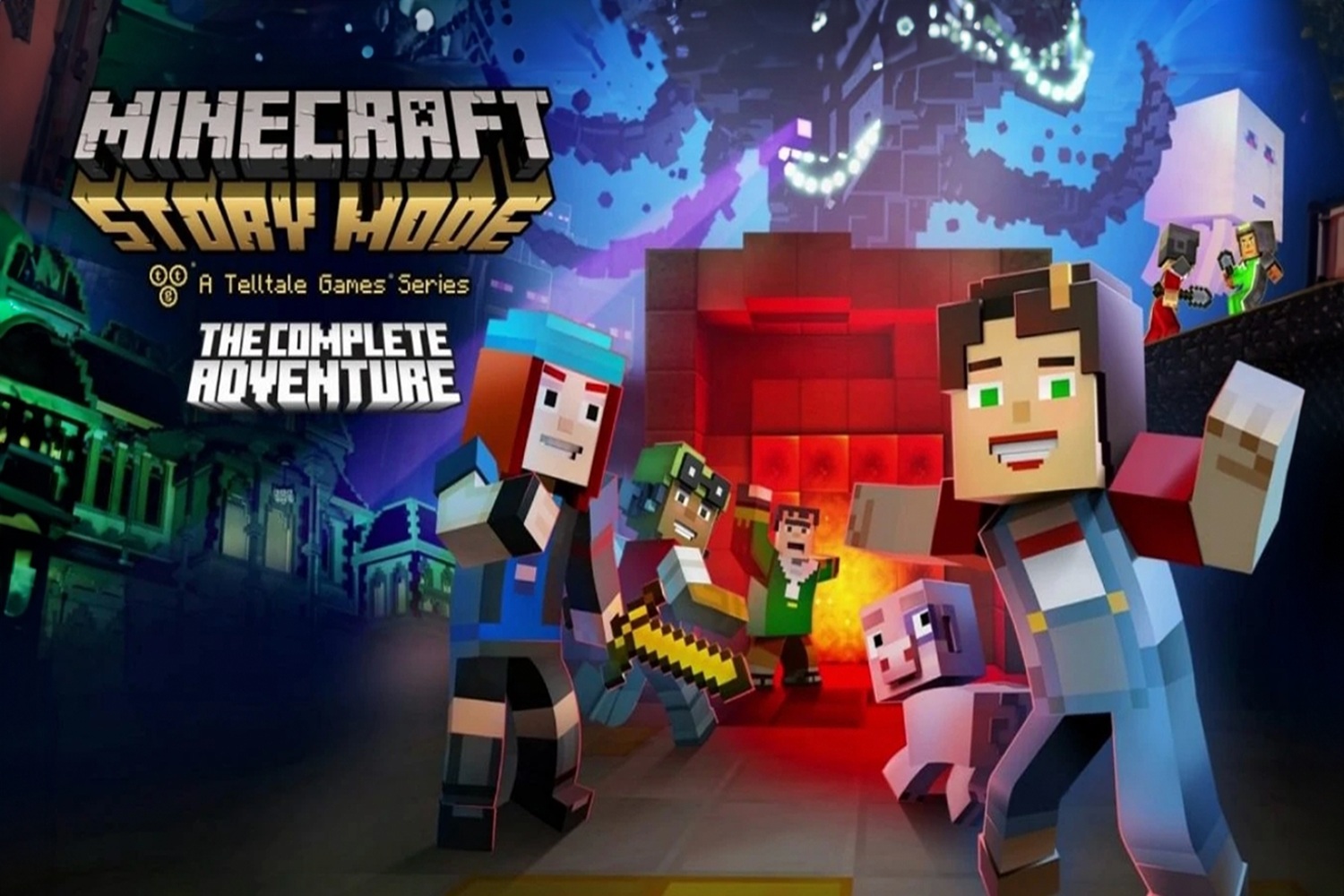
Minecraft: Story Mode takes the instantly recognizable world of Minecraft and turns it into a full cinematic adventure built around characters, relationships, exploration, action, and player choice. Developed by Telltale Games in collaboration with Mojang, the game follows Jesse, an ordinary Minecraft enthusiast whose trip to EnderCon unexpectedly becomes the beginning of a much larger journey. Together with friends Axel, Olivia, Petra, and the lovable pig Reuben, Jesse becomes involved in a crisis threatening the entire world. What starts as a competition between aspiring builders quickly grows into a desperate mission involving legendary heroes, ancient structures, dangerous dimensions, and the terrifying Wither Storm.
Instead of giving players an open sandbox and asking them to create their own objectives, Minecraft: Story Mode places familiar Minecraft mechanics inside a structured episodic narrative. Creepers, zombies, skeletons, Endermen, crafting tables, redstone, Nether portals, minecarts, enchanted weapons, and recognizable blocks all appear, but they serve a story rather than an unrestricted building simulation. Dialogue choices allow players to influence Jesse's personality and relationships, while exploration sections, quick-time events, puzzles, combat sequences, and crafting moments keep the adventure interactive. The result feels unmistakably Minecraft while offering an experience completely different from surviving the first night or constructing an enormous base.
Now playable online through Lemon Web Games, Minecraft: Story Mode brings Jesse's cinematic journey, branching conversations, quick-time action, crafting, exploration, memorable characters, and episodic storytelling directly into the web browser. Players can customize Jesse, make important decisions, explore familiar Minecraft environments from a new perspective, and experience the entire adventure as friendships and conflicts develop around them. The story eventually expands far beyond the original Wither Storm crisis, introducing new worlds, mysterious portals, dangerous artificial intelligence, murder mysteries, and powerful figures connected to forgotten Minecraft history. For players who love the Minecraft universe but want a more character-driven experience, Story Mode offers a completely different way to explore it.
Minecraft Becomes a Story-Driven World
The original Minecraft deliberately gives players enormous freedom without telling them exactly how to experience the world. Minecraft: Story Mode takes the opposite approach by placing recognizable Minecraft elements inside a carefully written narrative. The world still follows familiar logic—blocks can be mined, items crafted, mobs encountered, and portals constructed—but characters now have personal histories and motivations.
This creates a surprisingly natural combination. A Creeper approaching during a cinematic scene remains immediately recognizable as a threat, while discovering a crafting table tells experienced players exactly what might happen next. Story Mode can therefore introduce mechanics and locations without lengthy explanations because much of its visual language is already familiar.
At the same time, knowledge of Minecraft is not required to follow the plot. The adventure explains important concepts naturally through dialogue and events. Newcomers can enjoy the story as a fantasy adventure while longtime players recognize countless details borrowed from the sandbox game.
Jesse Can Be Your Version of the Hero
Players take control of Jesse, whose appearance and gender can be selected before beginning the adventure. Regardless of appearance, Jesse starts as an enthusiastic but relatively ordinary person rather than a legendary warrior. That makes the character's transformation across the story much more satisfying.
Jesse's personality is also influenced through dialogue choices. Players can respond confidently, cautiously, humorously, angrily, or sometimes remain silent. These decisions do not completely rewrite the main storyline, but they influence conversations, relationships, and how other characters react.
This gives Jesse enough flexibility to feel personal without turning the game into a completely open-ended role-playing system. One player may create a supportive leader who tries to keep everyone together, while another can make Jesse far more confrontational. The central adventure remains recognizable, but the tone can change.
EnderCon Starts the Adventure
The story begins around EnderCon, a large convention celebrating builders and adventurers within the Minecraft world. Jesse, Axel, Olivia, and Reuben arrive hoping to compete in a building contest and meet Gabriel the Warrior, one of the legendary members of the Order of the Stone. At this point, the adventure still feels relatively lighthearted.
Everything changes after Jesse encounters Petra and becomes involved with the mysterious Ivor. What initially appears to be a questionable transaction soon develops into something far more dangerous. A plan involving a command block and the Wither creates a creature that cannot be controlled normally.
EnderCon becomes the location where several seemingly unrelated characters and motivations collide. The event introduces friendships, rivalries, and the legendary heroes who will shape the rest of the story. By the time the group leaves, the peaceful building competition has become almost irrelevant.
The Wither Storm Becomes an Enormous Threat
The Wither Storm is one of the most memorable creations in Minecraft: Story Mode because it transforms the familiar Wither into something far more terrifying. Powered through the command block, the creature becomes capable of consuming blocks, structures, mobs, and entire environments while continuously growing. Ordinary weapons are not enough to stop it permanently.
Its scale gives the first major story arc genuine urgency. Towns and landscapes are destroyed as the creature moves through the world, forcing Jesse and the group to search for a solution before there is nothing left to save. The Wither Storm feels less like another Minecraft boss and more like a natural disaster capable of following the characters anywhere.
The creature also creates some of the game's most dramatic action sequences. Players run through collapsing environments, avoid debris, confront hostile mobs, and make quick decisions while enormous sections of the world disappear behind them. It gives Story Mode a sense of scale rarely associated with ordinary Minecraft gameplay.
The Order of the Stone Becomes the Only Hope
The Order of the Stone is introduced as a legendary group of heroes who supposedly defeated the Ender Dragon and became famous throughout the world. Its members include Gabriel the Warrior, Ellegaard the Redstone Engineer, Magnus the Rogue, and Soren the Architect. Jesse and friends believe reuniting them may provide the knowledge required to defeat the Wither Storm.
Finding the Order becomes one of the first major objectives. Different members specialize in different abilities, reflecting recognizable Minecraft play styles. Ellegaard represents sophisticated redstone engineering, Magnus embraces explosive destruction, Gabriel embodies combat, and Soren demonstrates extraordinary construction and research.
The group is not as perfect as the legends suggest. Old disagreements, hidden truths, and personal flaws gradually complicate Jesse's expectations. Story Mode repeatedly explores the difference between the heroes people imagine and the actual individuals behind those stories.
Gabriel Represents the Traditional Hero
Gabriel is the member of the Order most immediately associated with heroic adventure. His reputation as a powerful warrior has made him one of the most recognizable figures attending EnderCon. Jesse initially views meeting him as something extraordinary.
As the crisis develops, however, the story reveals that legendary status does not make someone immune to fear, mistakes, or consequences. Gabriel becomes another person trying to survive an unprecedented situation. His vulnerability makes the Order much more believable.
This also gives Jesse an opportunity to grow. Instead of relying permanently on established heroes, the younger group gradually learns to take responsibility themselves. Heroism becomes something demonstrated through actions rather than reputation.
Ellegaard Celebrates Minecraft Engineering
Ellegaard represents players who love redstone and complicated Minecraft machinery. Her environment is filled with inventions, circuits, pistons, and increasingly ambitious engineering experiments. Visiting her section of the story feels like entering the workshop of someone who has spent years mastering Minecraft's technical possibilities.
Her intelligence becomes important when dealing with the command block powering the Wither Storm. The problem cannot simply be solved through sword fighting. Understanding how the creature was created is essential to understanding how it might be destroyed.
Ellegaard also reinforces how Story Mode celebrates different approaches to Minecraft. Building, fighting, exploring, engineering, and improvisation can all be heroic skills. There is no single definition of what makes someone powerful.
Magnus Brings Explosive Chaos
Magnus represents the opposite end of Minecraft creativity. Instead of delicate redstone engineering, his world celebrates destruction, explosions, and aggressive competition. His personality immediately creates a very different atmosphere from Ellegaard's more technical environment.
This contrast allows the story to explore different versions of leadership. Magnus can be reckless, but his willingness to act decisively can also become useful during a crisis. Jesse needs to understand how to work with people who do not always agree.
The choice between seeking Magnus or Ellegaard early in the story also gives players one of the game's more noticeable branching moments. Both routes eventually return toward the central plot, but the journey and interactions differ. It provides a reason to replay the adventure.
Soren Holds Important Secrets
Soren the Architect gradually becomes one of the most important members of the Order because his knowledge reaches beyond ordinary building. His history is connected to the Endermen, the End, and the truth surrounding the Order's legendary reputation. Finding him becomes essential to understanding both the Wither Storm and the group's past.
Soren's fascination with Endermen leads to some of the game's strangest locations and sequences. Players see familiar Minecraft creatures presented through a more narrative perspective, emphasizing their mysterious behavior and unusual relationship with blocks. The Endermen become more than random hostile mobs.
The information surrounding Soren also begins dismantling the heroic mythology established early in the story. The Order's greatest achievement contains complications the public never knew. Jesse is forced to decide what being a hero actually means when legends prove imperfect.
Petra Becomes One of Jesse's Strongest Allies
Petra enters the story as a confident adventurer comfortable with dangerous expeditions and questionable deals. She is considerably more experienced than Jesse's original group and quickly becomes important once the Wither Storm crisis begins. Her courage makes her an obvious ally.
Her storyline also introduces some of the most emotional consequences of the early episodes. Depending on events and player decisions, Petra can suffer significantly because of the Wither Storm. Jesse's responses affect how their friendship develops.
Petra works well because she never becomes simply an invincible warrior. She has vulnerabilities, doubts, and moments where she needs support from the rest of the group. Her relationship with Jesse can become one of the strongest parts of the adventure.
Axel Brings Humor and Loyalty
Axel is one of Jesse's closest friends and frequently provides comic relief during stressful situations. He is enthusiastic, impulsive, and occasionally creates additional problems by acting before thinking everything through. Yet his loyalty to Jesse remains clear throughout the adventure.
His personality can also clash with other characters, particularly when the group begins interacting with people Axel does not trust. These disagreements help make the team feel like actual friends rather than permanently agreeable companions. Tension exists without automatically destroying the group.
Axel's relationship with Magnus also becomes particularly appropriate given both characters' enthusiasm for destruction. Story Mode frequently pairs characters according to personality rather than simply progressing everyone through identical roles. This helps the ensemble remain memorable.
Olivia Is the Technical Mind of the Original Group
Olivia is thoughtful, intelligent, and fascinated by engineering, making her naturally interested in Ellegaard's work. Where Axel often reacts impulsively, Olivia tends to consider problems more carefully. This creates a useful balance within Jesse's original group.
Her technical interests also give her a clear identity beyond being another friend. She understands machinery and redstone, allowing her to contribute directly when the group encounters complicated systems. Everyone has something useful to offer.
Like Axel, Olivia can occasionally disagree with Jesse's decisions. Player choices therefore influence the emotional atmosphere within the group. Leadership means keeping several personalities moving toward the same objective.
Reuben Gives the Adventure Its Emotional Heart
Reuben may be a pig, but he quickly becomes one of the most beloved characters in Minecraft: Story Mode. Jesse clearly cares deeply about him, and Reuben accompanies the group through dangerous situations that most ordinary Minecraft animals would never survive. His small reactions provide humor and warmth throughout the story.
Because Reuben cannot communicate through normal dialogue, his personality is expressed through animation, sounds, and Jesse's interactions with him. This makes their relationship surprisingly effective. He represents the quieter emotional side of an adventure increasingly dominated by enormous threats.
Reuben also reminds players that Story Mode is willing to create consequences that extend beyond jokes and action. The story can become genuinely emotional when characters the player has travelled with for hours are placed in danger. Friendship gives the larger spectacle meaning.
Dialogue Choices Shape Relationships
Telltale's familiar dialogue system appears throughout the game, presenting several responses while a timer encourages relatively quick decisions. Players can choose how Jesse reacts or sometimes remain silent entirely. Characters remember certain decisions and may refer to them later.
The overall story still follows major predetermined events, but relationships can feel noticeably different depending on Jesse's behavior. Supporting someone during a difficult moment may strengthen trust, while dismissing them can create tension. Small decisions accumulate.
This makes replaying enjoyable because players can deliberately create a different personality for Jesse. A supportive first playthrough can be followed by one where Jesse is more sarcastic or aggressive. The same scenes can feel surprisingly different.
Quick-Time Events Bring Action Into the Story
Minecraft: Story Mode frequently interrupts conversations and exploration with quick-time sequences requiring players to react to prompts. These moments appear during fights, escapes, collapsing environments, and other cinematic action scenes. Failing an input can change the animation or force another attempt.
The system allows Story Mode to present large action sequences without transforming into a conventional action game. Players remain involved while Jesse jumps over hazards, swings weapons, or escapes monsters. The mechanics remain accessible.
These sequences work especially well during the Wither Storm chapters because the creature creates enormous environmental destruction. Running from something consuming the world feels far more dramatic when the player must actively respond. Storytelling and gameplay blend together.
Crafting Remains Part of the Minecraft Identity
Crafting naturally appears throughout the adventure. Jesse can use crafting tables to combine materials into familiar tools, weapons, and other objects. Players who already know Minecraft recipes may immediately understand what should be constructed.
Story Mode simplifies crafting enough that it never interrupts the narrative for long. The mechanic exists primarily to remind players that Minecraft logic still governs the world. Characters solve problems using the same basic ideas players would use in ordinary Minecraft.
Crafting also creates satisfying moments where collected resources suddenly become useful. Instead of simply watching Jesse receive a weapon during a cutscene, the player gets to participate in making it. Familiar Minecraft actions become part of storytelling.
Exploration Lets Players Inspect the World
Between major conversations and action sequences, players can move Jesse through environments and examine objects. These sections slow the pace and provide opportunities to speak with characters, investigate clues, or collect items required for progression. They make the world feel more interactive.
Environmental design uses familiar Minecraft blocks while arranging them into cinematic locations. Streets, temples, laboratories, strongholds, the Nether, and other areas remain unmistakably block-based. Story Mode demonstrates how much atmosphere can be created while preserving Minecraft's visual language.
Optional conversations can also reveal extra character details. Players interested in the story are rewarded for looking around rather than moving immediately toward the next objective. Exploration gives quieter moments room to breathe.
The Nether Becomes a Cinematic Location
The Nether is immediately recognizable to Minecraft players, but Story Mode presents it through a more dramatic perspective. Minecart routes, lava, dangerous mobs, and enormous structures turn the dimension into an adventure setting rather than simply a resource-gathering destination. Travelling through it feels dangerous.
Characters react to the Nether as somewhere genuinely hostile. That helps translate ordinary Minecraft mechanics into narrative terms. What experienced players may treat casually becomes frightening for people living inside the world.
The Nether also demonstrates how Story Mode expands familiar environments without fundamentally changing them. Lava remains dangerous, hostile mobs remain recognizable, and portals still provide transportation. The difference is context.
Endermen Become Important to the Story
Endermen play a much larger role than many players might expect. Their unusual ability to move blocks becomes relevant to the fight against the Wither Storm, while Soren's research reveals additional observations about their behavior. Their mysterious nature fits naturally into the story.
Story Mode also emphasizes how unsettling Endermen would actually be if encountered as living creatures rather than simple game mobs. Their height, silence, teleportation, and strange relationship with blocks become much more noticeable in cinematic scenes.
Using established Minecraft behavior as part of a narrative solution is one of the game's cleverest ideas. Story Mode rarely needs to invent completely new rules. It often asks what familiar mechanics would mean if taken seriously inside the world.
The First Four Episodes Form the Wither Storm Saga
The opening episodes build toward the confrontation with the Wither Storm and the truth about the Order of the Stone. Each chapter expands the scale of the crisis while Jesse gradually develops from an enthusiastic builder into a genuine leader. The stakes become increasingly personal.
Episode 1 introduces EnderCon and the disaster, Episode 2 expands the search for the Order, Episode 3 brings the group closer to understanding the Wither Storm, and Episode 4 provides the major conclusion to that storyline. The structure resembles a serialized animated adventure.
The episodic format allows characters to change gradually rather than immediately. Friendships are tested, secrets are revealed, and Jesse earns the heroic reputation that initially belonged to other people. By the end of the arc, the group feels dramatically different from where it started.
Episode 5 Opens the Door to a Bigger Adventure
After the Wither Storm crisis, the story could easily have ended. Instead, the following chapter sends Jesse and friends toward new mysteries and eventually into a network of portals leading to completely different worlds. The adventure shifts from saving one world to exploring many.
This transition gives the later episodes a more experimental structure. Each new location can introduce unusual rules or scenarios without needing to connect directly to the Wither Storm. The series becomes almost an anthology of Minecraft adventures.
Jesse's new status also changes the tone. The group is no longer made up of inexperienced fans searching for legendary heroes. They have become famous adventurers themselves. The challenge becomes understanding what responsibility comes with that reputation.
A Portal Network Creates New Worlds
The portal hallway becomes the foundation for the extended adventure, connecting multiple strange environments together. Jesse and companions travel through portals hoping to find their way home, only to discover worlds with dramatically different cultures, dangers, and mysteries. The concept greatly expands what Story Mode can do.
One world can operate like a mystery story, while another becomes a technological dystopia or competitive survival challenge. Familiar Minecraft blocks remain present, but the narrative genre changes. The portal structure gives the writers enormous freedom.
It also emphasizes the scale of the Minecraft universe. Jesse's original home becomes only one possible world among many. Adventure no longer has clear geographical limits.
The White Pumpkin Creates a Murder Mystery
One later adventure places Jesse inside a mysterious mansion where familiar faces and new characters become involved in a series of deadly events connected to the White Pumpkin. The episode shifts away from world-ending disaster and toward a contained mystery. Players need to investigate what is happening and determine who can be trusted.
The Minecraft setting works surprisingly well for this type of story. Secret passages, traps, Redstone mechanisms, and hidden rooms naturally support a mystery plot. Block-based construction becomes part of the investigation.
This episode demonstrates how flexible Story Mode can be after the original arc. Jesse does not always need to fight another enormous monster. Sometimes the challenge is understanding another person's plan.
PAMA Turns Redstone Into a Technological Threat
Another world introduces PAMA, an advanced artificial intelligence capable of controlling people and machines through its network. What begins as impressive technological progress gradually reveals a much more disturbing desire for complete efficiency. Redstone becomes the foundation for something resembling a science-fiction dystopia.
This storyline is particularly interesting because Minecraft's simple technological systems are pushed toward a much larger idea. Redstone circuits and command-like logic become the building blocks for artificial intelligence and social control. Familiar mechanics take on an entirely different meaning.
The confrontation with PAMA also creates another type of danger. Brute force alone cannot solve everything when opponents may be controlled by a larger network. Jesse needs to understand the system before defeating it.
The Old Builders Introduce Another Kind of Power
The final extended storyline involves the Old Builders, powerful figures connected to portal technology and elaborate competitive games. Their world contains arenas and survival challenges where participants are forced to compete according to rules created by people holding enormous authority. Jesse and friends once again find themselves trapped inside someone else's system.
This setting allows Minecraft's competitive and survival mechanics to become part of the narrative. Resource gathering, building, fighting, and alliances all matter. The game reflects recognizable multiplayer experiences through Story Mode's character-focused approach.
The conflict also reinforces a recurring theme: power does not automatically make someone heroic. Whether dealing with the Order, PAMA, or the Old Builders, Jesse repeatedly encounters figures whose reputations or abilities hide serious flaws. Leadership needs to be demonstrated rather than claimed.
Eight Episodes Give the First Season Significant Variety
The complete first season spans eight episodes, beginning with the Wither Storm saga and eventually expanding into the portal adventures. This structure gives the game much more variety than its opening chapters initially suggest. Players move from conventions and villages to the Nether, the End, strange alternate worlds, technological cities, mansions, and competitive arenas.
The first four episodes provide a relatively unified central storyline, while the later adventures experiment much more freely. Both approaches have strengths. The Wither Storm provides emotional continuity, while the portal chapters allow the writers to explore unusual ideas.
For players completing the entire journey, Jesse's transformation becomes especially noticeable. The inexperienced builder from EnderCon eventually becomes someone capable of leading others through completely unfamiliar worlds. The adventure earns that development gradually.
The Blocky Visual Style Remains Surprisingly Expressive
Minecraft characters are built from simple block-shaped models, yet Story Mode manages to give them substantial personality through animation, voice acting, facial expressions, and body language. Jesse, Petra, Axel, Olivia, and the wider cast remain visually consistent with Minecraft while behaving like cinematic characters. The combination works better than it might initially sound.
Larger environments also benefit from the block aesthetic. Massive structures, underground temples, elaborate redstone machines, and the Wither Storm remain recognizably Minecraft while reaching scales rarely experienced in ordinary survival gameplay. The visual language remains consistent.
This allows Story Mode to feel connected to Minecraft without resembling an ordinary gameplay session. The world is familiar but presented through cinematic framing. It becomes a Minecraft movie the player can influence.
The Soundtrack Gives Major Scenes Additional Weight
Music plays an important role in differentiating exploration, humor, danger, and emotional moments. Quiet scenes between friends feel completely different from frantic escapes from the Wither Storm. The soundtrack helps the game move between tones smoothly.
Action sequences receive energetic compositions that complement quick-time events, while more emotional moments use restrained music to keep attention on the characters. This is particularly important because the simple visual style could otherwise make dramatic scenes feel less serious.
Sound design also reinforces familiar Minecraft elements. Mob noises, portals, crafting, and environmental effects remain recognizable. Story Mode builds on existing audio identity instead of replacing it.
Choices Matter Most Through Character Relationships
Players should not approach Minecraft: Story Mode expecting every dialogue choice to completely rewrite all eight episodes. Major story events remain relatively structured. The most noticeable consequences often involve relationships, character reactions, and which version of a scene the player experiences.
This structure works well for the kind of adventure Telltale is telling. Jesse can develop a distinct personality while the overall story remains coherent. Friends remember moments of support or conflict, giving decisions emotional significance.
Some larger choices also alter which character accompanies Jesse or which location is explored first. These provide enough variation to make another playthrough interesting. The game balances branching with a cinematic central narrative.
Minecraft Fans Will Recognize Details Everywhere
Story Mode constantly uses familiar Minecraft concepts as building blocks for its world. Creepers explode exactly as expected, crafting tables behave correctly, Endermen move blocks, the Nether contains lava and dangerous mobs, and Redstone powers increasingly complicated machinery. Longtime players can immediately understand many situations.
These references rarely exist only for nostalgia. Minecraft rules frequently become important to solving problems. Knowing how a portal, crafting recipe, or mob behaves can help the player anticipate what is happening.
That respect for the source material is one reason the adaptation works. Story Mode creates many original characters and ideas without forgetting the game it is built upon. The Minecraft identity remains visible throughout.
Playing Minecraft: Story Mode Online Today
Through Lemon Web Games, Minecraft: Story Mode can now be played directly in your web browser with no downloads or setup required. Features of the web-based version include:
New players should approach Story Mode as an interactive adventure rather than conventional Minecraft. There is no need to worry about building the perfect shelter or gathering resources endlessly. Pay attention to conversations, explore environments carefully, and choose the version of Jesse that feels most natural to you. The story is designed around character decisions rather than sandbox optimization.
Returning players can make another playthrough feel different by choosing alternative dialogue responses and major branching options. Support different characters, approach conflicts differently, or select another early route when searching for the Order. The overall adventure remains recognizable, but relationships and individual scenes can change considerably.
Who Should Play Minecraft: Story Mode
Minecraft: Story Mode is particularly suitable for players who love Minecraft's world but prefer guided stories over completely open-ended sandbox gameplay. Familiar blocks, mobs, dimensions, and crafting mechanics remain recognizable, yet every location exists as part of a larger narrative. It provides a way to experience Minecraft without needing to invent your own objectives.
It is also a strong choice for families and younger players interested in accessible cinematic adventures, while still offering enough emotional moments and character development for older Minecraft fans. The story mixes humor and action without becoming overwhelmingly complicated. Each episode provides clear goals while continuing the larger journey.
Play Minecraft: Story Mode Online Now
Minecraft: Story Mode transforms Minecraft from an open-ended sandbox into a cinematic adventure where friendship, leadership, exploration, and player choice become just as important as crafting and building. Jesse begins as an ordinary EnderCon participant and gradually becomes responsible for confronting the Wither Storm, reuniting the Order of the Stone, uncovering uncomfortable truths about legendary heroes, and eventually travelling through portals into entirely different worlds. Familiar Minecraft mechanics provide the foundation while Telltale's storytelling gives them new meaning.
Through Lemon Web Games, players can experience the adventure directly in a modern browser and follow Jesse, Petra, Axel, Olivia, Reuben, and the rest of the cast across all kinds of Minecraft-inspired challenges. Build items, explore dangerous environments, fight recognizable mobs, make difficult choices, survive quick-time sequences, and discover how the relationships within the group change along the way. With eight episodes spanning the Wither Storm saga and later portal adventures, Story Mode offers substantially more than one simple Minecraft quest.
Final Thoughts
Minecraft: Story Mode works because it understands that the Minecraft universe already contains everything needed for an adventure story. Creepers provide danger, crafting provides problem solving, Redstone creates technology, the Nether provides hostile exploration, Endermen bring mystery, and enormous player-created structures demonstrate what determined builders can accomplish. Telltale simply connects those familiar elements through characters and a continuing narrative.
Jesse's development gives the experience its emotional center. The player begins alongside friends who admire legendary heroes and gradually watches those same characters become heroes themselves. Petra, Axel, Olivia, Reuben, Gabriel, Ellegaard, Magnus, Soren, and the wider cast give meaning to choices that would otherwise be simple gameplay events. Even when the story moves into increasingly strange portal worlds, relationships keep the adventure grounded.
Through Lemon Web Games, Minecraft: Story Mode can now be enjoyed directly in the browser as a character-driven journey through one of gaming's most recognizable worlds. Its mix of dialogue choices, quick-time action, crafting, exploration, humor, dramatic moments, and eight-episode storytelling gives Minecraft a completely different personality without abandoning the mechanics and creatures fans recognize. For players who have ever wanted Minecraft to tell a full cinematic story rather than asking them to create one themselves, Minecraft: Story Mode remains a memorable adventure.











Comments 0