

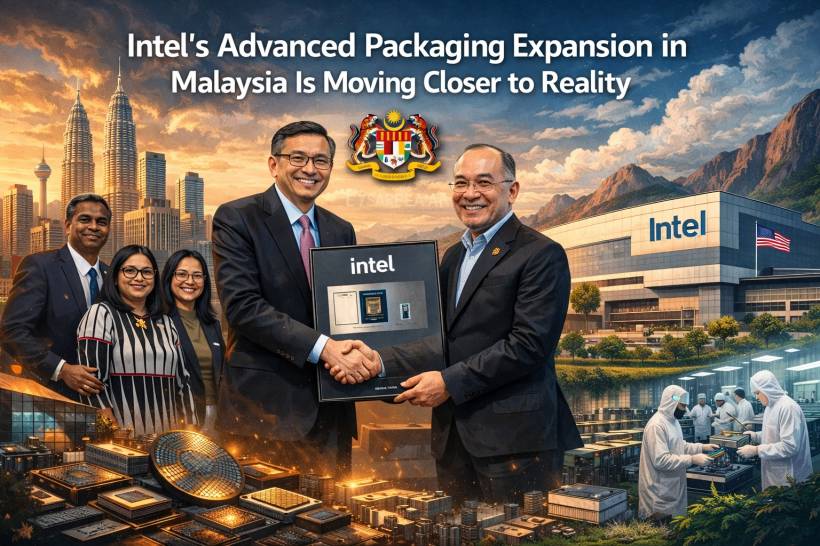
Intel's long-term presence in Malaysia appears to be entering another important phase, with the company's advanced packaging complex now expected to begin operations this year. The update came from Prime Minister Datuk Seri Anwar Ibrahim, who shared that he had been briefed on Intel's latest progress and investment plans in the country.
It is another sign that Malaysia continues to play a bigger role in the global semiconductor supply chain, especially at a time when chipmakers are rethinking where they build, test, package, and expand their operations.
Malaysia Remains a Key Part of Intel's Regional Strategy
For years, Intel has treated Malaysia as one of its major overseas bases, particularly in manufacturing-related operations. But this latest development suggests the company is not just maintaining its footprint here. It is strengthening it.
According to the Prime Minister, the briefing from Intel CEO Lip-Bu Tan focused on the company's work to support the development of its advanced packaging complex, along with its assembly and test manufacturing operations. These areas are not minor side projects. They form a central part of Intel's broader investment expansion in Malaysia.
That matters because advanced packaging is becoming increasingly important in modern semiconductor production. It is no longer just about making chips smaller or faster. The way chips are packaged, connected, and integrated now plays a major role in performance, power efficiency, and how different components work together inside everything from AI systems to data centres and consumer devices.
The First Phase Will Start With Assembly and Testing
The update also included details on how the rollout will happen. Intel Foundry executive vice-president and general manager Naga Chandrasekaran reportedly outlined plans for the first phase of the complex to begin with assembly and testing for advanced packaging.
In simpler terms, this means the facility is moving from the planning and development stage toward real operational use. The first phase may not represent the full final vision of the complex, but it is an important milestone because it signals that Intel is ready to start putting the site into action.
The Prime Minister welcomed the move, describing the decision to begin operations later this year as a positive step. From a national development perspective, this is the kind of project the government clearly wants more of, especially when it brings not only capital investment but also stronger industrial capability.
More Than Buildings and Machines
One of the more important parts of the announcement was the emphasis on talent development. The Prime Minister highlighted the need for continuous training and upskilling of local workers across the semiconductor value chain.
That is a crucial point. Large technology investments often attract attention because of the size of the facilities or the amount of money involved, but their long-term value depends heavily on whether they help build local expertise. If Malaysia wants to move beyond being seen only as a low-cost manufacturing location, it needs more projects that create high-value jobs, strengthen technical knowledge, and help local professionals move into more specialised roles.
That includes engineers, technicians, process specialists, operations teams, supply chain professionals, and many others who support semiconductor manufacturing from end to end.

Why Advanced Packaging Matters So Much Now
Advanced packaging may not sound as glamorous as chip design or AI processors, but it has become one of the most strategically important parts of the semiconductor industry. As chip architectures grow more complex, companies are relying more on packaging innovations to combine multiple chiplets, improve performance, manage heat, and boost overall efficiency.
This is why countries hoping to become serious semiconductor players are no longer focusing only on wafer fabrication. Packaging, testing, and backend manufacturing are increasingly valuable parts of the ecosystem. Malaysia already has a strong history in these areas, and Intel's expansion helps reinforce that reputation.
It also fits into a wider regional competition, where countries across Asia are trying to attract more semiconductor investment by offering the right infrastructure, talent pool, and policy support.
Intel's Global Reshuffle Gave Malaysia More Importance
This latest progress in Malaysia also makes more sense when viewed against Intel's global restructuring efforts. Last year, the company changed direction by cancelling projects in Germany and Poland while consolidating more of its assembly and test operations in Malaysia and Vietnam.
That shift was significant. It showed that Intel was being more selective about where it places manufacturing and operational resources. Malaysia benefited from that strategic reset, and the company later announced an additional RM860 million investment in the country.
So this is not an isolated announcement. It is part of a larger pattern in which Malaysia is becoming even more important to Intel's international operations.
A Boost for Malaysia's Technology Ambitions
From the government's point of view, this is closely aligned with its broader industrial plans, including the National Semiconductor Strategy. The aim is not just to attract foreign investment for headlines, but to turn those investments into long-term economic gains.
That means creating better jobs, strengthening industrial capability, encouraging knowledge transfer, and positioning Malaysia as a more serious regional technology hub. Semiconductor investments tend to have a ripple effect as well. They can benefit local suppliers, supporting industries, education partnerships, workforce development, and even infrastructure planning.
If projects like Intel's advanced packaging complex are executed well, the impact can stretch far beyond the factory floor.
Final Thoughts
Intel's advanced packaging complex beginning operations this year is more than just another corporate expansion update. It reflects Malaysia's growing role in the semiconductor world and highlights how strategic backend manufacturing has become in today's tech economy.
The real value, however, will depend on what comes next. If the investment leads to stronger talent development, more high-value jobs, and deeper integration into the semiconductor value chain, then this could become one of the more meaningful milestones in Malaysia's push to establish itself as a regional technology powerhouse.











Comments 0