

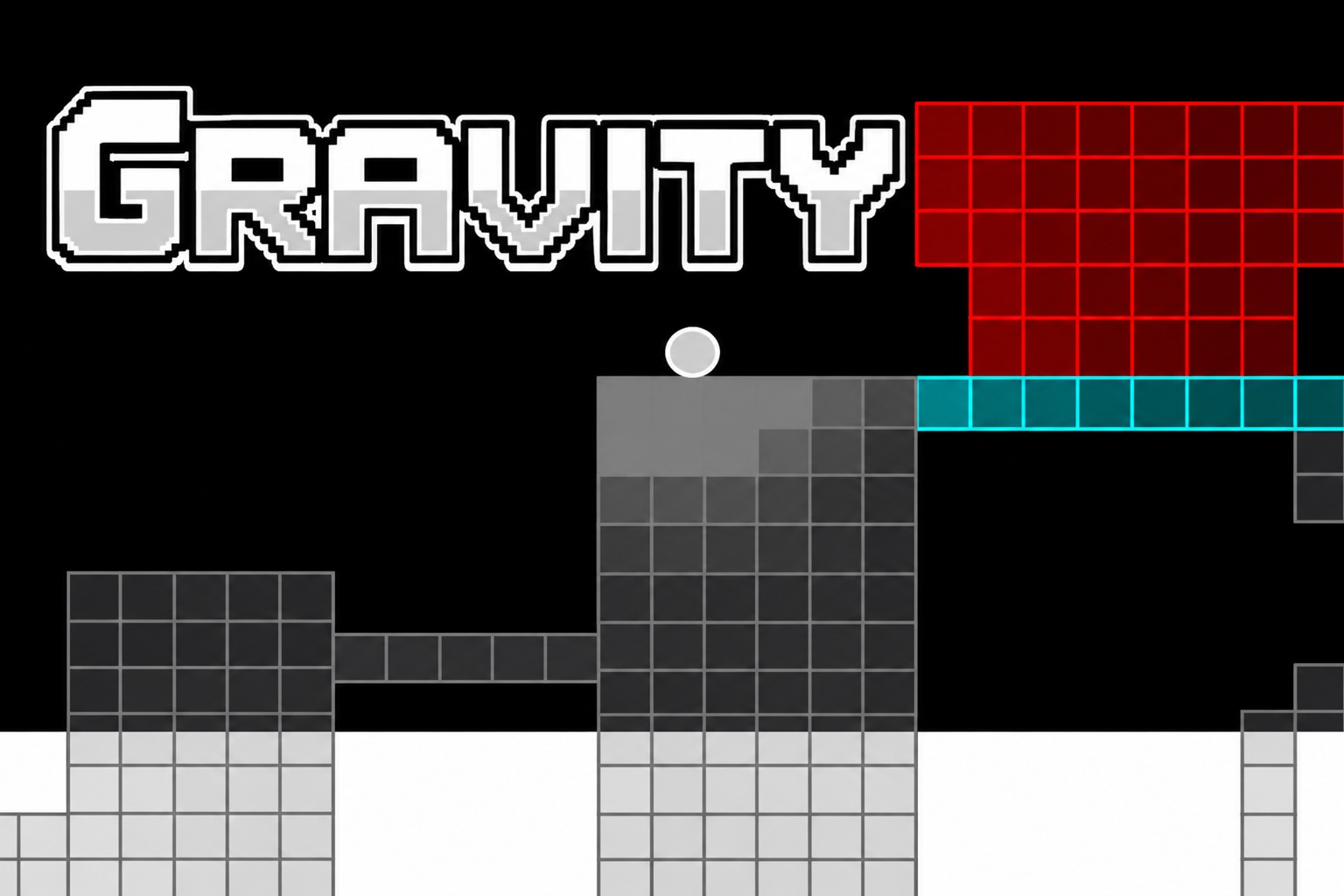
Gravity takes one powerful idea and builds an entire precision-platforming challenge around it: instead of relying on a conventional jump, players reverse gravity to move between the floor and ceiling. That single mechanic completely changes how ordinary platforming obstacles need to be approached. Gaps become opportunities to fall upward, ceilings become temporary pathways, and a simple corridor can become dangerous when spikes or moving hazards occupy both sides. Across 18 increasingly difficult levels, the game continually finds new ways to test whether players truly understand how momentum, positioning, and gravity interact.
The controls are deliberately simple, allowing players to concentrate almost entirely on timing. Moving left and right handles horizontal positioning, while flipping gravity sends the character toward the opposite surface. Early stages provide enough space to understand this unusual movement, but later levels combine narrow passages, spikes, moving obstacles, hostile guns, and increasingly demanding sequences where one poorly timed gravity change can immediately end the attempt. The challenge grows naturally from the mechanic rather than from an increasingly complicated control scheme.
Now playable online through Lemon Web Games, Gravity brings its 18-level gravity-flipping challenge directly into the web browser with no lengthy setup standing between the player and another attempt. Each level asks players to study the surrounding hazards, determine where gravity needs to change, and execute the route with increasingly precise timing. Quick restarts make experimentation painless, encouraging players to test different approaches until a seemingly impossible section begins to make sense. For fans of difficult platformers built around one carefully developed mechanic, Gravity offers a compact but increasingly demanding test of reflexes, patience, and spatial thinking.
A Platformer Without a Traditional Jump
Most platform games teach players to think in terms of running and jumping. The floor is normally safe, the ceiling is decorative, and falling usually means moving downward. Gravity immediately breaks those assumptions by making the direction of gravity itself part of the controls. The player does not simply leap over an obstacle; they can effectively fall toward the opposite side of the level.
This makes movement feel unusual from the beginning. Reversing gravity sends the character toward the ceiling, where movement can continue as though the entire world has been turned upside down. Another flip returns the character toward the floor. Progress becomes a sequence of carefully controlled transitions between these two states.
Removing the ordinary jump also prevents players from relying on familiar platforming habits. Every gap needs to be interpreted according to where the character will travel after the next gravity change. The player gradually learns to think vertically in both directions rather than treating one surface as permanently correct.
Gravity Flipping Is the Entire Foundation
The game does not overwhelm the player with dozens of abilities. Instead, almost every challenge comes from understanding the consequences of changing gravity at the correct moment. A single flip can avoid spikes, cross a gap, move past a projectile, or place the character onto a safer route. The same action has many different uses depending on the environment.
This simplicity gives the game a strong identity. The controls remain understandable even when the level design becomes difficult. Players never need to ask which special ability should be used because the answer almost always involves movement and gravity. The challenge is discovering exactly when and where to apply them.
That focused design also makes improvement easy to feel. Early attempts may involve flipping almost randomly and hoping to survive, while later play becomes much more deliberate. Players begin predicting where the character will land before pressing the gravity control. Movement slowly changes from experimentation into precision.
The Floor and Ceiling Are Equally Important
In conventional platformers, players primarily study the ground ahead. Gravity requires attention to both the floor and ceiling because either surface can become the next landing area. A harmless ceiling may contain spikes farther ahead, while a dangerous section of floor might be bypassed entirely by travelling above it. Every corridor has two possible orientations.
This dramatically changes how the levels are read. Players need to look ahead and identify which surface provides the safer path at each moment. Sometimes several rapid gravity changes are required because neither side remains safe for long. The route becomes a continuous exchange between upper and lower surfaces.
Eventually, players stop thinking of the ceiling as being upside down. It simply becomes another platform. That change in perception is one of the most satisfying parts of mastering Gravity.
Eighteen Levels Create a Focused Difficulty Curve
Gravity contains 18 levels, providing enough time for the main mechanic to evolve without stretching the concept unnecessarily. The earlier stages introduce the fundamental relationship between horizontal movement and gravity changes. Players are given space to understand how quickly the character travels and where a flip will place them. Later levels assume that knowledge.
The difficulty increases by combining familiar hazards in more demanding arrangements rather than constantly introducing unrelated mechanics. A gravity switch that was easy when crossing one open gap becomes much harder when spikes wait on the opposite surface. Add moving obstacles or enemy fire and the same action suddenly requires much more precise timing.
This progression makes the final stages feel earned. Players are being tested on techniques they have already encountered, but under much greater pressure. Success depends on applying familiar skills consistently.
Spikes Make Every Landing Matter
Spikes are among the simplest hazards in the game, but gravity reversal makes them especially effective. Because players can land on either the floor or ceiling, spikes can threaten both directions. A surface that looks safe before a gravity change may become immediately deadly once the character begins falling toward it.
This encourages players to plan beyond the current position. Before flipping gravity, it helps to identify exactly where the character will arrive and whether enough horizontal movement is possible during the transition. Acting too early or too late can send the character directly into danger. The margin for error becomes increasingly small.
Spikes also create strong visual clarity. Players immediately understand why an attempt failed. This makes repeated attempts feel constructive because the next correction is usually obvious, even when executing it remains difficult.
Moving Hazards Make Timing More Complicated
Static obstacles can be memorized, but moving hazards introduce another layer of timing. A path that is safe at one moment may be completely blocked seconds later. Players need to consider both where the character will land and where the hazard will be when that happens. Gravity changes become synchronized movements rather than isolated button presses.
The safest strategy is often to wait briefly and observe the pattern before committing. Once the timing becomes understandable, players can begin the sequence at the correct moment. Rushing usually creates unnecessary failures. Patience becomes part of platforming skill.
Later sections can combine moving hazards with narrow spaces, forcing players to react quickly after beginning the route. These sequences reward both planning and execution. Knowing the solution is only half the challenge.
Hostile Guns Add Pressure From a Distance
Guns introduce threats that do not require direct contact with the player. Projectiles can travel through parts of the stage, forcing players to move rather than simply wait indefinitely for the perfect moment. This changes the rhythm of certain sections because staying still can become dangerous. Gravity may need to be flipped specifically to move out of a firing line.
Projectiles also create opportunities for clever timing. A shot travelling across the lower half of a corridor may be avoided by switching to the ceiling before it arrives. Another projectile might require the opposite approach. Understanding the trajectory becomes part of the puzzle.
These encounters make movement feel more urgent without abandoning the game's central mechanic. The player still solves the problem using gravity. The difference is that the environment is now actively applying pressure.
Positioning Before the Flip Is Critical
A gravity change controls vertical movement, but horizontal positioning still determines where the character ultimately lands. This means the preparation before flipping can be just as important as the flip itself. Moving slightly farther left or right can completely change whether the character reaches a safe platform or collides with a hazard.
New players often focus on the exact moment gravity changes while overlooking where they started. With experience, they begin treating horizontal positioning as part of the same action. The character should already be aligned with the intended landing zone before committing whenever possible. This makes difficult sections much more consistent.
Precise positioning becomes especially important in narrow passages. There may only be a small safe area available on the opposite surface. Reaching it requires both correct timing and correct horizontal placement.
Momentum Can Help or Ruin a Perfect Plan
Once the character is moving, existing momentum continues to influence where they travel. A gravity change does not automatically place the player directly above or below the starting point. Horizontal motion can carry the character forward during the transition. Understanding that movement is essential for longer crossings.
Momentum can be extremely useful when a large gap needs to be cleared. Building horizontal speed before flipping gravity can carry the character toward a distant safe area. The same momentum becomes dangerous when the landing zone is narrow. Too much movement can push the character beyond safety.
This makes the game feel less like teleporting between surfaces and more like manipulating a physical trajectory. Players gradually learn to control the path rather than simply switch direction. Successful movement begins to feel fluid.
Some Obstacles Are Easier When Approached Slowly
The instinct in difficult platformers is often to move as quickly as possible, but Gravity frequently rewards slower preparation. A narrow opening may require careful alignment before the player commits to a gravity change. Moving too aggressively can reduce the time available to correct the trajectory. Control becomes more valuable than speed.
This is particularly true when hazards sit close to the intended landing area. A small error in horizontal movement can turn a correct gravity flip into a failed attempt. Approaching more carefully allows the player to reduce unnecessary momentum. Precision matters more than style.
Once a section becomes familiar, players can often perform it faster. Speed emerges naturally from mastery rather than being required from the beginning. Clean execution eventually replaces cautious experimentation.
Other Sections Demand Immediate Decisions
Not every challenge allows unlimited preparation. Moving hazards and projectiles can force players to commit quickly once an opening appears. The safe window may exist only briefly before another threat closes the route. Hesitation can become just as dangerous as moving too early.
These sections test whether the player has internalized the controls. There may not be enough time to consciously calculate every movement. Successful players begin recognizing patterns and reacting almost automatically. Practice turns deliberate thinking into instinct.
The contrast between slow planning and rapid execution creates variety. Gravity is not simply a game about waiting for the correct moment. Sometimes the correct moment disappears almost immediately.
Repeated Attempts Reveal the Intended Route
Some levels can initially look impossible because several hazards appear to block every obvious path. Repeated attempts gradually reveal how the route is supposed to work. A gravity flip that seemed unnecessary may actually position the character for a later section. A narrow opening may only be reachable from a particular starting point.
This learning process is central to the game. Failure provides information rather than simply ending progress. Players discover which timing was wrong, which surface should have been used, or which movement needed to begin earlier. Each attempt can refine the solution.
Eventually, a level that once looked chaotic becomes understandable. The obstacles have not changed, but the player's knowledge has. That transformation is one of the strongest rewards in precision platforming.
Instant Restarts Keep Failure From Becoming Frustrating
Difficult games rely heavily on how quickly they allow players to try again. Gravity's compact stages and rapid restarts make failure relatively painless. A missed timing does not require replaying a lengthy sequence before another attempt can begin. Players can immediately correct what went wrong.
This quick retry loop encourages experimentation. Someone unsure whether a particular gravity flip will work can simply test it. If the idea fails, another approach can be attempted almost immediately. The game rewards curiosity instead of punishing it with long delays.
Rapid restarts also make difficult levels strangely addictive. A player may intend to stop after one more attempt, then immediately notice another possible solution. The next restart happens almost automatically.
The Game Rewards Pattern Recognition
Many of the hardest sections become easier once players recognize how hazards repeat. Moving obstacles frequently follow predictable cycles, while projectile timing can often be learned through observation. Instead of reacting randomly, players can begin planning around those patterns. Knowledge reduces uncertainty.
This is especially important when several hazards overlap. Trying to respond independently to every moving object can feel overwhelming. Recognizing the overall rhythm allows the player to identify the safest moment to begin. One well-timed start can simplify the entire sequence.
Pattern recognition also reduces reliance on pure reflexes. Quick reactions help, but understanding the level provides a much larger advantage. Gravity becomes as much about learning as speed.
Precision Matters More Than Complexity
The controls never become complicated, yet the game can still become extremely difficult. This happens because later stages demand much greater precision from the same basic actions. Moving slightly too far, flipping a fraction too early, or hesitating for a moment can produce failure. Complexity comes from execution rather than additional buttons.
This design makes the challenge feel fairer. Players generally know what they were supposed to do. The difficulty lies in performing it correctly. There are fewer situations where failure comes from forgetting an obscure command.
The simplicity also makes the game approachable for newcomers. Anyone can understand how movement and gravity work within minutes. Mastering those controls is another matter entirely.
Minimalist Presentation Keeps the Focus on Movement
Gravity uses a straightforward visual style that keeps hazards and platforms easy to identify. This is particularly important in a game where precise positioning matters constantly. The player needs to understand immediately which surfaces are safe and which objects are dangerous. Decorative detail never overwhelms the functional layout.
The minimalist presentation also makes the gravity mechanic visually clear. Switching between the floor and ceiling is easy to follow because the environment remains readable during movement. The player's attention stays on trajectory and timing. Nothing distracts from the challenge.
This visual restraint fits the game's design philosophy. Gravity is interested primarily in how one mechanic can create many different situations. The presentation supports that focus rather than competing with it.
The Small Character Makes the Environment Feel Dangerous
The player character is deliberately simple and compact compared with the surrounding obstacles. This helps emphasize how threatening the environment can be. Large spike fields and moving hazards dominate the screen while the character appears vulnerable. Surviving depends entirely on control.
The small scale also allows narrow passages to become meaningful. A tiny safe area can be enough to continue, but reaching it precisely may require several attempts. The character's size supports detailed level design without requiring enormous environments.
This creates a satisfying contrast between visual simplicity and mechanical difficulty. The character may look uncomplicated, but navigating the world demands increasingly sophisticated movement. Skill comes from the player rather than the avatar.
Gravity Changes How Gaps Are Understood
A gap in most platformers represents a space that needs to be jumped across. In Gravity, a gap may instead be crossed by reversing gravity and travelling toward the opposite surface. The player begins thinking about empty space differently. Falling becomes a movement technique rather than automatically a mistake.
This makes level layouts visually interesting because seemingly impossible distances can become manageable once the correct gravity route is recognized. A platform on the ceiling may effectively function as the next step in a path. Traditional ideas about high and low lose their meaning.
The mechanic also allows stages to reuse the same physical space in two directions. One corridor can support movement along both surfaces. This helps compact levels contain more possibilities than their size suggests.
Upside-Down Movement Quickly Becomes Natural
At first, controlling the character on the ceiling can feel disorienting. Players are accustomed to reading movement with the ground beneath the character. After several levels, however, upside-down sections begin feeling surprisingly ordinary. The brain adapts to the game's rules.
That adjustment is important because later stages can require frequent gravity changes within only a few seconds. There is no time to mentally reorient after every flip. Players need to treat both directions as equally normal. Practice gradually removes the initial confusion.
Once that happens, the game becomes much smoother. The player starts thinking about paths rather than orientation. The ceiling stops feeling inverted and simply becomes another route.
Rapid Gravity Changes Create Satisfying Sequences
Some of the most enjoyable moments occur when several gravity reversals need to be performed in quick succession. The character may move from floor to ceiling, travel through a narrow opening, then immediately return toward the floor to avoid another hazard. When executed correctly, the sequence can feel almost choreographed. Movement flows continuously through the environment.
These sections often look intimidating before the solution is understood. Once the timing becomes familiar, however, they can become some of the most satisfying parts of the game. The player is no longer reacting independently to each obstacle. They are performing one connected movement sequence.
Mastering these sections creates a strong sense of improvement. What once required many cautious attempts can eventually be completed smoothly. The game rewards repetition with confidence.
The Best Route Is Not Always the Most Obvious One
Gravity-flipping levels naturally create multiple ways of viewing the same space. A dangerous lower route may make the upper surface look more attractive, while an obvious ceiling path might eventually lead into a trap. Players need to examine the entire level rather than following the first available opening. Observation becomes important.
Some solutions may involve flipping gravity earlier than expected. Others require staying on one surface longer before committing. The safest route is sometimes the one that initially looks indirect. Players who experiment often discover more reliable approaches.
This encourages flexible thinking. Traditional platforming instincts can become misleading because the environment is designed around bidirectional movement. The player needs to think according to Gravity's rules.
Timing Enemy Fire Can Create Safe Windows
Hostile guns can appear overwhelming when projectiles are constantly moving through the stage, but their attacks often create predictable gaps. Players can watch the firing rhythm and identify a moment when the route becomes temporarily safe. Starting movement during that window reduces the need for desperate corrections later.
Gravity reversal is particularly useful for avoiding horizontal lines of fire. A projectile moving across the floor can often be bypassed by travelling along the ceiling. Another shot may require returning immediately afterward. The player effectively uses the environment's vertical dimension as cover.
These encounters demonstrate how combat-like hazards can exist without giving the player a weapon. Survival comes entirely from movement. The objective is not to destroy the threat but to outmaneuver it.
Mistakes Usually Feel Understandable
A strong precision platformer benefits from making failure readable. Gravity generally makes it clear whether the problem was timing, positioning, or route selection. Colliding with a spike shows exactly where the trajectory went wrong. Being hit by a projectile reveals which firing line was not avoided.
This clarity encourages immediate improvement. The player rarely needs to guess why an attempt failed. They can adjust one specific part of the movement and try again. Progress happens through small corrections.
Understandable failure is especially important in later stages where many attempts may be required. Difficulty feels more manageable when each mistake teaches something. The game remains demanding without becoming completely arbitrary.
The Last Levels Test Everything Learned Earlier
By the later stages, Gravity expects players to be comfortable with rapid reversals, careful positioning, hazard timing, and movement across both surfaces. Challenges increasingly combine these skills instead of testing them separately. A successful run may require several precise actions without a safe place to stop. Consistency becomes essential.
The final stretch therefore feels like a genuine test of mastery rather than a sudden introduction of unrelated mechanics. Everything required has already been taught. The difficulty comes from combining familiar ideas under pressure.
This makes completion satisfying. Reaching the end demonstrates that the player has genuinely adapted to the gravity mechanic. The unusual movement that felt confusing at the beginning has become second nature.
Gravity Is a Good Example of Mechanic-Driven Design
Many games rely on large numbers of systems to create variety. Gravity demonstrates another approach: take one unusual mechanic and explore it thoroughly. Reversing gravity affects movement, platforming, hazard avoidance, projectile timing, and route planning. Almost every challenge grows naturally from the same foundation.
This creates a coherent experience. Players do not need to constantly learn unrelated rules because each new obstacle interacts with something they already understand. The game grows deeper rather than broader. That focus is one of its strongest qualities.
Mechanic-driven games can also make progression feel more personal. There is no character upgrade making difficult levels easier. The player simply becomes more capable at controlling gravity. Skill is the progression system.
The Difficulty Encourages Persistence
Some later sections may require several failed attempts before the correct timing becomes comfortable. This can be challenging, but the short levels and instant restarts make persistence relatively painless. Every attempt takes the player closer to understanding the route. Improvement is often visible even before the level is completed.
A player may initially fail near the beginning, then gradually reach halfway, and eventually approach the exit consistently. That incremental progress provides motivation. The game continually suggests that success is possible with one cleaner attempt.
This type of difficulty appeals particularly strongly to players who enjoy overcoming problems through repetition. Victory feels earned because the player has genuinely improved. Gravity does not hand out easy solutions.
Short Levels Make the Game Easy to Play in Small Sessions
Because the adventure is divided across 18 compact stages, Gravity works well for short play sessions. A player can attempt one or two levels without committing to a lengthy campaign. Progress always has a clear immediate objective. This makes the game comfortable to return to after a break.
The same structure also supports longer sessions. Completing one difficult stage naturally encourages the player to see what the next one contains. The challenge escalates gradually enough that momentum can carry through several levels. Short stages combine into a larger journey.
This flexibility works particularly well in a browser. Players can begin quickly, make progress, and stop whenever they choose. The game does not demand a long setup before the interesting mechanics appear.
There Is Satisfaction in Solving a Level Cleanly
Completing a difficult stage for the first time is rewarding, but returning and performing the same sequence smoothly can be equally satisfying. Once the route is understood, movement can become elegant. Gravity flips happen at exactly the right moments, hazards are avoided without panic, and the character reaches the exit almost continuously.
This creates an informal mastery challenge even after a level has been completed. Players can attempt cleaner runs with fewer hesitations or mistakes. The game does not need an elaborate scoring system for improvement to feel meaningful. The quality of movement itself becomes the reward.
Smooth play also highlights how carefully the mechanic fits the level design. Sections that once seemed chaotic begin to reveal a clear rhythm. Mastery transforms the experience.
Why Gravity Remains Addictive
The combination of simple controls, difficult execution, and rapid retries creates a powerful gameplay loop. A failed attempt rarely feels like a reason to stop because the solution often seems only one adjustment away. Players immediately want to test the new idea. The next run begins before frustration has time to grow.
The gravity mechanic also remains interesting because it continually changes how familiar obstacles are interpreted. Spikes, gaps, moving objects, and projectiles all become more complicated when either surface can be the next destination. The game extracts considerable variety from a small toolset. Each level feels like another question built from the same rules.
Most importantly, improvement is easy to recognize. Players move more confidently, make fewer unnecessary flips, and begin seeing safe routes earlier. The game becomes easier because the player becomes better.
Playing Gravity Online Today
Through Lemon Web Games, Gravity can now be played directly in your web browser with no downloads or setup required. Features of the web-based version include:
The browser-based format suits Gravity particularly well because each level can be attempted repeatedly without a lengthy commitment. New players can spend the early stages learning how movement behaves during a gravity reversal, while experienced players can concentrate on performing increasingly complicated sequences cleanly. The controls remain simple from beginning to end. The difficulty comes entirely from using them well.
Players struggling with a particular stage should avoid treating every failure as a reason to move faster. Study the layout, watch moving hazards, identify where the character needs to land, and then choose the correct moment to flip gravity. It is often useful to focus on solving one part of the route at a time. Once the sequence is understood, execution becomes much more consistent.
Who Should Play Gravity
Gravity is particularly suitable for players who enjoy games where understanding the controls is easy but mastering them takes considerably longer. The basic idea can be explained in seconds: move left or right and flip gravity to travel toward the opposite surface. The levels then spend the rest of the game exploring how difficult that simple action can become. Every stage pushes the same mechanic a little further.
It should also appeal to players who enjoy solving movement challenges through experimentation. Failure rarely removes significant progress because another attempt can begin quickly. This makes it easy to test unusual routes and refine timing without feeling heavily punished. Persistence is consistently rewarded.
Play Gravity Online Now
Gravity turns one simple mechanical idea into an increasingly demanding 18-level platforming challenge. Instead of jumping over obstacles in the traditional way, players reverse gravity and travel between the floor and ceiling while carefully controlling horizontal movement. Spikes, moving hazards, narrow passages, hostile guns, and projectiles gradually transform straightforward movement into a sequence of precision challenges. Every successful stage proves that the player has become more comfortable manipulating the direction of the world.
Through Lemon Web Games, players can experience Gravity directly in a modern browser and immediately begin experimenting with its unusual movement system. Quick restarts keep difficult levels approachable, while the compact stage design ensures that failure rarely wastes much time. The controls remain consistent throughout the adventure, allowing the level design to become progressively more demanding without becoming confusing. For players who enjoy games where repeated attempts gradually turn impossible-looking sequences into smooth movement, Gravity offers a focused and rewarding challenge.
Final Thoughts
Gravity succeeds because it understands the value of building deeply around one strong mechanic. Reversing gravity sounds simple, but the game uses that idea to completely change how players interpret platforms, gaps, ceilings, hazards, and projectiles. The floor is not permanently safe, the ceiling is not merely background scenery, and falling can become the primary method of movement. Once those assumptions are removed, even simple level layouts can create interesting challenges.
The 18-level structure provides enough room for the mechanic to grow steadily more demanding. Early stages teach the basic relationship between movement and gravity, while later levels combine spikes, moving hazards, hostile guns, narrow landing areas, and rapid reversals into increasingly precise sequences. There are no complicated upgrades hiding the challenge. Success comes from observation, timing, and repeated practice.
Through Lemon Web Games, Gravity can be played directly in the browser as a compact precision-platforming experience that is easy to understand but increasingly difficult to master. Its quick restarts make experimentation painless, while its minimalist presentation keeps attention entirely on movement. For players who enjoy difficult platformers where one perfectly timed input can turn an impossible obstacle into a clean escape, Gravity demonstrates just how much challenge and satisfaction can come from simply deciding which way is down.











Comments 0