

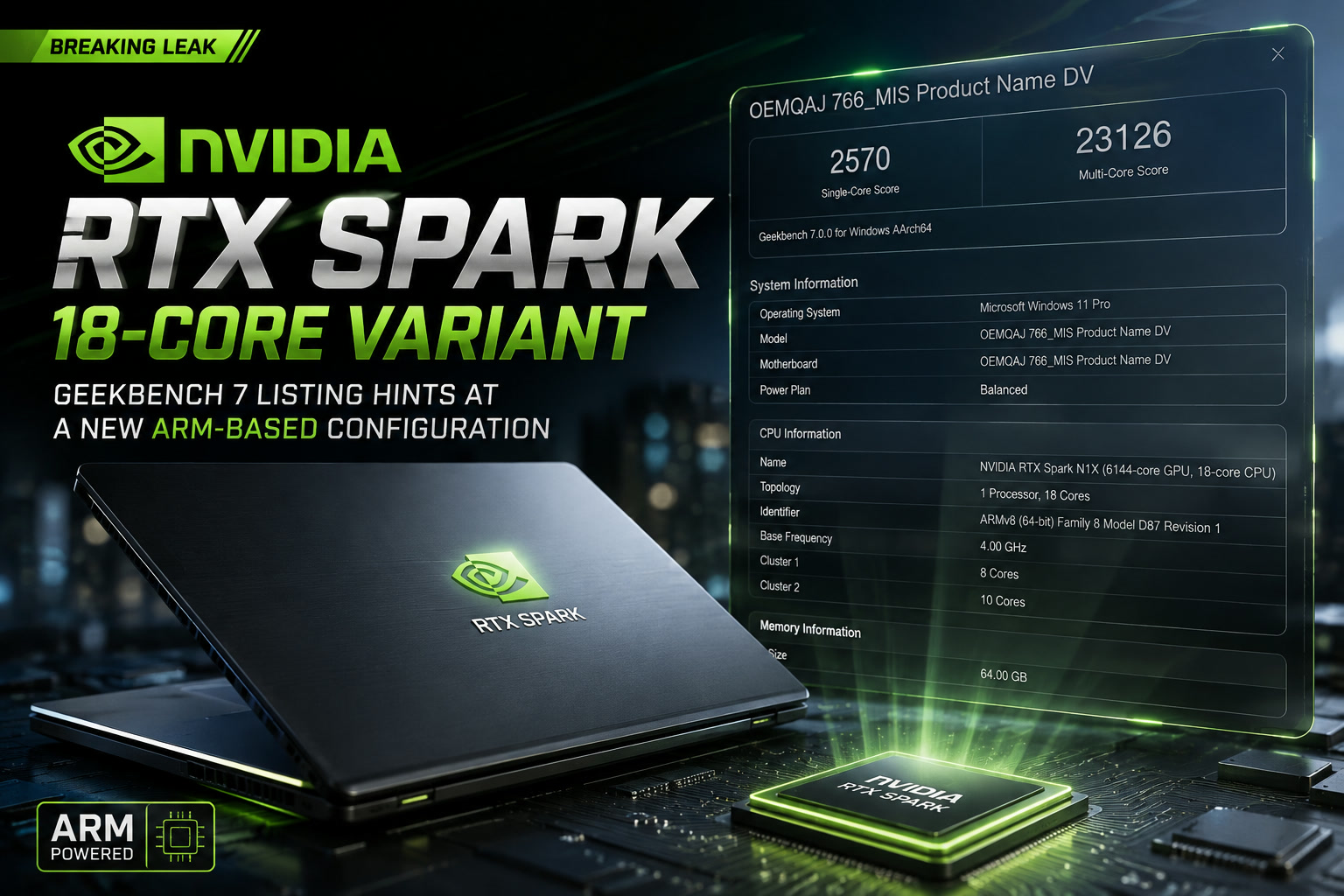
NVIDIA's upcoming RTX Spark platform may be getting more than one processor configuration. After earlier benchmark appearances involving the full 20-core version, an 18-core RTX Spark variant has now reportedly surfaced on Geekbench 7, suggesting NVIDIA could be preparing multiple SKUs for future laptops.
The benchmark entries have since disappeared, but screenshots captured before their removal provide an early look at how the two configurations may compare. As always with unreleased hardware, these numbers should be treated cautiously until NVIDIA confirms the specifications and retail devices become available.
RTX Spark Is NVIDIA's Big Push Into ARM-Based PCs
RTX Spark is particularly interesting because it represents NVIDIA's attempt to combine its GPU expertise with a powerful ARM-based CPU platform aimed at mainstream computers. The chip was developed in partnership with MediaTek and was officially detailed during Computex 2026.
NVIDIA's announced configuration features 20 Grace CPU cores, 6,144 Blackwell RTX GPU cores, fifth-generation Tensor Cores and up to 128GB of unified memory. That combination makes RTX Spark considerably more ambitious than a conventional laptop processor with a relatively small integrated GPU.
Instead, NVIDIA appears to be building something closer to a tightly integrated CPU-GPU computing platform, with gaming, content creation and AI workloads all sharing the same high-capacity memory architecture.
When NVIDIA originally demonstrated the platform, however, the company did not clearly say whether the 20-core configuration would be the only version available. Some product information reportedly hinted that additional variants could eventually appear, and this new Geekbench listing may be the first sign of exactly that.
An 18-Core Version Could Be Joining The Line-Up
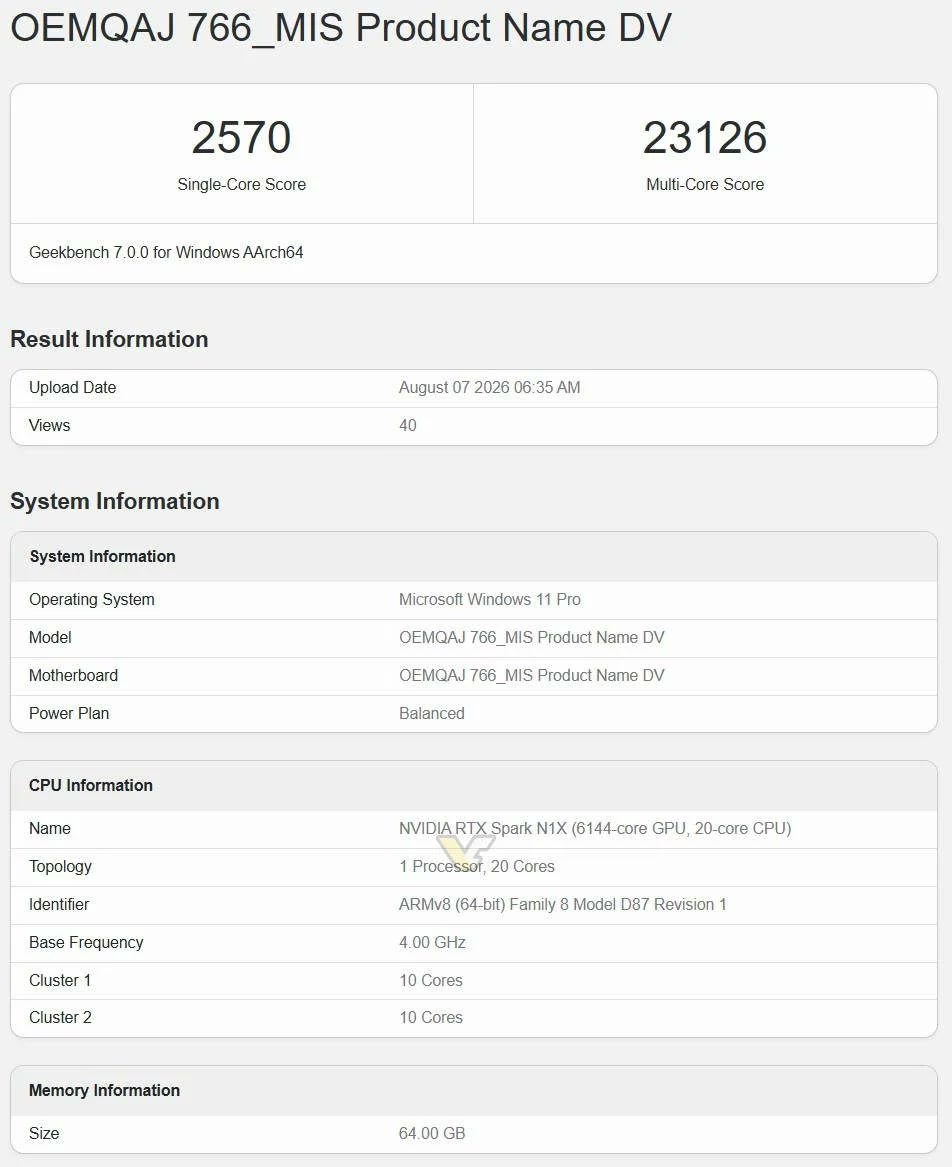
According to the leaked Geekbench 7 results, the standard 20-core RTX Spark reached a single-core score of 2,570 and a multi-core score of 23,316.
The alleged 18-core model was not far behind, scoring 2,541 in single-core performance and 21,776 in multi-core.
That is actually a relatively small reduction considering the loss of two CPU cores. Single-core performance is nearly identical, which makes sense if both variants use the same underlying CPU architecture and operate at similar frequencies.
The bigger difference appears in heavily threaded workloads, where the additional cores of the flagship configuration naturally give it an advantage.
If these figures prove representative of retail hardware, the 18-core version could potentially become a slightly lower-priced RTX Spark option while retaining most of the platform's everyday performance.
The 20-Core Model Looks Competitive Against AMD
The leaked numbers also provide some interesting comparisons with existing high-performance laptop processors.
Based on the reported Geekbench scores, the 20-core RTX Spark comes out roughly 6% ahead of AMD's Ryzen AI Max+ 395 in single-core performance and around 12% ahead in multi-core performance.
The Ryzen AI Max+ 395 remains an important comparison because it helped demonstrate just how powerful an integrated CPU-and-GPU platform could become, particularly in premium laptops and compact gaming systems.
RTX Spark appears to be taking that same general concept considerably further, particularly through NVIDIA's Blackwell GPU architecture and unified-memory design.
Of course, Geekbench primarily measures CPU performance. The much more interesting comparison may eventually come from GPU, gaming and AI workloads, where NVIDIA's architecture could become the platform's biggest advantage.
Intel Still Has The Single-Core Advantage
Against Intel's Core Ultra X9 388H, the picture becomes a little more complicated.
The leaked RTX Spark result reportedly trails Intel's processor by around 7% in Geekbench 7 single-core performance, indicating that Intel retains an advantage in lightly threaded workloads.
Once more CPU cores are brought into play, however, NVIDIA reportedly moves ahead. The 20-core RTX Spark scores approximately 20% higher in multi-core performance based on these benchmark results.
That could make RTX Spark particularly attractive for heavily parallel workloads such as rendering, software development, media processing and certain professional applications.
For ordinary laptop use, however, single-core responsiveness, power efficiency and sustained performance will matter just as much as the headline multi-core score.
Apple's M5 Max Still Appears To Be In Another League
One processor RTX Spark apparently cannot catch yet is Apple's high-end M5 Max.
According to the comparisons cited alongside the leaked results, the 20-core RTX Spark remains around 32% behind the M5 Max in single-core performance and roughly 35% behind it in multi-core performance.
That is a sizeable difference, although these platforms are not necessarily targeting exactly the same devices or workloads.
Apple's advantage comes from years of developing tightly integrated ARM processors around macOS and its own hardware ecosystem. NVIDIA, meanwhile, is entering the broader Windows-on-ARM space while simultaneously bringing a much larger RTX-class GPU architecture into the same package.
CPU benchmarks alone therefore may not tell the complete story.
An RTX Spark notebook could potentially trade some CPU performance for much stronger compatibility with NVIDIA's CUDA, RTX and AI ecosystem, which could make it considerably more appealing for certain professional users.
The Unified Memory Design Could Be One Of Its Biggest Strengths
One feature that may matter more than a few hundred Geekbench points is the reported 128GB unified-memory architecture.
Traditional laptops usually divide memory between the CPU and GPU. A discrete graphics card might have 16GB or 24GB of its own VRAM while the operating system uses separate system memory.
A unified architecture allows both processors to access the same large memory pool.
That is particularly interesting for AI models and professional workloads where GPU memory capacity can quickly become a limitation. If applications can effectively utilise a large portion of that 128GB pool for GPU workloads, RTX Spark laptops could become unusually capable portable AI development machines.
This may ultimately be where NVIDIA tries to differentiate RTX Spark rather than simply competing over CPU benchmark scores.
Why Would NVIDIA Offer An 18-Core Model?
Multiple configurations would make plenty of commercial sense.
Not every laptop needs the full 20-core processor, and disabling two CPU cores could allow NVIDIA and its partners to offer a more affordable version while still retaining the same basic platform.
Chip manufacturers also commonly create multiple SKUs from the same silicon. Dies that do not meet requirements for the flagship configuration can sometimes still operate perfectly with a small number of cores disabled.
An 18-core model could therefore help NVIDIA offer RTX Spark across a broader range of premium notebooks rather than restricting it entirely to ultra-high-end systems.
The biggest unanswered question is whether other specifications would change as well. NVIDIA could theoretically differentiate models through GPU core counts, memory capacity, clock speeds or power limits in addition to CPU cores.
For now, none of that has been officially confirmed.
Geekbench Only Tells Part Of The Story
As interesting as these early results are, Geekbench should not be treated as the final verdict on RTX Spark.
Laptop processors operate under very different power limits depending on the machine they are installed in. Cooling systems, firmware, memory configuration and sustained power targets can all significantly affect real-world performance.
A thin ultraportable running RTX Spark may perform very differently from a larger creator laptop using the same underlying silicon with substantially more cooling capacity.
Gaming performance will also depend heavily on drivers and how efficiently the integrated Blackwell GPU can access the unified-memory architecture.
Then there is battery life. ARM-based laptops are increasingly judged not only by raw performance but also by how efficiently they deliver it.
Those are things a short Geekbench run simply cannot answer.
Final Thoughts
The appearance of an alleged 18-core RTX Spark is arguably more interesting than the benchmark numbers themselves because it suggests NVIDIA may be building an entire family of ARM-based PC processors rather than launching a single flagship chip.
The leaked results show relatively strong performance from both configurations, with the 20-core model looking particularly competitive in multi-threaded workloads. Intel appears to retain an advantage in single-core performance, while Apple's M5 Max remains comfortably ahead based on these early comparisons.
But RTX Spark's real appeal may eventually come from somewhere else entirely: the combination of Grace CPU cores, a large Blackwell RTX GPU, Tensor acceleration and up to 128GB of unified memory inside one platform.
That could make it far more interesting for gaming, AI development and professional workloads than Geekbench alone suggests.
For now, the numbers provide an intriguing preview. The proper test will come once actual RTX Spark laptops reach reviewers and we can see how the platform performs outside a benchmark window.











Comments 0