

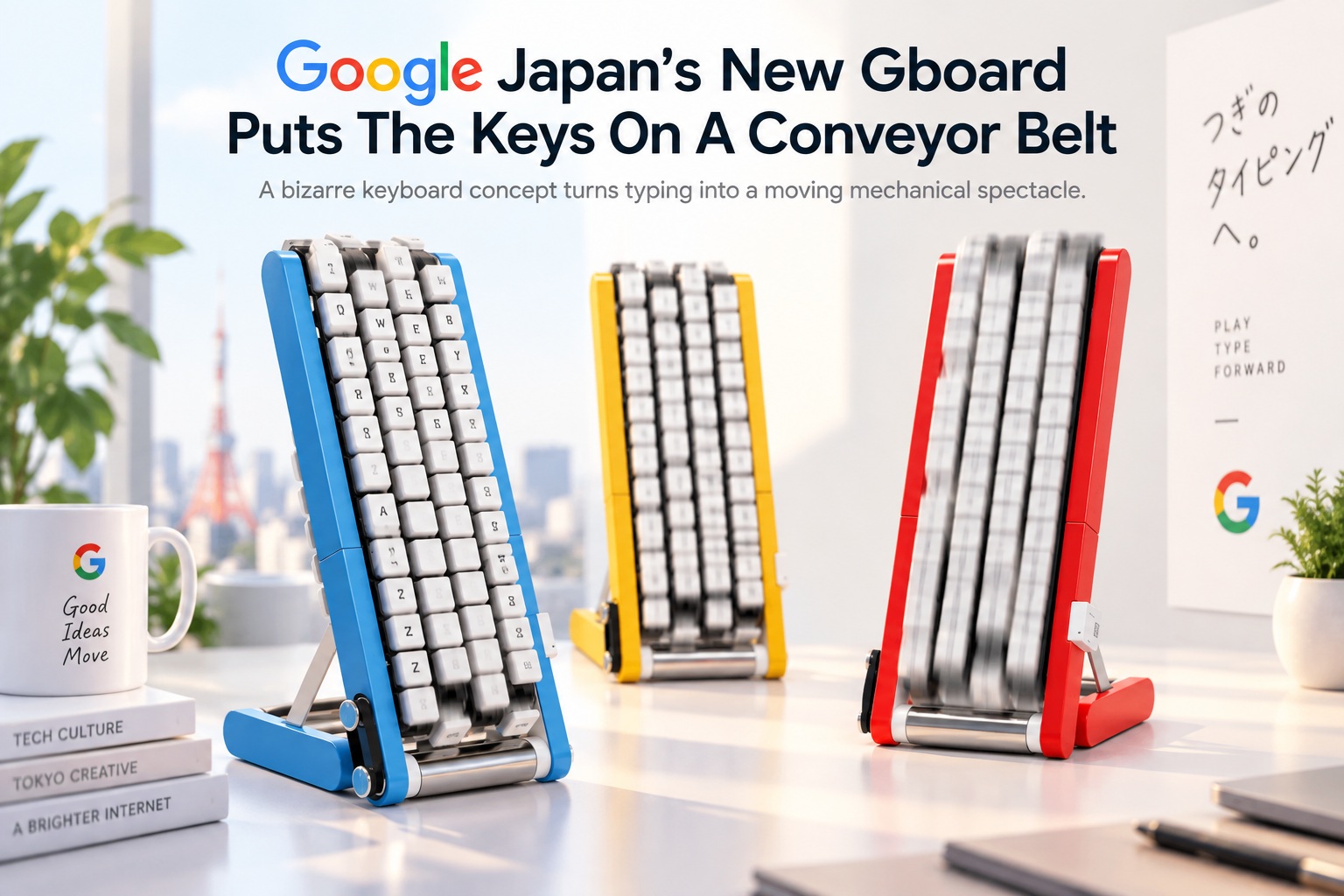
Google Japan has built a reputation for creating some of the strangest keyboard concepts around, and its latest experiment may be one of the most unusual yet. After previously showing off designs that replaced traditional keys with rotary dials, the company has now created the Gboard Conveyor Belt Version. Instead of making users move their hands across a keyboard, this concept brings the keys directly to their fingertips.
The result looks as unconventional as it sounds. Rather than sitting flat on a desk, the keyboard stands vertically and uses continuously moving belts to cycle keys towards the user. It is not intended to be a mainstream commercial product, but it continues Google Japan's long-running tradition of experimenting with deliberately impractical yet surprisingly well-engineered keyboard concepts.
Keys That Move Towards The User
The Gboard Conveyor Belt Version uses four vertical conveyor belts, with each belt carrying 29 keys. These keys continuously rotate downwards towards the user's hand, allowing the person to wait for the required character to arrive instead of moving their fingers across a conventional layout. The idea is that typing can be performed with much less hand movement.
Google presents the concept as a more "intuitive" way to type, although the design is clearly meant to be playful rather than a serious attempt to replace standard keyboards. The moving arrangement turns typing into something closer to timing and coordination, where users press the right key as it passes within reach. It is essentially a keyboard that does the travelling for you.
One-Handed Typing Is Part Of The Joke
One of the supposed benefits highlighted by Google is the ability to type using only one hand. Since the keys move towards the same position, users can theoretically keep one hand on the keyboard while the other remains free to operate a mouse. This is presented as an efficiency advantage, even though the overall design is far more complicated than simply using a normal keyboard.
For users who somehow feel that one moving keyboard is not enough, Google jokingly suggests using two units at the same time. That would allow both hands to remain occupied while each keyboard continuously feeds characters towards the user. As with much of the project, the feature is presented with a completely serious tone despite the deliberately ridiculous concept.
Google Even Imagined Different Versions
The company also explored how the conveyor belt design could be expanded into different form factors. One possibility mentioned is a longer version that could accommodate more characters, which would increase the number of available keys travelling along the belts. A smaller variation was also imagined for mobile use, potentially bringing the same concept to portable devices.
Google additionally suggested a high-speed mode intended to improve hand-eye coordination. In theory, faster-moving keys would require users to react more quickly and press the correct character as it passes. It sounds less like traditional typing and more like a rhythm game built into a keyboard, which fits perfectly with the deliberately playful nature of the project.
Part Of A Long-Running Google Japan Tradition
The Conveyor Belt Version is not an isolated experiment. Google Japan has been producing unusual Gboard-related keyboard concepts for more than a decade, often taking familiar input devices and redesigning them in ways nobody seriously asked for. Earlier examples have included unconventional shapes, layouts and control methods that turn ordinary typing into something far stranger.
The tradition originally began as an April Fool's Day project. Over time, however, Google Japan shifted the annual release away from 1 April and began unveiling these concepts on 1 October instead. The date itself is another joke, referring to the familiar 101-key keyboard standard.
More Engineering Than A Simple Joke
While these projects are intentionally humorous, they often involve a surprising amount of actual engineering. The conveyor system needs to move keys reliably, maintain a consistent layout and detect input as the belts rotate. That means the project goes well beyond simply creating a funny promotional image or animation.
This is part of what makes Google Japan's experimental keyboards so interesting. The company takes an absurd idea and develops it far enough that it becomes a real, functioning device. The result sits somewhere between engineering experiment, design exercise and elaborate joke.
You Cannot Actually Buy One
Anyone hoping to purchase the Gboard Conveyor Belt Version will unfortunately be disappointed. Google Japan is not selling the keyboard as a commercial product, so there is no retail version or official price. It remains an experimental project created primarily to showcase the concept.
However, the company has continued its tradition of releasing open-source blueprints for its unusual keyboards. This means enthusiasts with enough time, tools and patience can attempt to build one themselves. For anyone fascinated enough by the design, creating a homemade version is currently the only way to own one.
Final Thoughts
The Gboard Conveyor Belt Version is exactly the kind of product that makes Google Japan's experimental keyboard projects entertaining. It solves a problem that nobody was seriously complaining about by introducing an even more complicated mechanical system, yet it does so with enough technical effort to make the concept strangely compelling. Turning typing into a conveyor-driven experience is impractical, unnecessary and undeniably creative.
More importantly, the project demonstrates how experimentation does not always need to result in a commercially viable product. Sometimes the value comes from exploring unusual ideas, testing mechanical concepts and simply having fun with design. The Gboard Conveyor Belt Version may never replace the keyboard on your desk, but that was probably never the point.











Comments 0