

Malaysia's plan to restrict social media access for children aged 16 and below is starting to look a lot more specific than the early headlines suggested. Communications Minister Fahmi Fadzil recently clarified that the intention isn't to block young teens from the internet entirely, but to stop them from running their own social media accounts.
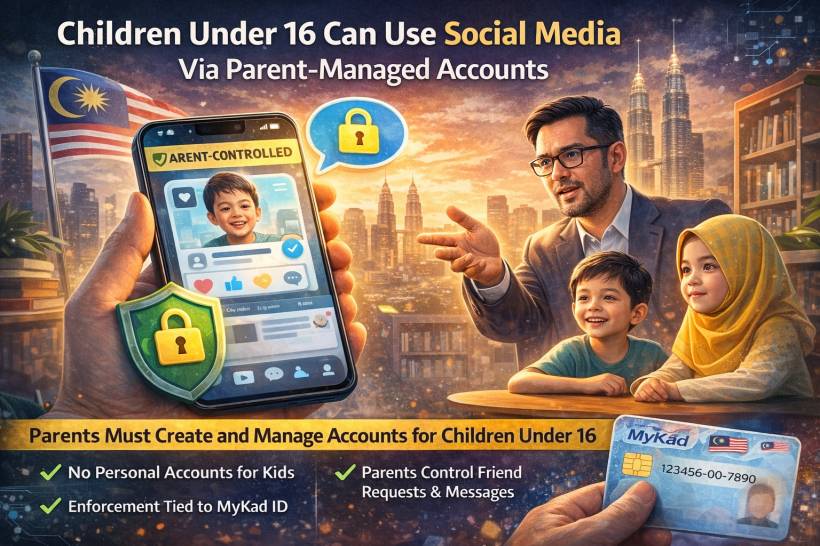
The core idea is this: children under 16 won't be allowed to operate personal accounts on their own, but parents may still open and manage accounts on their behalf.
The Main Issue: Control, Not Just Age
According to the minister, the government's biggest concern is who controls the account. When a child manages their own profile, it can be much harder for parents to see what's happening in the background, especially when it comes to messages, comments, and contact requests from strangers.
Parent-managed accounts, on the other hand, are framed as a safety compromise. If the parent is the one running the account, they're more likely to notice suspicious messages, unwanted contact, or attempts by unknown individuals to start conversations with the child.
In plain terms, the policy is less about "no social media" and more about "no unsupervised social media."
A Regulatory Sandbox Is Already Running
One practical challenge with age limits is enforcement. Saying "minimum age 16" is easy. Making it work across different apps and sign-up flows is where things get messy.
That's why the government is reportedly running a regulatory sandbox with social media platforms right now. A sandbox is basically a controlled testing environment where the rules and the technical enforcement methods can be tried out before anything goes nationwide.
This testing phase is meant to figure out what's realistic, what's enforceable, and what will inevitably be exploited if it's designed poorly. The earlier signals from the ministry suggest a possible rollout around mid-2026, with July sometimes mentioned as an early window.
Watching Content May Still Be Allowed
Another key clarification is that children could still be allowed to consume online content, including videos on platforms like YouTube, even if they can't create their own personal accounts.
This matters because personal accounts often unlock the interactive parts of a platform: messaging, DMs, comment engagement, following, posting, live interaction, and other features that make it easier for strangers to reach a child directly.
So the policy appears to draw a line between passive viewing and active participation, with the biggest restrictions aimed at the features that enable contact and private communication.
Parents Still Have a Job to Do
Alongside the policy explanation, Fahmi also gave a very direct reminder to parents: connected devices shouldn't be treated like babysitters.
That's not just a scolding soundbite. It's actually an important point because regulation can reduce risk, but it can't replace supervision. Even with age rules, kids will still encounter content, algorithms, and peer influence, especially when they have access to phones or tablets for long stretches without oversight.
In practice, the policy only works as intended if parents stay involved.
Malaysia's Likely Approach: Identity-Based Age Verification
Malaysia also appears to be leaning toward a different enforcement approach than countries that rely heavily on "age assurance" systems, such as AI estimation or third-party verification tools.
The direction described is more legislation-driven and tied to national identity, with MyKad positioned as part of the identity and age verification mechanism.
There has also been discussion previously around using eKYC-style processes, which could involve submitting MyKad or passport details and potentially using MyDigital ID as part of verification. In other words, the enforcement model being discussed sounds closer to "prove your age with an identity-backed method" than "let an AI guess your age from signals."
What This Could Mean in Real Life
If the policy goes forward as described, it changes the default expectations for under-16 users:
Platforms may have to change how they handle registrations, especially for users who look or claim to be under the minimum age.
The biggest changes will likely revolve around messaging, contact permissions, and other features that allow stranger-to-child interaction.
And like any online restriction, the real-world impact will come down to the details: how strict the enforcement is, how consistent it is across platforms, and whether loopholes are easy to exploit.
Final thoughts
This update reframes the policy in a way that's less about banning kids from the internet and more about shifting responsibility upward. Under-16 users may still be able to watch content, but personal accounts and interactive features are being treated as higher-risk areas that require adult oversight.
If Malaysia does implement identity-backed age checks and parent-managed accounts, the big question won't be whether the rule exists. It'll be whether it's practical enough to follow, strict enough to matter, and sensible enough that families and platforms can actually live with it.











Comments 0