

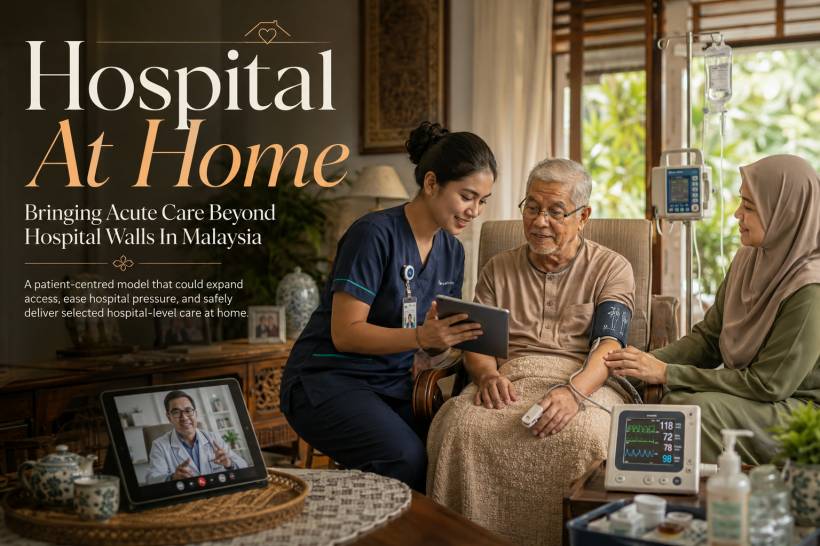
Malaysia's healthcare system is approaching a point where expanding hospitals alone may no longer be enough to meet rising demand. An ageing population, more people living with chronic illnesses, recurring bed shortages, longer hospital stays and pressure on the healthcare workforce are forcing providers to reconsider how acute care should be organised.
One increasingly important question is whether every clinically stable patient receiving hospital-level treatment must remain inside a hospital building.
The growing Hospital at Home model suggests that, for carefully selected patients, the answer may be no.
Hospital at Home does not mean sending patients home early and expecting families to manage on their own. It is a structured clinical service that brings selected hospital treatments, monitoring and multidisciplinary support into the patient's home while maintaining clear governance, escalation and safety arrangements.
For Malaysia, it could become a practical extension of hospital care rather than a replacement for hospitals.
What Hospital at Home Actually Means
Hospital at Home, commonly shortened to HAH, allows eligible patients to receive acute hospital-level care in their own homes.
Depending on the patient's condition and the programme's capabilities, the service may include:
The patient remains under the responsibility of a structured clinical team rather than being treated as an ordinary outpatient.
That distinction is important. HAH is not simply home nursing, telemedicine or routine follow-up care. It is designed for patients who would otherwise require admission or continued hospitalisation but can be managed safely at home under a clearly defined care pathway.
Why Malaysia Should Consider the Model Now
Malaysia is expected to become an aged society by 2030, with older adults accounting for at least 15% of the population.
An older population will naturally require more healthcare services. Older patients are more likely to live with multiple chronic conditions, require repeated hospital treatment and experience longer recovery periods following acute illness.
At the same time, hospitals already face significant pressure. Emergency departments can become crowded, wards may operate near capacity and staff must manage increasingly complex patients with limited time and resources.
Building more beds may address part of the problem, but it does not resolve every issue. New facilities require substantial investment, staffing, maintenance and long-term operational funding.
HAH offers another option: increasing the healthcare system's effective capacity by safely delivering suitable hospital services outside the physical hospital.
The Model Is Not About Replacing Hospitals
Hospital at Home should not be misunderstood as an attempt to reduce the importance of hospitals.
Hospitals will continue to be essential for patients requiring emergency intervention, surgery, intensive monitoring, complex diagnostics or immediate access to specialist teams and equipment.
HAH is better understood as an extension of hospital capability.
It allows selected patients to continue receiving appropriate treatment at home while hospital beds remain available for people who genuinely need facility-based care.
This could help reduce avoidable admissions, support earlier discharge and improve patient flow without compromising clinical standards.
A successful programme would complement hospitals, primary care, community nursing, rehabilitation and social services rather than compete with them.
International Experience Offers Useful Lessons
Healthcare systems in Singapore, Australia and several other countries have developed more mature Hospital at Home services.
Their experience shows that carefully selected patients can receive acute care at home when the programme is supported by:
These programmes demonstrate that home-based acute care can be safe and effective, but only when it is treated with the same seriousness as hospital care.
Malaysia can learn from these examples, but it should not simply copy another country's model. Differences in geography, healthcare financing, workforce availability, family structures and digital access mean that the local approach must be designed around Malaysian realities.
Malaysia Already Has Useful Building Blocks
Malaysia would not be creating HAH from nothing.
Several existing services could provide a foundation for future development, including:
Many healthcare professionals already support patients beyond the hospital setting. The challenge is bringing those services together under a coordinated acute-care model with consistent standards, clinical oversight and funding.
Rather than creating an entirely separate system, Malaysia could connect and strengthen services that already exist.
Which Patients May Be Suitable?
Not every patient can or should receive hospital-level care at home.
Eligibility must be based on clinical stability, the type of treatment required, home conditions, caregiver capacity and the ability to respond quickly if the patient deteriorates.
Potentially suitable cases may include selected patients receiving treatment for:
The decision must always remain clinical.
A patient should not be transferred into HAH simply because a hospital needs a bed. The home setting must be safe, the patient must understand the arrangement and the clinical team must be confident that the required standard of care can be delivered.
Patient Selection Will Determine Safety
One of the most important parts of any HAH programme is choosing the right patient.
A structured assessment should consider:
The patient's home must also be suitable for care.
A person living alone in an unsafe environment may not be an appropriate candidate, even if their medical condition appears stable. Similarly, a family caregiver should not be expected to perform tasks beyond their ability or comfort.
Digital Health Can Support Care, But It Cannot Replace It
Technology will be an important part of Hospital at Home, particularly for monitoring and communication.
Patients may use connected devices to record:
These readings can be reviewed by a clinical team, with alerts generated when values move outside agreed limits.
Video consultations can also allow doctors, nurses and allied health professionals to assess progress without requiring every review to take place in person.
However, technology should support clinical care rather than become a substitute for it.
Remote monitoring cannot replace physical assessment when a patient's condition changes. HAH programmes still need home visits, reliable communication and rapid escalation to hospital when necessary.
They must also offer alternatives for patients who do not have smartphones, stable internet access or strong digital literacy.
The Role of Nurses Will Expand Significantly
Nurses are likely to become central to any Malaysian Hospital at Home model.
Their responsibilities may extend beyond traditional home visits to include:
This creates valuable opportunities for expanded nursing practice.
It also means nursing education and professional development must evolve. Future nurses may need stronger preparation in community-based acute care, remote monitoring, clinical decision-making and technology-supported care.
HAH could also create new advanced nursing roles, particularly in gerontology, chronic disease management, rehabilitation and transitional care.
Multidisciplinary Care Is Essential
Hospital at Home cannot depend on one profession alone.
A mature service may involve:
The exact team will vary according to the patient's needs.
What matters is that responsibilities are clearly assigned and communication remains consistent. The patient should not receive fragmented instructions from different professionals working independently.
A shared care plan and common clinical record would help ensure that every member of the team understands the treatment goals, current condition and escalation criteria.
Caregivers Must Be Supported, Not Overloaded
Family involvement is common in Malaysian healthcare, and relatives may be willing to support care at home.
However, Hospital at Home should not transfer the burden of professional care to unpaid family members.
Caregivers need:
They should also be able to decline the arrangement if they do not feel capable of supporting it.
A programme cannot be considered successful if it reduces hospital costs by creating unsafe or exhausting responsibilities for families.
Financing Will Shape Accessibility
The way Hospital at Home is funded will determine whether it becomes widely accessible or remains available only to patients who can afford private care.
Malaysia will need to decide how these services are reimbursed across public hospitals, private healthcare providers and insurance arrangements.
Funding should recognise that HAH includes more than a virtual consultation. It may require home visits, medication delivery, diagnostics, monitoring devices, clinical coordination and emergency support.
Payment models should encourage appropriate patient selection and good outcomes rather than simply rewarding the number of visits or devices used.
Equity must remain a central concern. Rural communities, lower-income households and patients with limited digital access should not be excluded from the benefits of the model.
Clinical Governance Must Be Clear
Moving hospital-level care into the home changes the location of treatment, but it does not reduce the need for clinical accountability.
Every programme should clearly define:
Clinical protocols should be supported by regular audit, outcome monitoring and patient-safety review.
The service must also be integrated with emergency departments and ambulance services so deteriorating patients can return to hospital without unnecessary delay.
Medico-Legal Questions Need Early Attention
Hospital at Home raises important legal and regulatory questions.
For example:
These matters should be addressed during programme design, not after an incident occurs.
Clear documentation, professional guidelines, insurance arrangements and data-governance requirements will be necessary to protect patients, caregivers and healthcare workers.
Data Privacy and Cybersecurity Cannot Be Secondary
HAH may involve wearable devices, mobile applications, cloud platforms and remote-access systems.
These technologies can improve care, but they also create cybersecurity and privacy risks.
Patient information must be protected during collection, transmission and storage. Access should be limited to authorised personnel, and every system should maintain reliable audit records.
Programmes should also prepare for device failure, internet outages, system downtime and cyber incidents.
A safe HAH service needs manual fallback procedures so care can continue even when technology is unavailable.
Malaysia Needs a Locally Designed Model
Malaysia's Hospital at Home approach should reflect local cultural, geographic and healthcare conditions.
Urban areas may be able to support rapid home visits more easily, while rural communities may require different service structures and partnerships with district health facilities.
Malaysia's multigenerational households may provide strong family support in some cases, but they may also create privacy or space limitations.
Language, health literacy and varying levels of digital confidence must also be considered.
A locally designed model should therefore be flexible enough to work across different communities rather than assuming that one national template will suit every patient.
Pilot Programmes Could Build Evidence Safely
Malaysia does not need to introduce HAH across the entire healthcare system at once.
A safer approach would be to begin with carefully designed pilot programmes in selected hospitals or regions.
Initial pilots could focus on specific patient groups with predictable care needs and clear escalation pathways.
The programme should measure:
The findings could then guide national standards, financing models and workforce planning.
Success Should Be Measured Beyond Cost Savings
Reducing hospital costs may be one benefit of HAH, but it should not be the only measure of success.
A programme should also ask:
A cheaper service is not necessarily a better service if it shifts risk elsewhere.
The strongest model will balance efficiency with quality, safety and fairness.
Hospital at Home Supports a Broader Shift in Healthcare
HAH reflects a larger change in how healthcare may be delivered in the future.
Rather than expecting every patient to travel repeatedly to hospitals, healthcare systems are gradually moving appropriate services closer to where people live.
This may include home monitoring, virtual consultation, mobile diagnostics, rehabilitation and community-based treatment.
For older adults and people with chronic illness, this approach could reduce the disruption caused by hospitalisation and support recovery in a familiar environment.
However, the change must remain clinically led. Technology and convenience should never override patient safety.
Final Thoughts
Hospital at Home could become an important part of Malaysia's response to ageing, chronic disease, hospital congestion and workforce pressure.
The model offers a way to extend hospital-level care beyond traditional walls while keeping patients connected to multidisciplinary clinical teams.
Malaysia already has many of the foundations needed, including community nursing, telemedicine, rehabilitation and home-based care. The next step is to bring these strengths together under a structured model supported by sustainable financing, strong governance, workforce development and safe digital infrastructure.
Hospital at Home should not be treated as a shortcut for reducing admissions or saving money. It should be developed as a high-quality care option for appropriately selected patients.
With careful planning, local evidence and a strong commitment to equity, Malaysia has an opportunity to shape a HAH model that improves access while preserving safety, dignity and human connection.











Comments 0