

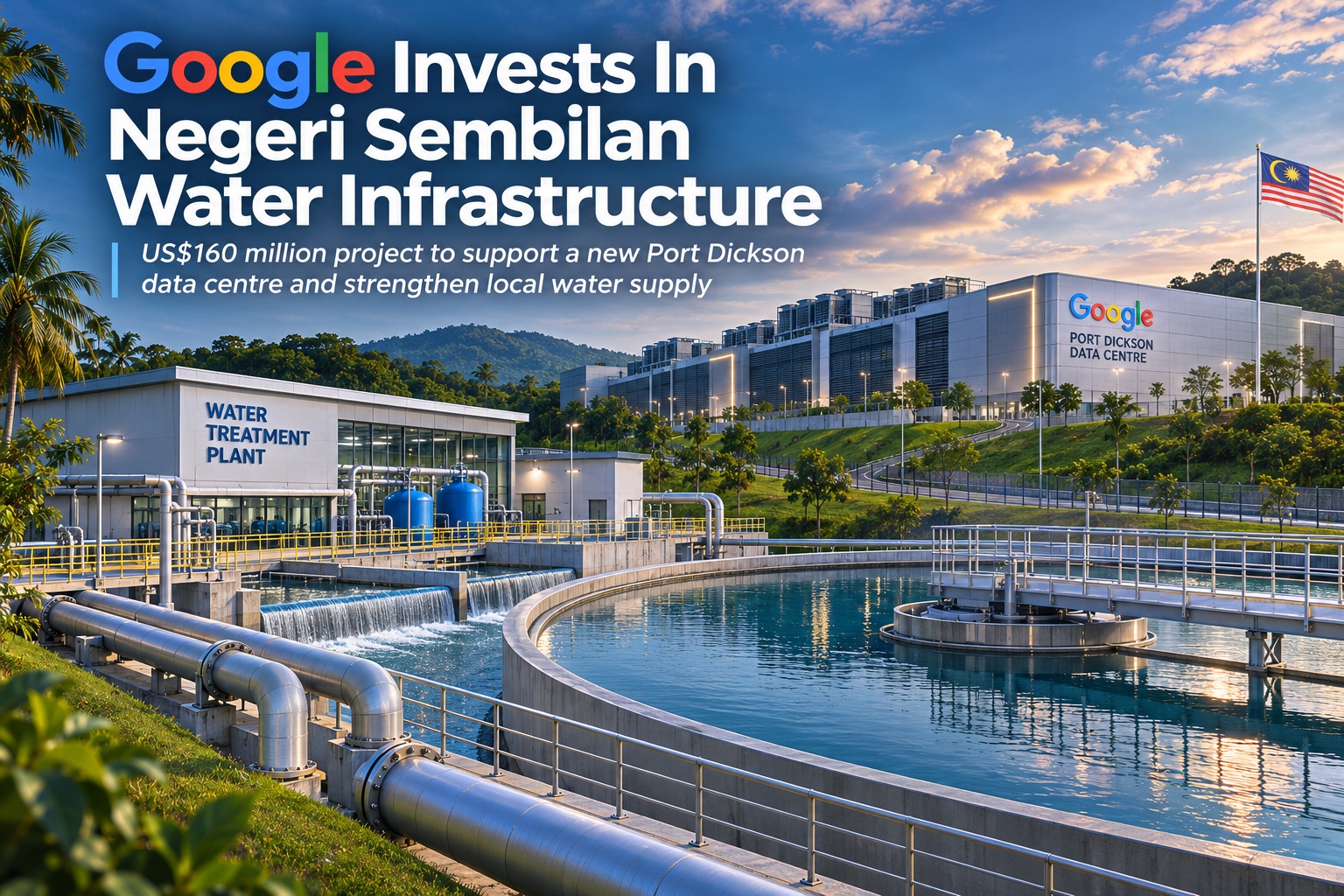
Google is investing US$160 million, or approximately RM651 million, to develop new water infrastructure in Negeri Sembilan as part of preparations for its upcoming data centre campus in Port Dickson. The project is intended not only to support Google's future data centre operations but also to improve water availability for surrounding residential and commercial communities. Working together with the Negeri Sembilan state government and Syarikat Air Negeri Sembilan (SAINS), Google has appointed Gamuda Berhad to construct an off-river storage reservoir and a new water treatment plant. The development represents another major infrastructure investment connected to Malaysia's rapidly expanding data centre sector.
New Water Treatment Plant Will Supply 65 Million Litres Daily
Once operational, the new water treatment plant will be capable of producing around 65 million litres of treated water every day. The additional capacity will support domestic users, businesses and Google's planned data centre rather than being reserved exclusively for the technology company. This is particularly important as large data centres can place substantial demands on local water infrastructure, especially where cooling systems rely on water. By expanding the overall supply capacity, the project is intended to accommodate Google's needs while also strengthening water availability for the wider area.
Off-River Reservoir Will Capture Excess Water
The off-river storage reservoir will be located along the Linggi River and will capture excess river flow and rainwater during periods when water is plentiful. Instead of allowing that additional water to flow away unused, the reservoir will store it for periods when river levels are lower and demand remains high. This creates an additional reserve that can help improve the resilience of Negeri Sembilan's water supply during drier conditions. The approach could become increasingly valuable as industrial development and population growth increase overall demand.
The Reservoir Will Also Help Reduce Flooding
Water storage is only one of the reservoir's intended functions, as it will also operate as a retention basin during periods of heavy rainfall. By temporarily holding excess water, the facility can help reduce pressure on surrounding waterways and potentially lower the risk of flooding in nearby areas. This gives the project a broader environmental and community benefit beyond supplying Google's data centre. Infrastructure that can address both water security and flood management may become increasingly important as weather patterns become less predictable.
Infrastructure Will Eventually Belong To Negeri Sembilan
Once the reservoir and treatment plant are completed, both facilities will be owned by Menteri Besar Negeri Sembilan (Incorporated), or MBINS. MBINS is the state statutory body responsible for managing government assets, meaning the infrastructure will ultimately remain under state ownership rather than becoming permanent private assets belonging to Google. This arrangement gives Negeri Sembilan long-term control over the facilities and allows the additional water capacity to continue serving public and commercial users. Google's investment therefore contributes to infrastructure that could remain useful well beyond the immediate needs of the data centre.
The Project Supports Google's Port Dickson Data Centre Campus
The new infrastructure is being developed in support of Google's upcoming data centre campus at Springhill Industrial Park in Port Dickson. Large data centre campuses require far more than buildings filled with servers, as they also depend on reliable electricity, water, telecommunications and transport infrastructure. The water project helps ensure that the surrounding utility network can support additional demand without simply placing more pressure on existing facilities. It also prepares the industrial area for broader future growth as more technology and commercial activities move into the region.
Water Consumption Has Become A Major Data Centre Concern
The announcement comes at a time when the water consumption of large-scale data centres is receiving increasing attention around the world. Servers generate substantial heat, and some facilities rely heavily on water-based cooling systems to keep equipment operating safely and efficiently. Communities hosting data centres therefore increasingly want assurances that new facilities will not compete excessively with households and businesses for limited freshwater supplies. Google's decision to invest directly in additional water infrastructure appears intended to address those concerns before the Port Dickson campus becomes fully operational.
Google Aims To Replenish 120% Of The Freshwater It Consumes
Google has reiterated its global ambition to replenish 120% of the freshwater it consumes across its operations. In practical terms, the company wants to restore more water to local environments and communities than its facilities directly consume. The Negeri Sembilan project supports that broader strategy by increasing storage and treatment capacity rather than simply relying on existing supplies. Achieving the wider global target will naturally depend on many different projects, but investments such as this demonstrate how Google intends to connect data centre expansion with local water-management initiatives.
Data Centres Need Much More Than Computing Hardware
Data centre announcements often focus on AI accelerators, servers and cloud infrastructure, but the supporting utilities around those systems are just as important. A facility cannot operate reliably without continuous electricity, sufficient cooling capacity and dependable water supplies. As AI workloads become more demanding, those infrastructure requirements are becoming even larger because modern AI servers consume significant amounts of power and generate substantial heat. Google's Negeri Sembilan investment illustrates how the true cost of building a large data centre extends far beyond the computing equipment placed inside it.
Google Will Cover Its Own Electricity Costs
Google has also confirmed that it will fully cover the electricity costs associated with its Port Dickson data centre campus. This includes not only the power consumed during normal operation but also the direct infrastructure expenses needed to connect the facility to the electricity grid. The commitment is important because large data centres can require enormous amounts of electricity and may need new grid infrastructure before they can operate at full scale. By funding those requirements directly, Google says the project will not shift those infrastructure costs onto surrounding communities.
AI Is Increasing Infrastructure Requirements
The rapid expansion of artificial intelligence is significantly increasing the infrastructure demands associated with modern data centres. AI training and inference systems use large numbers of high-performance processors that consume considerable electricity and generate much more heat than many traditional enterprise workloads. This increases the need for cooling systems, stronger electricity networks and reliable water supplies. As technology companies build increasingly large AI campuses, utility planning is becoming one of the most important parts of the entire project.
Port Dickson Is Joining Malaysia's Data Centre Expansion
Malaysia has become an increasingly attractive destination for international technology companies developing cloud and data centre infrastructure in Southeast Asia. Johor has received considerable attention, but investments are now spreading into other locations with suitable land, connectivity and supporting utilities. Port Dickson's Springhill Industrial Park is becoming part of that expansion through Google's planned campus. The US$160 million water project signals that the company expects the site to play a meaningful role in its Malaysian infrastructure strategy.
The Investment Could Benefit Surrounding Communities
Although Google's data centre is a major reason for constructing the new facilities, the infrastructure is designed to provide water for a much broader group of users. Domestic households and commercial customers will share the treatment capacity alongside the data centre, making the investment more than a private utility project. This could help the state accommodate future economic and population growth without placing all additional demand on existing treatment facilities. The public benefit becomes particularly significant once ownership transfers to MBINS.
Gamuda Will Handle Construction
Google has appointed Gamuda Berhad to construct both the off-river storage reservoir and the new water treatment plant. The work will involve more than building ordinary industrial facilities because the infrastructure must integrate river management, water treatment and the wider Negeri Sembilan supply network. It will also need to operate reliably over the long term while supporting potentially substantial daily demand. Gamuda's role therefore places the Malaysian infrastructure company at the centre of one of the major utility projects supporting Google's data centre expansion.
SAINS Will Play An Important Role
Syarikat Air Negeri Sembilan is also involved because the project needs to integrate with the state's wider water system. Collaboration with SAINS helps ensure that the new capacity supports existing water-management requirements rather than operating as an isolated system built only for Google. Once the facilities are completed, the additional treated water can serve multiple categories of users. This shared approach is particularly important if the development is expected to provide lasting public value.
Off-River Storage Provides Additional Flexibility
An off-river reservoir provides a different approach from constructing a traditional dam directly across a river. Water can be diverted and stored when river flow is high without permanently blocking the main waterway. This gives operators more flexibility to capture water during wet periods and retain it for later use. The stored supply can then provide additional resilience during periods when natural river flow drops.
Additional Storage Can Improve Drought Resilience
Periods of low rainfall can create serious challenges for water systems when rivers and conventional reservoirs begin falling below normal levels. Additional storage provides another source that can be used when natural supply becomes less reliable. With industrial and data centre activity increasing, having additional reserves becomes more important because overall demand is unlikely to decrease during dry conditions. The off-river reservoir therefore provides another layer of protection against future shortages.
Flood Mitigation Adds Another Community Benefit
The ability to temporarily retain excess water means the reservoir could also help surrounding communities during heavy rainfall. Rather than allowing all stormwater and high river flow to move downstream immediately, part of it can be captured and stored. This may reduce pressure on vulnerable areas and lessen the severity of certain flooding events. Combining water storage with flood management makes the infrastructure useful under both dry and wet conditions.
Google Is Also Expanding Its Partnership With SOLS Foundation
Beyond physical infrastructure, Google says it is expanding its partnership with the SOLS Foundation through two initiatives focused on education and renewable energy skills. Both programmes are scheduled to begin in Negeri Sembilan in early 2027. One initiative will establish solar-energy laboratories in participating government schools, while the second will provide digital skills training for young people interested in renewable-energy careers. These programmes broaden Google's local investment beyond its data centre and utility requirements.
Government Schools Will Receive Solar Energy Laboratories
The solar-energy laboratories are intended to give students practical exposure to renewable technologies rather than limiting learning entirely to classroom theory. Participants will be able to understand how solar systems operate and how renewable energy can be applied in real-world environments. This could become increasingly relevant as Malaysia expands solar generation and other clean-energy projects. Early exposure may also encourage more students to pursue technical education and careers connected to renewable infrastructure.
Youth Will Receive 36 Hours Of Digital Skills Training
Google and SOLS Foundation are also introducing a 36-hour digital skills programme aimed at youths interested in building careers within the renewable-energy sector. Modern renewable-energy roles increasingly require digital knowledge alongside conventional technical skills, particularly as systems become more automated and data-driven. The programme is intended to help participants develop capabilities that can support future employment in the sector. Starting the initiative in Negeri Sembilan connects workforce development directly with the state's growing technology and infrastructure investments.
The Education Initiatives Begin In Early 2027
Both the school-based solar laboratories and the youth digital skills programme are expected to begin in early 2027. Launching them in the same state as Google's new data centre creates a broader local development package involving infrastructure, technology and human-capital investment. It also gives Google an opportunity to demonstrate community involvement beyond constructing and operating a large computing facility. The longer-term value will depend on how widely the programmes expand and how many participants eventually benefit.
Data Centres Are Increasingly Expected To Support Their Host Communities
Communities hosting major data centres increasingly expect more than construction activity and headline investment figures. These facilities consume significant amounts of electricity, water and land, so questions naturally arise about how surrounding communities benefit in return. Investments in public infrastructure, education and skills development can help create a more balanced relationship between technology companies and their host locations. Google's Negeri Sembilan project combines all three by funding water capacity, covering its electricity infrastructure and supporting renewable-energy education.
Infrastructure Costs Are Becoming Part Of Data Centre Investment
Large technology companies can no longer assume existing local utilities will automatically provide everything required by increasingly powerful data centres. New substations, electricity connections, water treatment plants, reservoirs and pipelines may all need to be constructed alongside the computing campus itself. These supporting projects can significantly increase the real investment required before a data centre becomes operational. Google's US$160 million water commitment demonstrates how substantial those additional infrastructure costs can become.
Malaysia Needs To Balance Investment With Resource Management
Data centres can generate major economic opportunities, attract technology investment and support construction and digital industries, but they also create substantial demands on public resources. Malaysia therefore needs to balance the benefits of attracting these projects with the need to protect electricity and water availability for existing communities. Infrastructure needs to expand alongside industrial demand rather than being expected to absorb unlimited new consumption. Projects where private investment also expands public utility capacity may offer a more sustainable approach.
The Negeri Sembilan Project Could Become A Useful Model
If the project successfully supports Google's data centre while increasing water availability and improving flood management for surrounding communities, similar arrangements could become more common. Technology companies may increasingly be expected to contribute directly to the infrastructure expansion their facilities require. This can reduce the financial burden on governments and utility customers while improving acceptance of large industrial projects. The approach may become even more important as AI drives the construction of larger and more resource-intensive data centres.
Final Thoughts
Google's US$160 million, or approximately RM651 million, investment in Negeri Sembilan water infrastructure is an important part of the company's preparations for its upcoming data centre campus at Springhill Industrial Park in Port Dickson. Working with the state government and SAINS, Google has appointed Gamuda to construct an off-river storage reservoir and a treatment plant capable of supplying 65 million litres of treated water per day. The facilities will serve domestic, commercial and data centre demand while the reservoir will also store excess water during periods of high river flow and help mitigate flooding.
Once completed, both facilities will belong to Menteri Besar Negeri Sembilan (Incorporated), giving the state long-term ownership of the infrastructure. Google has also reiterated its ambition to replenish 120% of the freshwater it consumes and says it will fully cover the electricity costs and direct grid-connection expenses required by its data centre campus. Alongside the infrastructure investment, the company is expanding its SOLS Foundation partnership through solar laboratories in government schools and a 36-hour digital skills programme for youths interested in renewable-energy careers.
The project highlights an increasingly important reality surrounding Malaysia's data centre boom: building enormous computing campuses is only one part of the investment. The water, electricity and skills infrastructure surrounding those facilities must expand at the same time if data centre growth is going to remain sustainable for the communities hosting it.











Comments 0