

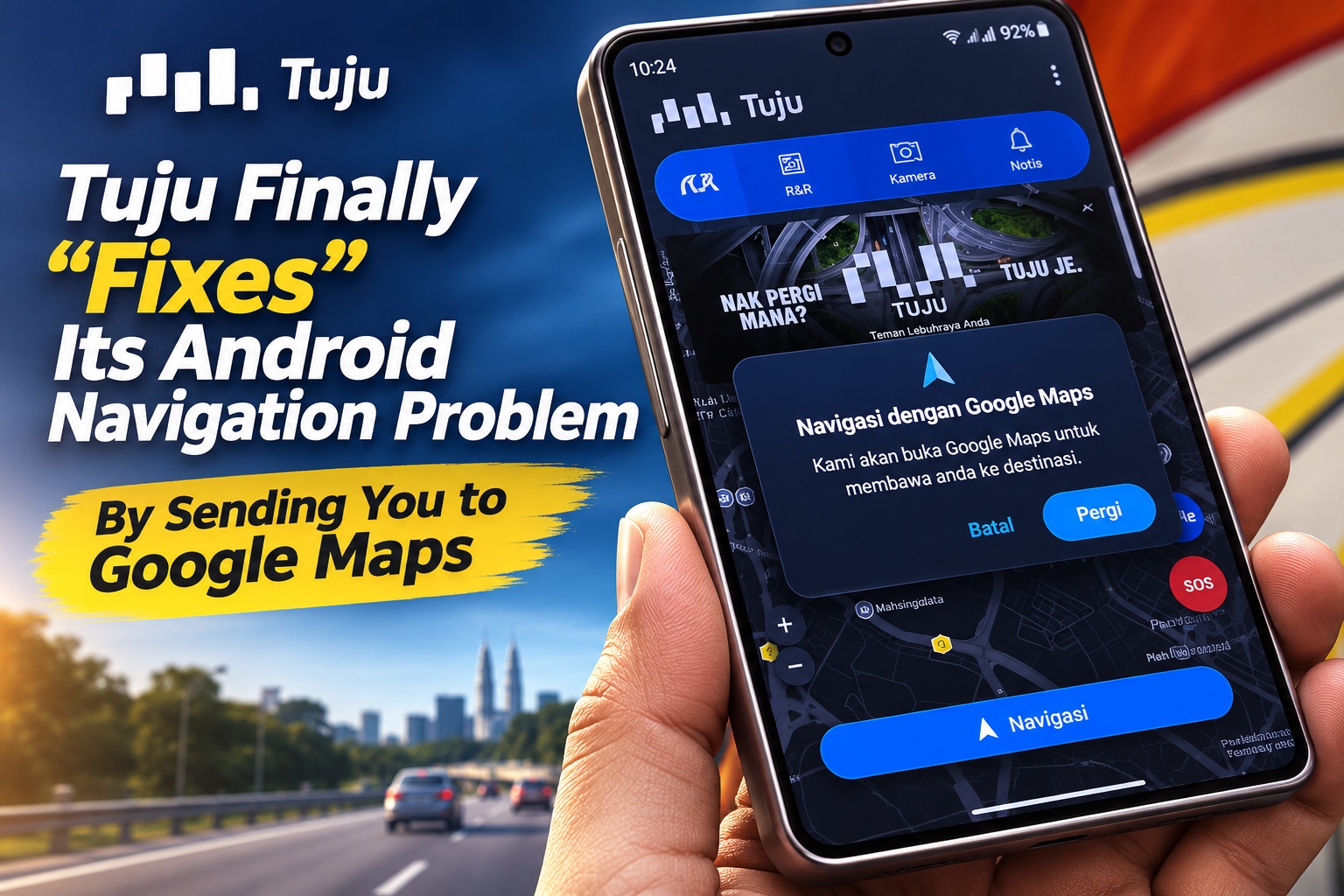
Malaysia's homegrown navigation app Tuju has finally addressed one of the biggest complaints surrounding its turn-by-turn navigation on Android, although probably not in the way anyone expected. Instead of trying to improve its own routing experience enough to compete with established navigation platforms, Tuju now simply hands the job over to Google Maps.
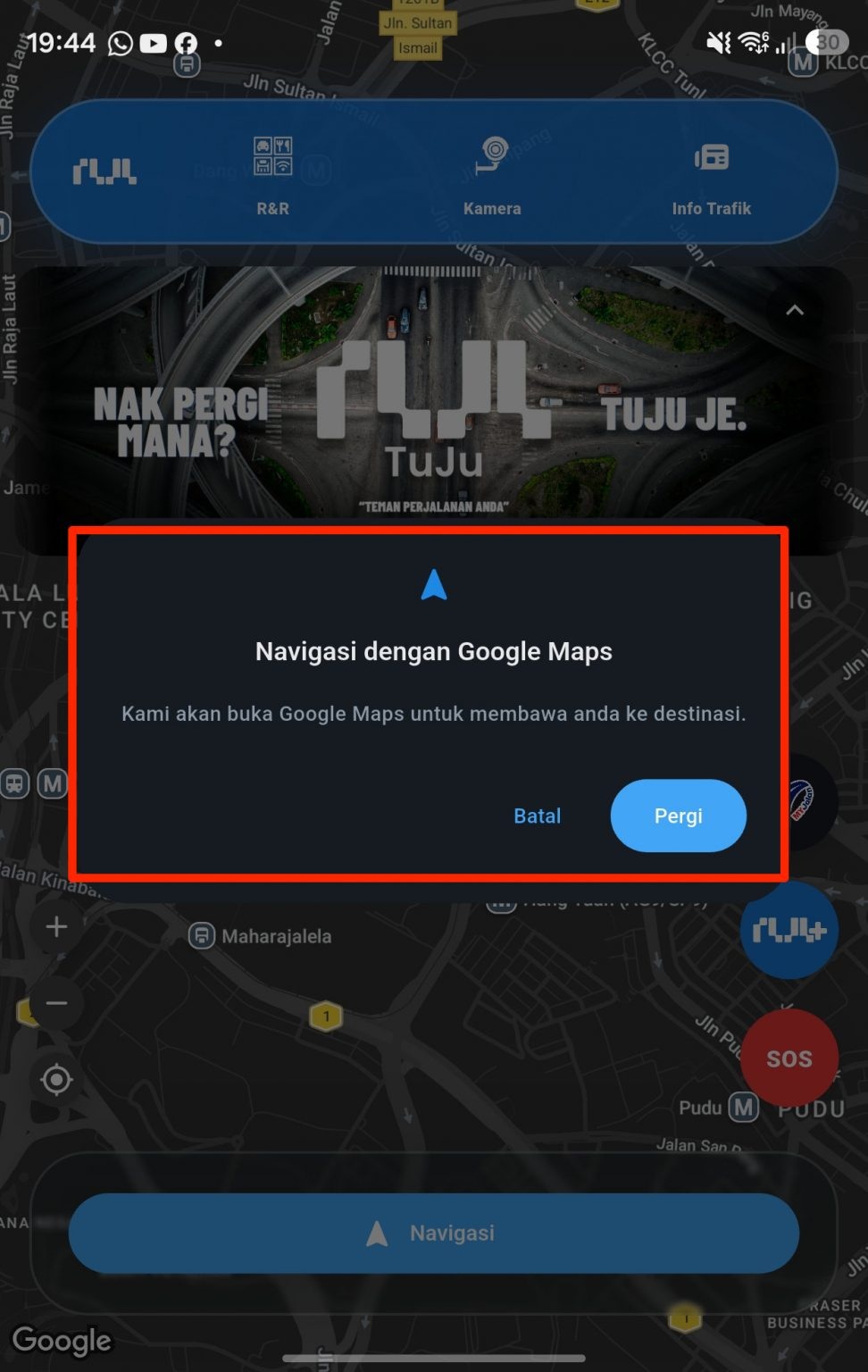
Following a recent Android update, tapping the navigation button inside Tuju displays a message informing users that Google Maps will be launched to guide them to their destination. It is certainly a practical solution, especially considering the criticism Tuju previously received for vague and unreliable driving directions. In short, Tuju has solved its navigation problem by letting an app already proven at navigation handle it instead.
Tuju For Android Now Redirects Navigation To Google Maps
The change arrives through Tuju version 2.0.4 for Android, which was released on 30 October 2026. The update comes ahead of the developer's previously stated 6 November deadline for restoring navigation functionality after the feature was temporarily disabled.
Rather than restoring the original turn-by-turn system, however, the updated Android app now tells users that Google Maps will open when they select navigation. This means Tuju effectively becomes the place where users find their destination or highway information, while Google Maps handles the actual driving instructions.
From a usability perspective, that may be the most sensible decision Tuju has made so far.
The Old Navigation Experience Was Difficult To Rely On
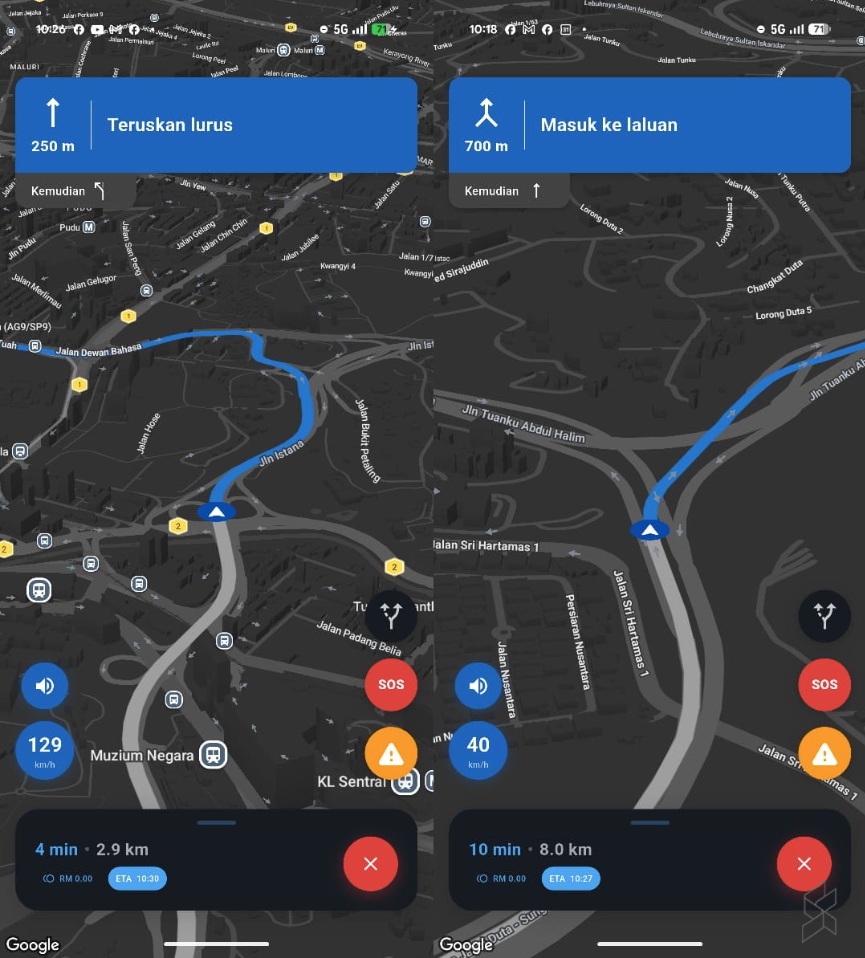
Tuju's original turn-by-turn navigation struggled to provide the level of guidance users normally expect from modern navigation software. During testing on both Android and iOS, directions frequently consisted of very basic instructions such as continuing straight or merging, without enough contextual information to make them genuinely useful while driving.
Good navigation should tell drivers which lane to use, where the next turn is, how far away an exit is and what they should expect before reaching it. When those details are missing, users may spend more time looking at the screen trying to understand the instructions, which can become distracting behind the wheel.
Handing navigation over to Google Maps therefore removes the weakest part of Tuju's experience while allowing the app to focus on the information it handles better.
The Tagline Now Feels Slightly Ironic
Tuju's homepage still prominently displays the tagline "Nak Pergi Mana? Tuju Je", which roughly translates to "Need to go somewhere? Just use Tuju." That messaging made perfect sense when the app positioned itself as a navigation solution, but it now creates a rather amusing contradiction.
You can indeed use Tuju when deciding where you want to go. Once you actually want directions to get there, however, Tuju now effectively says: use Google Maps.
It is difficult not to appreciate the irony, although users will probably care more about finally receiving reliable navigation than whether the branding remains perfectly consistent.
Google Maps Also Brings Android Auto Support
Redirecting users to Google Maps provides another important benefit: Android Auto compatibility. Drivers can use Google Maps through their vehicle's infotainment display rather than relying entirely on their phone screen.
This immediately gives Tuju users access to a much more mature driving experience, including lane guidance, traffic information, voice navigation and integration with supported vehicles. Developing all of those capabilities independently would require substantial time and resources.
By relying on Google Maps, Tuju can effectively gain access to those advantages without attempting to rebuild them from scratch.
The iPhone Version Has Not Changed Yet
The change currently applies only to Android. Tuju for iPhone remains listed as version 1.5.5, with its most recent update dating back to November 2025.
That means iOS users have not yet received the same Google Maps handoff introduced on Android. Whether Tuju eventually adopts a similar approach on iPhone remains to be seen.
Given how straightforward the Android solution is, extending the same concept to iOS would seem like a logical move unless the developers have a different navigation strategy planned for Apple devices.
Navigation Was Disabled After Heavy Criticism
The latest update follows a difficult period for Tuju after its navigation feature received widespread criticism. On 22 October, tests of the app found inaccurate routing, vague directions and several missing features that users normally expect from a navigation application.
The overall experience was described as frustrating and potentially distracting, particularly because drivers had to interpret unclear instructions while already focusing on the road. Following the criticism, the Malaysian Highway Authority (LLM) temporarily disabled Tuju's navigation capability.
That decision gave the developers time to reconsider how the feature should work before restoring it to users.
The Original Navigation Was Missing Too Much Context
Navigation systems need to communicate information quickly because drivers cannot spend several seconds interpreting every instruction. Established platforms such as Google Maps and Waze have spent years refining how they present lane guidance, upcoming turns, road names, traffic conditions and alternative routes.
Tuju's earlier implementation appeared significantly more basic. Instructions such as "go straight" or "merge" are not necessarily wrong, but they become much less useful without sufficient information about where, when and how the driver should perform those actions.
A simpler system can work when the road is straightforward, but complicated intersections and unfamiliar highways quickly expose its limitations.
Using Google Maps Removes A Safety Concern
Moving turn-by-turn navigation into Google Maps could also reduce the safety concerns associated with unclear directions. Drivers are already familiar with the interface and voice guidance provided by Google's navigation system, which reduces the amount of attention required to interpret instructions.
A navigation app should ideally communicate information without forcing the driver to repeatedly look at the screen. If Tuju cannot yet provide that level of reliability independently, handing the task to a mature platform is much better than continuing to offer an experience users may struggle to trust.
Sometimes admitting another tool handles a particular job better is the more responsible product decision.
LLM Says Tuju Was Never Intended To Replace Waze
The Malaysian Highway Authority has since clarified that Tuju was never meant to be a direct replacement for Waze. Instead, it is intended primarily as a highway companion application that provides information relevant to Malaysian road users.
Its features include real-time highway updates, toll exit information, rest and service area locations, live camera feeds and emergency assistance contacts. Viewed from that perspective, Tuju's strongest value may never have been turn-by-turn navigation in the first place.
The confusion likely came from how the app was promoted and how much attention its navigation functionality initially received.
Tuju Makes More Sense As A Highway Companion
Repositioning Tuju around highway information could actually give the app a clearer purpose. Google Maps and Waze already dominate navigation, and competing with them directly would require enormous amounts of mapping data, traffic information and engineering work.
Tuju can instead concentrate on information specific to Malaysian highways that may not always be as easy to find in global navigation apps. Detailed toll information, rest stops, highway cameras and local emergency contacts can all complement Google Maps rather than compete with it.
This approach makes the two applications potentially useful together instead of forcing users to choose between them.
One App Can Provide Information While Another Handles Navigation
The updated Android workflow essentially turns Tuju into a specialised information layer. Users can look up destinations, check highway information and access locally relevant data within Tuju before moving into Google Maps for actual turn-by-turn guidance.
That arrangement may not be as seamless as having everything inside one application, but it is considerably more practical than relying on an unreliable navigation system. It also allows Tuju's developers to concentrate resources on the features where a Malaysian-built application can offer something genuinely different.
There is little benefit in rebuilding Google Maps badly when Tuju can instead build services Google Maps does not provide.
The Change Also Highlights The Difficulty Of Building Navigation Software
Navigation may look relatively simple from the user's perspective, but building a reliable system is incredibly complicated. The application needs accurate map data, road restrictions, speed limits, turn rules, lane information, routing algorithms and constantly changing traffic conditions.
A small error can produce directions that are merely inconvenient, while a larger one can send drivers somewhere unsafe or impossible. Major navigation companies have spent years collecting data and refining routing systems across millions of journeys.
For a newer local application, reaching that level of reliability requires far more than simply drawing a route between two points.
Traffic Data Is Another Major Challenge
Navigation also depends heavily on real-time traffic information. Waze benefits from crowdsourced reports and an enormous user base, while Google Maps can analyse traffic conditions across millions of devices and historical journeys.
A newer application with fewer users naturally has much less information available. Without enough real-time data, route recommendations may be slower to react to congestion, accidents or road closures.
This network effect makes navigation one of the most difficult categories for a new competitor to enter successfully.
The Original Push For Local Alternatives Added Pressure
Tuju gained significant attention after Prime Minister Datuk Seri Anwar Ibrahim encouraged Malaysians to consider locally developed alternatives to Waze because of national security and data privacy concerns. That naturally raised expectations around what Tuju could provide.
Users may have assumed the application was intended to replace Waze completely, including its mature navigation experience. LLM's later clarification that Tuju was primarily a highway companion suggests the original expectations and the intended product role were not completely aligned.
Better communication around that purpose could have prevented some of the backlash.
A Local App Can Still Have Value Without Replacing Global Platforms
There is nothing inherently wrong with Tuju relying on Google Maps while providing its own specialised highway services. Many applications use third-party mapping platforms rather than attempting to build their own navigation infrastructure.
The value of a local application can come from the information layered around the map rather than the routing engine itself. Malaysian highway operators possess local data that could potentially make Tuju particularly useful for toll information, rest areas, incidents and emergency assistance.
That may ultimately be a much stronger reason for Malaysians to install Tuju than trying to position it as another Waze.
Fahmi Fadzil Says Management Must Be Accountable
Communications Minister Datuk Seri Fahmi Fadzil recently said that the management responsible for Tuju should be held accountable if inaccurate information was presented to the government. His comments add another layer to the controversy surrounding the application's launch and positioning.
Government-supported digital projects naturally attract scrutiny when the public experience does not match expectations. If officials were given inaccurate impressions about the application's capabilities, questions around project governance and communication would be understandable.
The technical problems may be fixable, but rebuilding public confidence can take considerably longer.
Users Mostly Care That Navigation Finally Works
For ordinary users, the politics and development history may matter much less than whether the application gets them where they need to go. The latest Android update solves that immediate problem in a wonderfully straightforward way.
Tap navigation in Tuju, Google Maps opens, and the user gets reliable turn-by-turn directions. It is not technologically ambitious, but it works.
Sometimes the smartest software decision is not building another complicated system but connecting users to something that already solves the problem well.
The Solution Is Funny But Sensible
It is easy to make fun of a navigation app that fixes its navigation by launching another navigation app. The situation practically writes its own joke, especially when the homepage still says "Nak Pergi Mana? Tuju Je."
But behind the humour is a genuinely sensible product decision. Continuing to push unreliable navigation simply to keep everything inside Tuju would have been worse for users.
Redirecting to Google Maps acknowledges reality and immediately provides a better experience.
Tuju Can Now Focus On What Makes It Different
The change could ultimately be good for the application if the development team uses it as an opportunity to focus on Tuju's strengths. Instead of spending enormous effort trying to reproduce Google Maps or Waze, resources can go towards highway-specific services designed specifically for Malaysian users.
Better live highway information, clearer toll data, more useful camera feeds and stronger emergency assistance features could make Tuju valuable even if navigation itself is handled externally.
A complementary app does not need to replace everything users already have.
Final Thoughts
Tuju's latest Android update finally addresses its troubled navigation experience, albeit through a solution that is both practical and slightly amusing. Version 2.0.4, released on 30 October 2026, now redirects users to Google Maps whenever they request turn-by-turn navigation instead of attempting to provide those directions itself.
Considering the criticism aimed at Tuju's previous routing experience, this is arguably the best short-term solution. Google Maps already provides reliable turn-by-turn navigation, traffic information, lane guidance and Android Auto support, while Tuju can focus on its role as a Malaysian highway companion offering toll information, rest stops, live cameras, highway updates and emergency contacts.
The irony of a platform carrying the slogan "Nak Pergi Mana? Tuju Je" only to launch Google Maps when users actually want to go somewhere is difficult to ignore. But users are likely to prefer a slightly awkward branding situation over inaccurate driving directions.
Tuju may not be replacing Waze or Google Maps anytime soon, and LLM now says that was never really the intention. Perhaps that is ultimately the right direction for the app: let Google handle the navigation, and let Tuju concentrate on providing the Malaysian highway information that global platforms may not offer as well.











Comments 0