

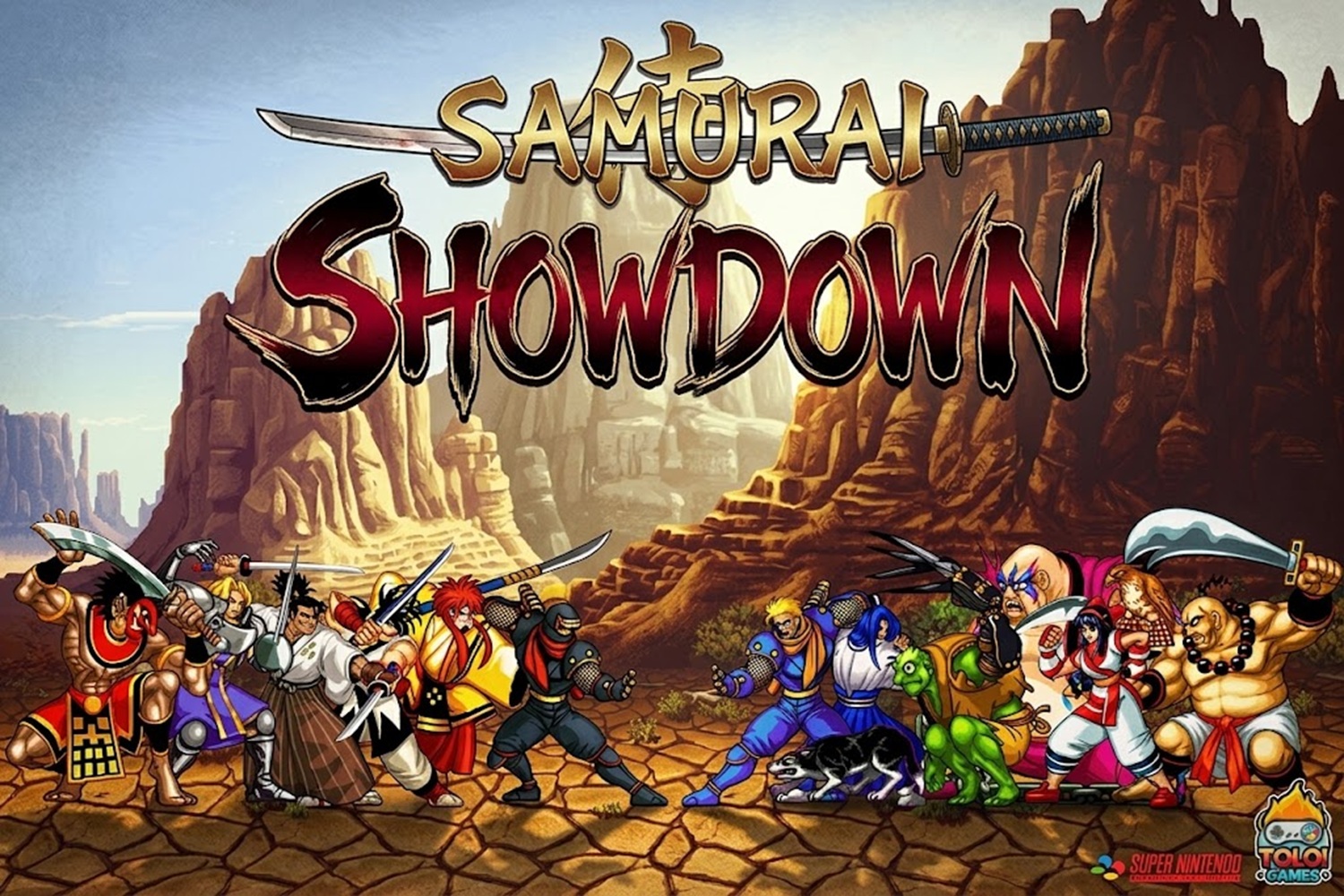
Samurai Shodown brought a very different philosophy to the crowded fighting-game scene of the early 1990s. Instead of encouraging players to overwhelm opponents with endless combinations of punches and kicks, SNK built its battles around weapons, spacing, patience, and attacks capable of removing a frightening amount of health when they connect cleanly. Swords, claws, polearms, and other weapons immediately give each fighter a stronger sense of identity, while slower and more deliberate exchanges make every mistake feel dangerous. The result is a fighting game where waiting for the correct moment can be just as important as knowing a special move.
The Super Nintendo adaptation preserves the fundamental appeal of the arcade original while translating the experience to 16-bit home hardware. Fighters such as Haohmaru, Nakoruru, Galford, Hanzo Hattori, Jubei Yagyu, Charlotte, Ukyo Tachibana, Gen-an, Tam Tam, Kyoshiro Senryo, and Wan-Fu bring dramatically different weapons and personalities into battle. Matches combine traditional fighting-game movement with weapon clashes, powerful slashes, projectile techniques, defensive positioning, and the famous POW gauge that becomes increasingly dangerous as a fighter takes damage. Even decades later, Samurai Shodown feels immediately different from faster combo-oriented fighters because a single well-timed strike can completely change the direction of a round.
Now playable online through Lemon Web Games, Samurai Shodown brings its tense weapon-based fighting directly into the web browser without requiring the original console hardware. Players can choose from a varied roster of warriors, learn character-specific special techniques, manage distance carefully, build the POW gauge, and punish mistakes with devastating heavy attacks. The browser-based experience provides a convenient way to revisit one of SNK's most influential fighting concepts while preserving the deliberate pace that made the series famous. For players accustomed to fighting games built around constant offensive pressure, Samurai Shodown offers a refreshing reminder that sometimes the most dangerous move is simply waiting for the opponent to make the first mistake.
A Fighting Game Built Around Weapons
The defining idea behind Samurai Shodown is immediately visible when the match begins: most fighters enter battle carrying a weapon. Haohmaru uses a katana, Nakoruru fights with a short blade while working alongside her hawk Mamahaha, Charlotte carries a fencing sword, and Jubei fights using paired blades. These weapons are not cosmetic additions. Their length, speed, and attack arcs strongly influence how each character should be played.
This creates a greater emphasis on range than many contemporary fighters. A character with a long-reaching weapon can threaten an opponent from a distance where shorter attacks simply cannot connect. Faster fighters may compensate by moving quickly and attacking during openings. Learning where each fighter becomes dangerous is therefore one of the most important skills in the game.
Because weapons extend attack range significantly, careless movement can be punished immediately. Walking into the wrong position against a powerful slash may cost a large portion of the health bar. Players quickly learn to respect the space in front of an opponent. Combat becomes a constant negotiation over distance.
Heavy Attacks Can Completely Change a Round
Samurai Shodown became famous for the extraordinary damage caused by its strongest weapon attacks. A properly timed heavy slash can remove a huge amount of health, especially when the POW gauge is active. This means a player who appears to be losing badly may still be only one successful read away from recovering. Matches can remain tense until the final seconds.
Heavy attacks are powerful precisely because they are dangerous to use carelessly. Their longer animations can leave the attacker vulnerable if the opponent avoids or blocks them. Throwing out powerful strikes repeatedly is therefore rarely an effective strategy against an experienced player. The reward is enormous, but so is the risk.
This risk-and-reward structure gives matches their distinctive rhythm. Players circle, test distance, use safer attacks, and watch for one opening large enough to justify a devastating strike. The moments between attacks can become as tense as the attacks themselves. Samurai Shodown turns hesitation into part of the battle.
The POW Gauge Rewards Fighters Under Pressure
The POW gauge provides another important layer of strategy. As a fighter takes damage, the gauge increases, gradually creating the potential for much stronger attacks. This means damaging an opponent also makes them increasingly dangerous. A large health advantage does not necessarily allow the leading player to relax.
Once powered up, ordinary weapon attacks can become significantly more threatening. An opponent who has spent most of the round defending may suddenly be capable of reversing the match with only a few successful hits. The system discourages reckless attempts to finish the battle quickly. Players need to respect a wounded opponent.
The mechanic also fits the dramatic personality of the game. Samurai Shodown is filled with warriors who become more dangerous when pushed toward defeat. Instead of representing only statistics, the POW gauge feels like mounting anger and desperation. It gives each round a natural escalation.
Haohmaru Embodies the Samurai Shodown Style
Haohmaru quickly became one of the defining faces of the series. His fighting style revolves around strong sword techniques, solid range, and powerful attacks that reward careful timing. He can pressure opponents effectively without needing extremely complicated sequences. This makes him a natural character for understanding the basic rhythm of Samurai Shodown.
His projectile technique gives him an option at range, while his sword attacks become dangerous once opponents move closer. The contrast allows players to control space rather than constantly chasing the opponent. Haohmaru performs particularly well when the player remains patient and waits for an opportunity to punish a mistake.
Visually, his untamed appearance and oversized katana reinforce the game's exaggerated interpretation of historical warriors. He feels like a wandering swordsman taken directly from a dramatic samurai film. That identity helped him become closely associated with the entire franchise.
Nakoruru Brings Speed and Mobility
Nakoruru provides a very different style from heavier sword fighters. Her attacks are faster, her movement feels more agile, and her relationship with the hawk Mamahaha gives her techniques a distinctive personality. She can pressure opponents in ways that feel completely different from Haohmaru's more direct swordplay. Her smaller weapon encourages players to rely on movement and timing.
Mamahaha is more than a visual companion. Nakoruru's special techniques incorporate the bird into her offensive options, giving her unusual ways to threaten opponents. This relationship between character and animal became one of the most recognizable elements of the series. It also helps reinforce her connection with nature.
Her design demonstrates how Samurai Shodown uses weapons to create genuinely different play styles. Not every fighter needs a huge sword to be dangerous. Speed, mobility, and unusual techniques can compensate for shorter range. Players need to adjust their approach depending on the opponent.
Galford Combines Ninja Techniques with His Companion
Galford introduces a more mobile ninja-oriented style and fights alongside his canine companion, Poppy. His attacks mix weapon combat with agile movement and techniques that can quickly disrupt an opponent's positioning. The presence of Poppy gives his special moves a playful visual identity despite the otherwise dangerous nature of the battles. He feels very different from traditional samurai characters.
Speed is one of Galford's strongest qualities. Players who prefer constant movement and sudden attacks may find him more comfortable than slower weapon specialists. His ability to create pressure from unexpected angles can make defensive opponents uncomfortable. However, careless aggression still leaves him vulnerable to powerful counters.
His inclusion also demonstrates that Samurai Shodown is not attempting to represent only historically strict samurai combat. The roster blends historical inspiration, fantasy, supernatural powers, and exaggerated personalities. That freedom gives the game a much broader character identity.
Hanzo Hattori Rewards Ninja Tactics
Hanzo Hattori brings another ninja-inspired fighting style, combining quick movement with special techniques designed to confuse and pressure opponents. He can approach combat differently from conventional sword users because mobility plays such an important role in his game plan. Players who enjoy trickier characters may find him especially appealing. His techniques reward unpredictability.
Fighting Hanzo requires patience because rushing toward him can create exactly the opening he wants. A well-timed evasive or repositioning move can turn an aggressive attack into a dangerous counter opportunity. This makes matches against him feel different from straightforward sword duels. Movement becomes part of the mind game.
Hanzo's presence strengthens the game's mixture of samurai cinema and ninja fantasy. He is recognizable as a historical-inspired figure while still behaving like an exaggerated fighting-game warrior. Samurai Shodown embraces that combination rather than attempting strict realism.
Ukyo Tachibana Is About Precision
Ukyo Tachibana is one of the most recognizable swordsmen in the series because his style feels restrained and precise. His attacks often emphasize quick draws and carefully timed strikes rather than constant swinging. He appears calm even when dealing enormous damage. That personality is reflected directly in how he fights.
Players who enjoy controlling distance can make excellent use of Ukyo's reach. His sword techniques can punish opponents who step into the wrong space, while special attacks give him additional ways to control movement. He rewards players who understand exactly when the opponent has committed to an attack. Patience becomes a weapon.
Ukyo's style perfectly illustrates Samurai Shodown's fascination with the drama of a single decisive sword strike. The most satisfying moments do not necessarily involve complicated combinations. Sometimes one perfectly timed attack is enough.
Charlotte Brings European Fencing Into the Roster
Charlotte provides a very different visual and mechanical identity from the Japanese swordsmen. Her weapon resembles a fencing blade, allowing her to attack with quick thrusts and long-reaching techniques. Her European-inspired appearance also broadens the international character of the roster. Samurai Shodown is not limited to one region despite its title.
The straight-line reach of her weapon can make approaching her difficult. Opponents need to respect the space directly in front of Charlotte because a quick thrust can interrupt careless movement. She can control the middle distance effectively without relying on the sweeping sword arcs associated with Haohmaru. This makes her positioning feel distinct.
Her inclusion helps demonstrate how weapon variety affects gameplay. Two characters may both be using blades, yet the shape and reach of those weapons create very different tactical possibilities. Samurai Shodown continually builds character identity through those differences.
Jubei Yagyu Uses Two Blades
Jubei Yagyu brings a dual-sword style into the roster. Fighting with two weapons gives his attacks a visually powerful appearance and reinforces his identity as an experienced swordsman. His techniques can feel more controlled and disciplined than the wild aggression of characters such as Haohmaru. He rewards measured play.
The paired blades allow several attacks to cover useful defensive space. Players can use this to discourage reckless approaches and force opponents to think carefully before moving forward. Jubei becomes especially dangerous when the player understands how to turn defense into immediate offense. His style feels methodical.
This creates another variation within the game's sword-based fighters. Samurai Shodown avoids making every swordsman feel interchangeable. Weapon shape, attack animation, movement, and special techniques continually provide meaningful differences.
Gen-an Brings a Strange and Monstrous Style
Gen-an stands out immediately because he looks nothing like a conventional warrior. His hunched appearance, oversized claw weapon, and unusual movements give him a much more monstrous personality than the human swordsmen surrounding him. He represents the darker fantasy side of Samurai Shodown. Fighting him can feel deliberately uncomfortable.
His weapon changes how opponents need to think about range. Claw attacks can create awkward angles and unusual pressure compared with traditional swords. His animation also makes certain movements less immediately readable to new players. This unpredictability can become an advantage.
Gen-an demonstrates how willing the game is to move beyond realistic weapon combat. Samurai Shodown takes inspiration from historical imagery but freely introduces supernatural and grotesque elements. That mixture became a major part of the series' identity.
Tam Tam Provides Long-Reaching Pressure
Tam Tam uses an unusually large blade and brings a highly animated, tribal-inspired visual style to the roster. His attacks can cover substantial distance, making him dangerous against players who approach without thinking. The combination of long reach and unusual animation immediately separates him from more conventional sword users. He can control large portions of the screen.
His special techniques add further pressure from unexpected angles. Players fighting Tam Tam need to understand when they can safely enter his preferred range. Simply walking forward can result in repeatedly being pushed back by long-reaching strikes. Patience is essential.
His design once again reinforces the international and fantastical character of Samurai Shodown. The game wants every fighter to be recognizable at a glance. Silhouettes, weapons, movement, and stage presentation all contribute to that distinction.
Kyoshiro Senryo Turns Performance Into Combat
Kyoshiro Senryo is inspired by traditional Japanese theatrical performance and fights using a long polearm. His dramatic poses and exaggerated movements make every attack look like part of a stage performance. This gives him one of the most distinctive personalities in the roster. Even standing still, he looks theatrical.
The long weapon provides excellent reach and makes controlling distance an important part of his strategy. Opponents need to find ways around sweeping attacks before they can comfortably approach. His style rewards players who enjoy keeping enemies at the edge of attack range. Careless advances can be punished repeatedly.
Kyoshiro demonstrates how successfully Samurai Shodown connects visual identity with fighting mechanics. His theatrical personality is not confined to story artwork. It is present in every movement he performs during battle.
Wan-Fu Relies on Strength and Power
Wan-Fu represents a more physically overwhelming style of combat. Rather than relying primarily on elegant swordsmanship, his attacks emphasize raw force and large movements. He can make every successful hit feel significant. Players who enjoy heavy characters may appreciate that sense of impact.
Powerful fighters often require greater commitment when attacking. Missing can leave them exposed long enough for a faster opponent to retaliate. This creates another version of the game's central risk-and-reward philosophy. Strength becomes most useful when combined with patience.
Matches involving Wan-Fu can therefore feel extremely dramatic. A player may spend several seconds carefully searching for an opening and then suddenly remove a large portion of health with one successful attack. That rhythm perfectly suits Samurai Shodown.
Spacing Matters More Than Constant Combos
Many fighting games reward players for staying close and maintaining offensive pressure. Samurai Shodown frequently rewards the opposite. Remaining just outside an opponent's strongest range can force them to commit to an unsafe attack. A small movement backward can sometimes be more valuable than another strike.
This makes footsies and positioning central to the experience. Players gradually learn the reach of each weapon and begin recognizing the dangerous space around every fighter. Walking into that space without a plan becomes increasingly risky. Battles often feel like duels rather than brawls.
Because single attacks can cause enormous damage, correct spacing produces immediate rewards. One missed heavy slash can provide enough time for a devastating counter. Players do not need lengthy combinations to demonstrate good decision-making. The fundamentals are visible in every exchange.
Weapon Clashes Add Drama to Close Encounters
When both fighters attack at similar moments, weapons can collide, creating some of the most dramatic exchanges in the game. These moments reinforce the feeling that two armed warriors are genuinely competing for control of the battle. Instead of attacks simply overlapping visually, the weapons themselves become part of the confrontation. The result feels more physical.
Close-range clashes also remind players that attacking simultaneously is not always predictable. What looked like a perfect opportunity can suddenly become a struggle for advantage. Players need to react quickly once the situation changes. This adds another element of uncertainty.
The feature may be relatively simple mechanically, but it contributes greatly to atmosphere. Samurai Shodown understands that weapon fighting should feel different from ordinary hand-to-hand combat. The game consistently reinforces that distinction.
Losing a Weapon Changes Everything
One of the most memorable ideas in Samurai Shodown is that a fighter can end up without their primary weapon. When this happens, their options change dramatically because many powerful techniques depend on being armed. The character can still fight, but the balance of the match immediately shifts. Recovering the weapon becomes an urgent objective.
This creates moments of genuine vulnerability. A previously dominant swordsman may suddenly need to avoid direct confrontation while trying to retrieve the dropped weapon. The opponent can use that opportunity to apply pressure. Every second becomes dangerous.
Weapon loss makes the equipment itself feel meaningful. The sword is not merely part of the character sprite. Losing it has consequences. That simple idea reinforces the entire design philosophy of Samurai Shodown.
Background Items Can Disrupt a Perfect Plan
Battles occasionally include items entering the arena, adding an unpredictable element to otherwise highly deliberate combat. Helpful objects may restore health while dangerous ones can explode or create temporary disruption. Players need to remain aware of what appears while still watching the opponent. Ignoring the environment can be costly.
These items introduce a small amount of chaos into matches built largely around careful spacing. A fighter might momentarily abandon the ideal position to collect a useful item. That decision can itself become an opportunity for the opponent. Even a helpful object can therefore create strategic tension.
The randomness prevents every round from becoming completely controlled. Players need to adapt to changing circumstances. Samurai Shodown remains tactical without becoming sterile.
Stages Give Every Warrior a Strong Identity
Character stages are an important part of the game's presentation. Rather than using generic arenas repeatedly, environments are designed to reflect the personality and cultural background of the fighters. Japanese villages, European-inspired locations, wilderness areas, temples, and other settings provide substantial visual variety. Battles feel connected to the characters.
Background activity also makes stages feel alive. Spectators, animals, weather effects, and environmental animation provide movement beyond the two fighters. These details help compensate for the smaller scale of the home conversion. The environments remain memorable even without arcade hardware.
The stages also contribute to the game's cinematic atmosphere. Samurai Shodown often feels like a sequence of dramatic duels taking place across different regions rather than a conventional tournament inside identical arenas. Each location becomes part of the journey.
A Strong Feudal-Japan Atmosphere
Although the roster includes international fighters and supernatural elements, the overall presentation remains strongly influenced by Japanese historical imagery. Samurai, ninja, traditional buildings, swords, theatrical performers, and rural landscapes all contribute to the atmosphere. The result feels very different from contemporary urban fighting games. Samurai Shodown immediately establishes its own visual world.
The music reinforces this identity with tracks that incorporate traditional-sounding instruments and rhythms alongside video-game composition techniques. Some stages feel calm and almost reflective before combat suddenly becomes violent. Others create immediate tension. The soundtrack supports the slower pace extremely well.
This atmosphere remains one of the game's greatest strengths. Even players unfamiliar with individual characters can immediately understand that Samurai Shodown wants to evoke legendary warriors and dramatic sword duels. Everything from the menus to the stages supports that concept.
The Super Nintendo Version Brings the Duel Home
Translating an arcade fighting game designed for powerful Neo Geo hardware to the Super Nintendo inevitably required compromises. Character sprites, animation, stage detail, and visual effects had to be adapted for the console's technical limitations. The dramatic arcade presentation is therefore reduced in several areas. Even so, the core identity remains recognizable.
The most important systems survive the transition. Fighters still rely heavily on weapon range, powerful attacks, special techniques, defensive positioning, and the POW gauge. The game therefore continues to feel like Samurai Shodown rather than simply becoming another generic console fighter. Tactical decision-making remains central.
For many home players, this version provided an opportunity to experience SNK's unusual weapon-based fighter without owning expensive arcade-style hardware. That accessibility helped introduce the concept to a wider console audience. The adaptation remains an interesting part of the game's history.
A Different Alternative to Street Fighter-Style Combat
During the early 1990s, many fighting games followed the rapid success of Street Fighter II and adopted similar structures. Samurai Shodown clearly belongs to the same broader genre, but its weapon focus gives battles a very different tempo. Players are encouraged to respect attack range rather than constantly moving into punching distance. Large damage values also make mistakes more dangerous.
This means skills developed in other fighters do not always transfer directly. A player accustomed to constant pressure may repeatedly walk into heavy weapon attacks. Someone comfortable waiting and observing can often perform surprisingly well. Samurai Shodown rewards discipline.
That difference helped the series stand out during an extremely competitive period for fighting games. SNK already understood arcade fighting, but Samurai Shodown demonstrated that the basic formula could support a completely different atmosphere. The weapon system became its defining identity.
Special Moves Support Rather Than Replace Fundamentals
Every fighter has techniques that extend beyond basic weapon attacks. Projectiles, movement skills, unusual strikes, and character-specific abilities provide additional strategic options. Learning these moves is important, but simply memorizing every command does not guarantee victory. Positioning remains fundamental.
A special technique used at the wrong distance can leave the character completely exposed. Conversely, a basic slash placed correctly may be all that is needed to win the exchange. The game continually rewards choosing the right move rather than the most spectacular one. This keeps fundamental fighting skills relevant.
The result is approachable on the surface but deeper than it initially appears. New players can quickly understand attacking and defending, while experienced players begin thinking about exact range, timing, recovery, and risk. The complexity emerges naturally through competition.
Patience Is One of the Most Important Skills
Samurai Shodown may be an action game, but patience is arguably its most important skill. Players who constantly attack become predictable and provide easy opportunities for punishment. Waiting can force the opponent to reveal their intentions. Sometimes doing nothing is the strongest move available.
This creates psychological battles between experienced players. Both may remain just outside attack range, each hoping the other commits first. A small step can suggest an attack and provoke a reaction. Matches begin resembling fencing exchanges where positioning communicates intent.
The tension created by this patience is one reason the game remains enjoyable. Long combinations are not required to make a round exciting. The possibility of one enormous counterattack is enough.
Learning Each Character's Range Changes the Game
Early matches often feel chaotic because players do not yet understand how far each weapon reaches. Once that knowledge develops, Samurai Shodown becomes much more strategic. Players begin deliberately standing just outside dangerous distances. Attacks that once seemed random become predictable.
Knowing an opponent's range also helps determine when aggression is appropriate. A shorter-range fighter may need to move quickly through a dangerous zone, while a long-range character may prefer to hold position. Every matchup therefore creates slightly different spacing problems. The battlefield changes according to the fighters involved.
This knowledge provides long-term replay value. Learning one character is only the beginning. Understanding how that fighter interacts with the entire roster creates much deeper mastery.
Single-Player Battles Introduce the Entire Roster
The single-player progression allows players to face different opponents and gradually learn how varied the roster can be. Each match introduces another weapon type, stage, and set of special techniques. What works against one fighter may fail completely against another. Adaptation becomes increasingly important.
The journey eventually leads toward the supernatural threat behind the conflict, giving the sequence of fights a larger purpose. Amakusa serves as the central antagonist, connecting the otherwise separate warriors through a shared crisis. The story remains relatively simple compared with modern fighting games, but it provides enough context for the battles. Character endings offer additional motivation to complete the game with different fighters.
Repeated playthroughs therefore reveal more of the roster. Choosing another character changes both fighting style and perspective. The game encourages experimentation instead of treating one completion as the end.
Multiplayer Is Where the Combat Truly Shines
Fighting another player reveals the strongest parts of Samurai Shodown's design. Human opponents understand when to hesitate, bait an attack, retreat, or suddenly commit to a heavy strike. The slower pace creates opportunities for genuine mind games. Every movement can communicate intent.
A player who repeatedly uses the same technique can quickly be punished. Adaptation becomes essential because the opponent is learning at the same time. Even simple attacks gain strategic depth when both players understand the risks involved. Matches can become remarkably tense.
The high damage also means victory is never completely secure. A player with very little health can still punish one major mistake and suddenly return to the fight. This makes multiplayer rounds exciting until the final hit.
Why Samurai Shodown Still Feels Different
Many fighting games have become faster and more combination-focused over the years, but Samurai Shodown's central ideas remain unusual. Weapons create longer engagement ranges, heavy attacks carry enormous consequences, and patience is consistently rewarded. The game does not need constant visual activity to create tension. The threat of damage is enough.
Its roster also contributes enormously to its identity. Haohmaru, Nakoruru, Ukyo, Galford, Hanzo, Charlotte, Jubei, and the other warriors are immediately recognizable because their weapons and fighting styles are so distinct. Character design and mechanics support one another. Every fighter feels like someone who belongs in this world.
The result is a fighting game that remains worth experiencing even after countless newer releases. Its design priorities are simply different. Samurai Shodown asks players to slow down, think about distance, and make each attack count.
Playing Samurai Shodown Online Today
Through Lemon Web Games, Samurai Shodown can now be played directly in your web browser with no downloads or setup required. Features of the web-based version include:
Playing Samurai Shodown through a browser makes it easy to revisit a fighting game built around a very different pace from many modern competitors. New players should resist the temptation to attack constantly and instead spend time learning how far each weapon reaches. Understanding distance quickly makes battles feel more controlled. The game becomes far more rewarding once every movement has a purpose.
Returning players can immediately rediscover the tension created by heavy sword attacks and the constantly changing danger of the POW gauge. Familiar characters remain enjoyable because their weapons produce such different tactical situations. Even short matches can generate memorable reversals. A single correct decision can decide everything.
Who Should Play Samurai Shodown
Samurai Shodown is particularly suitable for players who enjoy thoughtful fighting rather than constant offensive pressure. Understanding when not to attack is often just as valuable as executing a special move. The enormous damage of a correctly timed slash makes every mistake meaningful. Matches can feel almost like tactical duels.
It is also a strong choice for anyone interested in seeing how differently the fighting genre developed during its early boom. Samurai Shodown borrows familiar ideas from traditional fighting games but changes the rhythm through weapons and high damage. The result still feels unusual today. Its identity has never depended on copying another series.
Play Samurai Shodown Online Now
Samurai Shodown transforms the traditional fighting-game formula into a tense series of armed duels where range, timing, and patience matter enormously. Haohmaru's powerful katana attacks, Nakoruru's speed and partnership with Mamahaha, Galford's ninja techniques, Ukyo's precise swordplay, Charlotte's long-reaching thrusts, and the rest of the roster create dramatically different matchups. The POW gauge makes damaged opponents increasingly dangerous, while powerful strikes ensure that no health advantage feels completely safe. Every round encourages players to think before committing.
Through Lemon Web Games, players can experience this classic weapon-based fighter directly through a modern browser and discover why Samurai Shodown became such an important part of SNK's fighting-game legacy. The Super Nintendo adaptation may simplify aspects of the original arcade presentation, but its underlying combat philosophy remains unmistakable. Learning weapon range, punishing unsafe attacks, and waiting for the perfect opening are still the keys to success. Few classic fighters make a single sword strike feel quite as important.
Final Thoughts
Samurai Shodown remains memorable because it understands that fighting does not need to be fast to feel intense. The possibility of receiving one devastating weapon strike makes even quiet moments dangerous. Players constantly measure distance, watch movement, and decide whether the next attack is worth the risk. That deliberate pacing separates the game from many of its contemporaries and gives every successful counterattack tremendous impact.
The roster strengthens that identity by connecting every character to a distinctive weapon and style. Haohmaru feels completely different from Nakoruru, Charlotte approaches distance differently from Jubei, and ninja characters introduce movement options unavailable to straightforward swordsmen. The POW gauge, weapon mechanics, special techniques, and environmental interruptions add further unpredictability without overwhelming the core duel. Everything revolves around making each decision matter.
For players discovering Samurai Shodown today, its greatest lesson is simple: patience can be exciting. Through Lemon Web Games, the classic SNK weapon fighter can once again be experienced directly in the browser, allowing new and returning players to enter its world of samurai, ninja, blades, and dangerous counterattacks. More than three decades after the original concept emerged, the thrill of landing one perfectly timed heavy slash remains as powerful as ever.











Comments 0