

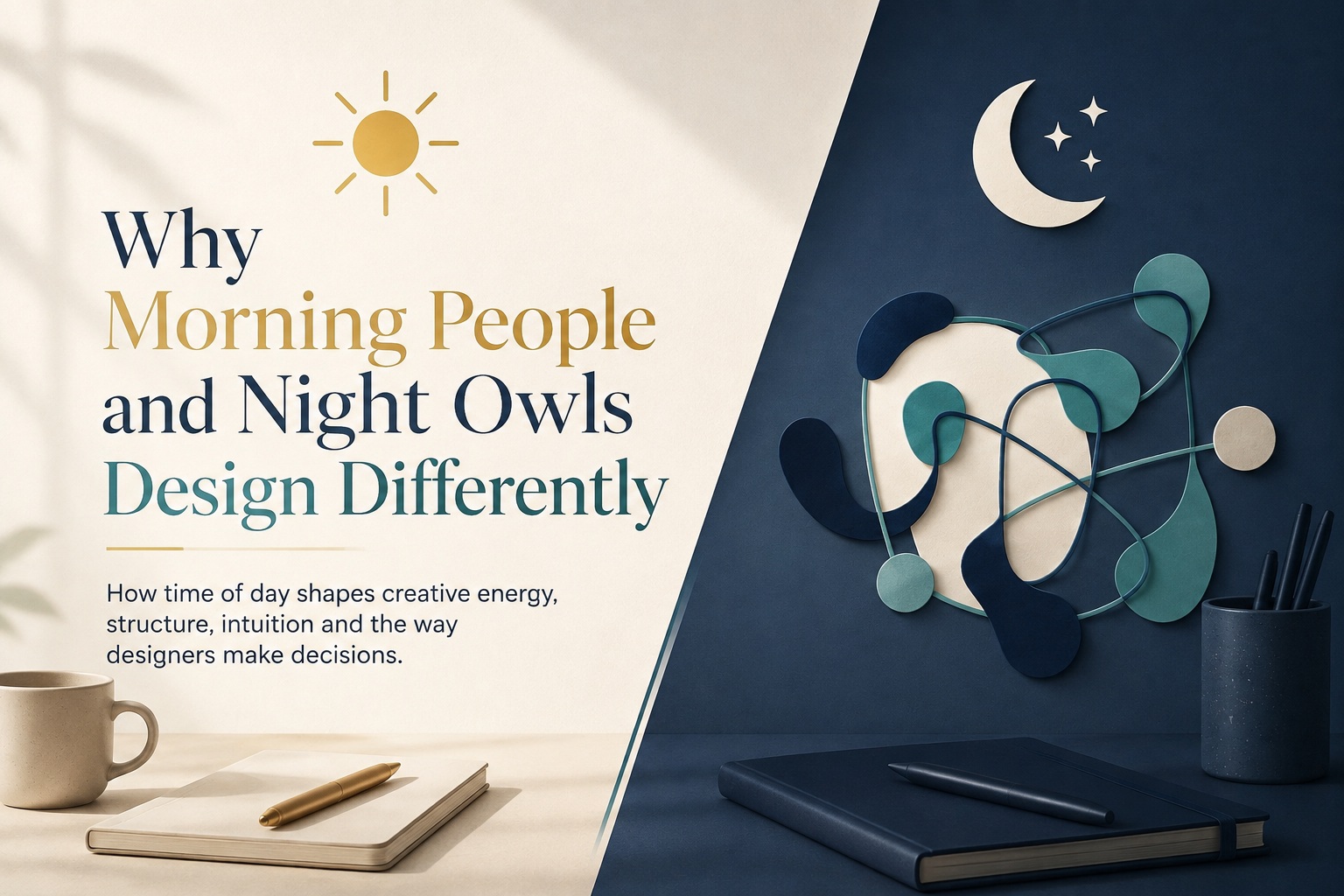
Creative work is shaped by more than talent, experience and software. The time of day you choose to work can influence how you think, how much patience you have, how willing you are to experiment and even what kinds of decisions feel natural. A designer working at 8am may approach the same problem very differently from someone opening the same file at midnight.
That does not mean morning people are automatically better at structure or night owls are naturally more creative. Human energy patterns are far more individual than that. But many designers do notice that their work changes depending on when they are most alert, when they are tired and when their attention begins to loosen. Understanding those shifts can help you use different parts of the day more deliberately instead of expecting yourself to work the same way all the time.
The Morning Mind Tends to Favour Clarity
For people who naturally function well early in the day, mornings often come with a sense of mental space. The day has not yet filled up with messages, meetings, decisions and small interruptions, so attention can feel more focused. That makes the morning particularly useful for tasks that benefit from patience, structure and careful judgement.
This is often when layout problems become easier to solve. You may notice alignment issues more quickly, make cleaner decisions about spacing and hierarchy, or find it easier to think through how several sections fit together as one system. Typography, grid structure and information architecture can also feel more manageable when your mind is fresh enough to compare options without getting impatient.
Morning work often feels deliberate. You are less likely to accept something simply because you are tired of looking at it, and more likely to question whether the design actually makes sense.
Fresh Attention Can Make Systems Easier to Build
There is a reason many designers prefer to tackle complex interface work earlier in the day. Systems require consistency, and consistency requires attention. When you are building components, deciding spacing rules or creating a design language that needs to work across dozens of screens, small decisions accumulate quickly.
A fresh mind is often better equipped to hold those relationships together. You can think not only about whether one button looks right, but whether the rule behind that button will still make sense elsewhere. That broader perspective helps turn isolated visual decisions into a coherent system.
This does not necessarily make morning work more original, but it can make it more dependable. When the task is about making the whole design hold together, clarity is extremely valuable.
Morning Work Can Also Become Too Safe
The strength of a fresh and organised mind can also become a weakness. When your thinking is clear, you may naturally reach for solutions that are already proven. Familiar grids, reliable type combinations and conventional layouts can feel sensible because they reduce uncertainty.
The result may be technically excellent but somewhat predictable. Everything works, everything aligns and nothing is obviously wrong, yet the design may lack the unexpected element that gives it character. This is one reason some designers find that their morning work is strong for refinement but less exciting for experimentation.
Clarity is useful, but it can occasionally make you too efficient. If you arrive at the first reasonable solution too quickly, you may stop exploring before something more interesting has a chance to appear.
The Night Mind Often Works More Loosely
Night work can feel very different. By the end of the day, attention may be less disciplined, but that does not always mean creativity disappears. Sometimes the opposite happens: when the analytical part of the mind becomes tired, you may become more willing to follow unusual associations instead of immediately judging them.
This can make evenings and late nights surprisingly productive for exploratory design. Colour combinations that would have seemed too strange earlier may suddenly feel worth trying. A composition that breaks the grid may feel more interesting than irresponsible. You may become less concerned with whether every choice can be justified and more interested in whether the work has energy.
Night work is often less controlled, but that looseness can create room for discovery.
Tiredness Can Reduce the Fear of Making Something Wrong
One of the unexpected advantages of working later is that your internal critic may become less aggressive. During the day, you may reject ideas almost instantly because they do not fit your usual standards. At night, you might simply try them because you are curious.
That can lead to work that is rougher but more surprising. You may experiment with texture, exaggerate a type scale or introduce a colour you would normally avoid. Some of those choices will be terrible the next morning, but others may contain exactly the idea the project was missing.
The important point is that lower inhibition can sometimes create creative opportunities. A tired mind may make more mistakes, but it may also be willing to travel down paths a fully alert mind would dismiss too quickly.
Night Work Often Feels More Emotional
Design produced late at night can sometimes feel more atmospheric because the process becomes less analytical. Instead of constantly asking whether something is correct, you may start responding to whether it feels right. Mood, texture, colour and rhythm become more important than perfect structure.
This is especially useful in projects where emotional tone matters. Album artwork, campaign visuals, editorial layouts, concept art and experimental branding can benefit from a more intuitive state because they rely on atmosphere as much as logic.
The danger, of course, is that intuition becomes harder to evaluate when you are tired. Something that feels brilliant at 1am may look strangely overworked at 9am. That is why late-night creativity often benefits from a fresh review later.
Morning and Night Work Are Not Opposites So Much as Different Modes
It is tempting to frame the difference as morning equals discipline and night equals creativity, but that is too simple. Both states can produce excellent work, and both can produce bad work. The more useful distinction is between control and exploration.
When you are highly alert, you may be better at controlling complexity. You notice inconsistencies, maintain standards and think through consequences. When your attention becomes looser, you may become better at wandering, combining unrelated ideas and accepting temporary messiness.
Good design needs both. A project that is all control may feel rigid, while a project that is all exploration may never become usable.
The Best Workflow May Use Both States
Instead of asking whether morning or night is better, it can be more useful to ask what each state is good for. You may discover that certain tasks consistently feel easier at particular times of day. For example, you might use your clearest hours for:
• Layout refinement and grid decisions
• Typography and spacing
• Information architecture
• Reviewing usability
• Cleaning up components
• Final quality checks
Then use your looser hours for:
• Sketching concepts
• Exploring colour and texture
• Generating variations
• Moodboarding
• Trying unusual compositions
• Experimenting without worrying about polish
The exact pattern does not matter as much as recognising that creative energy changes throughout the day.
Morning People Can Deliberately Create More Chaos
If you naturally work best in the morning but feel that your designs are becoming too safe, you can introduce artificial disruption. The goal is not to make yourself tired; it is to create conditions that prevent your efficient brain from immediately choosing the most familiar solution.
Try setting a short timer and forcing yourself to produce five completely different layouts before refining anything. Use a typeface you normally avoid, start with an unusual colour palette or deliberately break your usual grid. Constraints like these create some of the unpredictability that night work often introduces naturally.
The structure of the exercise gives you permission to explore without abandoning your natural preference for organised work.
Night Owls Can Add Structure Without Losing Their Energy
Night-oriented designers may face the opposite problem. You may generate interesting ideas easily but struggle to keep the work organised or know when to stop. In that case, a little structure can help preserve the creativity without allowing the design to drift indefinitely.
Start the session with one specific objective rather than opening the project with no direction. Make a short written note about what you are trying to solve, limit the number of variables you change at once and save alternative versions instead of endlessly modifying a single file.
These small constraints provide enough discipline to make late-night exploration productive without removing the intuitive energy that makes it valuable.
Reviewing Night Work in the Morning Is a Powerful Combination
One of the most effective creative habits is to separate creation from evaluation. Produce ideas when you feel most willing to experiment, then review them later when your judgement is sharper.
Late at night, you might create six unusual concepts without worrying about whether they are practical. The following morning, you can evaluate them with a clearer mind and ask which ideas genuinely deserve to survive.
This process combines the advantages of both states. The night creates possibilities, while the morning decides which possibilities are worth developing.
The Reverse Can Work Too
Some designers benefit from starting with structure in the morning and deliberately loosening the work later. You may spend the early part of the day establishing the grid, hierarchy and functional requirements, then revisit the project in the evening when you are more willing to challenge those decisions.
That second pass can prevent an organised design from becoming sterile. Perhaps the layout is technically sound but needs more personality, or the colour system works but feels too conservative. Evening experimentation can introduce those elements without requiring you to rebuild the entire foundation.
A strong creative workflow does not have to happen in one continuous mental state.
Your Natural Rhythm Matters More Than the Clock
It is also important not to treat "morning person" and "night owl" as rigid categories. Some people are genuinely most alert before sunrise, while others do their best thinking late at night. Many fall somewhere between the two, and personal rhythms can change with age, workload, sleep and lifestyle.
The important thing is observing yourself rather than following generic productivity advice. Notice when you make your clearest decisions. Notice when you become more adventurous. Notice when you start making careless mistakes and when ideas suddenly seem easier to generate.
Your most useful creative schedule may have very little to do with conventional office hours.
Different Types of Design May Need Different Energy
Not every design task benefits from the same mental state. Building a complex dashboard requires a different kind of attention from creating a poster, and refining a design system demands something different from brainstorming a campaign concept.
This is why trying to force all creative work into the same time slot can be inefficient. A designer might be excellent at technical interface work in the morning but much more imaginative with branding concepts at night.
Instead of asking, "When am I most productive?", it may be better to ask, "When am I most useful for this particular kind of work?"
That question produces a much more practical answer.
Fatigue Is Not the Same as Creativity
There is one important caution. The fact that tiredness can reduce inhibition does not mean sleep deprivation is a useful creative technique. Chronic fatigue usually damages concentration, judgement, memory and overall performance.
The goal is not to exhaust yourself deliberately. It is simply to recognise that your cognitive style changes naturally throughout the day and that different states may support different types of thinking.
Late-night creativity can be valuable when it fits your natural rhythm. It becomes much less useful when you are forcing yourself to stay awake long after your brain has stopped functioning properly.
Changing the Time Can Sometimes Break a Creative Block
If a project feels stuck, changing when you work on it can sometimes be more effective than changing the design itself. You may have been trying to solve an exploratory problem during the part of the day when your brain wants structure, or trying to refine details when your attention is naturally wandering.
Returning to the same file at a different time can make the problem feel surprisingly different. You notice things you ignored before, reject solutions you previously accepted and sometimes discover possibilities that were invisible in the earlier session.
The design has not changed. Your mental state has.
Final Thoughts
Morning people and night owls do not necessarily produce better or worse design. They often approach design from different cognitive states, and those states can emphasise different strengths.
Fresh, focused periods are often ideal for structure, hierarchy, refinement and consistency. Looser, more intuitive periods can be useful for experimentation, mood and unexpected combinations. Strong creative work frequently emerges when these modes support one another rather than compete.
The most useful lesson is not that you should suddenly become a morning person or force yourself to work at midnight. It is to pay attention to how your thinking changes throughout the day and organise your work accordingly.
If your design feels too rigid, try working during a period when you are naturally more relaxed and exploratory. If it feels chaotic, return to it when your attention is sharper. Sometimes the breakthrough is not another tool, another reference or another round of inspiration.
Sometimes you simply need to meet the same design with a different version of your own mind.











Comments 0